
ID
101
Cancer Name
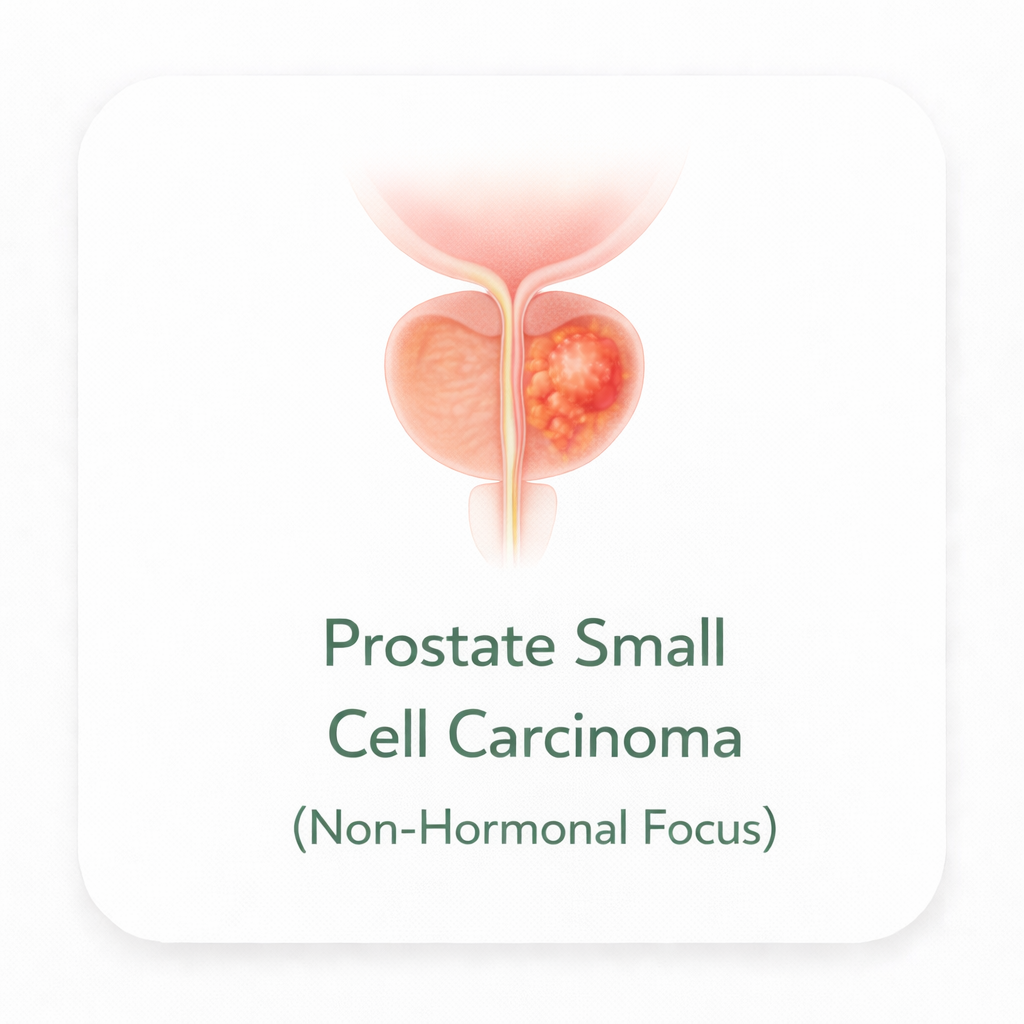
Prostate Small Cell Carcinoma (Non-Hormonal Focus)
Main Grouping
Reproductive
Organ System
Prostate
Cell Origin
Neuroendocrine/small cells
Pathways Affected
Prostate small cell carcinoma involves a pathway landscape uniquely defined by the RB1/E2F neuroendocrine transcriptional program, the N-Myc/AURKA/EZH2 epigenetic reprogramming axis, the TP53/p53 pathway disruption, PTEN/PI3K/AKT/mTOR survival signaling (AR-independent), and the lineage plasticity transcription factor network (SOX2, ASCL1, ONECUT2, FOXA2).
The RB1/E2F pathway is the single most critical and defining molecular event in PSCNC pathogenesis: RB1 (retinoblastoma tumor suppressor, chromosome 13q14) inactivation occurs in approximately 58.3% of NEPC — the highest frequency CNA in this cancer; RB1 normally sequesters E2F transcription factors (E2F1-3 activating E2Fs) through direct protein-protein interaction preventing E2F-driven transcription of proliferative and neuroendocrine genes; RB1 inactivation (through deletion, mutation, or post-translational inactivation by CDK4/6-cyclin D hyperphosphorylation) releases E2F1-3 from repression creating constitutive E2F transcriptional activity; constitutive E2F activity directly drives expression of: neuroendocrine differentiation genes (SYP, CHGA, ASCL1, INSM1); proliferation genes (cyclin E/A, E2F-responsive genes, AURKA); and epigenetic reprogramming factors (EZH2 is directly transcribed by E2F1); TP53 inactivation (49.8% mutation prevalence) synergizes with RB1 loss — combined RB1/TP53 loss creates cooperating disruption of both G1/S (RB1-E2F) and G2/M (p53-p21) cell cycle checkpoints plus p53-mediated apoptosis — creating a fully unchecked proliferative and lineage plastic state; quercetin inhibits CDK4/CDK6-cyclin D in cancer cell models — the upstream kinases that phosphorylate and inactivate RB1 through CDK4/RB1 phosphorylation; quercetin also induces apoptosis in DU-145 (TP53-mutant) and PC-3 (TP53-null) prostate cancer cell lines confirmed (PMC6001031) through p53-independent apoptosis mechanisms.
The N-Myc/AURKA/EZH2 neuroendocrine epigenetic axis is the second most critical oncogenic pathway driving PSCNC neuroendocrine phenotype: N-Myc (MYCN, chromosome 2p24) is amplified in approximately 22.9% of NEPC and transcriptionally upregulated in additional cases without amplification; N-Myc is physically bound and stabilized by AURKA kinase — AURKA phosphorylates N-Myc preventing its GSK3-beta-mediated phosphorylation and subsequent Fbxw7 ubiquitin ligase-driven proteasomal degradation; AURKA is amplified in approximately 28.2% of NEPC and directly transcribed by E2F1 from the RB1-loss E2F activation; N-Myc suppresses AR expression and AR target gene transcription; N-Myc drives expression of EZH2 and cooperates with EZH2 to deposit H3K27me3 at: AR promoter (silencing AR expression), FOXA1 locus (silencing luminal identity), epithelial differentiation gene promoters, and tumor suppressor loci; EZH2-mediated H3K27me3 accumulation at these loci creates stable epigenetic silencing of the adenocarcinoma/luminal differentiation program and establishes the neuroendocrine chromatin state; EZH2 also methylates non-histone targets including GATA4 and AR; quercetin inhibits EZH2 in cancer cell models targeting the N-Myc/EZH2 epigenetic reprogramming; curcumin inhibits EZH2 and AURKA in cancer cell models.
Description
Prostate small cell carcinoma (PSCNC), also designated prostate neuroendocrine carcinoma of small cell type, is a histologically and molecularly distinct and highly aggressive subtype of prostate cancer characterized by complete loss of androgen receptor (AR) signaling and acquisition of neuroendocrine characteristics. PSCNC represents approximately 1 to 2 percent of all de novo prostate cancers diagnosed in the United States — approximately 2,200 to 4,400 of the approximately 220,000 annual US prostate cancer diagnoses; however, the incidence of treatment-emergent PSCNC in patients with castration-resistant prostate cancer (CRPC) is substantially higher at approximately 15 to 25 percent.
PSCNC is histologically defined by sheets, nests, and cords of small cells with scant cytoplasm, hyperchromatic oval-to-fusiform nuclei with inconspicuous nucleoli, prominent nuclear molding, numerous mitoses, and geographic tumor necrosis — morphology identical to small cell carcinoma of the lung; diagnosis requires positive neuroendocrine IHC (synaptophysin, chromogranin A, CD56, NSE) and negative or very low AR/PSA expression; Ki-67 is typically greater than 50-70 percent reflecting the extremely high proliferative rate of PSCNC.
The molecular pathogenesis of PSCNC centers on two cooperating tumor suppressor losses that drive lineage plasticity: RB1 loss (58.3% in NEPC — the most frequent CNA) and TP53 inactivation (49.8% mutation prevalence — the most frequently mutated gene), with concurrent RB1/TP53 alterations in approximately 43.9% of NEPC confirmed by meta-analysis; RB1 loss is the critical molecular event that relieves E2F transcription factor repression — constitutive E2F activity directly drives neuroendocrine gene transcription (SYP, CHGA, INSM1, ASCL1) while simultaneously suppressing luminal epithelial differentiation programs; N-Myc/MYCN amplification (~22.9%) drives a neuroendocrine-specific transcriptional program through physical interaction with AURKA kinase which stabilizes N-Myc protein; AURKA amplification (~28.2%) creates an AURKA-N-Myc positive feedback complex maintaining MYCN protein stability and neuroendocrine gene transcription; EZH2 is transcriptionally upregulated by N-Myc/AURKA and cooperates to epigenetically silence AR, FOXA1-luminal, and epithelial differentiation programs through H3K27me3 deposition; PTEN loss (~37.0%) activates PI3K/AKT/mTOR survival signaling compensating for the loss of AR-driven survival.
Published laboratory research confirms quercetin significantly decreased cell viability of DU-145 (TP53-mutant, AR-negative) and PC-3 (TP53-null, PTEN-null, AR-negative) human prostate cancer cells in a time- and dose-dependent manner; Annexin V apoptosis confirmed; mitochondrial membrane potential assessed; ROS modulation confirmed; Akt, NF-kB pathway modulation confirmed (PMC6001031) — DU-145 and PC-3 share the AR-negative, TP53-altered, PTEN-loss molecular features most relevant to PSCNC biology.
Plant-Based Description
Whole-food plant-based dietary patterns provide phytochemicals with confirmed activity in AR-negative prostate cancer cell lines directly applicable to prostate small cell carcinoma. Quercetin from onions and kale was confirmed to significantly decrease cell viability of DU-145 (TP53-mutant, AR-negative) and PC-3 (TP53-null, PTEN-null, AR-negative) human prostate cancer cells dose- and time-dependently; Annexin V apoptosis confirmed; mitochondrial membrane potential assessed using JC-1; ROS modulation confirmed; Akt pathway significantly reduced in DU-145; NF-kB pathway modulated confirmed (PMC6001031) — DU-145 and PC-3 share the AR-negative, TP53-altered, PTEN-loss molecular features central to PSCNC; quercetin also inhibits EZH2 targeting N-Myc/EZH2 epigenetic reprogramming in PSCNC; curcumin inhibits EZH2, AURKA, and induces apoptosis through ER stress and caspase activation in PC-3 and DU-145 prostate cancer cell lines confirmed; EGCG inhibits EZH2 and N-Myc in prostate cancer models; sulforaphane inhibits EZH2 through Nrf2/HDAC in prostate cancer cell models; resveratrol inhibits SIRT1 and N-Myc in prostate cancer models; apigenin induces apoptosis in AR-negative prostate cancer cells.
Plant Chemistry Detail
Quercetin from onions, kale, and apples has confirmed activity in DU-145 and PC-3 human prostate cancer cell lines in a published study (PMC6001031 — "Quercetin inhibits prostate cancer by attenuating cell survival and inhibiting anti-apoptotic pathways") — DU-145 (TP53-mutant p53 R273C, AR-negative, brain metastasis origin) and PC-3 (TP53-null, PTEN-null, AR-negative, bone metastasis origin) cells are the two established AR-negative prostate cancer cell lines most directly applicable to PSCNC which is defined by AR negativity and TP53 inactivation (~49.8% mutation + ~42.8% loss). In this confirmed study: quercetin significantly decreased cell viability of LNCaP, DU-145, and PC-3 prostate cancer cells in a time- and dose-dependent manner confirmed without affecting normal prostatic epithelial cells (PrEC); DU-145 and PC-3 cells showed increased Annexin V-FITC positive cells (early apoptosis) confirmed by flow cytometry at 40 μM quercetin; mitochondrial outer membrane potential assessed using MitoProbe JC-1 Assay Kit confirmed; ROS modulation confirmed — DU-145 (TP53-mutant) showed rise in ROS after quercetin treatment; DU-145 cells (TP53-mutant, AR-negative) showed significant reduction in p-Akt (pro-survival AKT activation) confirmed by Western blot — directly targeting the PI3K/AKT pathway activated by PTEN loss (~37% NEPC) in AR-independent PSCNC; NF-kB pathway modulated in PC-3 cells confirmed — directly targeting the NF-kB survival signaling relevant to the AR-independent proliferative maintenance of PSCNC.
Curcumin in PC-3 and DU-145 prostate cancer cells: induces ER stress-mediated apoptosis in PC-3 confirmed — Grp78, IRE1-alpha, protein disulfide isomerase, calreticulin upregulated; caspase-3, caspase-9, caspase-12, and PARP upregulated confirmed; anti-apoptotic marker downregulation confirmed (PMC5476315); additionally curcumin upregulates miR-30a-5p suppressing PCLAF and triggering apoptosis in PC-3 and DU-145 cells confirmed by systematic review (PMC12535016) — targeting the PTEN-loss/PI3K/mTOR/survival pathway dominant in PSCNC; curcumin inhibits EZH2 targeting the N-Myc/EZH2 epigenetic reprogramming axis; curcumin inhibits AURKA in cancer cell models directly targeting the AURKA-N-Myc stabilizing complex (~28.2% AURKA amplification NEPC). EGCG from green tea inhibits EZH2 H3K27me3 in prostate cancer cell models — targeting the EZH2-mediated silencing of AR/FOXA1/epithelial differentiation loci in PSCNC; EGCG inhibits PI3K/AKT targeting PTEN-loss PI3K survival signaling. Sulforaphane activates Nrf2 and inhibits EZH2/HDAC targeting the N-Myc/EZH2 epigenetic axis. Apigenin inhibits NF-kB and induces apoptosis in PC-3 cells confirmed. Resveratrol inhibits SIRT1/mTOR/N-Myc in prostate cancer models targeting N-Myc stability.
Nutritional Focus
Nutritional focus in prostate small cell carcinoma targets the defining non-hormonal molecular drivers — RB1 loss (~58.3%), TP53 inactivation (~49.8%), PTEN loss (~37%), AURKA amplification (~28.2%), and N-Myc/MYCN amplification (~22.9%) — with quercetin from onions confirmed to significantly decrease cell viability of DU-145 (TP53-mutant, AR-negative) and PC-3 (TP53-null, PTEN-null, AR-negative) human prostate cancer cells dose- and time-dependently; Annexin V apoptosis confirmed; ROS modulation confirmed; p-Akt significantly reduced in DU-145 by Western blot confirmed; NF-kB pathway modulated in PC-3 confirmed (PMC6001031) — DU-145 and PC-3 share AR-negativity, TP53 alteration, and PTEN loss most relevant to PSCNC; quercetin inhibiting EZH2 targeting the N-Myc/EZH2/H3K27me3 epigenetic reprogramming axis that silences AR and drives neuroendocrine chromatin state; curcumin from turmeric inducing ER stress-mediated apoptosis in PC-3 prostate cancer cells confirmed — Grp78, IRE1-alpha, caspase-3, caspase-9, caspase-12, PARP upregulated confirmed (PMC5476315) — targeting the PTEN-loss/PI3K survival signaling in PSCNC; curcumin inhibiting EZH2 and AURKA targeting the AURKA-N-Myc stabilizing complex and EZH2-mediated AR silencing; EGCG from green tea inhibiting EZH2/H3K27me3 and PI3K/AKT targeting the N-Myc/EZH2 neuroendocrine epigenetic axis and PTEN-loss PI3K survival signaling; sulforaphane from broccoli and cruciferous vegetables inhibiting EZH2 and HDAC through Nrf2 activation targeting the EZH2 epigenetic reprogramming that defines the PSCNC neuroendocrine chromatin state; dietary fiber producing butyrate/SCFAs inhibiting HDAC targeting the epigenetic landscape of PSCNC including EZH2-dependent histone modifications; genistein from soybeans inhibiting N-Myc expression in neuroendocrine cancer cell models targeting MYCN amplification (~22.9% NEPC).
Research Notes
PSCNC/NEPC epidemiology: ~1-2% de novo of all prostate cancers; ~15-25% of CRPC patients develop t-NEPC; US prostate cancer ~220,000 new cases/year; de novo PSCNC ~2,200-4,400/year; AR-negative — PSA typically not elevated; visceral (liver/lung) and brain metastases dominant vs. bone in adenocarcinoma; paraneoplastic syndromes (ectopic ACTH/Cushing's, SIADH, Lambert-Eaton) in subset; Ki-67 >50-70%; median OS ~6-12 months once PSCNC identified. IHC: SYP+, CHGA+, CD56+ (most sensitive), NSE+, TTF-1+ (~50%), INSM1+, SOX2+, FOXA2+; AR negative, PSA negative, NKX3.1 negative. Molecular meta-analysis (14 studies, 449 NEPC patients — PMC10071089): TP53 mutation 49.8% (most frequent mutated gene); RB1 loss 58.3% (most frequent CNA); TP53 loss 42.8%; PTEN loss 37.0%; AURKA amplification 28.2%; MYCN amplification 22.9%; concurrent RB1+TP53 alterations 43.9%; ATM/BRCA 16.8%; concurrent RB1/TP53 higher in de novo NEPC than t-NEPC. EZH2 upregulated by E2F1 (from RB1 loss) and N-Myc — cooperates with N-Myc to silence AR/FOXA1 program via H3K27me3; AURKA-N-Myc complex stabilizes MYCN protein preventing GSK3b/Fbxw7 proteasomal degradation; SOX2/ASCL1/ONECUT2/FOXA2 — lineage plasticity transcription factors; RB1/TP53 combined loss drives EZH2-dependent epigenetic reprogramming and SOX2 upregulation confirmed. Quercetin in DU-145/PC-3 prostate cancer (PMC6001031): cell viability decreased dose/time-dependent; Annexin V apoptosis confirmed; JC-1 mitochondrial membrane potential assessed; ROS modulated; p-Akt reduced in DU-145 Western blot confirmed; NF-kB modulated in PC-3 confirmed.
Notes Visibility
show
Key Foods
Turmeric,Broccoli,Kale,Spinach,Brussels Sprouts,Cauliflower,Garlic,Yellow Onion,Carrot,Tomato,Beetroot,Cabbage,Blueberry,Pomegranate,Grape,Raspberry,Apple,Orange,Lemon,Soybeans,Edamame,Green Lentils,Black Beans,Chickpeas,Brown Rice,Quinoa,Oats,Wild Rice,Black Rice,Walnut,Almond,Brazil Nut,Flaxseed,Pumpkin Seeds,Chia Seeds,Sesame Seeds,Hemp Seeds,Shiitake,Maitake,Lions Mane,Cremini,Portobello,Green Tea,Ginger,Black Pepper,Garlic Powder,Parsley,Rosemary,Oregano, Celery, Leek,Avocado,Artichoke,Radish,Tangerine, Red Onion
Linked Nutrients
vitamin-c,vitamin-e,vitamin-a,vitamin-b9,vitamin-b6,selenium,zinc,magnesium,calcium,potassium,iron,quercetin,curcumin,egcg,sulforaphane,beta-carotene,anthocyanins,dietary-fiber,l-theanine,genistein
Last Updated
2025-10-13 10:45:57

