
The P53 Nutritional Pathway System™ evaluates whole plant foods by connecting food composition to cancers, ailments, conditions, biological pathways, vitamins, minerals, amino acids, phytochemicals, enzymes, hormones, oxidative balance, apoptosis, and cell cycle regulation.
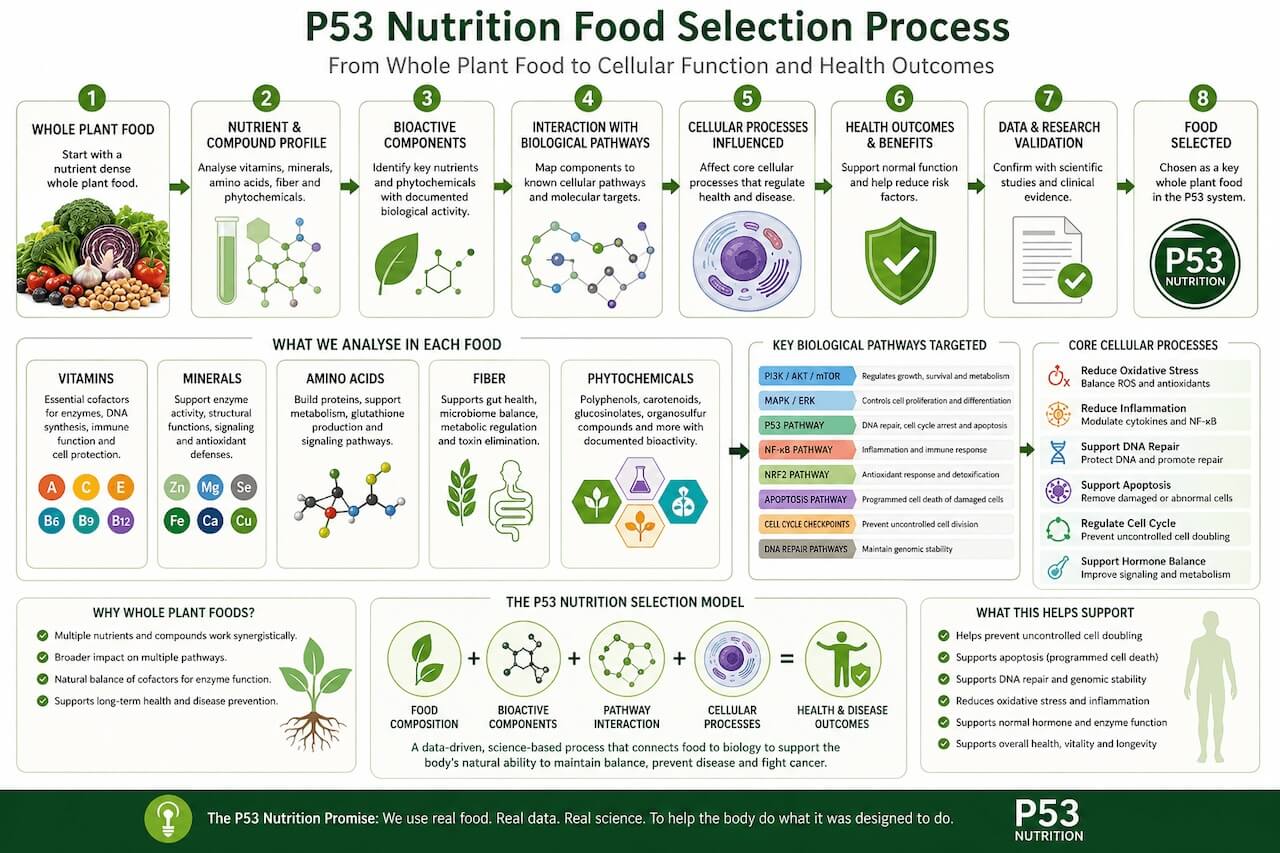
The selection of a key whole plant food within a structured system such as P53 Nutrition is based on measurable biological interactions between food-derived compounds and human physiology. Whole plant foods contain defined amounts of vitamins, minerals, amino acids, fiber, and phytochemicals. These components participate in known biochemical pathways, enzyme systems, hormone-regulated processes, immune signaling, oxidative balance, and cellular function.
A food is selected because its full nutrient and phytochemical profile connects to biological processes that are relevant to cancers, ailments, and chronic conditions.
Cancer biology involves disruptions in normal cellular regulation, including altered cell cycle control, reduced apoptosis, oxidative stress imbalance, inflammatory signaling, angiogenesis, DNA repair disruption, epigenetic changes, metabolic reprogramming, and dysregulated growth pathways. These changes affect how cells grow, divide, respond to damage, and interact with their surrounding environment.
Normal cells follow tightly regulated processes that control division, repair, and death. In cancer, these regulatory systems become altered through mutations, signaling imbalances, and environmental influences, leading to uncontrolled proliferation and resistance to normal cellular checkpoints. These disruptions are measurable across multiple biological pathways and are central to how cancers develop, progress, and respond to interventions.
Key systems involved include cell cycle regulation, apoptosis signaling, DNA repair mechanisms, inflammatory signaling networks, oxidative stress balance, epigenetic control systems, cellular communication pathways, and metabolic processes that influence energy production and biosynthesis within cells.
Ailments and chronic conditions are connected to multiple biological systems that regulate metabolism, immune function, inflammation, oxidative balance, cellular signaling, and tissue repair. These conditions do not occur in isolation; they are associated with measurable changes in pathways, enzymes, hormones, and cellular processes across the body.
Key systems involved include inflammatory signaling, oxidative stress regulation, insulin and glucose metabolism, gut microbiome activity, hormone signaling, vascular function, detoxification pathways, mitochondrial energy production, immune response, and epithelial barrier integrity. These systems interact continuously and influence the development, progression, and resolution of many chronic conditions.
Vitamins serve as cofactors in enzymatic reactions. Vitamin C supports redox balance, vitamin A regulates gene expression and differentiation, vitamin E protects membranes, and B vitamins support DNA synthesis, methylation, amino acid metabolism, nervous system function, and energy metabolism.
Minerals provide structural and catalytic support. Zinc is involved in DNA repair enzymes, magnesium stabilizes ATP, selenium is incorporated into antioxidant enzymes, calcium functions in signaling, potassium supports electrolyte balance, and copper and manganese contribute to redox enzymes.
Amino acids from plant proteins support metabolism, signaling, and protein synthesis. Glutamine supports nucleotide synthesis, arginine supports nitric oxide signaling, glycine contributes to glutathione production, methionine supports methylation, cysteine supports sulfur metabolism, and leucine influences mTOR signaling.
Phytochemicals include polyphenols, flavonoids, carotenoids, glucosinolates, isothiocyanates, lignans, organosulfur compounds, catechins, anthocyanins, terpenes, and phenolic acids. These compounds are studied for interactions with oxidative stress, inflammatory signaling, gene expression, enzyme activity, detoxification, and cellular pathways.
Pathways such as PI3K/AKT/mTOR, MAPK/ERK, p53, NF-κB, Nrf2, apoptosis, angiogenesis, DNA repair, AMPK, insulin signaling, immune-response signaling, gut microbiome signaling, detoxification, and hormone signaling are used to organize food, nutrient, and phytochemical relationships.
Apoptosis is programmed cell death. It removes damaged or abnormal cells through caspase enzymes, mitochondrial signaling, and BCL-2 family regulation. Cell cycle control uses cyclins, CDKs, checkpoint proteins, p53, and RB1 to regulate cellular division and prevent uncontrolled cell doubling.
Oxidative stress occurs when reactive oxygen species exceed antioxidant capacity. The body uses glutathione, superoxide dismutase, catalase, and glutathione peroxidase to regulate redox balance. Plant foods provide vitamins, minerals, amino acids, and phytochemicals that participate in these systems.
Enzymes catalyze biochemical reactions and require nutrients to function. Zinc, magnesium, selenium, copper, manganese, and B vitamins act as cofactors across DNA repair, ATP metabolism, antioxidant defense, methylation, detoxification, hormone metabolism, and neurotransmitter synthesis.
Hormones regulate metabolism, growth, reproduction, stress response, and cellular communication. Nutrients can influence insulin signaling, thyroid hormone regulation, sex hormone pathways, cortisol response, IGF-1 signaling, vitamin D receptor activity, and hormone metabolism.
Whole plant foods contain multiple interacting components. A single food may provide fiber, vitamins, minerals, amino acids, and several phytochemical classes at the same time. A cruciferous vegetable may provide vitamin C, folate, fiber, glucosinolates, and minerals. A legume may provide fiber, amino acids, magnesium, folate, and phytochemicals. A berry may provide vitamin C, anthocyanins, flavonoids, and fiber.
This complete profile is the reason foods are evaluated as whole biological inputs. A whole food can connect to multiple pathways at once, while isolated compounds represent only one piece of the food’s chemistry.
The selection of a key whole plant food is based on an integrated analysis of its composition and biological relationships. The system evaluates vitamins, minerals, amino acids, fiber, and phytochemicals, along with documented roles in pathways, enzymes, hormones, oxidative balance, apoptosis, DNA repair, cell cycle regulation, immune signaling, metabolism, and ailment-specific biological processes.
A key whole plant food is selected because it contributes measurable biological inputs to multiple systems. These include vitamins for enzymatic reactions, minerals for catalytic and structural functions, amino acids for protein synthesis and metabolism, fiber for gut and metabolic pathways, and phytochemicals for pathway interaction.
This creates a structured, data-driven framework that explains how whole plant foods relate to cancer biology, ailments, chronic conditions, and cellular function through measurable nutrient and pathway relationships.
P53 Nutritional Pathway System™
Mapping whole plant foods to nutrients, pathways, enzymes, hormones, cancer biology, ailments, conditions, and cellular function.

