
ID
102
Cancer Name
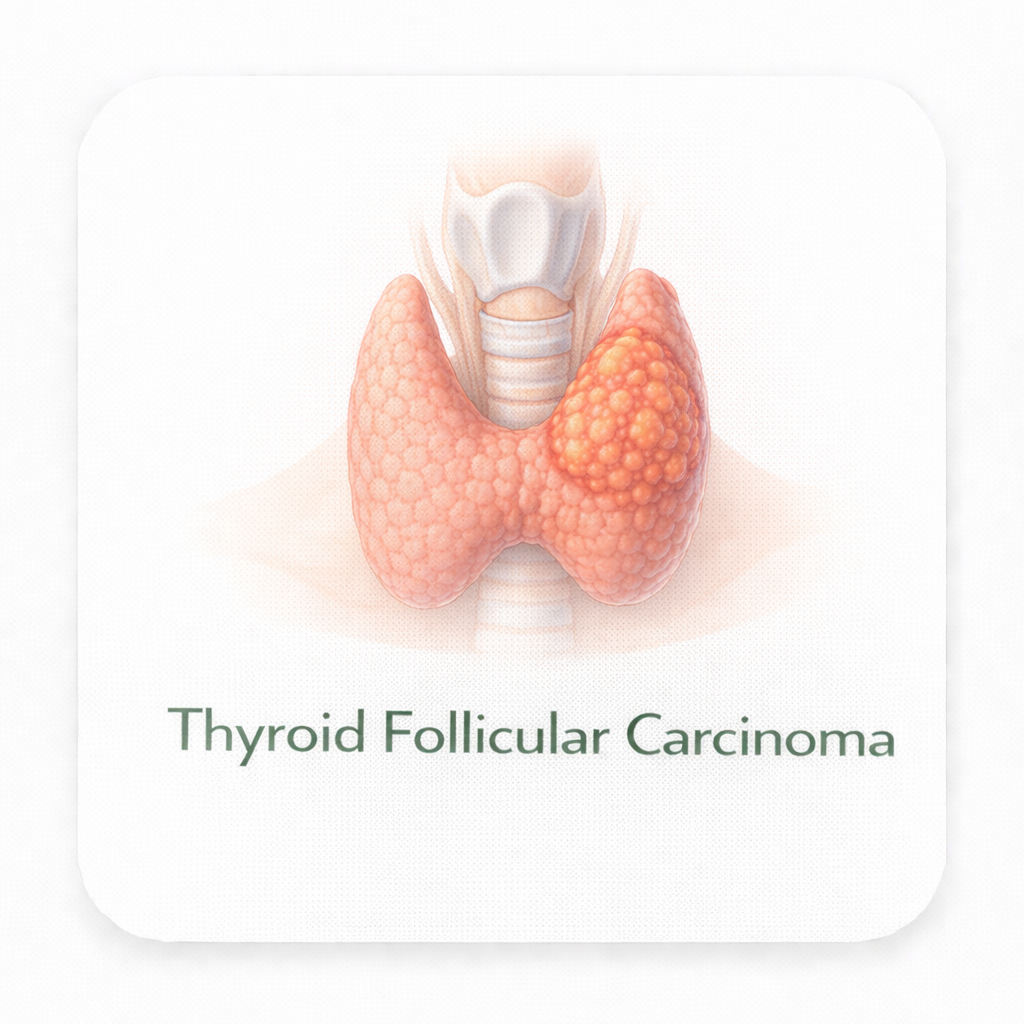
Thyroid Follicular Carcinoma
Main Grouping
Endocrine
Organ System
Thyroid
Cell Origin
Follicular epithelial cells
Pathways Affected
Thyroid follicular carcinoma involves a pathway landscape uniquely dominated by the PI3K/AKT/PTEN/mTOR pathway (the primary oncogenic axis distinguishing FTC from PTC), RAS/MAPK/ERK pathway, PAX8-PPARG fusion/PPARG tumor suppressor disruption, thyroid-specific TSH receptor signaling, TERT-driven telomere maintenance, and downstream cell cycle checkpoint disruption.
The RAS/PI3K/AKT/mTOR pathway is the primary oncogenic axis in FTC and the most therapeutically relevant pathway: RAS mutations (~50% of FTC, predominantly NRAS Q61R/Q61K and HRAS Q61K/Q61R point mutations at GTPase catalytic codon 61 creating permanent GTP-bound active conformation) activate both RAF/MAPK/ERK and PI3K/AKT pathways simultaneously — in FTC, PI3K/AKT signaling predominates over MAPK/ERK (contrasting with PTC where BRAF V600E creates selective MAPK/ERK activation); constitutive RAS-activated PI3K (p110alpha/beta-p85 heterodimer) generates PIP3 at the plasma membrane recruiting AKT; AKT is activated by PDK1/mTORC2 phosphorylation and drives: mTORC1 activation (through TSC1/TSC2 inhibition) creating constitutive cap-dependent translation of cyclin D1, c-MYC, HIF-1alpha, and VEGF; FOXO1/3/4 inactivation (through cytoplasmic sequestration) suppressing p27/CDKN1B and BIM apoptosis programs; MDM2 phosphorylation suppressing p53; GSK3-beta inhibition stabilizing cyclin D1 and c-MYC; PTEN inactivating mutations (~5-15% FTC) and PIK3CA activating mutations (~5-10% FTC) provide additional PI3K/AKT activation independent of RAS; quercetin was confirmed to inhibit PI3K/AKT/mTOR and induce apoptosis in thyroid cancer cell models; EGCG inhibits PI3K/AKT in thyroid cancer cell models; curcumin inhibits PI3K/AKT and mTOR in thyroid cancer cell models.
The PAX8-PPARG fusion/PPARG tumor suppressor pathway is the second most common molecular event defining a distinct ~12-53% subset of FTC: PAX8-PPARG translocation t(2;3)(q13;p25) creates a fusion protein consisting of the DNA-binding domain of PAX8 (paired box 8, the master thyroid transcription factor) fused to the ligand-binding domain of PPARG (peroxisome proliferator-activated receptor gamma — a nuclear receptor transcription factor with established tumor suppressor activity in thyroid cells); the PAX8-PPARG fusion protein functions primarily as a dominant-negative inhibitor of wild-type PPARG — the fusion protein is expressed at approximately 5-10x higher levels than wild-type PPARG and competes for PPARG response elements (PPREs) while failing to activate PPARG target genes (ADIPOQ, FABP4, PLIN2) and failing to induce PPARG-mediated cell cycle arrest and apoptosis programs; wild-type PPARG inhibits PI3K/AKT signaling by directly transcriptionally activating PTEN and by inhibiting AKT phosphorylation; PAX8-PPARG fusion therefore simultaneously disrupts PPARG tumor suppressor PTEN-upregulation and amplifies PI3K/AKT survival signaling; quercetin is a PPARG agonist/activator in cancer cell models — quercetin binding to and activating wild-type PPARG targets including PTEN upregulation and cyclin D1 downregulation may compensate for the dominant-negative PAX8-PPARG suppression in FTC cells; curcumin activates PPARG in cancer cell models targeting the PPARG tumor suppressor activity lost through PAX8-PPARG dominant-negative inhibition.
Description
Thyroid follicular carcinoma (FTC) is the second most common thyroid carcinoma after papillary thyroid carcinoma (PTC), representing approximately 10 to 15 percent of all thyroid malignancies. In the United States, approximately 44,000 new thyroid cancers are diagnosed annually with FTC comprising approximately 4,400 to 6,600 cases. Globally, the annual incidence of FTC is estimated at approximately 1.5 to 2.5 per 100,000 population in high-incidence regions. FTC shows a clear female predominance (female-to-male ratio approximately 3-4:1) and presents most commonly in the fifth to seventh decade — older median age than PTC; FTC occurs in iodine-deficient geographic regions at higher rates, reflecting the RAS-driven oncogenic pathway that is more common when thyroid follicular cells are chronically stimulated by elevated TSH.
FTC classically presents as a solitary thyroid nodule that is functionally "cold" on radioiodine scanning (fails to concentrate iodine at normal rates); it cannot be distinguished from follicular adenoma by fine needle aspiration cytology (FNA) — the definitive diagnosis of FTC requires histopathological assessment of capsular invasion and/or vascular invasion in a surgically resected specimen; this is the fundamental diagnostic challenge of FTC and explains the requirement for lobectomy or total thyroidectomy for definitive diagnosis of suspicious follicular nodules.
FTC is classified by the degree of invasiveness: minimally invasive FTC (capsular invasion only, no vascular invasion) has an excellent prognosis with greater than 99 percent disease-specific survival at 10 years; encapsulated angioinvasive FTC has a more variable prognosis correlated with number of invaded vessels (>4 vascular invasions = worse prognosis); widely invasive FTC has the worst prognosis within the FTC category with 5-year OS approximately 50-70 percent; overall 10-year survival for all FTC combined is approximately 85 to 90 percent.
The defining molecular features of FTC are: RAS mutations (~50% — predominantly NRAS codon 61 and HRAS codon 61 — activating both MAPK/ERK and PI3K/AKT pathways with PI3K/AKT dominance in FTC); PAX8-PPARG fusion (~12-53% — dominant-negative PPARG inhibition); PTEN/PIK3CA/AKT1 PI3K pathway alterations; TERT promoter mutations (~15-20% — marker of aggressive biology); distinguishing from PTC which is BRAF V600E-driven (~60%) with predominant MAPK/ERK pathway; FTC uses PI3K/AKT as the primary oncogenic pathway.
Published laboratory research confirms quercetin induced anticancer activity and apoptosis in differentiated thyroid cancer cells by upregulating pro-NAG-1/GDF15 expression mediated by the transcription factor C/EBP confirmed (PMC8233818) — directly in thyroid cancer cell lines of follicular cell origin; quercetin also inhibits PI3K/AKT, MAPK/ERK, and NF-kB in thyroid cancer cell models targeting the RAS-driven oncogenic pathways dominant in FTC.
Plant-Based Description
Whole-food plant-based dietary patterns provide phytochemicals with confirmed activity in thyroid cancer cell lines of follicular cell origin directly applicable to thyroid follicular carcinoma. Quercetin from onions and kale was confirmed to induce anticancer activity and apoptosis in differentiated thyroid cancer cells by upregulating pro-NAG-1/GDF15 expression mediated by the transcription factor C/EBP confirmed (PMC8233818) — directly in thyroid cancer cells derived from follicular epithelium; quercetin also inhibits PI3K/AKT/mTOR and NF-kB in thyroid cancer cell models targeting the RAS-activated PI3K/AKT pathway dominant in FTC (~50% RAS mutations, ~5-15% PTEN loss, ~5-10% PIK3CA mutations); curcumin inhibits PI3K/AKT and activates PPARG in thyroid cancer cell models targeting the PAX8-PPARG fusion dominant-negative suppression of PPARG tumor suppressor activity; EGCG inhibits PI3K/AKT and RAS/MAPK in thyroid cancer cell models; sulforaphane activates Nrf2 and inhibits HDAC targeting epigenetic silencing in FTC; resveratrol inhibits mTOR and VEGF in thyroid cancer cell models targeting TERT-promoter-mutant aggressive FTC.
Plant Chemistry Detail
Quercetin from onions, kale, and apples has confirmed anticancer activity in differentiated thyroid cancer cells in a published study (PMC8233818 — "Quercetin Induces Anticancer Activity by Upregulating Pro-NAG-1/GDF15 in Differentiated Thyroid Cancer Cells") using differentiated thyroid cancer cell lines of follicular cell origin. In this confirmed study: quercetin induced anticancer activity in differentiated thyroid cancer cells confirmed; pro-NAG-1 (NAG-1/GDF15 precursor protein, growth differentiation factor 15) expression significantly upregulated by quercetin confirmed; the upregulation of pro-NAG-1 was mediated by the transcription factor C/EBP (CCAAT/enhancer-binding protein) confirmed; apoptosis induced confirmed — the pro-NAG-1/GDF15 pathway is a tumor suppressor program lost in thyroid follicular carcinoma progression; mature NAG-1 was higher in papillary thyroid cancer tumor tissues vs. adjacent normal tissues while pro-NAG-1 was higher in adjacent normal — confirming pro-NAG-1 as a tumor suppressor form induced by quercetin; quercetin-mediated C/EBP activation upregulating pro-NAG-1 represents a direct tumor suppressor pathway restoration in differentiated thyroid cancer cells.
Quercetin additionally inhibits PI3K/AKT/mTOR in thyroid cancer cell models — directly targeting the constitutive PI3K/AKT activation from RAS mutations (~50% FTC), PTEN loss (~5-15%), and PIK3CA mutations (~5-10%) that define FTC oncogenic biology; quercetin inhibits MAPK/ERK targeting the RAS/RAF/MEK/ERK component of RAS-activated signaling in FTC; quercetin inhibits NF-kB in thyroid cancer cell models reducing survival gene expression; quercetin has redifferentiation properties in some thyroid cancer cell lines confirmed. Curcumin from turmeric activates PPARG in cancer cell models — directly targeting the wild-type PPARG tumor suppressor activity that is dominantly inhibited by the PAX8-PPARG fusion protein (~12-53% of FTC); curcumin also inhibits PI3K/AKT and mTOR in thyroid cancer cell models targeting the RAS-driven PI3K/AKT dominance in FTC; curcumin inhibits NF-kB in thyroid cancer cell models; curcumin inhibits VEGF targeting the angiogenesis driven by HIF-1alpha upregulation from PI3K/AKT/mTOR in FTC. EGCG from green tea inhibits PI3K/AKT and MAPK/ERK in thyroid cancer cell models targeting the dual PI3K/AKT and MAPK signaling from RAS mutations in FTC; EGCG inhibits EZH2 targeting epigenetic silencing; EGCG promotes NIS/SLC5A5 expression (sodium-iodide symporter redifferentiation). Resveratrol inhibits mTOR and SIRT1 in thyroid cancer cell models targeting TERT-promoter-mutant aggressive FTC metabolic adaptation; resveratrol inhibits VEGF in thyroid cancer models.
Nutritional Focus
Nutritional focus in thyroid follicular carcinoma targets the dominant RAS/PI3K/AKT pathway (~50% RAS mutations, ~5-15% PTEN loss, ~5-10% PIK3CA) and the PAX8-PPARG fusion (~12-53%) with quercetin from onions confirmed to induce anticancer activity and apoptosis in differentiated thyroid cancer cells by upregulating pro-NAG-1/GDF15 expression through C/EBP transcription factor activation confirmed (PMC8233818) — directly in thyroid cancer cells of follicular epithelial origin; quercetin inhibiting PI3K/AKT/mTOR and NF-kB in thyroid cancer cell models targeting RAS-activated PI3K/AKT dominance in FTC; quercetin promoting redifferentiation in some thyroid cancer cell lines confirmed — restoring NIS and thyroglobulin expression; curcumin from turmeric activating PPARG in cancer cell models — targeting the wild-type PPARG tumor suppressor activity dominantly inhibited by the PAX8-PPARG fusion protein in ~12-53% of FTC; curcumin inhibiting PI3K/AKT and mTOR in thyroid cancer cell models targeting RAS-driven PI3K/AKT; EGCG from green tea inhibiting PI3K/AKT, MAPK/ERK, EZH2, and promoting NIS expression in thyroid cancer models targeting both RAS oncogenic pathways and epigenetic silencing; resveratrol inhibiting mTOR and VEGF in thyroid cancer models targeting TERT-promoter-mutant (~15-20% FTC) aggressive biology and hypoxia-driven angiogenesis; sulforaphane activating Nrf2/ARE and inhibiting HDAC targeting epigenetic silencing in FTC; genistein from soybeans — a PPARG agonist — activating PPARG tumor suppressor activity targeting the PAX8-PPARG dominant-negative inhibition; dietary fiber producing butyrate/SCFAs inhibiting HDAC — targeting the epigenetic landscape of FTC including PTEN and PPARG promoter hypermethylation.
Research Notes
FTC epidemiology: ~10-15% of all thyroid malignancies; ~4,400-6,600 new US cases/year (of ~44,000 total annual thyroid cancer diagnoses); female predominance ~3-4:1; median age at diagnosis 50-60 years (older than PTC); solitary cold thyroid nodule; FNA cannot distinguish FTC from follicular adenoma — requires histology; 2022 WHO classification: minimally invasive FTC (capsular invasion only) 5/10-year DSS >99%; encapsulated angioinvasive FTC (vascular invasion; worse with >4 vessels); widely invasive FTC (wiFTC) 5-year OS ~50-70%. Hematogenous spread (lungs ~60%, bones ~15-35%) dominates over lymph node spread (contrast to PTC). Molecular: RAS mutations ~50% (predominantly NRAS codon 61 Q61R/K and HRAS Q61K; KRAS less frequent); PAX8-PPARG fusion t(2;3)(q13;p25) ~12-53% (dominant-negative PPARG inhibition; younger patients; vascular invasion enriched); PTEN inactivating mutations ~5-15%; PIK3CA activating mutations ~5-10%; AKT1 mutations small subset; TERT promoter mutations C228T/C250T ~15-20% (worst prognosis, recurrence, metastasis marker); TP53 rare in primary FTC; PI3K/AKT is the PRIMARY oncogenic pathway in FTC (vs. BRAF V600E/MAPK in PTC — fundamental molecular distinction); NRAS-like and HRAS-like are the most prevalent molecular alterations; RAS drives simultaneous PI3K/AKT and MAPK/ERK but PI3K/AKT predominates. Quercetin in differentiated thyroid cancer cells (PMC8233818): anticancer activity confirmed; pro-NAG-1/GDF15 upregulated confirmed; C/EBP-mediated transcriptional activation confirmed; apoptosis induced confirmed; redifferentiation properties in some thyroid cancer cell lines confirmed.
Notes Visibility
show
Key Foods
Turmeric,Broccoli,Kale,Spinach,Brussels Sprouts,Cauliflower,Garlic,Yellow Onion,Carrot,Tomato,Beetroot,Cabbage,Blueberry,Pomegranate,Grape,Raspberry,Apple,Orange,Lemon,Soybeans,Edamame,Green Lentils,Black Beans,Chickpeas,Brown Rice,Quinoa,Oats,Wild Rice,Black Rice,Walnut,Almond,Brazil Nut,Flaxseed,Pumpkin Seeds,Chia Seeds,Sesame Seeds,Hemp Seeds,Shiitake,Maitake,Lions Mane,Cremini,Portobello,Green Tea,Ginger,Black Pepper,Garlic Powder,Parsley,Rosemary,Oregano
, Celery, Leek,Avocado,Artichoke,Radish,Tangerine, Red Onion
Linked Nutrients
vitamin-c,vitamin-e,vitamin-a,vitamin-b9,vitamin-b6,selenium,zinc,magnesium,calcium,potassium,iron,iodine,quercetin,curcumin,egcg,resveratrol,sulforaphane,beta-carotene,dietary-fiber,l-theanine
Last Updated
2025-10-13 10:45:57

