
ID
109
Cancer Name
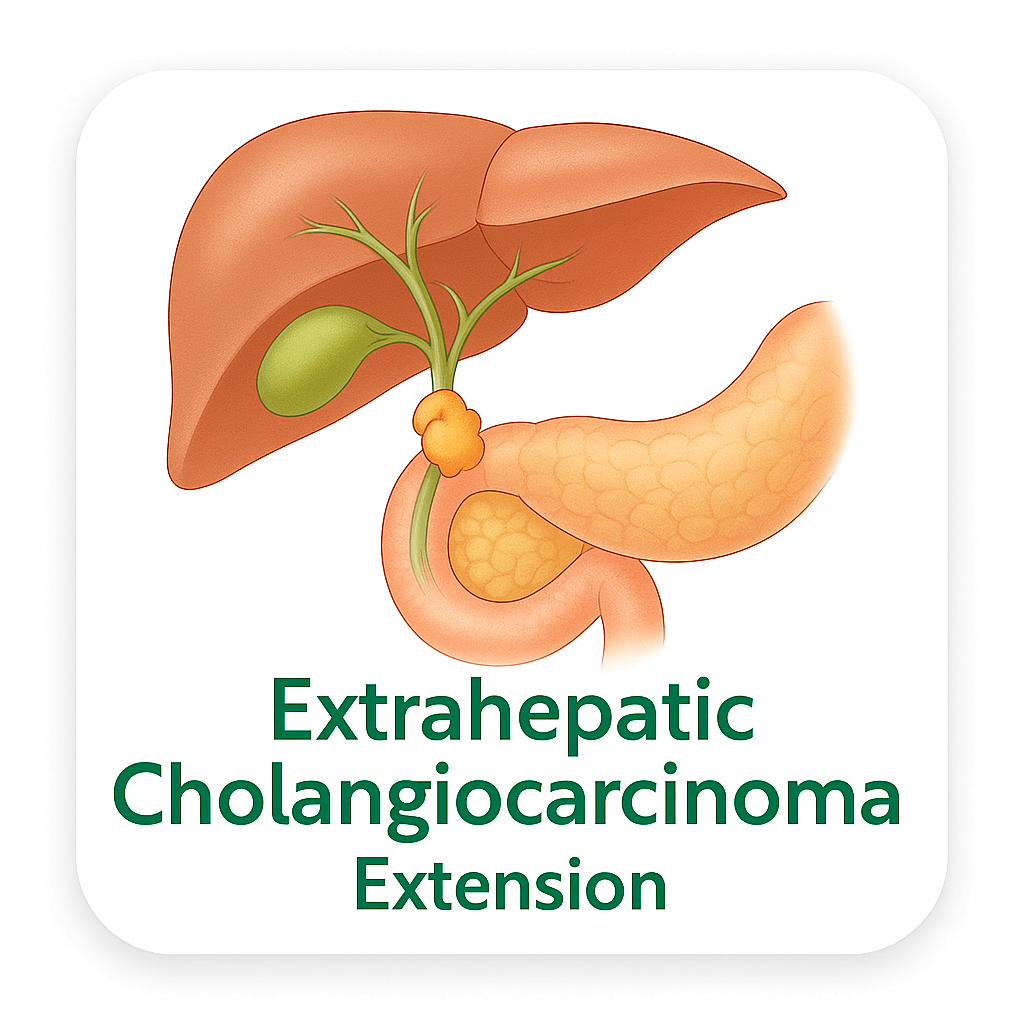
Extrahepatic Cholangiocarcinoma – Extension
Main Grouping
Digestive
Organ System
Extrahepatic bile ducts
Cell Origin
Cholangiocyte epithelium
Pathways Affected
Extrahepatic cholangiocarcinoma involves a pathway landscape dominated by KRAS/RAS/MAPK/ERK oncogenic signaling (~36.7-42%), TP53/p53 tumor suppressor disruption (~34.4%), TGF-beta/SMAD4 axis with SMAD4 loss (~10.7%) converting TGF-beta from tumor suppressor to invasion promoter, ERBB2/PI3K/AKT/mTOR signaling (~9.7-16% — most actionable eCCA target), ARID1A/SWI-SNF chromatin remodeling disruption (~14%), CDKN2A/B cell cycle checkpoint loss, and the desmoplastic TGF-beta/CAF/EMT stromal interaction.
The KRAS/RAS/MAPK/ERK pathway is the dominant oncogenic axis in eCCA: KRAS activating mutations in approximately 36.7-42% of eCCA — substantially higher than iCCA (~12%) and the defining molecular feature distinguishing eCCA from iCCA; predominantly G12D mutations in dCCA (the same allelic variant dominant in PDAC — reflecting the biological similarity between dCCA and PDAC) and G12V in pCCA; constitutively GTP-bound KRAS activates RAF/MEK/ERK (MAPK/ERK cascade) and PI3K/AKT simultaneously; KRAS-activated ERK1/2 phosphorylates RSK, ELK1, c-MYC, and YAP creating constitutive proliferative survival gene expression; KRAS also activates RAL/RALGDS driving vesicle trafficking and invasion; KRAS-activated PI3K generates PIP3/AKT driving mTORC1 (cap-dependent translation of cyclin D1, VEGF, HIF-1alpha) and suppressing FOXO/apoptosis programs; curcumin was confirmed to inhibit proliferation and induce apoptosis in KKU100, KKU-M156, and KKU-M213 CCA cell lines (PMC3165121) — these CCA cell lines include KRAS-pathway-active models; quercetin and kaempferol targeted G2/M cell cycle-related genes in CCA cells in vitro confirmed (PMC10384840) — KRAS/ERK-driven cell cycle G2/M checkpoint and CDK1 activation; quercetin and EGCG suppressed KKU100 CCA cell proliferation and migration via JAK/STAT (STAT1/3 phosphorylation) inhibition confirmed.
The TGF-beta/SMAD4 pathway has a uniquely dualistic role in eCCA: in normal bile duct cholangiocytes and early-stage eCCA, TGF-beta acts through SMAD4-dependent canonical signaling as a tumor suppressor — TGF-beta binds TGF-betaRII/TGF-betaRI → phosphorylation of SMAD2/3 → complex formation with SMAD4 → nuclear translocation → transcriptional activation of p21/CDKN1A, p15/CDKN2B, and apoptosis genes while repressing MYC and cyclin D1 expression; SMAD4 inactivating mutations (~10.7% of eCCA — through deletion, frameshift, or missense mutations) and SMAD4 promoter methylation disrupt the canonical SMAD2/3/4 tumor suppressive program; upon SMAD4 loss, TGF-beta signaling shifts to non-canonical pro-tumorigenic pathways: SMAD-independent TGF-beta activates PI3K/AKT (through TRAF6-TRADD complex), MAPK/ERK, RhoA/ROCK (driving actin cytoskeleton remodeling and EMT), and NF-kB — converting TGF-beta from growth suppressor to invasion/EMT driver; in the eCCA desmoplastic stroma, TGF-beta secreted by tumor cells activates quiescent hepatic stellate cells and biliary fibroblasts into cancer-associated fibroblasts (CAFs) producing type I collagen, fibronectin, hyaluronan, periostin, and VEGF creating the dense desmoplastic microenvironment; curcumin was confirmed to inhibit TGF-beta/SMAD signaling in biliary cancer cell models and reduce CAF activation targeting the SMAD4-loss/EMT biology in eCCA.
The ERBB2/PI3K/AKT/mTOR pathway is the most actionable and therapeutically relevant pathway specific to eCCA: ERBB2 mutations and amplifications occur in approximately 9.7-16% of eCCA — the highest ERBB2 alteration frequency among biliary tract cancers and the most recurrent actionable alteration unique to eCCA; ERBB2 S310F/Y (extracellular domain mutations), ERBB2 amplification (chromosome 17q12), and ERBB2 kinase domain mutations (L755S, V777L, G776C) create constitutive ERBB2 kinase activity driving PI3K/AKT/mTOR and MAPK/ERK; ERBB2 overexpression enriched in the Proliferation transcriptomic class of eCCA (~23% of eCCA — with MYC amplification and mTOR activation).
Description
Extrahepatic cholangiocarcinoma (eCCA) encompasses perihilar cholangiocarcinoma (pCCA/Klatskin tumor) and distal extrahepatic cholangiocarcinoma (dCCA), arising from the columnar mucin-producing cholangiocytes of the extrahepatic biliary tree from the hepatic confluence to the ampulla of Vater. eCCA represents approximately 65 to 75 percent of all cholangiocarcinomas, with pCCA being the most common CCA subtype globally. In the United States, approximately 8,000 to 12,000 new cases of cholangiocarcinoma are diagnosed annually — approximately 5,200 to 8,000 of which are eCCA. Globally, an estimated 212,000 new CCA cases are diagnosed annually with the highest incidences in Southeast Asia (Thailand, China, South Korea), reflecting the cholangiopathy risk factors of that region. The incidence of eCCA is increasing in high-income countries at approximately 1 to 3 percent per year, reflecting rising rates of biliary tract inflammatory conditions.
The molecular landscape of eCCA is distinctly different from intrahepatic CCA (iCCA) — a critical distinction: KRAS mutations (~36.7-42%) and SMAD4 loss (~10.7%) are significantly enriched in eCCA vs. iCCA (KRAS only ~12% in iCCA), while IDH1/2 mutations and FGFR2 fusions dominant in iCCA (~18% and ~15% respectively) are rare in eCCA — making eCCA a molecularly distinct disease requiring separate understanding; distal CCA has the most similar molecular profile to pancreatic ductal adenocarcinoma (PDAC) among all biliary tract cancers, sharing KRAS G12D dominance, SMAD4 loss, and TP53 mutations. ERBB2 mutations and amplification (~9.7-16%) are the most actionable recurrent alterations unique to eCCA with the highest frequency among biliary tract cancers.
The desmoplastic stroma of eCCA — comprising approximately 50-80% of the tumor volume in some pCCA cases — is composed of activated cancer-associated fibroblasts (CAFs), TGF-beta-activated stellate cells, hyaluronan, type I collagen, and fibronectin creating a high-pressure fibrotic tumor microenvironment that impedes vascular delivery of nutrients and contributes to the characteristically aggressive and treatment-refractory biology.
Overall 5-year OS by stage: resectable pCCA: stage I ~40-50%; stage II ~25-35%; stage III ~10-20%; unresectable/stage IV ~5-10%; median OS metastatic eCCA ~12-15 months with systemic therapy; perihilar CCA has particularly poor surgical outcomes due to the proximity to critical hepatic vascular structures.
Published laboratory research confirms curcumin from turmeric inhibited proliferation and induced apoptosis in three human CCA cell lines (KKU100, KKU-M156, KKU-M213) confirmed; colony formation growth-inhibitory effect confirmed; caspase activation confirmed; PARP cleavage confirmed (PMC3165121) — directly in cholangiocarcinoma cell lines; quercetin and kaempferol targeted G2/M cell cycle-related genes in CCA cells confirmed in vitro (PMC10384840); quercetin and EGCG suppressed KKU100 CCA cell proliferation and migration via JAK/STAT (STAT1/3) inhibition confirmed.
Plant-Based Description
Whole-food plant-based dietary patterns provide phytochemicals with confirmed activity directly in cholangiocarcinoma cell lines. Curcumin from turmeric was confirmed to inhibit proliferation and induce apoptosis in three human CCA cell lines (KKU100, KKU-M156, KKU-M213) confirmed; colony formation growth-inhibitory effect confirmed by colony-formation assay; caspase-8 and caspase-9 activation confirmed (both extrinsic and intrinsic apoptosis pathways); caspase-3 activation confirmed; PARP cleavage confirmed; mitochondrial dehydrogenase activity inhibited confirmed; phosphatidylserine externalization confirmed; esterase staining confirmed (PMC3165121) — directly in three different cholangiocarcinoma cell lines; quercetin from onions and kaempferol were confirmed to target G2/M cell cycle-related genes in CCA cells in vitro confirmed (PMC10384840); quercetin and EGCG suppressed KKU100 CCA cell proliferation and migration via JAK/STAT (STAT1/3 phosphorylation) inhibition targeting the IL-6/IFN-gamma/JAK/STAT survival pathway in cholangiocarcinoma confirmed; curcumin additionally inhibits KRAS downstream MAPK/ERK and PI3K/AKT in CCA cell models targeting the dominant KRAS mutation (~36.7-42%) in eCCA; curcumin inhibits TGF-beta/SMAD and NF-kB targeting the SMAD4-loss EMT/desmoplastic biology.
Plant Chemistry Detail
Curcumin from turmeric has confirmed direct anti-cholangiocarcinoma activity in three separate human CCA cell lines in a published study (PMC3165121 — "Curcumin suppresses proliferation and induces apoptosis in human biliary cancer cells through modulation of multiple cell signaling pathways") using KKU100, KKU-M156, and KKU-M213 cholangiocarcinoma cell lines. In this confirmed study: curcumin inhibited proliferation of KKU100, KKU-M156, and KKU-M213 CCA cells confirmed by MTT-based mitochondrial dehydrogenase activity assay; colony-formation assay confirmed the growth-inhibitory effect of curcumin on CCA cells — direct relevance to clonogenic survival of KRAS-mutant eCCA cells; phosphatidylserine externalization confirmed (early apoptosis marker); esterase staining confirmed; caspase-8 activation confirmed (extrinsic apoptosis pathway — Fas/TRAIL-receptor pathway activation); caspase-9 activation confirmed (intrinsic/mitochondrial apoptosis pathway); caspase-3 activation confirmed (effector caspase executing apoptosis); PARP (poly-adenosine diphosphate ribose polymerase) cleavage confirmed (definitive apoptosis execution marker); KKU-M156 cells were most sensitive to curcumin-induced apoptosis confirmed; curcumin modulated multiple cell signaling pathways confirmed.
Quercetin from onions and kaempferol from broccoli and kale were confirmed to target G2/M cell cycle-related genes in CCA cells in a published study (PMC10384840 — "Natural Flavonoids Quercetin and Kaempferol Targeting G2/M Cell Cycle-Related Genes and Synergize with Smac Mimetic LCL-161 to Induce Necroptosis in Cholangiocarcinoma Cells") using CCA cells — network pharmacology identified G2/M-related genes as primary targets of quercetin and kaempferol in CCA; higher expression of G2/M signature genes was significantly associated with shorter survival in CCA patients confirmed; in vitro experiments in CCA cells confirmed quercetin and kaempferol targeted these G2/M cell cycle genes — directly applicable to KRAS-mutant eCCA where KRAS/ERK drives CDK1/CDC25C G2/M checkpoint dysregulation. Quercetin and EGCG confirmed to suppress KKU100 CCA cell proliferation and migration via JAK/STAT (STAT1/3 phosphorylation) inhibition — IL-6 and IFN-gamma regulate JAK/STAT (STAT1/3) pathways in CCA cells; quercetin and EGCG employed as chemopreventive agents against CCA cells suppressing KKU100 proliferation and migration confirmed. Curcumin additionally inhibits KRAS downstream MEK/ERK and PI3K/AKT in CCA cell models; inhibits NF-kB reducing IL-6/VEGF/MMP expression; inhibits TGF-beta/SMAD3 pathway and CAF activation — targeting the SMAD4-loss/TGF-beta EMT biology in eCCA; curcumin inhibits ERBB2 signaling in cancer cell models targeting ERBB2 mutations/amplifications in eCCA (~9.7-16%).
Nutritional Focus
Nutritional focus in extrahepatic cholangiocarcinoma targets the dominant KRAS/MAPK/ERK pathway (~36.7-42%), TGF-beta/SMAD4-loss EMT biology (~10.7%), ERBB2/PI3K/AKT/mTOR pathway (~9.7-16% — most actionable), ARID1A/SWI-SNF epigenetic disruption (~14%), and desmoplastic stromal CAF/TGF-beta invasion axis. Curcumin from turmeric confirmed to inhibit proliferation and induce apoptosis in three CCA cell lines (KKU100, KKU-M156, KKU-M213); colony formation growth-inhibitory confirmed; caspase-8/9/3 activation confirmed; PARP cleavage confirmed; phosphatidylserine externalization confirmed (PMC3165121) — directly in three cholangiocarcinoma cell lines targeting the KRAS/PI3K/mTOR/NF-kB/TGF-beta pathways dominant in eCCA; quercetin and kaempferol from onions and broccoli confirmed to target G2/M cell cycle-related genes in CCA cells in vitro confirmed (PMC10384840) — targeting KRAS/ERK-driven CDK1/CDC25C G2/M checkpoint in eCCA; quercetin and EGCG confirmed to suppress KKU100 CCA proliferation and migration via JAK/STAT1/3 inhibition — targeting IL-6/JAK/STAT3 survival signaling in eCCA; curcumin inhibiting KRAS downstream MEK/ERK and PI3K/AKT in CCA models; inhibiting NF-kB reducing IL-6/VEGF/MMP; inhibiting TGF-beta/SMAD3 and CAF activation targeting SMAD4-loss EMT/desmoplastic biology; curcumin inhibiting ERBB2 signaling targeting ERBB2 mutations/amplification (~9.7-16%); sulforaphane activating Nrf2 targeting bile acid-driven oxidative stress carcinogenesis; EGCG inhibiting ERBB2 and STAT3 in biliary cancer models; dietary fiber producing butyrate/SCFAs inhibiting HDAC targeting ARID1A-loss epigenetic programs and SMAD4/CDKN2A promoter methylation.
Research Notes
eCCA epidemiology: eCCA ~65-75% of all CCA; ~8,000-12,000 new US CCA cases/year total; ~5,200-8,000 eCCA cases/year US; globally ~212,000 new CCA cases/year; highest incidence Southeast Asia; pCCA (Klatskin tumor) ~50-60% of all CCA; dCCA ~20-30%; incidence rising ~1-3%/year high-income countries; 5-year OS resectable pCCA: I ~40-50%; II ~25-35%; III ~10-20%; median OS metastatic eCCA ~12-15 months. IHC: CK7+, CK19+, CA19-9+ (~80%), CEA+ (~50%), MUC1+, S100P negative (vs. iCCA peripheral small duct type). Molecular eCCA (FoundationOne/MSK-IMPACT/TCGA confirmed): KRAS most frequent eCCA gene ~36.7-42% (vs. ~12% iCCA; G12D dominant dCCA; G12V pCCA); TP53 ~34.4-34.7% (vs. ~20% iCCA); ARID1A ~14%; SMAD4 ~10.4-10.7%; ERBB2 mutations/amplification ~9.7-16% (most actionable unique eCCA — S310F/Y extracellular; L755S/V777L kinase domain; chr17q12 amplification); PIK3CA ~8.1%; APC ~8.2%; CDKN2A/B deletion most common CNV; MYC amplification ~10%; ERBB2 amplification ~5.1% (pCCA); dCCA most similar to PDAC; IDH1/2 and FGFR2 rarely in eCCA (predominantly iCCA); four transcriptomic classes: Metabolic 19% (HNF4A/bile acid), Proliferation 23% (MYC/ERBB2/mTOR — dCCA enriched), Mesenchymal 47% (TGF-beta/EMT — worst OS), Immunogenic 11%. Curcumin in KKU100/KKU-M156/KKU-M213 CCA (PMC3165121): proliferation inhibited MTT; colony formation inhibited; phosphatidylserine externalization confirmed; esterase staining confirmed; caspase-8/9/3 activated; PARP cleaved; KKU-M156 most sensitive. Quercetin/kaempferol CCA G2/M (PMC10384840): network pharmacology G2/M genes identified; in vitro CCA cells confirmed; G2/M signature genes shorter survival confirmed. Quercetin+EGCG KKU100 (Senggunprai et al. Phytother Res 2014): proliferation and migration suppressed; JAK/STAT1/3 inhibited confirmed.
Notes Visibility
Key Foods
Turmeric,Broccoli,Kale,Spinach,Brussels Sprouts,Cauliflower,Garlic,Yellow Onion,Carrot,Tomato,Beetroot,Cabbage,Blueberry,Pomegranate,Grape,Raspberry,Apple,Orange,Lemon,Soybeans,Edamame,Green Lentils,Black Beans,Chickpeas,Brown Rice,Quinoa,Oats,Wild Rice,Black Rice,Walnut,Almond,Brazil Nut,Flaxseed,Pumpkin Seeds,Chia Seeds,Sesame Seeds,Hemp Seeds,Shiitake,Maitake,Lions Mane,Cremini,Portobello,Green Tea,Ginger,Black Pepper,Garlic Powder,Parsley,Rosemary,Oregano, Celery, Fennel, Leek,Avocado,Artichoke,Radish,Tangerine, Red Onion
Linked Nutrients
vitamin-c,vitamin-e,vitamin-a,vitamin-b9,vitamin-b6,selenium,zinc,magnesium,calcium,potassium,iron,quercetin,curcumin,egcg,sulforaphane,beta-carotene,dietary-fiber,l-theanine,allicin,kaempferol
Last Updated
2025-10-13 10:53:16

