
ID
11
Cancer Name
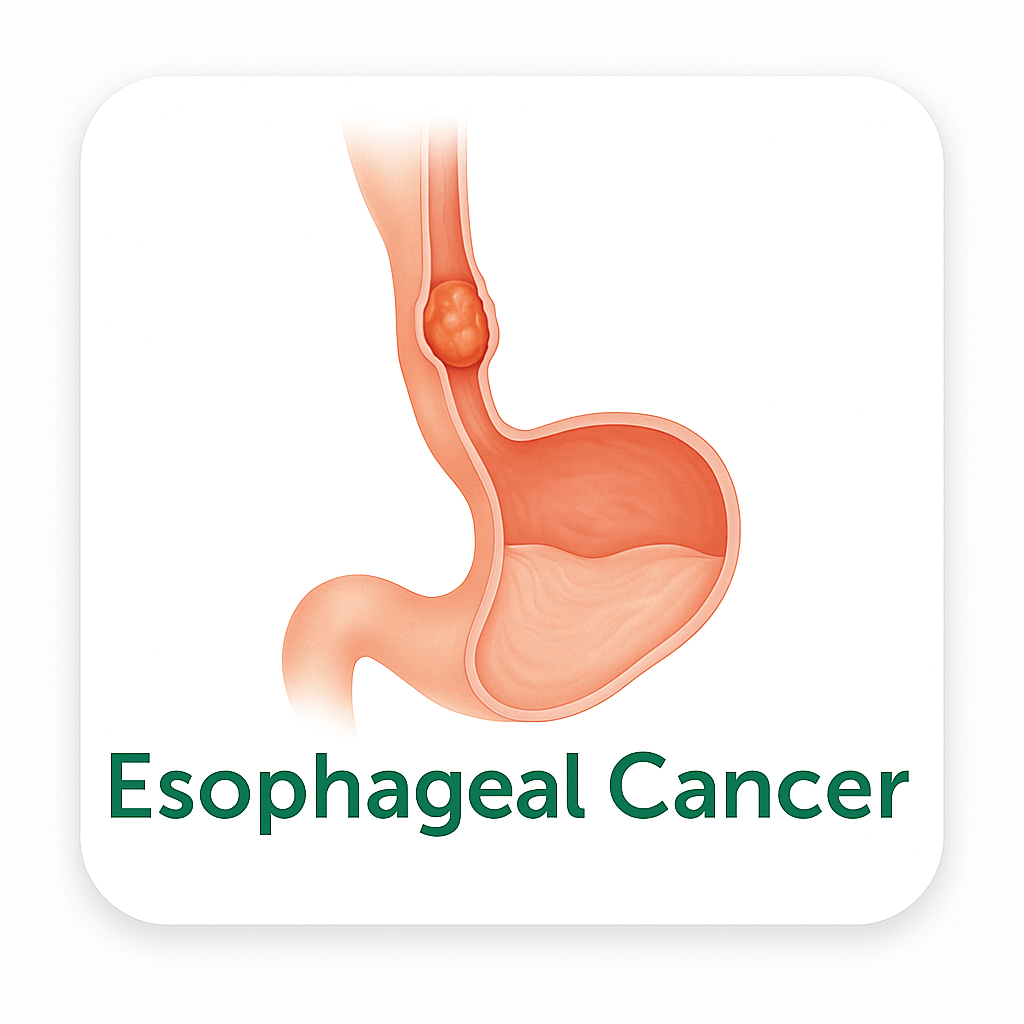
Esophageal Cancer
Main Grouping
Digestive
Organ System
Esophagus,upper gastrointestinal tract,gastroesophageal junction
Cell Origin
Squamous epithelial cells lining the upper and middle esophagus give rise to esophageal squamous cell carcinoma (ESCC)
Pathways Affected
Esophageal cancer involves dysregulation across multiple interconnected molecular signaling pathways that vary in frequency between ESCC and EAC subtypes. The EGFR/ErbB signaling pathway is altered in both subtypes, with EGFR amplification or mutation in 19 percent of ESCCs, EGFR amplification in 15 percent of EACs, and ERBB2 amplification in 32 percent of EACs. Upon ligand binding, EGFR undergoes dimerization and activates downstream PI3K/AKT/mTOR, JAK/STAT, and MAPK/ERK signaling cascades promoting tumor cell proliferation, survival, and metastasis.
The PI3K/AKT/mTOR pathway is the most frequently altered oncogenic pathway in EAC with mutations or copy number alterations in PIK3CA, PTEN, PIK3R1, and related genes found in approximately 24 percent of tumors across both subtypes, with phospho-S6 as a measurable downstream effector that was reduced by 87.9 percent in the freeze-dried strawberry phase II trial. The TP53 tumor suppressor pathway is frequently inactivated in both ESCC and EAC, with TP53 mutation representing a central event in the dysplasia-to-carcinoma transition in Barrett's esophagus. CDKN2A (p16) inactivation occurs in 76 percent of EACs through mutation, deletion, or epigenetic silencing, disrupting cell cycle regulation at the G1/S checkpoint.
The WNT/beta-catenin pathway is activated in esophageal carcinogenesis with FZD6 and LEF1 identified as transcriptional mediators. NF-kB signaling drives inflammatory cytokine expression, anti-apoptotic gene regulation, and epithelial-to-mesenchymal transition in both Barrett's esophagus pathogenesis and esophageal tumor progression, and phospho-NF-kB-p65 was reduced by 63.1 percent in the strawberry phase II trial demonstrating direct pathway modulation by whole berry consumption. Cyclooxygenase-2 (COX-2) inflammatory signaling was reduced by 47.3 percent and inducible nitric oxide synthase by 77.3 percent in the same trial, documenting multi-pathway suppression through dietary strawberry consumption. The IL-6/STAT3 pathway contributes to inflammatory signaling, stemness, and immune evasion in Barrett's esophagus and EAC. NOTCH and Hedgehog developmental pathways are involved in Barrett's metaplasia and esophageal tumor cell identity. VEGF-mediated angiogenesis signaling with VEGFA amplification supports tumor vascularization. Apoptosis pathway dysregulation through BCL-2 family proteins and caspase cascades allows tumor cell survival across both esophageal cancer subtypes.
Description
Esophageal cancer ranks among the ten most common cancers worldwide and is the eighth leading cause of cancer-related mortality globally. In 2022, China alone reported 510,716 new esophageal cancer cases and deaths. Two histologically and molecularly distinct subtypes dominate the disease landscape. Esophageal squamous cell carcinoma (ESCC) arises from the squamous epithelium of the upper and middle esophagus and accounts for the majority of cases globally, with highest incidence in the esophageal cancer belt spanning northern China, Iran, Kazakhstan, and parts of sub-Saharan Africa. Esophageal adenocarcinoma (EAC) arises from glandular columnar epithelium at the gastroesophageal junction through a defined metaplasia-dysplasia-carcinoma sequence and is the predominant subtype in North America, Northern Europe, and Australia.
The primary precursor lesion for EAC is Barrett's esophagus (BE), an acquired condition in which normal esophageal squamous epithelium is replaced by metaplastic intestinal-type columnar epithelium, driven by chronic gastroesophageal reflux disease (GERD). The progression from Barrett's metaplasia through low-grade dysplasia, high-grade dysplasia, and invasive adenocarcinoma involves sequential accumulation of molecular alterations including TP53 mutation, CDKN2A (p16) inactivation, chromosomal instability, and activation of EGFR/ErbB, PI3K/AKT/mTOR, and Wnt/beta-catenin signaling pathways. ERBB2 amplification is found in 32 percent of EACs, EGFR gene amplification in 15 percent of EACs, and PI3K pathway alterations in 24 percent of tumors. In ESCC, EGFR amplification or mutation is found in 19 percent of tumors, and PIK3CA, PTEN, and PIK3R1 alterations activating the PI3K pathway are present in 24 percent of ESCC cases. CDKN2A inactivation occurs in 76 percent of EACs.
Risk factors for ESCC include tobacco use, alcohol consumption, nutritional deficiencies, low intake of fruits and vegetables, hot beverage consumption, and poor nutritional status. Risk factors for EAC include GERD, obesity, Barrett's esophagus, and tobacco use. A landmark randomized phase II clinical trial published in Cancer Prevention Research (2012) by Chen and colleagues at Ohio State University enrolled 75 patients with esophageal dysplastic precancerous lesions in a high-risk region of China and administered freeze-dried strawberry powder at 60 grams per day for six months. At the 60g dose, histologic grade of dysplastic premalignant lesions decreased in 29 of 36 patients, representing 80.6 percent of participants, with a p-value below 0.0001. Strawberry consumption reduced inducible nitric oxide synthase protein expression by 77.3 percent, cyclooxygenase-2 by 47.3 percent, phospho-NF-kB-p65 by 63.1 percent, and phospho-S6 by 87.9 percent. Cell proliferation as measured by Ki-67 labeling index was significantly inhibited by 37.9 percent. This study was heralded as groundbreaking in an editorial published in the same journal by the American Association for Cancer Research.
Plant-Based Description
Whole-food plant-based dietary patterns provide nutrients and phytochemicals studied in relation to oxidative stress, inflammation, DNA damage response, carcinogen detoxification, and cellular metabolism relevant to esophageal cancer biology. Research documents inverse correlations between Barrett's esophagus and EAC and diets rich in fruits, vegetables, fiber, and vitamins C, E, and beta-carotene. Strawberries carry the most direct clinical evidence of any single plant food in esophageal cancer, with a randomized phase II trial demonstrating histologic reversal of esophageal dysplastic lesions in 80.6 percent of participants consuming 60 grams of freeze-dried strawberry powder daily for six months, with simultaneous suppression of NF-kB, COX-2, iNOS, and PI3K/mTOR pathway biomarkers and a 37.9 percent reduction in cell proliferation. Fruits provide vitamin C, polyphenols, flavonoids, anthocyanins, and carotenoids. Vegetables provide carotenoids, glucosinolates, folate, and fiber. Legumes provide fiber, isoflavones, and protease inhibitors. Whole grains provide fiber and fermentable carbohydrates. Nuts and seeds provide vitamin E and selenium. Mushrooms provide beta-glucans. Herbs and spices including green tea, turmeric, ginger, garlic, and rosemary provide concentrated phytochemicals studied in EGFR, NF-kB, PI3K/AKT, STAT3, and apoptosis pathway biology in esophageal cancer cell models.
Plant Chemistry Detail
Strawberries carry the most directly documented clinical evidence of any single whole plant food in esophageal cancer reversal. A randomized phase II trial by Chen et al. (Cancer Prevention Research, 2012) conducted in 75 patients with esophageal dysplastic precancerous lesions in high-risk China found that 60 grams per day of freeze-dried strawberry powder for six months reduced histologic grade of dysplastic lesions in 80.6 percent of patients (p less than 0.0001), with lesions in some patients regressing from mild dysplasia to histologically normal esophagus. Measured biomarker reductions included inducible nitric oxide synthase reduced by 77.3 percent, COX-2 by 47.3 percent, phospho-NF-kB-p65 by 63.1 percent, phospho-S6 by 87.9 percent, and Ki-67 cell proliferation index by 37.9 percent. Prior preclinical work by the same team found freeze-dried strawberries significantly inhibited tumor formation in the rat esophagus by inhibiting metabolism of NMBA nitrosamine carcinogens. The active phytochemicals in strawberries relevant to these effects include ellagic acid, pelargonidin anthocyanin, quercetin, kaempferol, and vitamin C.
Epigallocatechin-3-gallate (EGCG) from green tea inhibits EGFR kinase activity, PI3K/AKT, NF-kB, and STAT3 signaling. Meta-analysis of 10 epidemiological studies including 33,731 participants found a pooled relative risk of 0.76 for high green tea consumption versus non-drinking for esophageal cancer risk. Quercetin from yellow onions, apples, kale, and broccoli inhibits PI3K/AKT and NF-kB signaling and induces apoptosis in esophageal cancer models. Sulforaphane from cruciferous vegetables activates Nrf2/ARE phase II detoxification enzyme induction and inhibits NF-kB in esophageal cancer cell models. Curcumin from turmeric inhibits NF-kB, EGFR, PI3K/AKT, STAT3, and Wnt/beta-catenin signaling. Vitamin C from citrus fruits, kiwi, and red bell pepper supports antioxidant defense and carcinogen detoxification relevant to ESCC risk. Beta-carotene and related carotenoids from carrot, sweet potato, spinach, and kale are inversely associated with esophageal cancer risk in dietary studies.
Nutritional Focus
Nutritional focus in esophageal cancer research is led by freeze-dried strawberries, which in a randomized phase II trial demonstrated histologic reversal of esophageal dysplastic precancerous lesions in 80.6 percent of patients at the 60g per day dose over six months with simultaneous suppression of NF-kB, COX-2, iNOS, PI3K/mTOR pathway biomarkers, and a 37.9 percent reduction in cell proliferation. Additional nutritional priorities include vitamin C from citrus fruits, kiwi, and red bell pepper as a key nutrient inversely associated with ESCC risk; carotenoids including beta-carotene from carrot, sweet potato, and leafy greens; EGCG from green tea; sulforaphane from cruciferous vegetables; curcumin from turmeric; quercetin from onions and apples; folate from legumes and dark leafy greens; dietary fiber from whole grains, legumes, and vegetables; vitamin E from nuts and seeds; and selenium from Brazil nuts and pumpkin seeds.
Research Notes
Chen et al. (Cancer Prevention Research, 2012, PMC5081263) conducted a randomized noncomparative phase II trial in 75 patients with esophageal dysplastic precancerous lesions in a high-risk region of China, randomized to 30g per day or 60g per day of freeze-dried strawberry powder for six months. At the 60g dose, histologic grade decreased in 29 of 36 patients representing 80.6 percent (p less than 0.0001), with biopsy-confirmed lesion regression to normal esophageal tissue in representative patients. Biomarker reductions at 60g included inducible nitric oxide synthase reduced 77.3 percent, COX-2 reduced 47.3 percent, phospho-NF-kB-p65 reduced 63.1 percent, phospho-S6 reduced 87.9 percent, and Ki-67 cell proliferation index reduced 37.9 percent. This trial was heralded as groundbreaking in an editorial in Cancer Prevention Research by the American Association for Cancer Research.
A prospective cohort study (Chinese Journal of Cancer Research, 2024, PMC10915634) spanning 17 years involving 15,709 participants found that higher healthful plant-based diet index scores were associated with reduced esophageal cancer risk, with legume consumption specifically linked to reduced EC risk. Meta-analysis of 10 epidemiological studies including 33,731 participants and 3,557 esophageal cancer cases (BMC Gastroenterology, 2012) found a pooled relative risk of 0.76 for high green tea consumption versus non-drinking for esophageal cancer risk. Research on Barrett's esophagus and EAC documents inverse correlations with diets rich in fruits, vegetables, fiber, and vitamins C, E, and beta-carotene (PMC4617683). TCGA integrated genomic characterization (Nature, 2017, PMC5651175) identified ERBB2 amplification in 32 percent of EACs, EGFR amplification in 15 percent of EACs, and CDKN2A inactivation in 76 percent of EACs. Molecular pathway review (PMC11480525) documented alterations in EGFR/ErbB, PI3K/AKT/mTOR, and Notch/Wnt/beta-catenin pathways as primary drivers of esophageal carcinogenesis.
Notes Visibility
show
Key Foods
Strawberry,Broccoli,Kale,Spinach,Brussels Sprouts,Cauliflower,Carrot,Sweet Potato,Garlic,Yellow Onion,Tomato,Apple,Blueberry,Orange,Kiwi,Grape,Pomegranate,Raspberry,Green Lentils,Black Beans,Chickpeas,Soybeans,Edamame,Brown Rice,Quinoa,Oats,Wild Rice,Rye Berries,Sorghum,Walnut,Almond,Brazil Nut,Pumpkin Seeds,Flaxseed,Chia Seeds,Sesame Seeds,Hemp Seeds,Shiitake,Maitake,Cremini,Portobello,Oyster Mushroom,Green Tea,Turmeric,Garlic Powder,Ginger,Black Pepper,Parsley,Rosemary, Leek,Avocado,Artichoke,Radish,Tangerine, Red Onion
Linked Nutrients
vitamin-a,vitamin-c,vitamin-e,vitamin-d,vitamin-b6,folate,vitamin-k,selenium,zinc,magnesium,calcium,potassium,iron,ellagic-acid,anthocyanins,egcg,quercetin,sulforaphane,curcumin,resveratrol,beta-carotene,beta-glucans,plant-ala-omega3,dietary-fiber
Last Updated
2025-10-13 09:16:53

