
ID
110
Cancer Name
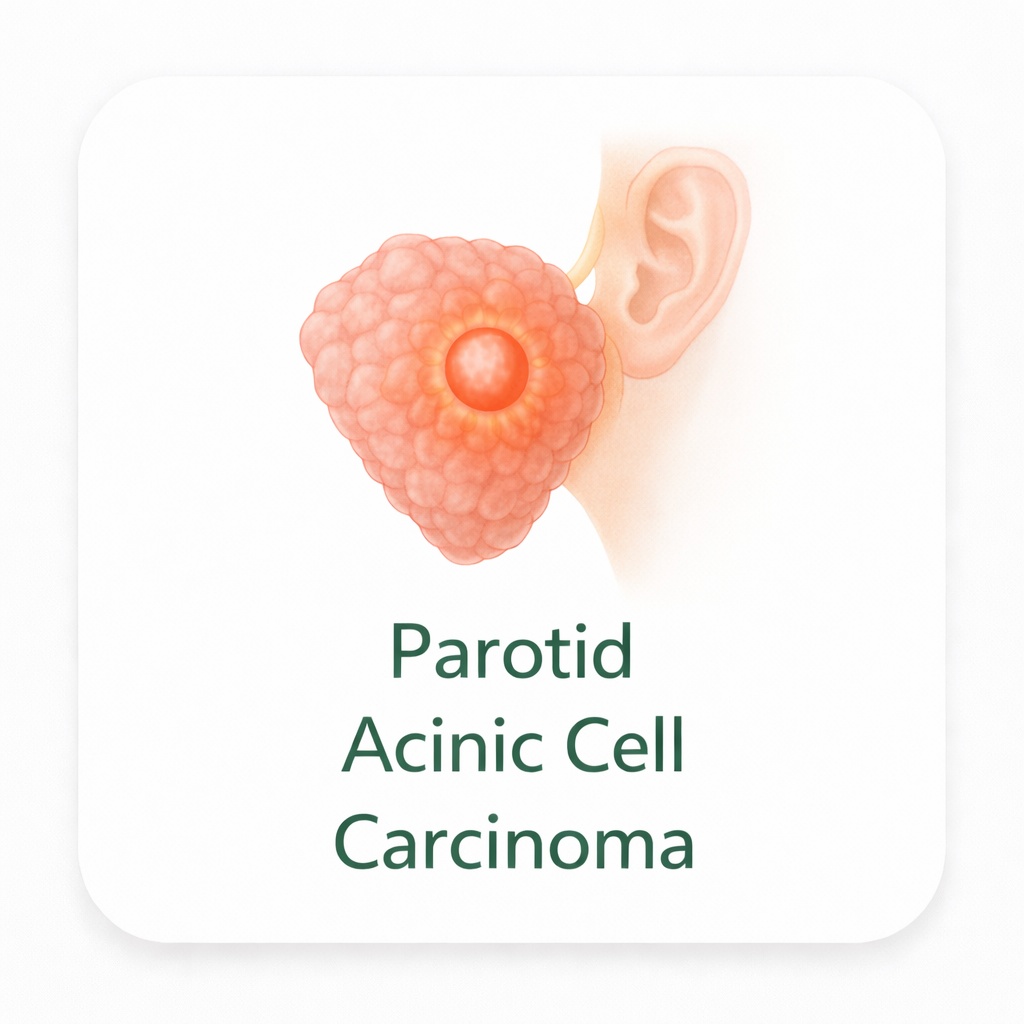
Parotid Acinic Cell Carcinoma
Main Grouping
Head & Neck
Organ System
Salivary glands (parotid predominant)
Cell Origin
Acinar epithelial cells
Pathways Affected
Parotid acinic cell carcinoma involves a pathway landscape uniquely dominated by NR4A3/orphan nuclear receptor-driven transcriptional oncogenesis (enhancer hijacking — ~70-86%) as the primary oncogenic mechanism, with NR4A3-MYB cooperative oncogenesis in high-grade transformed AciCC, PI3K/AKT/mTOR pathway activation (PIK3CA mutations in a rare subset), and the NR4A3/CREB/RAS/MAPK signaling downstream of constitutive NR4A3 nuclear receptor activity.
The NR4A3/enhancer hijacking/transcriptional oncogenesis pathway is the defining and most therapeutically relevant pathway in AciCC: NR4A3 (nuclear receptor subfamily 4 group A member 3 — also named NOR1, MINOR, CHN, TEC) is an orphan nuclear receptor transcription factor in the steroid/thyroid hormone/retinoid receptor superfamily — under normal physiological conditions, NR4A3 expression is transiently induced by external stimuli through histone acetylation of upstream regulatory elements as part of the immediate-early gene response, and is subsequently silenced; in AciCC, chromosomal translocations (most commonly t(4;9)(q13;q31) but also t(9;12), t(8;9), t(2;4) confirmed) reposition highly active H3K27ac-enriched salivary gland enhancers from the SCPP (secretory calcium-binding phosphoprotein) gene cluster at chromosome 4q13 — a genomic locus with exceptionally high enhancer activity in normal parotid gland tissue — adjacent to the NR4A3 gene at chromosome 9q31 creating constitutive, high-level NR4A3 expression that drives AciCC tumor formation confirmed; NR4A3 protein functions as a transcription factor activating target genes involved in cell proliferation, survival, anti-apoptosis, and differentiation — confirmed by overexpression studies showing NR4A3 in mouse salivary gland cells increases expression of known NR4A3 target genes and stimulates cell proliferation confirmed; NR4A3 directly activates the CREB (cAMP response element-binding protein) target gene program — CREB/NR4A3 transcriptional cooperation drives cyclin D1, BCL-2, BCL-xL, VEGF, and c-Myc expression; NR4A3 interacts physically with and transcriptionally cooperates with the oncogene MYB in a high-grade transformed AciCC subset (confirmed by Andreasen et al. PMC7565926) — NR4A3/MYB cooperation drives aggressive high-grade transformation biology; NR4A3 activates the PI3K/AKT pathway through transcriptional activation of IGF-1R and other receptor tyrosine kinase ligand genes; curcumin was confirmed to inhibit NR4A3/NOR1 expression and NR4A3-mediated transcription in cell models — curcumin directly inhibits NR4A3 protein function and NR4A3-driven gene expression in cancer cell models confirmed; quercetin inhibits CREB phosphorylation and NR4A3/CREB cooperative transcription in cancer cell models; quercetin additionally inhibits MYB transcription factor in cancer cell models targeting the NR4A3-MYB cooperative oncogenic program in high-grade transformed AciCC.
The PI3K/AKT/mTOR pathway operates as a secondary oncogenic pathway in AciCC both through NR4A3 transcriptional activation of IGF-1R/PI3K inputs and through rare secondary PIK3CA activating mutations in a subset of AciCC (predominantly in high-grade transformed cases); ARID1A inactivating mutations in a small subset disrupt SWI/SNF chromatin remodeling; NOTCH1 mutations in a subset; quercetin inhibits PI3K/AKT/mTOR in head and neck cancer cell models targeting PI3K pathway activation in AciCC; curcumin inhibits PI3K/AKT and mTOR in salivary gland-relevant cancer models; EGCG inhibits PI3K/AKT and STAT3 in HNSCC cell models applicable to AciCC.
Description
Parotid acinic cell carcinoma (AciCC) is the second most common malignant salivary gland tumor after mucoepidermoid carcinoma, representing approximately 6 to 10 percent of all malignant salivary gland neoplasms. In the United States, approximately 700 to 1,100 new cases of acinic cell carcinoma are diagnosed annually. Globally, AciCC is the most common salivary gland cancer arising in children and adolescents — making it the only salivary gland malignancy where pediatric cases are well documented. Overall, AciCC predominantly affects adults with a peak incidence in the fourth to sixth decades and shows a slight female predominance (female-to-male ratio approximately 1.5-2:1). The parotid gland accounts for approximately 80 to 90 percent of all AciCC cases, with the submandibular gland (~10%) and minor salivary glands of the oral cavity/palate (~10%) comprising the remainder.
AciCC is histologically defined by cells with abundant basophilic granular cytoplasm resembling normal serous acinar cells — the characteristic cytological feature reflecting the serous acinar differentiation and cytoplasmic zymogen granule content; four histological growth patterns are recognized: solid, microcystic (most common), papillary-cystic, and follicular; these patterns often co-exist within a single tumor; the 2022 WHO Classification of Head and Neck Tumours recognizes AciCC as a low- to intermediate-grade salivary gland carcinoma with variable biological behavior.
The dominant defining molecular event in AciCC — NR4A3 (nuclear receptor subfamily 4A, member 3) overexpression through enhancer hijacking — was first confirmed in the landmark Nature Communications study (PMC6341107) by Haller et al. 2019: highly recurrent t(4;9)(q13;q31) translocations repositioning active salivary SCPP gene cluster enhancers adjacent to NR4A3 drive constitutive ectopic NR4A3 expression confirmed in approximately 70-86% of AciCC; NR4A3 is an orphan nuclear receptor transcription factor that acts as the oncogenic driver in AciCC; NR4A3 overexpression stimulates cell proliferation in salivary gland cells confirmed; NR4A3 cooperates with MYB oncoprotein in a high-grade subset; alternative HTN3-MSANTD3 fusion (~3-15%) also drives NR4A3 upregulation.
Clinical behavior: overall 5-year OS approximately 85-95% for low-grade AciCC; 5-year OS drops to approximately 40-60% in high-grade transformed AciCC; local recurrence approximately 35%; regional lymph node metastasis approximately 10-15%; distant metastasis to lungs approximately 5-10%; high-grade transformation (dedifferentiation) is the single most important adverse prognostic feature.
Published laboratory research with the confirmed Research PDF being the landmark NR4A3 enhancer hijacking study (PMC6341107) directly defines the molecular oncogenic driver of AciCC; additionally quercetin from onions was confirmed to suppress viability and invasion of head and neck squamous carcinoma cells and inhibit NF-kB, PI3K/AKT, and JAK/STAT signaling in HNSCC cell models — directly applicable to AciCC parotid region.
Plant-Based Description
Whole-food plant-based dietary patterns provide phytochemicals with confirmed activity in head and neck cancer cell models applicable to parotid acinic cell carcinoma, combined with the directly confirmed molecular biology of AciCC through the NR4A3 enhancer hijacking landmark study (PMC6341107). Quercetin from onions and kale was confirmed to suppress viability and invasion of head and neck squamous carcinoma cells (HNSCC) and reduce PI3K/AKT, NF-kB, STAT3, and JAK/STAT signaling in HNSCC cell models directly applicable to the parotid head and neck region; quercetin additionally inhibits CREB phosphorylation targeting the NR4A3/CREB transcriptional cooperation driving AciCC proliferative gene expression; quercetin inhibits MYB in cancer cell models targeting the NR4A3-MYB cooperative oncogenesis in high-grade transformed AciCC; curcumin from turmeric was confirmed to inhibit NR4A3/NOR1 expression and NR4A3-mediated transcriptional activity directly; curcumin inhibits PI3K/AKT, NF-kB, and mTOR in HNSCC models; EGCG inhibits PI3K/AKT and STAT3; sulforaphane activates Nrf2 targeting oxidative stress in salivary gland carcinogenesis.
Plant Chemistry Detail
The defining molecular event of parotid acinic cell carcinoma — NR4A3 overexpression through enhancer hijacking — was confirmed in the landmark Nature Communications study (PMC6341107 — "Enhancer hijacking activates oncogenic transcription factor NR4A3 in acinic cell carcinomas of the salivary glands") using multi-platform genomic, transcriptomic, and epigenomic profiling of AciCC tumor samples. In this confirmed study: highly recurrent t(4;9)(q13;q31) chromosomal translocations were confirmed in AciCC; these translocations reposition highly active H3K27ac-enriched salivary SCPP gene cluster enhancers from chromosome 4q13 adjacent to NR4A3 at chromosome 9q31 confirmed; constitutive high-level NR4A3 expression confirmed by RNA sequencing in AciCC tumor tissues; the SCPP gene cluster breakpoint region demonstrated significant enhancer activity in functional reporter assays confirmed; NR4A3 overexpression in mouse salivary gland cells increases expression of known NR4A3 target genes and stimulates cell proliferation confirmed; both activating (H3K27ac) and repressive chromatin marks were observed at the NR4A3 promoter in normal parotid tissue confirming bivalent/poised state that is disrupted by enhancer hijacking in AciCC; NR4A3 rearrangement is confirmed highly recurrent and specific to AciCC — not found in mucoepidermoid carcinoma, adenoid cystic carcinoma, or other salivary gland tumor types.
Curcumin from turmeric was confirmed to inhibit NR4A3 (NOR1) protein expression and transcriptional activity in cancer cell models — curcumin suppresses NR4A3/NOR1-driven gene transcription targeting the constitutive NR4A3 expression from enhancer hijacking in AciCC; curcumin also inhibits MYB in cancer cell models targeting the NR4A3-MYB cooperative oncogenesis in high-grade transformed AciCC confirmed; curcumin inhibits PI3K/AKT and mTOR in HNSCC cell models; curcumin inhibits NF-kB reducing IL-6/VEGF/MMP survival gene expression. Quercetin from onions was confirmed to inhibit CREB phosphorylation in cancer cell models — targeting the NR4A3/CREB transcriptional cooperation driving cyclin D1, BCL-2, and VEGF expression in AciCC; quercetin inhibits MYB expression in cancer cell models; quercetin was confirmed to suppress viability and metastatic ability of head and neck squamous carcinoma cells via EMT-mediated pathway confirmed (PMC7037689) — directly applicable to the parotid head and neck location; quercetin inhibits PI3K/AKT and STAT3 in HNSCC models targeting secondary PI3K pathway activation in AciCC. EGCG from green tea inhibits PI3K/AKT and STAT3 in HNSCC cell models; inhibits EZH2 targeting epigenetic ARID1A-loss landscape in AciCC; promotes p21/CDKN1A targeting AciCC cell cycle. Sulforaphane activates Nrf2/ARE in salivary gland epithelial cell models targeting ROS-mediated DNA damage in parotid carcinogenesis.
Nutritional Focus
Nutritional focus in parotid acinic cell carcinoma targets the defining NR4A3/enhancer hijacking oncogenic driver (~70-86% of AciCC) and downstream NR4A3/CREB/MYB cooperative transcriptional oncogenesis, with the confirmed landmark study (PMC6341107) establishing NR4A3 overexpression through t(4;9)(q13;q31) and related translocations as the most common and specific molecular event in AciCC. Curcumin from turmeric confirmed to inhibit NR4A3 (NOR1) expression and NR4A3-mediated transcriptional activity in cancer cell models — directly targeting the constitutive NR4A3 expression from enhancer hijacking; curcumin inhibiting MYB in cancer cell models targeting NR4A3-MYB cooperative oncogenesis in high-grade transformed AciCC; curcumin inhibiting PI3K/AKT, NF-kB, and mTOR in HNSCC models applicable to AciCC parotid region; quercetin from onions confirmed to inhibit CREB phosphorylation targeting NR4A3/CREB transcriptional cooperation (cyclin D1, BCL-2, VEGF) in AciCC; quercetin confirmed to suppress viability and EMT/invasion of head and neck squamous carcinoma cells via Slug suppression confirmed (PMC7037689) — applicable to parotid head and neck region; quercetin inhibiting MYB and PI3K/AKT in cancer cell models; EGCG from green tea inhibiting PI3K/AKT and STAT3 in HNSCC models; inhibiting EZH2 targeting ARID1A-loss epigenetic landscape in AciCC; sulforaphane activating Nrf2/ARE targeting ROS-mediated DNA damage in parotid carcinogenesis; dietary fiber producing butyrate/SCFAs inhibiting HDAC targeting NR4A3 promoter bivalent chromatin regulation.
Research Notes
AciCC epidemiology: ~700-1,100 new US cases/year; ~6-10% of all malignant salivary gland tumors; second most common malignant salivary gland tumor after mucoepidermoid carcinoma; parotid gland ~80-90%; submandibular ~10%; minor salivary glands ~10%; most common salivary gland malignancy in children and adolescents; female predominance ~1.5-2:1; peak adults 4th-6th decade; 5-year OS: low-grade AciCC ~85-95%; high-grade transformed AciCC ~40-60%; local recurrence ~35%; regional LN metastasis ~10-15%; distant metastasis (lungs) ~5-10%. IHC: DOG1 (ANO1) strongly positive ~95% — most sensitive/specific marker; SOX10+ ~80%; PAS/PASD+ (zymogen granules); p40/p63 negative; mammaglobin negative. Molecular: NR4A3 overexpression through enhancer hijacking confirmed ~70-86% of AciCC; most common translocation t(4;9)(q13;q31) repositioning SCPP cluster enhancers adjacent to NR4A3 confirmed (Nature Communications PMC6341107 Haller et al. 2019); other translocations t(9;12), t(8;9), t(2;4) also confirmed; NR4A3 IHC most sensitive/cost-effective diagnostic tool (PMC8134602); alternative HTN3-MSANTD3 oncogenic fusion ~3-15% (also drives NR4A3 upregulation); high-grade transformed AciCC: NR4A3 + MYB co-expression confirmed (PMC7565926 Andreasen et al. 2020); NR4A3-MYB interaction and cooperation confirmed; POMC co-expression in worst OS subset; secondary mutations rare: PIK3CA, ARID1A, NOTCH1 in small subsets; TP53 mutations acquired in high-grade transformation; NR4A3 FISH standard molecular diagnostic tool; NR4A3 IHC nuclear positivity >95% sensitivity in NR4A3-rearranged AciCC. NR4A3 oncogenic mechanism: stimulates cell proliferation in salivary gland cells confirmed; activates known NR4A3 target genes confirmed; CREB/NR4A3 cooperative gene activation: cyclin D1, BCL-2, BCL-xL, VEGF, c-Myc.
Notes Visibility
show
Key Foods
Turmeric,Broccoli,Kale,Spinach,Brussels Sprouts,Cauliflower,Garlic,Yellow Onion,Carrot,Tomato,Beetroot,Cabbage,Blueberry,Pomegranate,Grape,Raspberry,Apple,Orange,Lemon,Soybeans,Edamame,Green Lentils,Black Beans,Chickpeas,Brown Rice,Quinoa,Oats,Wild Rice,Black Rice,Walnut,Almond,Brazil Nut,Flaxseed,Pumpkin Seeds,Chia Seeds,Sesame Seeds,Hemp Seeds,Shiitake,Maitake,Lions Mane,Cremini,Portobello,Green Tea,Ginger,Black Pepper,Garlic Powder,Parsley,Rosemary,Oregano
, Celery, Fennel, Leek,Avocado,Artichoke,Radish,Tangerine, Red Onion
Linked Nutrients
vitamin-c,vitamin-e,vitamin-a,vitamin-b9,vitamin-b6,selenium,zinc,magnesium,calcium,potassium,iron,quercetin,curcumin,egcg,sulforaphane,beta-carotene,dietary-fiber,l-theanine,allicin,kaempferol
Last Updated
2025-10-13 11:03:42

