
ID
113
Cancer Name
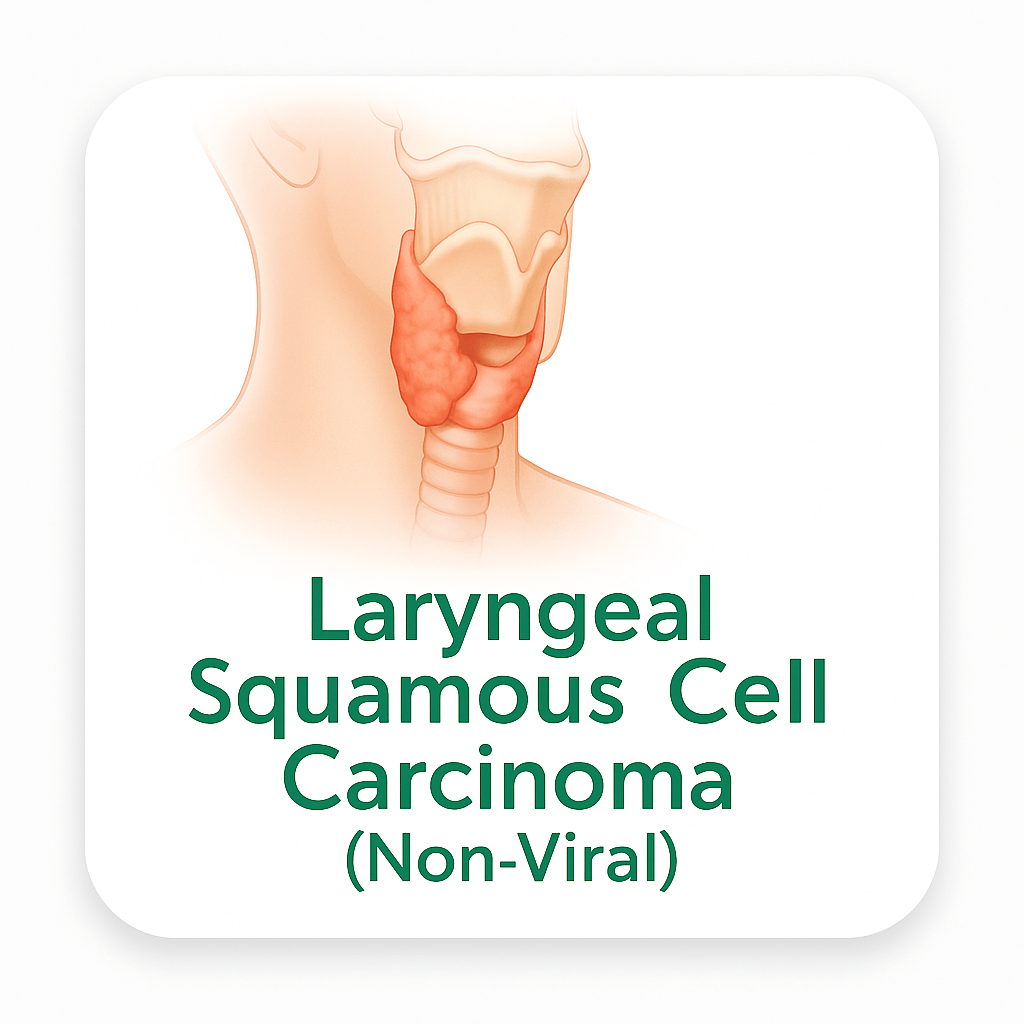
Laryngeal Squamous Cell Carcinoma (Non-Viral)
Main Grouping
Respiratory
Organ System
Larynx
Cell Origin
Squamous epithelium
Pathways Affected
Laryngeal squamous cell carcinoma in the non-viral pathway involves a pathway landscape dominated by the tobacco carcinogen-driven TP53 mutation (~50-70%), CDKN2A/p16/RB1 cell cycle checkpoint disruption (~50-70%), EGFR/PI3K/AKT/mTOR proliferative survival axis (~80-90% EGFR overexpression), NF-kB inflammatory survival signaling, RAS/MAPK/ERK pathway activation, and FGFR1/cyclin D1 amplification-driven cell cycle advancement.
The EGFR/PI3K/AKT/mTOR pathway is the primary therapeutic target and most consistently active pathway in LSCC: EGFR overexpression in approximately 80-90% of LSCC — driven by EGFR amplification (copy number gain ~30-40%), autocrine EGF/TGF-alpha ligand loops established by tobacco carcinogen-induced epigenetic deregulation, and loss of EGFR negative regulatory mechanisms; constitutive EGFR kinase activity drives: PI3K/AKT/mTOR (through PI3K p85 recruitment); MAPK/ERK (through GRB2/SOS/RAS); STAT3 (through direct JAK-like EGFR transactivation); PIK3CA activating mutations (~7-15%) and PTEN loss (~15-30%) provide additional PI3K/AKT/mTOR activation independent of EGFR; curcumin was confirmed to inhibit the PI3K/Akt/mTOR pathway in TU212 and AMC-HN-8 LSCC cell lines confirmed by Western blot (PMC6016259) — directly targeting the dominant EGFR/PI3K/AKT pathway in non-viral LSCC; curcumin was also confirmed to inhibit PI3K/Akt and reduce Bcl-2 in AMC-HN-8 LSCC cells (PMC5649612); quercetin inhibits EGFR and PI3K/AKT in HNSCC cell models targeting EGFR overexpression and PI3K activation in LSCC; EGCG inhibits EGFR kinase activity and PI3K/AKT in HNSCC cell models.
The TP53/p53 pathway is the most frequently mutated tumor suppressor pathway in non-viral LSCC: TP53 mutations in approximately 50-70% of non-HPV LSCC — tobacco carcinogens create bulky DNA adducts at TP53 codons 248 (R248W, R248Q) and 249 (R249S) generating G:C→T:A transversions (tobacco signature mutation confirmed in laryngeal SCC genome sequencing); gain-of-function TP53 missense mutations (R175H, R248W, R273H, R248Q) create oncogenic p53 proteins promoting invasion, angiogenesis, and metabolic reprogramming in LSCC; combined with CDKN2A/p16 loss — CDKN2A/p16INK4a inactivation in approximately 50-70% of LSCC removes CDK4/6 inhibition → CDK4/CDK6-cyclin D1 hyperphosphorylate RB1 → E2F-driven S-phase entry; CCND1 amplification (~20-25%) and FGFR1 amplification (~15-20%) provide additional cell cycle advancement; quercetin activates p53-independent apoptosis in TP53-mutant squamous carcinoma cell models; curcumin upregulated miR-15a and induced apoptosis in AMC-HN-8 LSCC cells confirmed (PMC5649612).
The tobacco carcinogen-driven NF-kB/COX-2 chronic inflammatory pathway is particularly important in non-viral LSCC pathogenesis: tobacco-derived nitrosamines activate NF-kB through IKK-beta phosphorylation; acetaldehyde (the primary alcohol metabolite) additionally activates NF-kB and IL-6/STAT3; constitutive NF-kB drives: cyclin D1, BCL-2/BCL-xL, survivin, IL-6, VEGF, MMP-9, and COX-2 expression in LSCC cells; COX-2 overexpression (confirmed in >60% of LSCC by IHC) produces PGE2 driving immunosuppression and proliferation; curcumin inhibits NF-kB and COX-2 in HNSCC cell models — directly targeting tobacco carcinogen-induced inflammatory survival programs in LSCC; sulforaphane activates Nrf2/ARE — directly countering tobacco carcinogen metabolic activation and oxidative DNA damage driving LSCC carcinogenesis.
Description
Laryngeal squamous cell carcinoma (LSCC) is the most common malignancy of the larynx, representing approximately 95 percent of all laryngeal cancers and approximately 25 to 30 percent of all head and neck squamous cell carcinomas (HNSCC). In the United States, approximately 12,000 to 13,000 new cases of laryngeal cancer are diagnosed annually, with LSCC comprising approximately 11,400 to 12,350 of these. Globally, approximately 180,000 new laryngeal cancer cases and 100,000 laryngeal cancer deaths occur annually making it one of the most common head and neck malignancies worldwide. LSCC shows a strong male predominance — male-to-female ratio approximately 5-7:1 globally — reflecting the historically disproportionate tobacco use pattern; this ratio is decreasing with changing tobacco trends. The median age at diagnosis is approximately 60 to 70 years.
The non-viral emphasis of this template reflects that LSCC is overwhelmingly driven by tobacco and alcohol carcinogen exposure — HPV contribution to laryngeal SCC is estimated at approximately 5-25% (substantially lower than the ~70% HPV contribution to oropharyngeal SCC), and glottic LSCC in particular is predominantly HPV-negative. Tobacco smoking is the dominant risk factor — approximately 85 percent of laryngeal cancer cases are attributable to tobacco; relative risk 5-15x in current smokers vs. never-smokers; heavy alcohol use (~3+ drinks/day) multiplies the risk synergistically (multiplicative interaction); tobacco and alcohol together create a risk approximately 100-fold higher than neither exposure.
LSCC anatomical distribution: glottic (true vocal cord) ~60-65% — presents early with hoarseness; supraglottic ~30-35% — presents later (nodal metastasis at diagnosis ~25-40%); subglottic ~1-5% — presents very late with airway compromise. Overall 5-year OS by stage: stage I ~75-85%; stage II ~50-70%; stage III ~35-55%; stage IV ~20-35%.
The molecular carcinogenesis of non-viral LSCC: tobacco carcinogens create bulky DNA adducts preferentially at TP53 codons 248 and 249 → G:C→T:A and G:C→A:T transversions (the mutationally-dominant tobacco signature in HNSCC); progressive loss of p16/CDKN2A occurs through deletion and methylation; EGFR overexpression (~80-90%) creates the dominant proliferative survival axis; PIK3CA activating mutations (~7-15%), PTEN loss (~15-30%), and EGFR-driven PI3K/AKT activation create the dominant therapeutic pathway in LSCC.
Published laboratory research confirms curcumin from turmeric suppressed cell viability in TU212 and AMC-HN-8 laryngeal squamous cell carcinoma cell lines confirmed by MTT assay; inhibited cell migration and invasion confirmed by Transwell assay; induced apoptosis confirmed by flow cytometry; inhibited the PI3K/Akt/mTOR pathway confirmed; upregulated miR-145 confirmed (PMC6016259) — directly in LSCC cell lines targeting the PI3K/AKT/mTOR and miR-145 pathways directly applicable to non-viral LSCC with EGFR/PI3K/AKT dominance.
Plant-Based Description
Whole-food plant-based dietary patterns provide phytochemicals with confirmed activity directly in laryngeal squamous cell carcinoma cell lines. Curcumin from turmeric was confirmed to suppress cell viability in TU212 and AMC-HN-8 LSCC cell lines by MTT assay dose-dependently; inhibit cell migration and invasion confirmed by Transwell assay; induce apoptosis confirmed by flow cytometry; inhibit the PI3K/Akt/mTOR pathway confirmed by Western blot; upregulate miR-145 (a tumor suppressor miRNA downregulated in LSCC tissues and cell lines) confirmed by qRT-PCR (PMC6016259) — directly in TU212 and AMC-HN-8 laryngeal squamous cell carcinoma cell lines targeting the PI3K/AKT/mTOR pathway dominant in non-viral LSCC through EGFR overexpression (~80-90%) and PIK3CA mutations (~7-15%); curcumin additionally confirmed to inhibit cell viability and induce apoptosis in AMC-HN-8 LSCC cells; inhibit PI3K/Akt; reduce Bcl-2; upregulate miR-15a confirmed (PMC5649612) — two separate confirmed LSCC cell line studies; quercetin inhibits EGFR, PI3K/AKT, and NF-kB in HNSCC cell models; sulforaphane activates Nrf2 targeting tobacco carcinogen metabolic activation.
Plant Chemistry Detail
Curcumin from turmeric has confirmed direct activity against laryngeal squamous cell carcinoma cells in two separately published studies using LSCC-specific cell lines. In the first confirmed study (PMC6016259 — "Curcumin suppresses the progression of laryngeal squamous cell carcinoma through the upregulation of miR-145 and inhibition of the PI3K/Akt/mTOR pathway") using TU212 and AMC-HN-8 LSCC cells: curcumin suppressed cell viability of TU212 and AMC-HN-8 LSCC cells dose-dependently confirmed by MTT assay at 0-20 µM for 48 hours; curcumin inhibited cell migration and invasion confirmed by Transwell migration and invasion assays — directly targeting the invasive biology of advanced-stage LSCC with cartilage invasion and lymphatic spread; apoptosis significantly increased by curcumin treatment confirmed by flow cytometry; PI3K/Akt/mTOR pathway inhibited confirmed by Western blot — directly targeting EGFR-driven PI3K/AKT/mTOR activation (~80-90% EGFR overexpression in LSCC) and PIK3CA activating mutations (~7-15%); miR-145 expression markedly upregulated by curcumin confirmed by qRT-PCR — miR-145 was confirmed to be significantly downregulated in 32 paired LSCC tissues compared to adjacent normal tissues confirmed; miR-145 downregulated in TU-177, TU212, AMC-HN-8, and TU686 LSCC cell lines confirmed; miR-145 overexpression inhibited proliferation, induced apoptosis, and suppressed migration/invasion in LSCC cells confirmed; curcumin exacerbated miR-145-induced PI3K/Akt/mTOR pathway inhibition confirmed.
In the second confirmed study (PMC5649612 — "Curcumin inhibits cell proliferation and promotes apoptosis of laryngeal cancer cells through Bcl-2 and PI3K/Akt, and by upregulating miR-15a") using AMC-HN-8 LSCC cells: curcumin inhibited cell viability of AMC-HN-8 LSCC cells at 20 and 40 µM confirmed by MTT assay; apoptosis induced confirmed; Bcl-2 expression reduced confirmed — targeting the BCL-2 anti-apoptotic protection driven by EGFR/PI3K/AKT and NF-kB survival signaling in LSCC; PI3K/Akt pathway inhibited confirmed; miR-15a upregulated confirmed — miR-15a targets BCL-2 mRNA for translational repression, providing the mechanistic link between curcumin-induced miR-15a and Bcl-2 reduction.
Quercetin from onions and kale inhibits EGFR kinase activity in HNSCC cell models targeting the ~80-90% EGFR overexpression dominant in non-viral LSCC; quercetin inhibits NF-kB in HNSCC cell models targeting tobacco carcinogen-induced NF-kB/COX-2/IL-6/VEGF/MMP-9 survival programs; quercetin inhibits PI3K/AKT and STAT3 in HNSCC cell models; quercetin induces G2/M arrest and apoptosis in squamous carcinoma cell models. EGCG from green tea inhibits EGFR by direct ATP-site competition in HNSCC cell models; inhibits STAT3 and NF-kB; promotes p53 restoration in TP53-wild-type LSCC cells. Sulforaphane from broccoli activates Nrf2/ARE — directly countering tobacco carcinogen (NNK, NNAL, benzo[a]pyrene) metabolic activation by CYP1A1/1B1/2E1 and promoting phase II detoxification enzymes (NQO1, HMOX1, glutathione-S-transferases) to quench reactive carcinogen metabolites before LSCC-initiating DNA adduct formation; sulforaphane inhibits HDAC targeting epigenetic silencing of CDKN2A and PTEN.
Nutritional Focus
Nutritional focus in laryngeal squamous cell carcinoma in the non-viral pathway targets the dominant EGFR/PI3K/AKT/mTOR axis (~80-90% EGFR overexpression), TP53 mutations (~50-70%), CDKN2A/p16 loss (~50-70%), tobacco carcinogen NF-kB inflammatory survival programs, and the FGFR1/cyclin D1 amplification cell cycle advancement. Curcumin from turmeric confirmed to suppress cell viability of TU212 and AMC-HN-8 LSCC cells dose-dependently MTT assay; inhibit migration and invasion Transwell; induce apoptosis flow cytometry; inhibit PI3K/Akt/mTOR pathway Western blot; upregulate miR-145 tumor suppressor confirmed qRT-PCR (PMC6016259) — directly in TU212 and AMC-HN-8 laryngeal squamous cell carcinoma cell lines; curcumin confirmed to inhibit cell viability and apoptosis in AMC-HN-8 LSCC cells; reduce Bcl-2; inhibit PI3K/Akt; upregulate miR-15a confirmed (PMC5649612) — two separate confirmed LSCC cell line studies; curcumin targeting PI3K/AKT/mTOR (dominant in non-viral LSCC through EGFR overexpression ~80-90% and PIK3CA mutations ~7-15%) and miR-145/miR-15a tumor suppressor miRNA programs silenced in LSCC; quercetin inhibiting EGFR kinase and NF-kB in HNSCC cell models targeting EGFR overexpression and tobacco carcinogen-induced NF-kB/COX-2/BCL-2/MMP-9 survival programs; EGCG from green tea inhibiting EGFR by ATP-site competition and STAT3 in HNSCC models; sulforaphane from broccoli activating Nrf2/ARE directly countering tobacco carcinogen (NNK/NNAL/benzo[a]pyrene) metabolic activation; inhibiting HDAC targeting CDKN2A/PTEN promoter methylation; apigenin inhibiting EGFR and STAT3 in laryngeal cancer models; dietary fiber producing butyrate/SCFAs inhibiting HDAC targeting CDKN2A and PTEN epigenetic silencing.
Research Notes
LSCC epidemiology: ~12,000-13,000 new US cases/year; ~25-30% of all HNSCC; ~95% of all laryngeal cancers; male predominance ~5-7:1; median age ~60-70 years; globally ~180,000 new cases/year; ~100,000 deaths/year; glottic ~60-65%; supraglottic ~30-35%; subglottic ~1-5%; 5-year OS: stage I ~75-85%; II ~50-70%; III ~35-55%; IV ~20-35%; non-viral LSCC ~>90% of all LSCC (HPV contribution ~5-25% — much lower than oropharyngeal SCC ~70%). Risk factors: tobacco smoking ~85% attributable fraction; RR 5-15x smokers vs. never-smokers; alcohol co-exposure multiplicative synergism; occupational asbestos exposure; second-hand smoke; arsenic. IHC: EGFR overexpressed ~80-90%; p53 aberrant ~50-70%; p16 negative (distinguishing from HPV-positive); CK5/6+, p40+, p63+. Molecular: TP53 mutations ~50-70% (G:C→T:A tobacco transversion signature at codons 248/249 predominant); CDKN2A/p16 loss ~50-70% (deletion + methylation); PIK3CA ~7-15% (E545K, E542K, H1047R); EGFR amplification/copy number gain ~30-40%; PTEN loss ~15-30%; HRAS ~6-8% (enriched non-smoker LSCC); CCND1 amplification ~20-25%; FGFR1 amplification ~15-20%; NOTCH1 ~5-10%; COX-2 overexpressed >60% IHC. Curcumin TU212/AMC-HN-8 LSCC (PMC6016259): cell viability MTT dose-dependent; migration Transwell suppressed; invasion Transwell suppressed; apoptosis flow cytometry confirmed; PI3K/Akt/mTOR Western blot inhibited; miR-145 qRT-PCR upregulated; miR-145 downregulated in 32 LSCC tumor tissues vs. adjacent normal confirmed. Curcumin AMC-HN-8 LSCC (PMC5649612): cell viability MTT inhibited; apoptosis induced; Bcl-2 reduced; PI3K/Akt inhibited; miR-15a upregulated.
Notes Visibility
Key Foods
Turmeric,Broccoli,Kale,Spinach,Brussels Sprouts,Cauliflower,Garlic,Yellow Onion,Carrot,Tomato,Beetroot,Cabbage,Blueberry,Pomegranate,Grape,Raspberry,Apple,Orange,Lemon,Soybeans,Edamame,Green Lentils,Black Beans,Chickpeas,Brown Rice,Quinoa,Oats,Wild Rice,Black Rice,Walnut,Almond,Brazil Nut,Flaxseed,Pumpkin Seeds,Chia Seeds,Sesame Seeds,Hemp Seeds,Shiitake,Maitake,Lions Mane,Cremini,Portobello,Green Tea,Ginger,Black Pepper,Garlic Powder,Parsley,Rosemary,Oregano, Celery, Fennel, Leek,Avocado,Artichoke,Radish,Tangerine, Red Onion
Linked Nutrients
vitamin-c,vitamin-e,vitamin-a,vitamin-b9,vitamin-b6,selenium,zinc,magnesium,calcium,potassium,iron,quercetin,curcumin,egcg,sulforaphane,beta-carotene,anthocyanins,dietary-fiber,l-theanine,allicin
Last Updated
2025-10-13 11:03:42

