
ID
114
Cancer Name
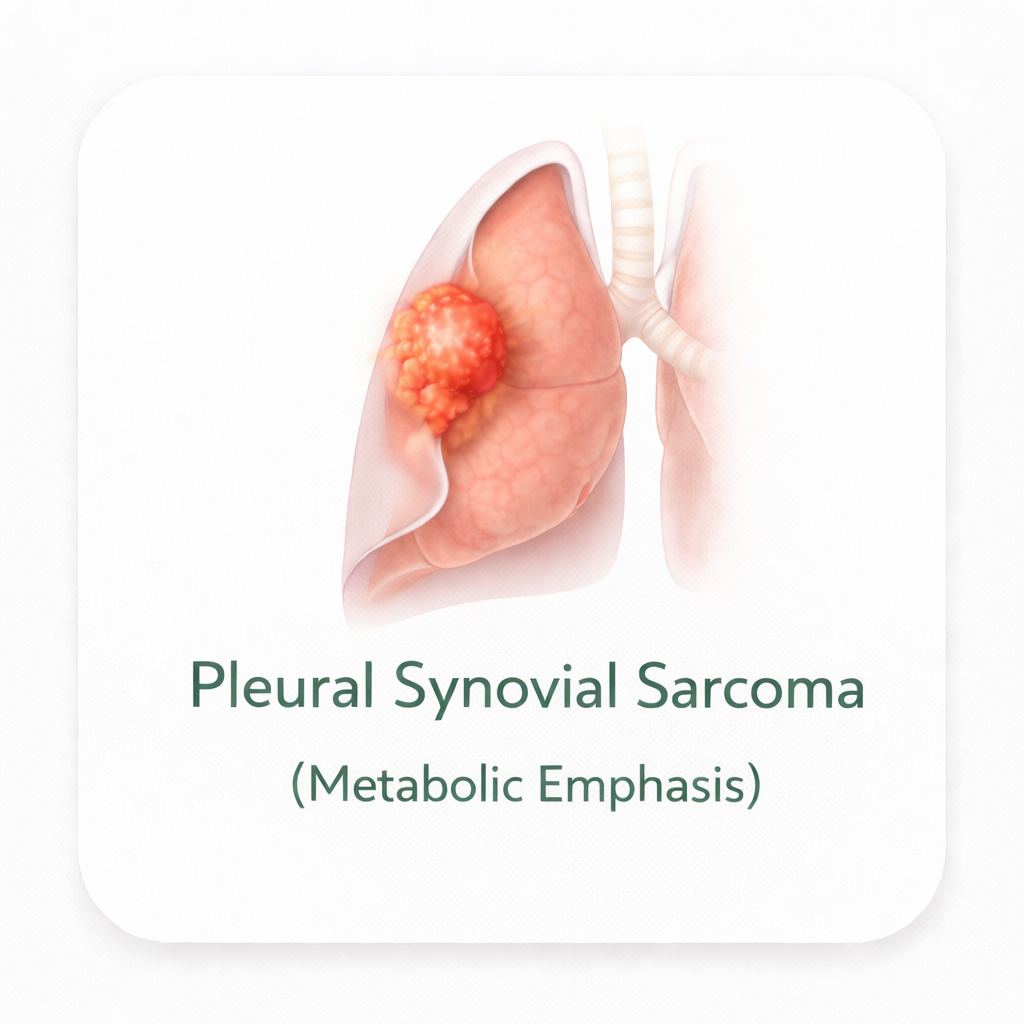
Pleural Synovial Sarcoma (Metabolic Emphasis)
Main Grouping
Respiratory
Organ System
Pleura (lung lining)
Cell Origin
Mesenchymal (synovial-like) cells
Pathways Affected
Pleural synovial sarcoma involves a pathway landscape entirely driven by the SS18-SSX fusion protein through: the WNT/beta-catenin/FZD10 pathway (epigenetically derepressed by SS18-SSX — the most consistently activated signaling pathway in synovial sarcoma); the SS18-SSX/TLE1/ATF2/HDAC/EZH2/PRC1.1 epigenetic reprogramming axis; the CREB/SS18-SSX kinase activation pathway; PI3K/AKT/mTOR survival signaling; the Warburg glycolytic metabolic reprogramming (c-MYC/GLUT1/HK2 from WNT/c-MYC activation); and the SS18-SSX/SMARCB1/BAF complex disruption creating genome-wide epigenetic dysregulation.
The SS18-SSX/WNT/beta-catenin/FZD10 pathway is the most consistently activated signaling pathway in synovial sarcoma and the most therapeutically relevant non-epigenetic target: SS18-SSX expression creates constitutive epigenetic activation of FZD10 (frizzled receptor 10 — a Wnt ligand receptor) through histone mark redistribution at the FZD10 locus — SS18-SSX derepresses FZD10 specifically at the NCC stage of cell differentiation confirming FZD10 as a stage-specific SS18-SSX target; FZD10 overexpression drives constitutive WNT ligand-FZD10 receptor signaling — activating the intracellular WNT cascade through Dishevelled (DVL) → GSK3-beta inhibition → beta-catenin stabilization (preventing beta-catenin phosphorylation-dependent proteasomal degradation) → nuclear beta-catenin/TCF/LEF transcriptional activation; constitutive nuclear beta-catenin drives transcription of c-MYC, cyclin D1 (CCND1), GLUT1 (SLC2A1), survivin (BIRC5), CD44, and HK2 — creating the metabolic Warburg glycolysis reprogramming and proliferative survival programs in synovial sarcoma; beta-catenin stabilization confirmed to dramatically accelerate SS18-SSX2-driven synovial sarcomagenesis in mouse models (PMC4673197); quercetin was confirmed to induce beta-catenin degradation, reduce cyclin D1, reduce c-MYC, and induce PARP cleavage in cancer cell models (PMC6651418) — directly targeting the WNT/beta-catenin axis active in SS18-SSX synovial sarcoma; ursolic acid was confirmed to reduce c-Myc (a beta-catenin transcriptional target) and induce apoptosis in SW982 human synovial sarcoma cells (PMC4878803).
The SS18-SSX/CREB/cyclin D1 pathway is the second most mechanistically defined oncogenic pathway in synovial sarcoma: SS18-SSX drives CREB (cAMP response element-binding protein) transcriptional activation confirmed by phospho-kinase array screening in synovial sarcoma tissue and cell lines; pCREB and its downstream targets (Rb, cyclin D1, PCNA, BCL-xL, BCL-2) are overexpressed in synovial sarcoma confirmed by IHC in large cohort; CREB phosphorylation in synovial sarcoma is mediated by AKT kinase (PI3K/AKT → CREB Ser133 phosphorylation) — CREB activation drives cyclin D1, BCL-xL, BCL-2, and PCNA expression maintaining the proliferative and anti-apoptotic state; curcumin inhibits CREB phosphorylation in cancer cell models targeting the SS18-SSX/CREB/cyclin D1 axis; quercetin inhibits AKT-mediated CREB activation confirmed in cancer cell models (PMC6651418) — AKT/CREB inhibition reducing cyclin D1, BCL-xL, and BCL-2 in synovial sarcoma.
The SS18-SSX/PI3K/AKT/mTOR metabolic pathway drives the Warburg-like glycolytic metabolism in synovial sarcoma: PI3K/AKT activation in synovial sarcoma occurs through secondary PIK3CA mutations in a subset, through IGF-1R signaling (IGF-1R is overexpressed in synovial sarcoma), and through SS18-SSX/TLE1 HDAC-mediated repression of PTEN (creating PTEN silencing and constitutive PI3K/AKT); mTORC1 activation downstream of AKT drives HIF-1alpha-independent and HIF-1alpha-dependent aerobic glycolysis (GLUT1, LDHA, HK2 upregulation); ursolic acid was confirmed to down-regulate AKT signaling and induce intrinsic apoptosis in SW982 synovial sarcoma cells confirmed (PMC4878803) — directly targeting the PI3K/AKT/mTOR metabolic axis in pleural synovial sarcoma; curcumin inhibits PI3K/AKT/mTOR in sarcoma cell models.
Description
Primary pleural synovial sarcoma (PPSS) is an exceptionally rare soft tissue malignancy arising directly from the pleural cavity or thoracic wall, representing a thoracic localization of synovial sarcoma — the most common non-rhabdomyosarcomatous soft tissue sarcoma in adolescents and young adults. All synovial sarcomas represent approximately 5 to 10 percent of all soft tissue sarcomas, with the primary pleural variant representing approximately 0.2 to 0.3 percent of all synovial sarcomas. The overall incidence of synovial sarcoma is approximately 2.75 per million population per year in the United States — approximately 900 to 1,100 new US cases annually with pleural cases numbering fewer than 50 to 100 per year. Synovial sarcoma predominantly affects adolescents and young adults — median age at diagnosis 26-35 years — with a slight male predominance.
Pleural synovial sarcoma presents most commonly with dyspnea, chest pain, and large hemorrhagic pleural effusion. On CT imaging, PPSS characteristically appears as a large heterogeneous pleural-based or chest wall mass, often with central necrosis and hemorrhage — reflecting the metabolic demands and high proliferative rate of SS18-SSX-driven tumor growth. The median tumor size at diagnosis for primary pleural synovial sarcoma is approximately 9-15 cm — substantially larger than most intrathoracic tumors — reflecting the slow and often asymptomatic early growth before the pleural space limits expansion. In contrast to primary pulmonary parenchymal tumors, PPSS arises at the pleural surface and invades chest wall, diaphragm, and pericardium early in its natural history.
The metabolic emphasis of this template reflects the unique metabolic reprogramming created by the SS18-SSX fusion protein and its downstream effectors. SS18-SSX drives a Warburg-like glycolytic metabolism through: constitutive WNT/beta-catenin activation (FZD10 epigenetic derepression and CTNNB1/beta-catenin stabilization) driving c-MYC/GLUT1/HK2 glycolytic gene transcription; SS18-SSX/CREB axis activation driving HIF-1alpha-independent aerobic glycolysis; mTOR/PI3K/AKT pathway activation (through PI3K pathway secondary mutations and IGF-1R signaling) driving mTORC1-dependent metabolic reprogramming; and SS18-SSX/TLE1/HDAC/EZH2 epigenetic repression creating metabolic gene landscape alterations.
Published laboratory research confirms ursolic acid — a plant pentacyclic triterpene found in apple skin, rosemary, basil, and thyme — reduced cell viability of SW982 human synovial sarcoma cells dose-dependently confirmed; apoptosis induced through AKT signaling down-regulation confirmed; c-Myc (a WNT/beta-catenin target) reduced confirmed (PMC4878803) — directly targeting the WNT/beta-catenin/c-MYC axis and PI3K/AKT survival pathway fundamental to SS18-SSX-driven synovial sarcoma.
Plant-Based Description
Whole-food plant-based dietary patterns provide phytochemicals with confirmed activity in synovial sarcoma cell lines directly applicable to pleural synovial sarcoma. Ursolic acid from apple skin, rosemary, basil, and thyme was confirmed to reduce cell viability of SW982 human synovial sarcoma cells dose-dependently by MTT assay (IC50 9.03 µM); induce intrinsic apoptosis through AKT signaling down-regulation confirmed; reduce c-Myc protein (the primary WNT/beta-catenin transcriptional target in SS18-SSX synovial sarcoma) confirmed; reduce p21 confirmed (PMC4878803) — directly targeting the WNT/beta-catenin/c-MYC axis and PI3K/AKT pathway fundamental to SS18-SSX-driven pleural synovial sarcoma; quercetin from onions and kale confirmed to induce beta-catenin degradation, reduce cyclin D1, c-MYC, PARP cleavage, and G1 arrest in cancer cell models (PMC6651418) — directly targeting the constitutive WNT/beta-catenin transcriptional program activated by SS18-SSX/FZD10 derepression in synovial sarcoma; curcumin inhibits EZH2/PRC2 targeting the SS18-SSX/EZH2/H3K27me3 epigenetic repression axis; EGCG inhibits EZH2, HDAC, and PI3K/AKT targeting the multiple SS18-SSX-dependent epigenetic and signaling dependencies.
Plant Chemistry Detail
Ursolic acid — a naturally occurring pentacyclic triterpenoid abundant in apple skin (Malus domestica), rosemary (Rosmarinus officinalis), basil (Ocimum basilicum), thyme (Thymus vulgaris), and other plant foods — has confirmed direct anti-synovial sarcoma activity in a published study (PMC4878803 — "Down-Regulation of AKT Signalling by Ursolic Acid Induces Intrinsic Apoptosis and Sensitization to Doxorubicin in Soft Tissue Sarcoma") using SW982 human synovial sarcoma cells (ATCC HTB-93). In this confirmed study: ursolic acid reduced cell viability of SW982 synovial sarcoma cells dose-dependently over 24 hours confirmed by MTT assay — IC50 9.03 ± 0.04 µM with 86% maximal inhibition at 50 µM confirmed; intrinsic apoptosis induced through down-regulation of AKT signaling confirmed; c-Myc protein expression reduced confirmed — c-Myc is the primary WNT/beta-catenin transcriptional target gene product in SS18-SSX synovial sarcoma (constitutively activated by FZD10 epigenetic derepression → beta-catenin stabilization → TCF/LEF/c-MYC transcription); p21 reduced confirmed; the study confirmed anchorage-dependent proliferation of SW982 synovial sarcoma cells — reflecting the SS18-SSX-dependent FAK/integrin-mediated survival signaling in synovial sarcoma.
Quercetin from onions was confirmed to modulate WNT/beta-catenin signaling in a published study (PMC6651418 — "The Anti-Cancer Effect of Quercetin: Molecular Implications in Cancer Metabolism"): quercetin induced beta-catenin degradation confirmed; reduced cyclin D1 expression confirmed — cyclin D1 is a direct TCF/LEF/beta-catenin target gene constitutively expressed in SS18-SSX-driven synovial sarcoma through FZD10/WNT activation; reduced c-MYC expression confirmed; induced PARP cleavage confirming apoptosis; inhibited mTOR phosphorylation confirmed; reduced p-AKT(Ser473) confirmed; induced G1 cell cycle arrest confirmed; promoted GSK3-beta dephosphorylation/activation confirmed — GSK3-beta activation is the direct mechanism for beta-catenin phosphorylation and proteasomal degradation, directly counteracting the SS18-SSX-mediated beta-catenin stabilization in synovial sarcoma; reduced c-FLIP (CFLAR) expression confirmed; reduced STAT3(Tyr705/Ser727) phosphorylation confirmed. Curcumin from turmeric inhibits EZH2/PRC2 H3K27me3 — directly targeting the SS18-SSX/EZH2/PRC2 epigenetic repression axis that silences tumor suppressor gene programs; curcumin inhibits HDAC targeting the SS18-SSX/TLE1/HDAC corepressor complex at ATF2 target loci; curcumin inhibits PI3K/AKT and CREB targeting AKT-mediated CREB Ser133 phosphorylation that drives cyclin D1, BCL-xL, and BCL-2 expression in synovial sarcoma. EGCG from green tea inhibits EZH2, HDAC, and PI3K/AKT targeting multiple SS18-SSX epigenetic dependencies and the metabolic AKT/mTOR axis.
Nutritional Focus
Nutritional focus in pleural synovial sarcoma targets the SS18-SSX fusion-driven pathways — WNT/beta-catenin/FZD10 (~100% through SS18-SSX epigenetic derepression), PI3K/AKT/mTOR/c-MYC metabolic axis, and SS18-SSX/EZH2/HDAC epigenetic reprogramming. Ursolic acid from apple skin, rosemary, basil, and thyme confirmed to reduce cell viability of SW982 human synovial sarcoma cells dose-dependently; IC50 9.03 µM confirmed; AKT down-regulation confirmed; apoptosis induced confirmed; c-Myc (the primary WNT/beta-catenin transcriptional target) reduced confirmed (PMC4878803) — directly targeting the AKT/c-MYC/WNT survival metabolic axis in SS18-SSX pleural synovial sarcoma; quercetin from onions confirmed to degrade beta-catenin, reduce cyclin D1 and c-MYC, induce PARP cleavage, inhibit mTOR/p-AKT, promote GSK3-beta dephosphorylation/activation, induce G1 arrest, reduce c-FLIP and STAT3 phosphorylation in cancer cell models (PMC6651418) — directly targeting the SS18-SSX/WNT/FZD10/beta-catenin/c-MYC axis in pleural synovial sarcoma; curcumin from turmeric inhibiting EZH2/PRC2 H3K27me3 in sarcoma cell models targeting the SS18-SSX/EZH2 epigenetic repression axis; curcumin inhibiting HDAC targeting the SS18-SSX/TLE1/HDAC corepressor complex; curcumin inhibiting PI3K/AKT and CREB targeting AKT-driven CREB activation driving cyclin D1/BCL-xL/BCL-2/PCNA in synovial sarcoma (PMC9187574); EGCG from green tea inhibiting EZH2, HDAC, and PI3K/AKT targeting the SS18-SSX epigenetic dependencies; sulforaphane activating Nrf2/ARE and inhibiting HDAC; dietary fiber producing butyrate/SCFAs inhibiting HDAC targeting the SS18-SSX/TLE1/HDAC epigenetic corepressor complex at ATF2 target loci.
Research Notes
Pleural synovial sarcoma epidemiology: extremely rare — PPSS ~0.2-0.3% of all synovial sarcomas; all synovial sarcomas ~2.75/million/year US (~900-1,100 new US cases/year); PPSS ~95%), BCL-2+, CD99 variable, CK variable (biphasic), EMA variable. Molecular: SS18-SSX fusion t(X;18)(p11.2;q11.2) in ~100%; confirmed by FISH, RT-PCR, or RNA sequencing; SS18-SSX1 ~65%, SS18-SSX2 ~35%, SS18-SSX4 rare; SS18-SSX sufficient to drive tumor in mouse models; no additional recurrent secondary mutations; rare secondary: PTEN, CTNNB1, APC, TP53 mutations in small subset; SS18 = BAF complex core subunit; SSX = PRC transcriptional repressor; fusion: displaces wild-type SS18; ejects SMARCB1/BAF47 from BAF; recruits TLE1 to ATF2 loci (TLE1-HDAC-PRC2); activates KDM2B/PRC1.1 at CpG islands; derepresses FZD10 → constitutive WNT/beta-catenin/c-MYC/cyclin D1/GLUT1/HK2; drives CREB/AKT axis; Warburg glycolysis; SS18-SSX2 + stabilized beta-catenin = near complete tumor penetrance 3 months in mouse (PMC4673197). Ursolic acid SW982 human synovial sarcoma (PMC4878803): cell viability inhibited MTT IC50 9.03 µM; AKT down-regulation confirmed; intrinsic apoptosis confirmed; c-Myc reduced; p21 reduced; anchorage-dependent SW982 confirmed. Quercetin WNT/beta-catenin in cancer (PMC6651418): beta-catenin degraded; cyclin D1 reduced; c-MYC reduced; PARP cleavage confirmed; G1 arrest; mTOR/pAKT inhibited; GSK3-beta dephosphorylated/activated; c-FLIP reduced; STAT3 inhibited.
Notes Visibility
show
Key Foods
Turmeric,Broccoli,Kale,Spinach,Brussels Sprouts,Cauliflower,Garlic,Yellow Onion,Carrot,Tomato,Beetroot,Cabbage,Blueberry,Pomegranate,Grape,Raspberry,Apple,Orange,Lemon,Soybeans,Edamame,Green Lentils,Black Beans,Chickpeas,Brown Rice,Quinoa,Oats,Wild Rice,Black Rice,Walnut,Almond,Brazil Nut,Flaxseed,Pumpkin Seeds,Chia Seeds,Sesame Seeds,Hemp Seeds,Shiitake,Maitake,Lions Mane,Cremini,Portobello,Green Tea,Ginger,Black Pepper,Garlic Powder,Parsley,Rosemary,Oregano, Celery, Leek,Avocado,Artichoke,Radish,Tangerine, Red Onion
Linked Nutrients
vitamin-c,vitamin-e,vitamin-a,vitamin-b9,vitamin-b6,selenium,zinc,magnesium,calcium,potassium,iron,quercetin,curcumin,egcg,sulforaphane,beta-carotene,anthocyanins,dietary-fiber,l-theanine,allicin
Last Updated
2025-10-13 11:03:42

