
ID
12
Cancer Name
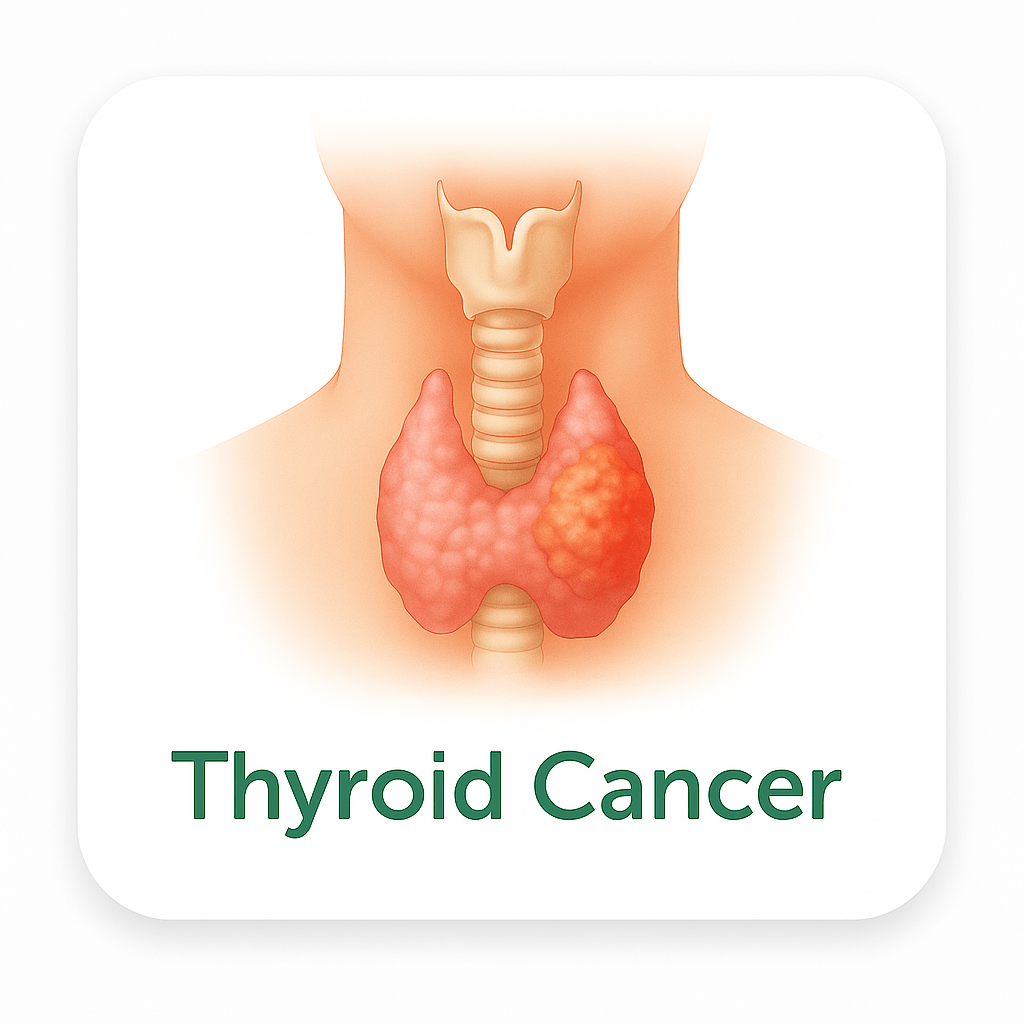
Thyroid Cancer
Main Grouping
Endocrine
Organ System
Thyroid gland,endocrine system,neck
Cell Origin
Follicular epithelium (papillary/follicular)
Pathways Affected
Thyroid cancer involves two primary and molecularly distinct carcinogenic pathways operating through follicular cell-derived tumors, along with multiple downstream signaling networks. The MAPK/ERK pathway is the dominant driver of PTC, activated primarily by BRAF V600E mutation, which constitutively activates the RAF-MEK-ERK signaling cascade, promoting thyroid follicular cell proliferation, survival, and suppression of thyroid-specific differentiation markers including sodium-iodide symporter and thyroglobulin. RET/PTC gene fusions and RAS mutations also activate MAPK/ERK signaling in PTC. The PI3K/AKT pathway is the dominant driver of FTC, activated through RAS mutations, PTEN loss, and PIK3CA mutations, promoting cell survival, protein synthesis via mTOR, and suppression of apoptosis. As genetic alterations accumulate in both pathways, differentiated thyroid cancers can progress to poorly differentiated and anaplastic forms.
The p53 tumor suppressor pathway is inactivated by TP53 mutation in poorly differentiated and anaplastic thyroid carcinoma, representing a key event in dedifferentiation and aggressive disease progression alongside TERT promoter mutation. NF-kB signaling drives pro-inflammatory cytokine expression, anti-apoptotic gene regulation, and is suppressed by resveratrol through downregulation of NF-kB/p65 nuclear translocation in thyroid cancer models. The JAK/STAT pathway contributes to immune evasion and tumor cell survival in thyroid cancer. The Wnt/beta-catenin pathway is activated through CTNNB1 mutations particularly in ATC and contributes to tumor stemness and dedifferentiation. The NOTCH signaling pathway is relevant in MTC biology, where resveratrol has been documented to enhance re-differentiation through Notch1 and Notch2 activation in ATC and MTC cell lines. VEGF-mediated angiogenesis signaling supports tumor vascularization across all thyroid cancer subtypes. The apoptosis pathway is dysregulated through BCL-2 family proteins and caspase cascades, and multiple plant phytochemicals including quercetin and resveratrol restore apoptotic signaling in thyroid cancer cell models. Cell cycle checkpoints are disrupted through CDKN2A inactivation and CCND1 amplification in advanced thyroid tumors.
Description
Thyroid cancer is the most common endocrine malignancy, accounting for 3.4 percent of all cancers diagnosed annually, and its global incidence has increased substantially over the past four decades. Four primary histological subtypes are recognized: papillary thyroid carcinoma (PTC), follicular thyroid carcinoma (FTC), medullary thyroid carcinoma (MTC), and anaplastic thyroid carcinoma (ATC). PTC accounts for 85 to 90 percent of all thyroid cancer cases and arises from follicular epithelial cells. FTC arises from follicular epithelial cells and accounts for approximately 10 percent of cases. MTC arises from parafollicular C-cells that produce calcitonin and accounts for approximately 5 percent of cases. ATC is rare but highly aggressive and arises from dedifferentiation of follicular cell-derived carcinomas.
The molecular landscape of thyroid cancer is well characterized. In PTC, the BRAF V600E point mutation is the most common driver mutation, present in approximately 75 percent of PTC patients, with approximately 67 percent being the V600E variant, which correlates with advanced clinical staging and increased lymph node metastasis. PTC has been reclassified into two molecular subtypes: BRAF-like, associated with conventional PTC and higher risk, and RAS-like, associated with follicular-variant PTC and lower risk. RET/PTC gene fusions are found in 10 to 30 percent of PTC cases. NTRK1 and NTRK3 fusions are also documented. FTC is primarily characterized by RAS mutations and activation of the PI3K/AKT pathway through PTEN loss and PIK3CA mutations. Progression from differentiated thyroid cancer to poorly differentiated and anaplastic forms requires additional oncogenic alterations including TP53 mutation and TERT promoter mutation, with both pathways converging on anaplastic disease. MTC is driven by RET proto-oncogene mutations, both germline in hereditary cases and somatic in sporadic cases.
Ionizing radiation exposure, particularly in childhood, is the most established environmental risk factor for PTC. Iodine deficiency is associated with elevated risk of follicular thyroid cancer in endemic goiter regions. Female sex and increasing age are major demographic risk factors, with thyroid cancer occurring three to four times more frequently in women than men. A pooled analysis of international case-control studies found that cruciferous vegetable intake was not positively associated with thyroid cancer risk, with combined odds ratios of 0.87 for moderate and 0.94 for high intake. Research on plant phytochemicals including quercetin, kaempferol, apigenin, genistein, EGCG, resveratrol, curcumin, and indole-3-carbinol documents activity against thyroid cancer cell lines across multiple molecular pathways. Genistein, resveratrol, and quercetin have been shown to suppress CD97, a differentiation marker in thyroid carcinoma induced by EGF, in documented cell line studies.
Plant-Based Description
Whole-food plant-based dietary patterns provide nutrients and phytochemicals studied in relation to oxidative stress, inflammation, MAPK/ERK and PI3K/AKT pathway modulation, apoptosis induction, and thyroid cell differentiation relevant to thyroid cancer biology. Fruits provide vitamin C, polyphenols, flavonoids, anthocyanins, resveratrol, and ellagic acid. Vegetables provide carotenoids, glucosinolates, indole-3-carbinol, quercetin, kaempferol, and fiber. Legumes provide isoflavones including genistein and daidzein, fiber, and plant protein. Whole grains provide fiber and fermentable carbohydrates supporting gut microbiome diversity. Nuts and seeds provide vitamin E, selenium, and plant-sourced ALA omega-3 fatty acids. Mushrooms provide beta-glucans and ergothioneine with immune-modulatory properties. Herbs and spices including green tea, turmeric, garlic, ginger, and rosemary provide concentrated phytochemicals studied against BRAF-driven MAPK, PI3K/AKT, NF-kB, Notch, and apoptosis pathway biology in thyroid cancer cell models.
Plant Chemistry Detail
Quercetin is a flavonol found in yellow onions, apples, kale, and broccoli that inhibits PI3K/AKT, MAPK/ERK, and NF-kB signaling, promotes apoptosis through caspase activation, and along with genistein and resveratrol has been documented to suppress CD97, a differentiation marker in thyroid carcinoma induced by EGF. Kaempferol, found in kale, spinach, and broccoli, modulates JAK/STAT, MAPK/ERK, PI3K/AKT, and NF-kB pathways in thyroid and other cancer models and acts as a chemosensitizer to restore apoptosis in resistant tumor cells. EGCG from green tea inhibits EGFR signaling, PI3K/AKT, and MAPK/ERK pathways and demonstrates synergy with receptor tyrosine kinase inhibitors in cancer cell studies.
Resveratrol, found in grapes, berries, and peanuts, has documented thyroid cancer-specific activity including enhancement of re-differentiation of ATC cell lines through Notch1 signaling pathway activation, induction of apoptosis in MTC cells through Notch2 signaling, induction of p53 through Ras-MAPK signal transduction in PTC and FTC cell lines, and downregulation of NF-kB/p65 nuclear translocation and COX-2 expression in thyroid tissue models. Genistein and daidzein from soybeans and edamame modulate PI3K/AKT signaling and estrogen receptor activity relevant to thyroid tumor biology and suppress CD97 thyroid differentiation markers. Curcumin from turmeric inhibits NF-kB, PI3K/AKT, and Wnt/beta-catenin pathways while inducing apoptosis in thyroid cancer cell models. Indole-3-carbinol and diindolylmethane from cruciferous vegetables modulate estrogen metabolism and cell cycle progression relevant to thyroid carcinogenesis. Ellagic acid from pomegranate and berries inhibits PI3K/AKT and Wnt/beta-catenin pathways in thyroid cancer models. Beta-glucans from shiitake and maitake mushrooms modulate innate immune signaling in the thyroid tumor microenvironment.
Nutritional Focus
Nutritional focus in thyroid cancer research includes quercetin and kaempferol from onions, kale, apples, and broccoli targeting MAPK/ERK, PI3K/AKT, and NF-kB pathways; EGCG from green tea inhibiting EGFR and MAPK/ERK signaling; resveratrol from grapes and berries with documented thyroid-specific activity including re-differentiation of ATC cell lines through Notch1 signaling and NF-kB/p65 suppression; genistein and daidzein from soy foods modulating PI3K/AKT signaling and CD97 thyroid differentiation markers; curcumin from turmeric inhibiting NF-kB and Wnt/beta-catenin pathways; indole-3-carbinol from cruciferous vegetables; selenium from Brazil nuts and pumpkin seeds supporting selenoprotein antioxidant defense in thyroid tissue; and tyrosine from plant foods as the direct amino acid precursor for thyroid hormone biosynthesis.
Research Notes
A pooled analysis of 10 international case-control studies (Bosetti et al., European Journal of Cancer Prevention, 2002) found combined odds ratios of 0.87 for moderate and 0.94 for high cruciferous vegetable intake versus lowest intake for thyroid cancer risk, with no positive association found between cruciferous vegetable consumption and thyroid cancer risk. Molecular pathway review (PMC3791171) documented that BRAF V600E mutation activates MAPK signaling to drive PTC development from follicular cells, while PI3K/AKT pathway activation through RAS, PTEN, and PIK3CA mutations drives FTC development, with both pathways converging on anaplastic disease through TP53 and TERT promoter mutations.
Kim et al. (PMC6356543, Antitumor Effect of Various Phytochemicals on Diverse Types of Thyroid Cancers) documented that resveratrol enhanced re-differentiation of ATC cell lines through Notch1 signaling, induced apoptosis in MTC cells through Notch2 signaling, induced p53 through Ras-MAPK signal transduction in PTC and FTC cell lines, and downregulated NF-kB/p65 nuclear translocation and COX-2 expression in thyroid models. Nardi et al. (PMC11050626, Promising Approaches in Plant-Based Therapies for Thyroid Cancer, 2024) reviewed phytochemicals including quercetin, kaempferol, apigenin, genistein, daidzein, EGCG, resveratrol, ellagic acid, curcumin, and indole-3-carbinol for thyroid cancer treatment, documenting that genistein, resveratrol, and quercetin suppress CD97 thyroid differentiation markers induced by EGF in thyroid carcinoma cell lines. Natural compounds targeting MAPK, PI3K/AKT, and JAK/STAT signaling in papillary thyroid cancer (PMC12607387) documented BRAF V600E as present in approximately 75 percent of PTC patients with approximately 67 percent being the V600E variant correlating with advanced staging.
Notes Visibility
show
Key Foods
Yellow Onion,Kale,Broccoli,Spinach,Brussels Sprouts,Cauliflower,Garlic,Carrot,Sweet Potato,Tomato,Apple,Blueberry,Strawberry,Grape,Pomegranate,Orange,Raspberry,Mango,Soybeans,Edamame,Green Lentils,Black Beans,Chickpeas,Brown Rice,Quinoa,Oats,Wild Rice,Rye Berries,Sorghum,Walnut,Almond,Brazil Nut,Pumpkin Seeds,Flaxseed,Chia Seeds,Sesame Seeds,Hemp Seeds,Shiitake,Maitake,Cremini,Portobello,Oyster Mushroom,Green Tea,Turmeric,Garlic Powder,Ginger,Black Pepper,Parsley,Rosemary, Leek,Avocado,Artichoke,Radish,Tangerine, Red Onion
Linked Nutrients
vitamin-a,vitamin-c,vitamin-e,vitamin-d,vitamin-b6,folate,vitamin-k,selenium,zinc,magnesium,calcium,potassium,iron,quercetin,kaempferol,egcg,resveratrol,curcumin,genistein,indole-3-carbinol,ellagic-acid,anthocyanins,beta-glucans,plant-ala-omega3,dietary-fiber
Last Updated
2025-10-13 09:16:53

