
ID
18
Cancer Name
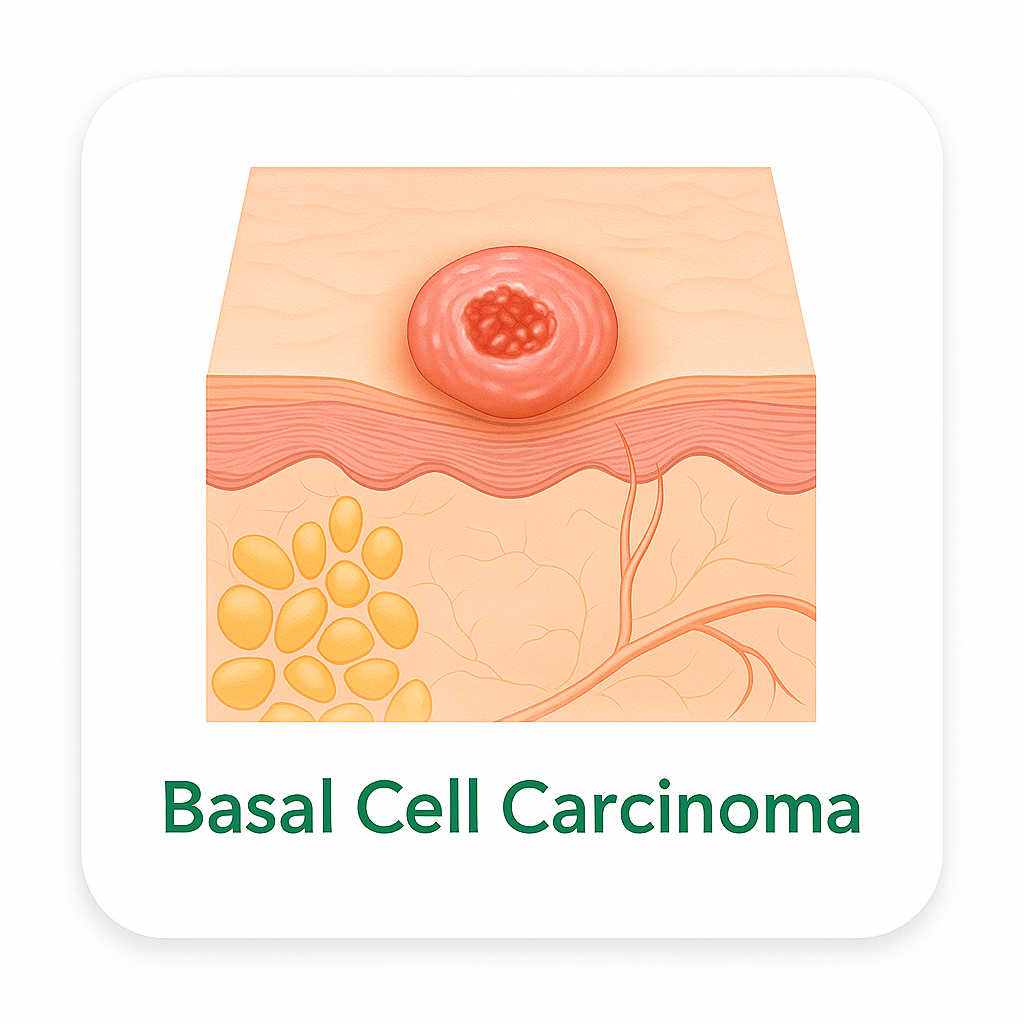
Basal Cell Carcinoma (Skin, Non-Melanoma)
Main Grouping
Integumentary
Organ System
Skin,epidermis,hair follicle unit
Cell Origin
Basal keratinocytes
Pathways Affected
BCC is distinguished from all other human cancers by its absolute dependence on aberrant Hedgehog signaling as the primary molecular driver of carcinogenesis. The Hedgehog/PTCH1/SMO/GLI pathway is constitutively activated in the overwhelming majority of BCCs through PTCH1 loss-of-function mutations in 70 to 90 percent of cases and SMO gain-of-function mutations in 10 to 20 percent of cases; downstream GLI1, GLI2, and GLI3 transcription factor activation drives transcription of proliferative, anti-apoptotic, and angiogenic target genes including CCND1, BCL-2, VEGF, FOXM1, and SNAI1. SUFU loss-of-function mutations also constitutively activate GLI factors by releasing them from cytoplasmic sequestration.
The p53 tumor suppressor pathway is inactivated by UV-induced TP53 mutations in 44 to 65 percent of BCCs, disrupting DNA damage response, cell cycle arrest, and apoptosis after UV-induced DNA adduct formation; TP53 mutations are involved in both initiation and tumor progression in BCC. The Hippo-YAP tumor suppressor pathway is disrupted through PTPN14 and LATS1 mutations, with YAP activation cooperating with GLI signaling in BCC; the Hippo-YAP pathway normally phosphorylates and inactivates YAP, preventing nuclear GLI activation and tumor growth. The NOTCH signaling pathway is mutated in approximately 43.8 percent of BCCs, particularly in superficial subtype, and plays a role in keratinocyte differentiation and skin carcinogenesis. TERT promoter mutations in approximately 57.9 percent of BCCs activate telomerase, enabling replicative immortality. MYCN amplification drives proliferative transcriptional programming. Cell cycle checkpoints are disrupted through CDKN2A/p16 loss.
The UV DNA repair pathway, specifically nucleotide excision repair (NER), is critical in removing cyclobutane pyrimidine dimers and 6-4 photoproducts generated by UV radiation; deficient NER drives accumulation of BCC-initiating mutations. The Nrf2 antioxidant response pathway regulates antioxidant enzymes in keratinocytes against UV-induced reactive oxygen species. The NF-kB signaling pathway contributes to pro-inflammatory UV-induced cytokine production and anti-apoptotic signaling in keratinocytes. The VEGF/angiogenesis pathway is a downstream GLI transcriptional target supporting BCC vascular supply. The apoptosis pathway is inhibited by BCL-2 family protein upregulation downstream of GLI activation, with BCL-2 overexpression documented as a consistent feature of BCC.
Description
Basal cell carcinoma (BCC) is the most common human cancer and the most common malignant skin tumor, accounting for approximately 80 to 90 percent of all non-melanoma skin cancers (NMSC) in Caucasians. Global incidence has reached approximately 2.75 million cases worldwide and continues to increase annually by 3 to 10 percent in many countries. BCC rarely metastasizes or causes death but can result in extensive morbidity through local invasion and tissue destruction, particularly when diagnosed at advanced stages.
BCC arises from basal keratinocytes and hair follicle stem cells of the epidermis. Chronic ultraviolet (UV) radiation exposure is the dominant environmental risk factor, driving the generation of UV-signature mutations in the PTCH1 and TP53 tumor suppressor genes. PTCH1 is the major tumor suppressor component of the Hedgehog (Hh) signaling pathway. Loss-of-function mutations in PTCH1 are found in 70 to 90 percent of BCCs and in 30 to 60 percent of cases by more conservative estimates. Activating mutations in the SMO oncogene are found in 10 to 20 percent of BCCs. In the normal state, PTCH1 constitutively represses SMO, blocking Hh signal transduction. When Hh ligands (Sonic hedgehog, Indian hedgehog, or Desert hedgehog) bind to PTCH1, SMO is de-repressed, translocates to the primary cilium, and activates GLI family transcription factors (GLI1, GLI2, and GLI3) through a cascade involving the SUFU suppressor protein. Loss-of-function mutations in PTCH1 or gain-of-function mutations in SMO lead to constitutive GLI activation in the absence of Hh ligands, driving transcription of genes regulating cell proliferation, cell cycle regulation, apoptosis, angiogenesis, and self-renewal.
TP53 mutations are the second most prevalent oncogenic event in BCC, found in 44 to 65 percent of sporadic BCCs, generated by UV radiation-induced C to T transitions and CC to TT tandem mutations at dipyrimidine sites. NOTCH1 mutations are found in approximately 43.8 percent of BCCs. TERT promoter non-coding mutations enabling telomere reactivation are found in approximately 57.9 percent. MYCN amplification or mutation is found in approximately 30 percent of BCCs. PTPN14 and LATS1 mutations, both effectors of the Hippo-YAP tumor suppressor pathway, are identified as new BCC-associated genes. CDKN2A alterations affecting p16 cell cycle regulation are also documented.
UV radiation exposure induces both direct DNA damage through cyclobutane pyrimidine dimer formation requiring nucleotide excision repair (NER) and indirect oxidative DNA damage through reactive oxygen species generation. BCC incidence correlates strongly with cumulative UV exposure, fair skin phenotype, red hair associated with MC1R variants, and immunosuppression. A completed Phase II/III randomized clinical trial (NCT02029352, Maastricht University Medical Center) evaluated sinecatechins (EGCG from green tea) 10% ointment for superficial BCC, based on epidemiological, cell culture, and animal data supporting anti-BCC carcinogenesis effects of green tea catechins. EGCG has been documented to have cytotoxic effects on skin cancer cells, to inhibit cell growth, and to induce apoptosis in BCC-relevant cell models.
Plant-Based Description
Whole-food plant-based dietary patterns provide nutrients and phytochemicals studied in relation to UV-induced DNA damage, oxidative stress, Nrf2-mediated antioxidant defense, and BCC-relevant molecular pathways. Research on phytochemicals for skin cancer chemoprevention documents anti-proliferative, anti-oxidant, and anti-inflammatory properties of EGCG, resveratrol, curcumin, apigenin, sulforaphane, lycopene, beta-carotene, and quercetin in BCC and non-melanoma skin cancer cell and animal models. A completed Phase II/III randomized trial evaluated sinecatechins (EGCG) for superficial BCC. Fruits provide vitamin C, carotenoids, anthocyanins, and polyphenols. Vegetables provide carotenoids, glucosinolates, and sulforaphane. Legumes and whole grains provide fiber and fermentable carbohydrates. Nuts and seeds provide vitamin E and selenium for skin antioxidant defense. Mushrooms provide beta-glucans. Herbs and spices including green tea, turmeric, rosemary, and garlic provide concentrated phytochemicals studied in BCC and UV carcinogenesis research.
Plant Chemistry Detail
EGCG from green tea is the most studied dietary phytochemical in BCC and non-melanoma skin cancer chemoprevention research. Cell culture studies demonstrate EGCG has cytotoxic effects on BCC and skin cancer cells, inhibits cell growth, and induces apoptosis. EGCG blocks UV-induced nitric oxide and hydrogen peroxide in both the epidermis and dermis, neutralizes free radicals generated by UV exposure, and has been found in studies to repair DNA in sun-damaged skin. A completed Phase II/III randomized clinical trial (NCT02029352) evaluated sinecatechins 10% ointment (a purified catechin preparation from green tea) for superficial BCC based on epidemiological, cell culture, and animal data supporting anti-BCC carcinogenesis activity. Early animal research found green tea constituent oral administration or injection resulted in inhibition or regression of UV-induced skin papillomas.
Beta-carotene and related carotenoids from carrot, sweet potato, kale, spinach, and tomato provide protection against UV radiation-induced free radical damage in skin tissue, with a review in the American Journal of Clinical Nutrition finding that optimal supply of antioxidant micronutrients in the skin increases basal dermal defense against UV irradiation. Resveratrol from grapes and berries has been documented to suppress tumorigenesis and decrease murine epidermal hyperplasia in UV carcinogenesis models, and inhibits GLI transcription factor activity downstream of Hedgehog signaling. Sulforaphane from cruciferous vegetables activates Nrf2/ARE phase II detoxification enzymes in keratinocytes and inhibits UV-induced oxidative DNA damage. Curcumin from turmeric inhibits NF-kB, PI3K/AKT, and UV-induced inflammatory signaling in skin tissue models. Apigenin from parsley and celery inhibits UV-induced cell proliferation and induces apoptosis in skin cancer models. Lycopene from tomatoes is a lipophilic carotenoid with potent antioxidant activity in lipid-rich skin tissue. Beta-glucans from shiitake and maitake mushrooms modulate skin immune surveillance relevant to UV-induced immunosuppression.
Nutritional Focus
Nutritional focus in BCC research includes EGCG from green tea, which is the most studied dietary phytochemical for BCC chemoprevention and was evaluated in a completed Phase II/III randomized clinical trial as sinecatechins 10% ointment for superficial BCC based on documented cell culture and animal data for anti-BCC activity; beta-carotene and carotenoids from carrot, sweet potato, kale, and tomato providing UV-radiation antioxidant defense in skin with documentation that optimal antioxidant micronutrient supply increases basal dermal defense against UV irradiation; vitamin E from nuts and seeds as a major lipid-soluble antioxidant in skin tissue; vitamin C from citrus fruits, kiwi, and red bell pepper supporting collagen biosynthesis and free radical neutralization in skin; lycopene from tomatoes as a lipophilic carotenoid in skin tissue; sulforaphane from cruciferous vegetables activating Nrf2 antioxidant response in keratinocytes; resveratrol from grapes and berries with documented suppression of UV-induced murine epidermal hyperplasia; and selenium from Brazil nuts and pumpkin seeds for glutathione peroxidase activity in skin antioxidant defense.
Research Notes
Molecular genetics review (PMC5713451) documented aberrant Hedgehog pathway activation as the defining molecular driver of BCC pathogenesis, with PTCH1 mutations found in the majority of BCCs carrying UV-signature somatic mutations, and identified PTPN14 and LATS1 as Hippo-YAP pathway effectors and MYCN as additional BCC-associated genes. Molecular alterations study (PMC8225846) of 57 BCC lesions found PTCH1 mutations in 71.9 percent, TP53 mutations in 45.6 percent, NOTCH1 mutations in 43.8 percent, TERT promoter mutations in 57.9 percent, and DPH3 promoter mutations in 49.1 percent, with sporadic BCC exhibiting approximately 65 mutations per megabase, one of the highest somatic mutation rates of all human cancers.
BCC pathogenesis review (PMC5962346) documented that intrafollicular epidermal stem cells, rather than committed progenitor cells, are the cells of origin capable of developing into BCC upon Hedgehog signaling activation. A Phase II/III randomized double-blind placebo-controlled clinical trial (NCT02029352, Maastricht University Medical Center) evaluated sinecatechins (EGCG) 10% ointment for superficial BCC treatment based on epidemiological, cell culture, and animal data supporting anti-BCC carcinogenesis effects. Review of phytochemicals in skin cancer prevention and treatment (PMC5979545) documented multiple studies demonstrating EGCG blocks UV-induced nitric oxide and hydrogen peroxide in epidermis and dermis, and that a study in Journal of Nutrition found green tea polyphenols repair DNA in sun-damaged skin. Review of dietary phytochemicals and skin cancer molecular mechanisms (PMC7600476) covered classes of polyphenols, phenolic acids, flavonoids, carotenoids, and organosulfur compounds active against NMSC including BCC. Review (PMC3741697) documented botanically derived compounds including EGCG, resveratrol, curcumin, proanthocyanidins, and apigenin as studied for NMSC prevention and treatment in preclinical and human trials.
Notes Visibility
show
Key Foods
Broccoli,Kale,Spinach,Brussels Sprouts,Cauliflower,Carrot,Sweet Potato,Tomato,Garlic,Yellow Onion,Apple,Blueberry,Strawberry,Pomegranate,Grape,Raspberry,Watermelon,Orange,Soybeans,Edamame,Green Lentils,Black Beans,Chickpeas,Brown Rice,Quinoa,Oats,Wild Rice,Sorghum,Rye Berries,Walnut,Almond,Brazil Nut,Pumpkin Seeds,Flaxseed,Chia Seeds,Sesame Seeds,Hemp Seeds,Sunflower Seeds,Shiitake,Maitake,Cremini,Portobello,Lions Mane,Green Tea,Turmeric,Parsley,Rosemary,Black Pepper,Garlic Powder,Ginger, Leek,Avocado,Artichoke,Radish,Tangerine, Red Onion
Linked Nutrients
vitamin-c,vitamin-e,vitamin-a,vitamin-d3,vitamin-b9,vitamin-b6,selenium,zinc,magnesium,calcium,potassium,iron,egcg,beta-carotene,lycopene,resveratrol,curcumin,apigenin,sulforaphane,quercetin,anthocyanins,beta-glucans,plant-ala-omega3,dietary-fiber
Last Updated
2025-10-13 09:16:53

