
ID
26
Cancer Name
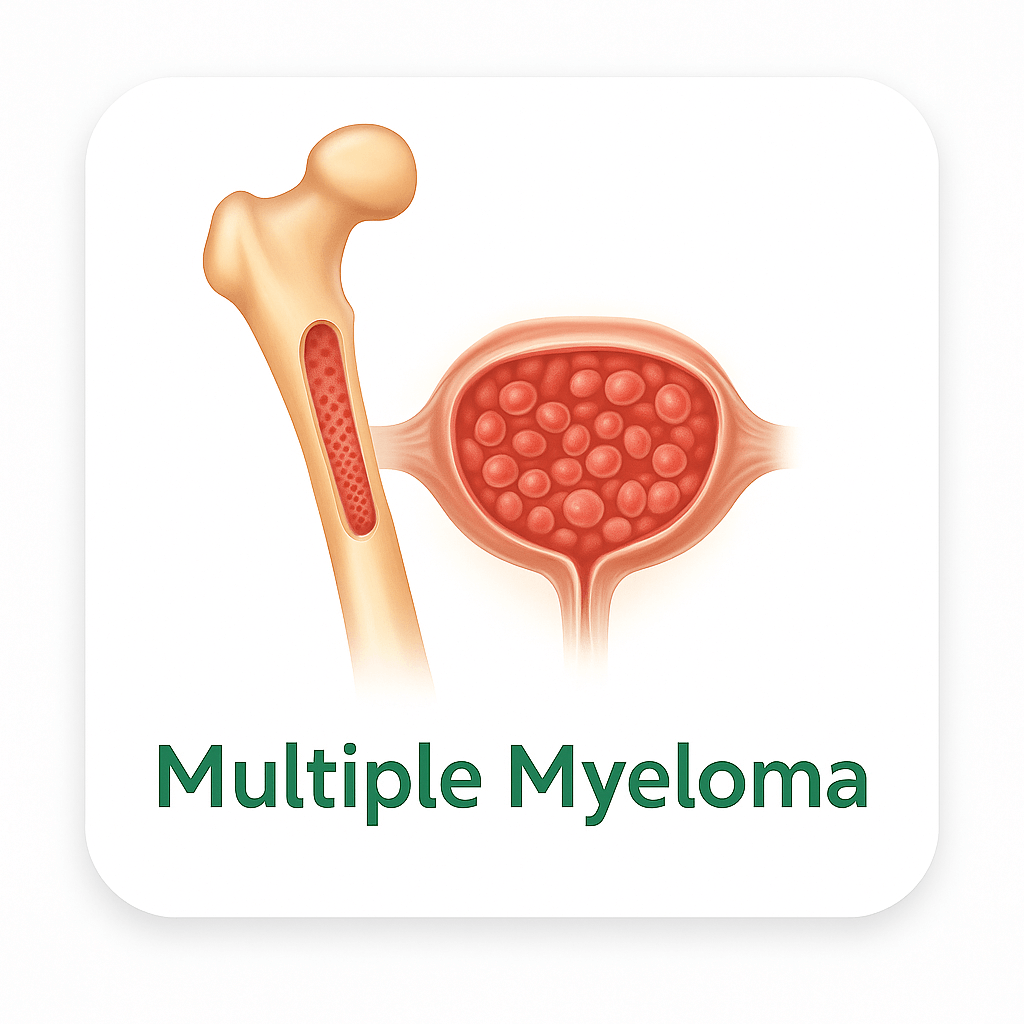
Multiple Myeloma
Main Grouping
Lymphatic/Hematologic
Organ System
Bone marrow,skeletal system,blood,kidneys,immune system
Cell Origin
Plasma cells
Pathways Affected
Multiple myeloma involves constitutive activation of multiple interconnected oncogenic signaling pathways, with IL-6/JAK/STAT3 and NF-kB as the two dominant survival axes complemented by PI3K/AKT/mTOR, MAPK/ERK, and Wnt pathway dysregulation. The JAK/STAT pathway, particularly STAT3, is the primary IL-6 downstream signaling node in myeloma cells; IL-6 secreted by bone marrow stromal cells in a paracrine manner and by myeloma cells themselves in an autocrine manner is the dominant myeloma survival and proliferation cytokine; JAK1/JAK2 phosphorylate STAT3, which translocates to the nucleus activating BCL-XL, MCL-1, cyclin D1, and MYC anti-apoptotic and pro-proliferative gene programs; curcumin has documented STAT3 inhibitory activity in myeloma cells in a clinical trial context.
The NF-kB signaling pathway is constitutively activated in approximately 20 percent of MM through somatic mutations in TRAF3, NIK, CYLD, and other pathway components; NF-kB activation drives anti-apoptotic gene expression including BCL-2 family members and drives RANKL expression promoting osteoclastogenesis and bone destruction; curcumin has documented NF-kB inhibitory activity in myeloma cells documented in the Phase I clinical trial (PMID 18332288) with biological activity confirmed.
The PI3K/AKT/mTOR pathway is activated in MM through IGF-1, IL-6, and VEGF receptor signaling from the bone marrow microenvironment, and through PTEN loss in a subset of MM; PI3K/AKT activates mTORC1 driving myeloma protein synthesis and the unfolded protein response (UPR), which is uniquely critical in plasma cells due to high immunoglobulin production demands. The MAPK/ERK pathway is activated through RAS mutations (NRAS approximately 20%, KRAS approximately 10%) and upstream IL-6, IGF-1, and FGFR3 signaling; FGFR3 is directly activated by the t(4;14) translocation placing it under IgH control. The RANKL/RANK/OPG pathway is directly dysregulated in MM, with myeloma cells and bone marrow stromal cells producing elevated RANKL while DKK1 from myeloma cells suppresses OPG production; RANKL-driven osteoclastogenesis produces the osteolytic bone lesions that are the hallmark clinical feature of MM. The Wnt/beta-catenin pathway is suppressed in MM through DKK1 secretion by myeloma cells, inhibiting osteoblast differentiation and contributing to the uncoupled bone remodeling (excess bone resorption without compensatory formation) that characterizes MM bone disease; despite this, canonical Wnt activation within myeloma cells themselves contributes to plasma cell proliferation. The UPR/unfolded protein response is uniquely critical in plasma cells and myeloma cells due to extremely high immunoglobulin synthesis demands; XBP1, IRE1alpha, and PERK are central UPR components in myeloma cell survival. The VEGF angiogenesis pathway is activated by myeloma cells and bone marrow stromal cells driving tumor vascularization. The IGF-1 signaling pathway from stromal cells activates PI3K/AKT and MAPK in myeloma cells, supporting survival and proliferation. Curcumin, quercetin, EGCG, and resveratrol all target multiple MM-relevant pathways including NF-kB, JAK/STAT3, and PI3K/AKT.
Description
Multiple myeloma (MM) is a malignant neoplasm of terminally differentiated plasma cells that accumulate in the bone marrow, produce monoclonal immunoglobulin (M-protein), and cause end-organ damage. MM is the second most common hematologic malignancy after non-Hodgkin lymphoma, accounting for approximately 10 percent of all blood cancers. Approximately 35,730 new cases of multiple myeloma were estimated in the United States for 2023, with approximately 12,590 deaths. The median age at diagnosis is 65 to 70 years, and MM is more common in men and in African American populations, who have a twofold higher incidence than white populations.
MM is uniformly preceded by the premalignant condition monoclonal gammopathy of undetermined significance (MGUS), which is present in approximately 3 percent of the general population over 50 years of age, and progresses to MM at a rate of approximately 1 percent per year. SMM (smoldering MM) is an intermediate asymptomatic stage that progresses to MM at a rate of approximately 10 percent per year. The characteristic clinical features of symptomatic MM are defined by the CRAB criteria: hypercalcemia, renal impairment, anemia, and bone disease. Osteolytic bone lesions occur in approximately 70 to 80 percent of MM patients at diagnosis, resulting from RANKL/OPG imbalance promoting osteoclast activation and osteoblast suppression.
The genomic landscape of MM is complex and heterogeneous. Primary IgH translocations are detected in approximately 40 to 45 percent of MM while hyperdiploidy characterizes the remainder. The t(4;14) translocation activating FGFR3 and MMSET (NSD2) is a high-risk feature associated with poor prognosis. The t(14;16) MAF translocation and del(17p) involving TP53 are also high-risk features. Secondary mutations in the RAS/MAPK pathway occur in approximately 20 to 30 percent of patients including NRAS (approximately 20%), KRAS (approximately 10%), BRAF (approximately 4%), and MAP2K1 mutations. The NF-kB pathway is deregulated in approximately 20 percent of MM through mutations in TRAF3, NIK, CYLD, and other components. The PI3K/AKT/mTOR pathway is activated in the majority of MM through IGF-1 and IL-6 receptor signaling from the bone marrow microenvironment.
The bone marrow microenvironment (BMM) is central to MM pathogenesis; myeloma cells interact with stromal cells, osteoclasts, osteoblasts, immune cells, and the extracellular matrix through adhesion molecules, cytokines, and growth factors; IL-6 secreted by bone marrow stromal cells is the primary myeloma growth and survival factor, activating JAK/STAT3, PI3K/AKT, and MAPK/ERK pathways; VEGF drives tumor angiogenesis; IGF-1 from stromal cells activates PI3K/AKT; RANKL drives osteoclastogenesis and bone destruction while DKK1 inhibits Wnt signaling and blocks osteoblast differentiation.
Curcumin is the most extensively studied plant phytochemical in multiple myeloma research, with a published Phase I clinical trial (MD Anderson Cancer Center, PMID 18332288) demonstrating that curcumin at 8g/day was safe and biologically active in myeloma patients, with documented NF-kB inhibition, STAT3 suppression, and anti-myeloma activity in NF-kB-expressing myeloma cells. Additional published data showed curcumin suppressed MM cell growth, inhibited osteoclastogenesis, and suppressed MM-induced bone resorption.
Plant-Based Description
hole-food plant-based dietary patterns provide nutrients and phytochemicals studied in relation to multiple myeloma biology including NF-kB pathway inhibition, JAK/STAT3 suppression, PI3K/AKT/mTOR modulation, RANKL-driven bone remodeling, osteoclastogenesis inhibition, apoptosis induction, and the unfolded protein response. Curcumin from turmeric has the most direct documented clinical evidence in myeloma, with a Phase I clinical trial at MD Anderson Cancer Center demonstrating safety at 8g/day and documenting NF-kB inhibition, STAT3 suppression, and anti-myeloma biological activity. Multiple preclinical studies document curcumin suppressing MM cell growth, inhibiting osteoclastogenesis, and suppressing MM-induced bone resorption. Quercetin targets NF-kB, STAT3, and PI3K/AKT in myeloma cell models. EGCG from green tea inhibits STAT3 and NF-kB. Resveratrol inhibits NF-kB, PI3K/AKT, and downregulates MYC. Beta-glucans from mushrooms modulate immune signaling relevant to the myeloma bone marrow microenvironment. Carotenoids from vegetables and fruits provide antioxidant protection relevant to the chronic oxidative stress in the MM bone marrow niche. Legumes provide plant protein and folate supporting bone marrow DNA methylation chemistry. Whole grains provide fiber and magnesium supporting immune function.
Plant Chemistry Detail
Curcumin from turmeric is the most directly documented plant phytochemical in multiple myeloma research with published clinical trial evidence. A Phase I clinical trial at MD Anderson Cancer Center (PMID 18332288) evaluated curcumin in myeloma patients with relapsed or plateau-phase disease and documented that curcumin at 8g/day was safe and produced biological activity including NF-kB inhibition and STAT3 suppression in NF-kB-expressing myeloma cells; the study documented downregulation of NF-kB-dependent anti-apoptotic and pro-proliferative gene products and demonstrated anti-tumor activity in this myeloma patient cohort. Multiple preclinical studies in myeloma cell lines document curcumin suppressing MM cell growth and survival through inhibition of NF-kB, STAT3, PI3K/AKT, and MAPK signaling, inducing apoptosis through BCL-2 family protein alterations, inhibiting osteoclastogenesis, and suppressing MM-induced bone resorption through RANKL pathway modulation.
Quercetin from yellow onions, kale, and apples inhibits both NF-kB and JAK/STAT3 pathways directly relevant to the two dominant MM survival axes; quercetin induces apoptosis in human myeloma cell lines through intrinsic mitochondrial pathway activation, CDK inhibitor elevation, and cyclin D1 downregulation relevant to CCND1-overexpressing t(11;14) MM. EGCG from green tea inhibits STAT3 phosphorylation directly relevant to JAK/STAT3-driven myeloma survival, and inhibits NF-kB through IKK suppression; EGCG also inhibits FGFR3 kinase activity documented in the t(4;14) MM subtype through receptor tyrosine kinase suppression. Resveratrol from grapes inhibits NF-kB through IKK blockade, suppresses STAT3, downregulates MYC expression, and activates intrinsic apoptosis in myeloma cell models; resveratrol also inhibits RANKL-induced osteoclastogenesis relevant to MM bone disease. Sulforaphane from cruciferous vegetables activates Nrf2 antioxidant response and inhibits NF-kB and HDAC activity in myeloma cell models. Genistein from soybeans inhibits PI3K/AKT, FGFR3, and STAT3 signaling in myeloma cell models with documented cytotoxicity. Beta-glucans from shiitake, maitake, and oyster mushrooms activate innate immune recognition through dectin-1/TLR signaling, with direct anti-myeloma activity documented in beta-glucan studies using myeloma models. Quercetin and curcumin both inhibit RANKL-mediated osteoclastogenesis, directly targeting the MM-driven bone destruction mechanism central to myeloma pathogenesis.
Nutritional Focus
Nutritional focus in multiple myeloma research is led by curcumin from turmeric, with the most direct clinical evidence of any plant phytochemical in MM: a Phase I clinical trial at MD Anderson Cancer Center (PMID 18332288) demonstrating curcumin at 8g/day was safe and biologically active in myeloma patients, with documented NF-kB inhibition, STAT3 suppression, downregulation of NF-kB-dependent anti-apoptotic gene products, and anti-tumor activity; additional preclinical studies documenting curcumin suppressing MM cell growth through NF-kB and STAT3 inhibition, inhibiting osteoclastogenesis, and suppressing MM-induced bone resorption through RANKL pathway modulation; quercetin from onions and kale inhibiting NF-kB and JAK/STAT3 (the two dominant MM survival axes) and inducing apoptosis in myeloma cell lines through CDK inhibitor elevation and cyclin D1 downregulation; EGCG from green tea inhibiting STAT3 phosphorylation and FGFR3 kinase activity relevant to t(4;14) MM; resveratrol from grapes inhibiting NF-kB and RANKL-induced osteoclastogenesis directly targeting MM bone disease biology; genistein from soybeans inhibiting FGFR3 and STAT3 in myeloma models; beta-glucans from shiitake and maitake mushrooms activating innate immune recognition through dectin-1/TLR signaling with documented anti-myeloma activity; and calcium from leafy greens and legumes with direct relevance to the hypercalcemia that is a hallmark clinical feature of MM bone disease.
Research Notes
MM genomic landscape and classification: primary IgH translocations in approximately 40-45% of MM include t(11;14) CCND1 (15-20%), t(4;14) FGFR3/MMSET (15%), t(14;16) MAF (5%); hyperdiploidy in approximately 55-60% of MM; secondary alterations include NRAS mutations (~20%), KRAS mutations (~10%), TP53 deletion/mutation (~10% at diagnosis), MYC rearrangements (~15-25%); NF-kB pathway mutations in approximately 20% of MM. IL-6 from bone marrow stromal cells is the primary myeloma growth and survival factor activating JAK/STAT3, PI3K/AKT, and MAPK/ERK; RANKL/DKK1 from myeloma cells drive osteoclastogenesis and osteoblast suppression respectively; VEGF drives angiogenesis; IGF-1 activates PI3K/AKT.
Curcumin Phase I clinical trial in myeloma (PMID 18332288, MD Anderson Cancer Center): curcumin at 8g/day demonstrated safety and biological activity in relapsed/plateau-phase myeloma patients; documented NF-kB inhibition in circulating myeloma cells, STAT3 suppression, downregulation of NF-kB-dependent anti-apoptotic gene products; confirmed anti-myeloma biological activity in this clinical trial setting. Curcumin preclinical myeloma studies documented suppression of MM cell growth, inhibition of osteoclastogenesis, and suppression of MM-induced bone resorption through RANKL pathway modulation (PMC on curcumin myeloma). EGCG documented to inhibit FGFR3 kinase activity in t(4;14) myeloma cell lines; EGCG and quercetin documented JAK/STAT3 and NF-kB inhibitory activity in multiple myeloma models. Resveratrol documented to inhibit RANKL-induced osteoclastogenesis, directly targeting the dominant bone destruction mechanism in MM. Genistein documented to inhibit FGFR3 and STAT3 in myeloma cell models with cytotoxicity.
Notes Visibility
show
Key Foods
Turmeric,Broccoli,Kale,Spinach,Brussels Sprouts,Cauliflower,Garlic,Yellow Onion,Carrot,Sweet Potato,Tomato,Apple,Blueberry,Pomegranate,Grape,Raspberry,Strawberry,Blackberry,Orange,Soybeans,Edamame,Green Lentils,Black Beans,Chickpeas,Brown Rice,Quinoa,Oats,Wild Rice,Rye Berries,Sorghum,Walnut,Almond,Brazil Nut,Pumpkin Seeds,Flaxseed,Chia Seeds,Sesame Seeds,Hemp Seeds,Shiitake,Maitake,Cremini,Portobello,Lions Mane,Green Tea,Ginger,Black Pepper,Garlic Powder,Parsley,Rosemary,Oregano, Leek,Avocado,Artichoke,Radish,Tangerine, Red Onion
Linked Nutrients
vitamin-c,vitamin-e,vitamin-d3,vitamin-b9,vitamin-b6,vitamin-a,selenium,zinc,magnesium,calcium,potassium,iron,phosphorus,curcumin,quercetin,egcg,resveratrol,sulforaphane,genistein,beta-carotene,anthocyanins,beta-glucans,plant-ala-omega3,dietary-fiber
Last Updated
2025-10-13 09:48:09

