
ID
3
Cancer Name
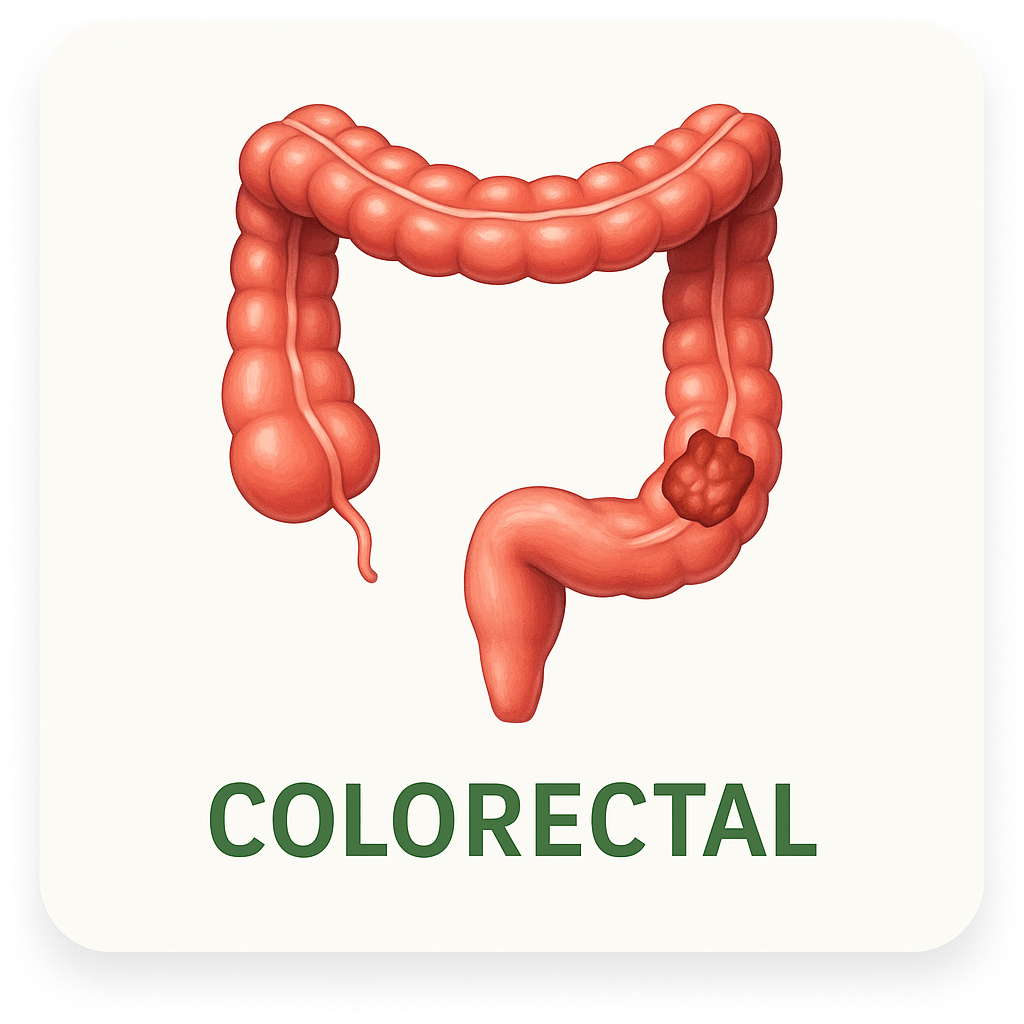
Colorectal Cancer
Main Grouping
Digestive
Organ System
Colon, Rectum
Cell Origin
Epithelial (adenocarcinoma)
Pathways Affected
Colorectal cancer involves the most extensively characterized cancer pathway landscape of any solid tumor, centered on the APC/WNT/beta-catenin pathway (~80%), KRAS/MAPK/ERK pathway (~40-45%), TP53/p53 pathway (~40-60%), PIK3CA/PI3K/AKT/mTOR pathway (~14-20%), TGF-beta/SMAD4 pathway (~10-15%), and the microsatellite instability/DNA mismatch repair pathway (~15%).
The APC/WNT/beta-catenin pathway is the most defining and earliest oncogenic event in CRC: APC (adenomatous polyposis coli — chromosome 5q21-22) inactivating mutations in approximately 80% of CRC represent the initiating mutation of the adenoma-carcinoma sequence; APC functions as the central scaffold of the beta-catenin destruction complex (APC/Axin/CK1/GSK-3beta) — in the absence of WNT ligand, this complex phosphorylates cytoplasmic beta-catenin at Ser33/Ser37/Thr41/Ser45 targeting it for ubiquitin-proteasomal degradation; APC mutation disrupts the destruction complex — cytoplasmic beta-catenin accumulates and translocates to the nucleus where it replaces the transcriptional repressor Groucho and cooperates with TCF/LEF transcription factors activating WNT target genes: c-MYC (promoting G1/S progression), cyclin D1, survivin (anti-apoptosis), VEGF (angiogenesis), MMP-7 (invasion), AXIN2, and LGR5 (ISC stem gene upregulation); quercetin was confirmed to inhibit beta-catenin/Tcf activity in SW480 colon cancer cells — the degradation of beta-catenin or downstream compounds and reduction in binding of Tcf complexes to DNA confirmed (PMC8953922); quercetin confirmed to induce G2/M cell cycle arrest in HT-29, HCT116, SW480 CRC cells — confirmed in multiple studies (PMC8953922); curcumin inhibits WNT/beta-catenin in CRC cell models; resveratrol inhibits WNT/beta-catenin and TCF/LEF in CRC cells.
The KRAS/RAS/MAPK/ERK pathway is the second most dominant oncogenic axis in CRC: KRAS activating mutations in approximately 40-45% of CRC (G12D ~13%, G12V ~9%, G12C ~6%, G13D ~5%, G12A ~3%, G12S ~2%) create constitutively GTP-bound KRAS that drives RAF/MEK/ERK (MAPK/ERK cascade) and PI3K/AKT/mTOR simultaneously regardless of upstream EGFR signaling; KRAS mutations are the primary resistance mechanism to anti-EGFR monoclonal antibodies; RAS/RAF/MEK/ERK activate transcription factors ELK1, c-MYC, AP1 (FOS/JUN) driving cyclin D1 and anti-apoptotic gene expression; BRAF V600E mutations (~8-15%) create constitutive BRAF kinase activity downstream of KRAS — BRAF V600E signals exclusively through MEK/ERK without requiring RAS activation; quercetin was confirmed to inhibit AKT phosphorylation in HT-29 HCT116 SW480 CRC cell lines confirmed and induce apoptosis by modulating p53/Bax/Bcl-2 in HT-29 cells confirmed (PMC8953922); curcumin inhibits KRAS downstream MAPK/ERK and PI3K/AKT in CRC cell models; EGCG inhibits MAPK/ERK and PI3K/AKT in CRC cells.
The TP53/p53 pathway is acquired during the adenoma-to-carcinoma transition: TP53 mutations in approximately 40-60% of CRC — predominantly gain-of-function missense mutations (R175H, R248W, R273H) creating oncogenic p53 proteins that promote invasion and drug resistance; wild-type p53 in CRC cells (HCT116 is p53 wild-type) can be activated by quercetin to upregulate p21/CDKN1A, Bax, and apoptosis confirmed; quercetin modulates Bax and Bcl-2 expression in HT-29 (p53 mutant) CRC cells confirmed (PMC8953922) — demonstrating both p53-dependent and p53-independent apoptosis induction in CRC.
Description
Colorectal cancer (CRC) is the third most commonly diagnosed cancer and the second leading cause of cancer death globally, representing a major public health burden across all continents. In the United States, approximately 153,000 new cases of colorectal cancer are diagnosed annually (colon cancer ~107,000 plus rectal cancer ~46,000) with approximately 52,000 deaths per year — making CRC the second deadliest cancer in the US. Globally, approximately 1.93 million new CRC cases are diagnosed annually with approximately 935,000 deaths. The incidence of CRC in adults under 50 years old (early-onset CRC) has been rising at approximately 1 to 2 percent per year in Western countries over recent decades, while rates in older adults have been declining due to colonoscopy screening.
CRC develops through well-characterized sequential mutational pathways from the normal colonic epithelium: the most common pathway is the chromosomal instability (CIN) pathway — accounting for approximately 70-80% of all CRC — characterized by sequential accumulation of APC mutation (~80%) → KRAS mutation (~40-45%) → SMAD4/TGF-beta pathway loss (~10-15%) → TP53 mutation (~40-60%); this multistep Vogelstein model of colorectal carcinogenesis proceeds through normal mucosa → hyperproliferative epithelium → early adenoma → late adenoma → invasive adenocarcinoma over approximately 10 to 15 years; the microsatellite instability (MSI) pathway accounts for approximately 15% of CRC — caused by defective DNA mismatch repair (dMMR) through germline MMR mutations (Lynch syndrome) or MLH1 promoter methylation (sporadic MSI) — creating tumors with high mutational burden, improved immunotherapy responses, and typically better prognosis; the serrated pathway accounts for approximately 15-20% — driven by BRAF V600E and MLH1 methylation in sessile serrated lesions.
CRC is anatomically divided into right-sided CRC (cecum through splenic flexure) and left-sided CRC (descending colon through rectum) — with significant biological and prognostic differences: right-sided CRC is more commonly MSI-H, BRAF V600E-mutant, mucinous, and microsatellite instable; left-sided CRC is more commonly MSS/MSI-L, KRAS-mutant, and chromosomally instable; rectal cancer is managed differently from colon cancer due to the anatomical proximity to pelvic structures, shorter surgical margins, and requirement for neoadjuvant chemoradiation in locally advanced stages.
Overall 5-year OS by stage: stage I ~90-95%; stage II ~80-85%; stage III ~40-70%; stage IV (metastatic) ~12-14% (historically) improving to ~35-40% with modern multiagent chemotherapy and targeted agents; the most common sites of metastasis are liver (~50% of stage IV), lung (~30%), peritoneum (~20%), and distant lymph nodes.
Published laboratory research confirms quercetin from onions and apples was confirmed to induce G2/M cell cycle arrest in HT-29, HCT116, SW480, and other CRC cell lines; inhibit beta-catenin/Tcf activity in SW480 colon cancer cells confirmed; downregulate AKT confirmed; modulate p53, Bax, and Bcl-2 confirmed in HT-29 cells; induce apoptosis in multiple CRC cell lines confirmed (PMC8953922) — directly applicable to APC/WNT, KRAS/MAPK, and PI3K/AKT pathways in CRC.
Plant-Based Description
Whole-food plant-based dietary patterns provide phytochemicals with confirmed activity directly in multiple colorectal cancer cell lines. Quercetin from onions, apples, and kale was confirmed to induce G2/M cell cycle arrest in HT-29, HCT116, SW480, RKO, and SW620 CRC cell lines; inhibit beta-catenin/Tcf transcriptional activity in SW480 colon cancer cells confirmed; downregulate AKT confirmed; modulate p53, Bax, and Bcl-2 in HT-29 cells confirmed; induce JNK and p38 MAPK upregulation in HCT-15, HCT-116, Caco-2, DLD-1, DLD-1 KRASG13D, and DLD-1 KRASWT CRC cell lines confirmed; induce apoptosis in multiple CRC lines confirmed (PMC8953922); curcumin from turmeric inhibits WNT/beta-catenin, NF-kB, COX-2, and PI3K/AKT in CRC cell models; sulforaphane from broccoli activates Nrf2 and induces p21 and apoptosis in CRC cells; resveratrol from grapes inhibits WNT/beta-catenin and induces apoptosis; EGCG inhibits MAPK and PI3K/AKT; dietary fiber produces butyrate/SCFAs inhibiting HDAC in colonocytes.
Plant Chemistry Detail
Quercetin from onions, apples, kale, and berries has confirmed direct anti-colorectal cancer activity across the most extensively tested phytochemical-CRC cell line evidence base in the published literature. In the comprehensive published review (PMC8953922 — "A Comprehensive View on the Quercetin Impact on Colorectal Cancer") the following confirmed activities across multiple CRC cell lines are documented: G2/M cell cycle arrest confirmed in HT-29, HCT116, SW480, RKO, and SW620 human CRC cell lines — targeting the APC/WNT-driven cell cycle dysregulation in CRC with cyclin B1 modulation and CDK1 regulation; G0/G1 cell cycle arrest also confirmed in HT-29 and HCT-116 cells in specific experimental conditions confirmed; beta-catenin/Tcf inhibitory activity confirmed in SW480 colon cancer cells — degradation of beta-catenin or downstream compounds and reduction in Tcf complex-DNA binding confirmed — directly targeting the APC mutation-driven WNT/beta-catenin pathway (~80% of CRC); AKT downregulation confirmed in HT-29, HCT116, SW480 CRC cell lines — targeting the PI3K/AKT survival pathway activated by PIK3CA mutations (~14-20%) and KRAS activating mutations (~40-45%) in CRC; p53 upregulation, Bax upregulation, and Bcl-2 downregulation confirmed in HT-29 CRC cells — inducing the intrinsic mitochondrial apoptosis pathway; JNK and p38 MAPK upregulation confirmed in HCT-15, HCT-116, Caco-2, DLD-1, DLD-1 KRASG13D, and DLD-1 KRASWT CRC cell lines confirmed — activating the stress-activated MAPK apoptosis pathway regardless of KRAS mutation status; cyclin D1 inhibition confirmed targeting the APC/WNT-driven cyclin D1 overexpression; cyclin A reduction and p21/Cdc-2 induction confirmed.
Curcumin from turmeric inhibits WNT/beta-catenin directly targeting the APC mutation-driven WNT pathway (~80%); inhibits NF-kB and COX-2 targeting the inflammatory prostaglandin/COX-2 pathway enriched in CRC; inhibits PI3K/AKT/mTOR targeting PIK3CA-activated mTOR signaling; inhibits KRAS downstream MEK/ERK; induces apoptosis in HCT116 and HT-29 CRC cells confirmed. Sulforaphane from broccoli and cruciferous vegetables activates Nrf2/ARE inducing NQO1, HO-1, and glutathione-S-transferases — countering the ROS-mediated DNA damage contributing to APC/TP53 somatic mutations in the colonic epithelium; sulforaphane inhibits HDAC targeting APC, MLH1, and other CpG-methylated tumor suppressor loci in CRC; induces p21/CDKN1A and apoptosis in CRC cell models. Resveratrol from grapes inhibits WNT/beta-catenin and TCF/LEF in CRC cell models; induces apoptosis through caspase activation. EGCG from green tea inhibits PI3K/AKT, MAPK/ERK, STAT3, and VEGF in CRC models. Dietary fiber from whole grains, legumes, and vegetables is fermented by colonic microbiota to short-chain fatty acids (butyrate, propionate, acetate) — butyrate inhibits HDAC in colonocytes targeting CRC epigenetic landscape.
Nutritional Focus
Nutritional focus in colorectal cancer targets the APC/WNT/beta-catenin pathway (~80%), KRAS/MAPK/ERK pathway (~40-45%), TP53/p53 pathway (~40-60%), PIK3CA/PI3K/AKT pathway (~14-20%), TGF-beta/SMAD4 (~10-15%), and the MLH1/mismatch repair pathway (~15% sporadic MSI-H). Quercetin from onions and apples confirmed to induce G2/M arrest in HT-29, HCT116, SW480, RKO, and SW620 CRC cell lines; inhibit beta-catenin/Tcf in SW480 confirmed — directly targeting APC mutation-driven WNT/beta-catenin (~80%); downregulate AKT confirmed in multiple CRC lines; modulate p53, Bax, Bcl-2 in HT-29 confirmed; upregulate JNK/p38 MAPK in HCT-15, HCT-116, Caco-2, DLD-1, DLD-1 KRASG13D, DLD-1 KRASWT confirmed — active regardless of KRAS mutation status; inhibit cyclin D1 confirmed (PMC8953922); curcumin from turmeric inhibiting WNT/beta-catenin targeting APC-mutant (~80%) CRC; inhibiting NF-kB/COX-2 targeting the inflammatory prostaglandin survival axis; inhibiting PI3K/AKT targeting PIK3CA-mutant CRC; inhibiting DNMT targeting MLH1 and APC promoter methylation; sulforaphane activating Nrf2/ARE and inhibiting HDAC targeting APC/MLH1 epigenetic silencing; EGCG inhibiting MAPK/ERK, PI3K/AKT, STAT3, and VEGF; resveratrol inhibiting WNT/beta-catenin; allicin from garlic inhibiting NF-kB; dietary fiber from whole grains and legumes producing colonocyte butyrate inhibiting HDAC targeting APC and tumor suppressor methylation.
Research Notes
CRC epidemiology: ~153,000 new US cases/year (colon ~107,000; rectal ~46,000); ~52,000 US deaths/year; second deadliest US cancer; globally ~1.93 million new cases/year; ~935,000 deaths/year; rising early-onset CRC in adults under 50 (~1-2%/year); 5-year OS: stage I ~90-95%; II ~80-85%; III ~40-70%; IV ~12-14% historically (improving with modern agents to ~35-40%); liver most common metastatic site (~50%); lung second (~30%). IHC: CK20+, CDX2+; MMR proteins MLH1/MSH2/MSH6/PMS2 for dMMR vs. pMMR; BRAF V600E IHC; HER2 IHC for HER2 amplification ~2-4%. Molecular TCGA 2012 and subsequent series: APC inactivating ~80%; KRAS activating ~40-45% (G12D, G12V, G12C, G13D dominant); TP53 ~40-60% (acquired adenoma-carcinoma transition); PIK3CA ~14-20%; BRAF V600E ~8-15% (right-sided, MSI-H, serrated); SMAD4 ~10-15%; FBXW7 ~10%; NRAS ~3-5%; HER2 amplification ~2-4% (left-sided); MLH1 promoter methylation ~15% sporadic MSI-H; Lynch syndrome germline MMR (MLH1/MSH2/MSH6/PMS2) ~3-5% all CRC; MSI-H ~15% all CRC; MSS ~85%; CIMP-H (CpG island methylator phenotype) ~15-20%; right-sided CRC more commonly MSI-H/BRAF V600E/mucinous; left-sided more commonly MSS/KRAS-mutant. Quercetin in CRC (PMC8953922): G2/M arrest confirmed HT-29/HCT116/SW480/RKO/SW620; G0/G1 arrest confirmed HT-29/HCT-116; beta-catenin/Tcf inhibited SW480; AKT downregulated HT-29/HCT116/SW480; p53/Bax/Bcl-2 modulated HT-29; JNK/p38 upregulated HCT-15/HCT-116/Caco-2/DLD-1/DLD-1KRASG13D/DLD-1KRASWT; cyclin D1 inhibited; cyclin A reduced; p21/Cdc-2 induced. Curcumin in CRC: WNT/beta-catenin inhibited; NF-kB/COX-2 inhibited; PI3K/AKT inhibited; apoptosis HCT116/HT-29 confirmed.
Notes Visibility
show
Key Foods
Turmeric,Broccoli,Kale,Spinach,Brussels Sprouts,Cauliflower,Garlic,Yellow Onion,Carrot,Tomato,Beetroot,Cabbage,Blueberry,Pomegranate,Grape,Raspberry,Apple,Orange,Lemon,Soybeans,Edamame,Green Lentils,Black Beans,Chickpeas,Brown Rice,Quinoa,Oats,Wild Rice,Black Rice,Walnut,Almond,Brazil Nut,Flaxseed,Pumpkin Seeds,Chia Seeds,Sesame Seeds,Hemp Seeds,Shiitake,Maitake,Lions Mane,Cremini,Portobello,Green Tea,Ginger,Black Pepper,Garlic Powder,Parsley,Rosemary,Oregano,Celery, Fennel, Leek,Avocado,Artichoke,Endive,Radish,Parsnip,Radicchio,Fig,Tangerine,Dragon Fruit Red, Red Onion
Linked Nutrients
vitamin-c,vitamin-e,vitamin-a,vitamin-b9,vitamin-b6,selenium,zinc,magnesium,calcium,potassium,iron,quercetin,curcumin,egcg,sulforaphane,beta-carotene,dietary-fiber,l-theanine,allicin,resveratrol
Last Updated
2025-10-13 08:50:54

