
ID
36
Cancer Name
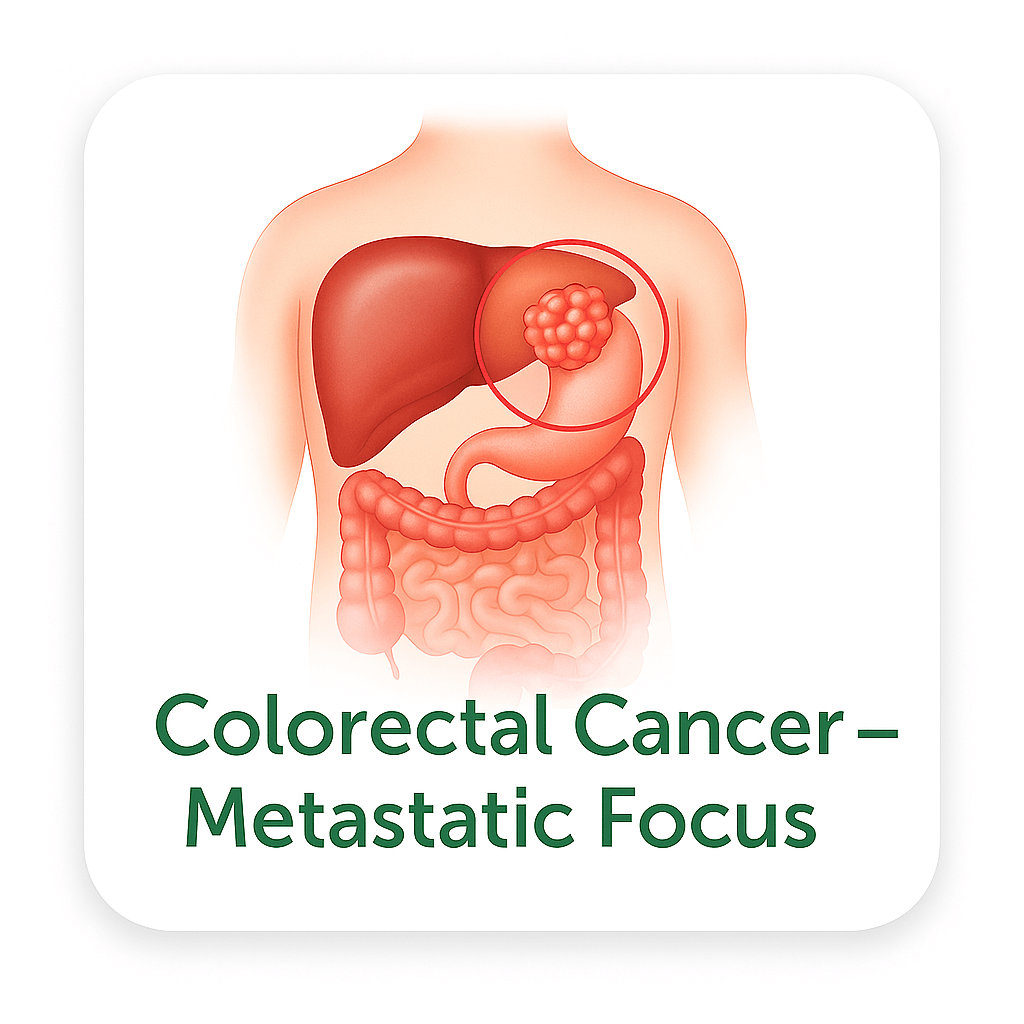
Colorectal Cancer – Metastatic Focus
Main Grouping
Digestive
Organ System
Colon, Rectum (with liver/lung mets)
Cell Origin
Mucosal Epithelial Cells (adenocarcinoma)
Pathways Affected
Metastatic colorectal cancer involves constitutive Wnt/beta-catenin pathway activation as the earliest and most consistent founding molecular event, complemented by KRAS/BRAF-driven constitutive MAPK/ERK and PI3K/AKT/mTOR activation, p53 tumor suppressor pathway dysfunction, TGF-beta/SMAD-driven EMT and metastasis signaling, VEGF angiogenesis, and NF-kB inflammatory signaling as the dominant oncogenic axes.
The Wnt/beta-catenin pathway is activated in approximately 75 to 80 percent of CRC through APC loss-of-function mutation eliminating the beta-catenin destruction complex (APC/AXIN/GSK3beta/CK1 complex); APC loss releases beta-catenin from ubiquitin-mediated degradation, enabling its nuclear translocation and TCF/LEF-mediated transcriptional activation of oncogenic target genes including MYC, CCND1 (cyclin D1), BIRC5 (survivin), and MMP7; sulforaphane from cruciferous vegetables has the most directly documented Wnt/beta-catenin inhibitory activity in CRC cell lines, with published evidence (PMC6188060) demonstrating that sulforaphane inhibited growth of SW480, DLD1, and HCT116 CRC cells with IC50 of 3.5 to 3.7 μM (within clinically achievable concentrations by oral intake), blocked Wnt/beta-catenin signaling, reduced colony formation, induced cell death and inhibited proliferation, and suppressed xenograft tumor growth; quercetin additionally inhibits Wnt/beta-catenin, blocking cyclin D1 and survivin production in SW480 colon cancer cells (PMC8953922).
The KRAS/MAPK/ERK pathway is constitutively activated in 40 to 45 percent of mCRC through KRAS codons 12 and 13 mutations making RAS GTPase constitutively active and independent of EGFR upstream signaling; BRAF V600E activates MAPK/ERK constitutively in approximately 5 to 10 percent of mCRC; constitutive KRAS/BRAF/MAPK/ERK signaling drives cell proliferation, survival, invasion, and metastasis; quercetin and EGCG inhibit KRAS downstream MAPK/ERK signaling in CRC cell models. The PI3K/AKT/mTOR pathway is activated in approximately 18 percent of CRC through PIK3CA mutations; KRAS mutations also activate PI3K/AKT downstream; PI3K/AKT/mTOR drives metabolic reprogramming, protein synthesis, and survival in mCRC; quercetin, curcumin, and resveratrol all inhibit PI3K/AKT/mTOR in CRC cell models. The p53 tumor suppressor pathway is disrupted through TP53 mutations in approximately 55 to 60 percent of mCRC, eliminating DNA damage checkpoint response and enabling chromosomal instability that accumulates as CRC progresses to metastatic disease; curcumin and quercetin restore p53 pathway activity and caspase-mediated apoptosis in p53-wild-type CRC cell models including HCT116. The TGF-beta/SMAD pathway has a dual role in CRC: in early CRC, TGF-beta acts as a tumor suppressor through SMAD4 (lost in approximately 10 percent of mCRC); in advanced mCRC, TGF-beta drives EMT and metastatic progression; the CMS4 mesenchymal subtype shows the highest TGF-beta activation and highest metastatic risk. The VEGF angiogenesis pathway is highly active in mCRC, with VEGF-A overexpression through HIF-1alpha, KRAS, and NF-kB driven transcription supporting the dense vascularization of both primary CRC and liver metastases; resveratrol, quercetin, and EGCG all inhibit VEGF expression in CRC-relevant cell models. The NF-kB pathway is constitutively activated in CRC through chronic colonic inflammation, KRAS downstream signaling, and TNF-alpha/IL-6 cytokine loops in the tumor microenvironment; curcumin has extensively documented NF-kB inhibitory activity in CRC cell models. The mismatch repair pathway is deficient in approximately 15 percent of CRC (dMMR/MSI-H), causing hypermutation and distinct immunogenicity. The gut microbiome signaling pathway is directly relevant to CRC carcinogenesis and mCRC progression, with short-chain fatty acids (SCFAs) from dietary fiber fermentation providing colonocyte-protective and anti-tumor signaling through butyrate-mediated HDAC inhibition and histone acetylation in colon cancer cells; dietary fiber from whole grains and legumes drives butyrate production through gut microbiome fermentation, directly inhibiting CRC cell proliferation through HDAC inhibition. The SCFA signaling pathway is therefore one of the most direct connections between plant-based dietary patterns and CRC biology.
Description
Metastatic colorectal cancer (mCRC) is the advanced stage of colorectal cancer in which the primary tumor has spread to distant organs, most commonly the liver (in approximately 50 percent of mCRC cases), lungs, peritoneum, and distant lymph nodes. Colorectal cancer is the third most commonly diagnosed cancer and the second leading cause of cancer-related death globally. An estimated 152,810 new cases of colorectal cancer and approximately 53,010 deaths were projected in the United States in 2024. Approximately 20 to 25 percent of newly diagnosed CRC patients present with synchronous metastatic disease at initial diagnosis, and an additional 30 to 40 percent of patients with initially localized CRC will develop metachronous metastases within five years of surgery. The 5-year relative survival for stage IV metastatic CRC is approximately 13 to 14 percent, in contrast to approximately 91 percent for stage I disease.
The molecular landscape of mCRC is defined by the founding mutations of the primary tumor that are largely preserved in metastatic deposits. APC mutations in 75 to 80 percent drive constitutive Wnt/beta-catenin signaling activation, which is the earliest and most consistent molecular event in CRC carcinogenesis; KRAS mutations in 40 to 45 percent of mCRC patients drive constitutive RAS/MAPK/ERK and PI3K/AKT proliferative and survival signaling independent of upstream EGFR receptor activation; BRAF V600E mutations in 5 to 10 percent drive constitutive MAPK/ERK activation and are associated with a particularly poor prognosis in mCRC, with median overall survival of approximately 10 to 12 months compared to approximately 25 to 30 months for KRAS/BRAF wild-type mCRC; TP53 mutations in 55 to 60 percent eliminate DNA damage checkpoint function enabling the chromosomal instability characteristic of CRC; PIK3CA mutations in approximately 18 percent activate PI3K/AKT/mTOR signaling; and SMAD4 mutations in approximately 10 percent disrupt TGF-beta tumor suppressor signaling enabling metastasis.
The Consensus Molecular Subtypes (CMS) of CRC provide a biologically meaningful framework: CMS1 (MSI-high, immune-rich, approximately 14%), CMS2 (canonical Wnt/MYC activation, approximately 37%), CMS3 (metabolic, KRAS-enriched, approximately 13%), and CMS4 (mesenchymal, TGF-beta activated, EMT-high, approximately 23%); CMS4 has the highest risk of developing liver and distant metastases through TGF-beta-driven EMT, and carries the worst prognosis. Approximately 15 percent of CRC shows dMMR/MSI-H status, which is associated with high tumor mutational burden and responsiveness to immune checkpoint blockade; dMMR/MSI-H status is far less common in mCRC (approximately 4 percent) than in stage I-II CRC.
Multiple plant phytochemicals have directly documented anti-CRC activity. Sulforaphane has the most directly confirmed activity targeting the dominant Wnt/beta-catenin pathway in CRC cells, with a published study documenting sulforaphane inhibiting growth, blocking Wnt/beta-catenin signaling, reducing colony formation and tumor xenograft growth in SW480, DLD1, and HCT116 CRC cell lines at concentrations achievable by oral intake (PMC6188060). Quercetin has comprehensive documented activity in multiple CRC cell lines including HCT116, HT-29, SW480, and SW620 (PMC8953922). Curcumin and resveratrol also have extensive CRC cell line evidence.
Plant-Based Description
Whole-food plant-based dietary patterns provide nutrients and phytochemicals with documented activity relevant to metastatic colorectal cancer through direct CRC cell line anti-proliferative activity targeting the dominant Wnt/beta-catenin, KRAS/MAPK/ERK, PI3K/AKT/mTOR, and NF-kB oncogenic axes, butyrate-mediated HDAC inhibition of colon cancer cell proliferation through gut microbiome fermentation of dietary fiber, and cell cycle arrest and apoptosis induction through multiple confirmed mechanisms in CRC cell models including HCT116, HT-29, SW480, DLD1, and SW620 cell lines. Sulforaphane from cruciferous vegetables has the most directly documented anti-CRC Wnt/beta-catenin pathway evidence: a published Oncotarget study (PMC6188060) demonstrated sulforaphane inhibiting growth of SW480, DLD1, and HCT116 CRC cells with IC50 of 3.5 to 3.7 μM within clinically achievable concentrations, blocking Wnt/beta-catenin signaling, reducing colony formation, inducing apoptosis, and suppressing xenograft tumor growth. Quercetin from onions and kale has comprehensive anti-CRC evidence across multiple cell lines including HCT116, HT-29, SW480, RKO, and SW620, inducing G2/M arrest, inhibiting Wnt/beta-catenin, AKT, CDK inhibitor elevation, p53/Bax/caspase-3/BCL-2 counter-regulation, and anti-metastatic effects (PMC8953922). Curcumin, EGCG, resveratrol, and ellagic acid all have documented activity in CRC cell models. Dietary fiber from whole grains and legumes drives butyrate production through colonic fermentation, with butyrate directly inhibiting HDAC activity and colon cancer cell proliferation. Beta-carotene and lycopene from orange and red vegetables provide antioxidant protection in colonic epithelium.
Plant Chemistry Detail
Sulforaphane from broccoli, Brussels sprouts, kale, and cruciferous vegetables is the most directly documented plant phytochemical targeting the defining Wnt/beta-catenin oncogenic driver of CRC. A published study in Oncotarget (PMC6188060) documented that sulforaphane significantly inhibited cell growth in a dose-dependent manner in all three tested CRC cell lines SW480, DLD1, and HCT116 with IC50 values of 3.7 μM (SW480), 3.5 μM (DLD1), and 3.6 μM (HCT116) that are within concentrations achievable through oral sulforaphane intake confirmed by clinical pharmacokinetic studies; colony formation assays confirmed sulforaphane suppression of metastasis-relevant single-cell outgrowth capacity; sulforaphane blocked Wnt/beta-catenin signaling directly targeting the dominant oncogenic pathway present through APC loss in approximately 75 to 80 percent of CRC; sulforaphane induced cell death (Annexin V and PI staining) and inhibited proliferation in CRC cell lines; sulforaphane suppressed tumor growth in CRC xenograft models; these findings directly target the constitutive Wnt/beta-catenin activation driving MYC, cyclin D1, and survivin oncogene expression in CRC.
Quercetin from yellow onions, kale, and apples has the most comprehensively documented multi-mechanism anti-CRC activity across multiple CRC cell lines. A comprehensive review (PMC8953922) documented quercetin inducing G2/M arrest in HT-29, HCT116, SW480, RKO, and SW620 CRC cell lines; inhibiting Wnt/beta-catenin through cyclin D1 and survivin suppression in SW480 cells; counter-regulating p53, Bax, caspase-3, and BCL-2 in the pro-apoptotic direction; inhibiting AKT and MAPK/ERK downstream kinase cascades; inhibiting VEGF expression and angiogenesis; and demonstrating anti-metastatic effects through MMP inhibition and EMT reversal in CRC models. Curcumin from turmeric inhibits NF-kB, Wnt/beta-catenin, PI3K/AKT, and EGFR in CRC cell models including HCT116, HT-29, and SW480 at 5 to 50 μM concentrations. EGCG from green tea inhibits Wnt/beta-catenin through GSK3beta activation and beta-catenin phosphorylation in CRC cells, and additionally inhibits VEGF, PI3K/AKT, and MAPK/ERK. Resveratrol from grapes inhibits Wnt/beta-catenin, VEGF, NF-kB, and PI3K/AKT in CRC cell models. Ellagic acid from pomegranate inhibits PI3K/AKT and MAPK/ERK and induces apoptosis in CRC cell models. Butyrate produced from dietary fiber fermentation by colonic microbiota from legumes, whole grains, and resistant starch inhibits HDAC enzymes in colon cancer cells, driving histone acetylation-mediated reactivation of silenced tumor suppressor genes and directly inhibiting CRC cell proliferation through cell cycle arrest at concentrations achieved in the colon through fermentation. Allicin and diallyl compounds from garlic inhibit NF-kB, EGFR, and COX-2 in CRC-relevant models. Genistein from soybeans inhibits Wnt/beta-catenin and PI3K/AKT in CRC cell models. Lycopene from tomatoes inhibits PI3K/AKT and NF-kB and reduces cyclin D1 in CRC cell models.
Nutritional Focus
Nutritional focus in metastatic colorectal cancer research is led by sulforaphane from cruciferous vegetables, with the most directly documented anti-CRC Wnt/beta-catenin pathway evidence from a published Oncotarget study (PMC6188060) demonstrating sulforaphane inhibiting growth of SW480, DLD1, and HCT116 CRC cell lines with IC50 of 3.5 to 3.7 μM at concentrations achievable through oral intake, blocking Wnt/beta-catenin signaling that is constitutively activated through APC loss in approximately 75 to 80 percent of CRC, reducing colony formation relevant to metastatic outgrowth capacity, inducing apoptosis, and suppressing xenograft tumor growth — directly targeting the founding oncogenic driver of CRC; quercetin from yellow onions and kale with comprehensive documented anti-CRC activity across HCT116, HT-29, SW480, RKO, and SW620 CRC cell lines including G2/M cell cycle arrest, Wnt/beta-catenin inhibition blocking cyclin D1 and survivin, p53/Bax/caspase-3/BCL-2 counter-regulation, AKT and MAPK/ERK inhibition, VEGF suppression, and anti-metastatic MMP inhibition (PMC8953922); curcumin from turmeric inhibiting NF-kB, Wnt/beta-catenin, PI3K/AKT, and EGFR in HCT116, HT-29, and SW480 CRC cell models; EGCG from green tea inhibiting Wnt/beta-catenin through GSK3beta/beta-catenin phosphorylation in CRC cells alongside PI3K/AKT and VEGF suppression; dietary fiber from legumes, whole grains, and resistant starch driving butyrate production through colonic fermentation with butyrate directly inhibiting HDAC enzymes in colon cancer cells at physiological colon concentrations providing direct SCFA-mediated anti-CRC signaling; resveratrol from grapes inhibiting Wnt/beta-catenin, VEGF, and NF-kB in CRC cell models; folate from leafy greens and legumes supporting SAM-cycle methionine chemistry relevant to CIMP-associated epigenetic silencing in a subset of CRC; and genistein from soybeans inhibiting Wnt/beta-catenin and PI3K/AKT in CRC cell models.
Research Notes
mCRC epidemiology: approximately 152,810 new CRC cases and 53,010 deaths in United States 2024; 3rd most common cancer globally; 2nd leading cause of cancer death; approximately 20-25% present with synchronous metastatic disease; 30-40% of initially localized CRC develop metachronous metastases; 5-year survival stage IV approximately 13-14%. Liver metastases: approximately 50% of mCRC patients; primary metastatic site via portal circulation; KRAS (33.5%), BRAF (6.1%), PIK3CA (13.4%) mutations each predict reduced time to relapse after liver resection (PMC5071774). CMS classification: CMS1 (MSI-H, immune, ~14%), CMS2 (Wnt/MYC, canonical, ~37%), CMS3 (metabolic, KRAS-enriched, ~13%), CMS4 (mesenchymal, TGF-beta, highest liver metastasis risk, ~23%). TCGA non-hypermutated CRC: APC (81%), TP53 (60%), KRAS (43%), PIK3CA (18%), SMAD4 (10%), FBXW7 (11%), NRAS (9%).
Sulforaphane Wnt/beta-catenin CRC (PMC6188060): SW480, DLD1, HCT116; IC50 3.5-3.7 μM (within clinical oral concentrations); blocked Wnt/beta-catenin signaling; reduced colony formation; induced apoptosis; inhibited proliferation; suppressed xenograft tumor growth. Quercetin CRC review (PMC8953922): G2/M arrest in HT-29, HCT116, SW480, RKO, SW620; Wnt/beta-catenin inhibition; p53/Bax/caspase-3 pro-apoptotic counter-regulation; AKT/MAPK inhibition; VEGF suppression. Quercetin and sulforaphane glutathione depletion in HCT116 xenograft model (PMC10138196): synergistic tumor suppression.
Notes Visibility
show
Key Foods
Broccoli,Kale,Brussels Sprouts,Cauliflower,Spinach,Garlic,Yellow Onion,Carrot,Tomato,Beetroot,Apple,Blueberry,Pomegranate,Grape,Raspberry,Strawberry,Orange,Lemon,Soybeans,Edamame,Black Beans,Green Lentils,Chickpeas,Brown Rice,Oats,Quinoa,Wild Rice,Rye Berries,Sorghum,Walnut,Almond,Brazil Nut,Pumpkin Seeds,Flaxseed,Chia Seeds,Sesame Seeds,Hemp Seeds,Shiitake,Maitake,Cremini,Portobello,Lions Mane,Turmeric,Green Tea,Ginger,Black Pepper,Garlic Powder,Parsley,Rosemary,Oregano, Leek,Avocado,Artichoke,Radish,Tangerine, Red Onion
Linked Nutrients
vitamin-c,vitamin-e,vitamin-d3,vitamin-b9,vitamin-b6,vitamin-a,selenium,zinc,magnesium,calcium,potassium,iron,sulforaphane,quercetin,curcumin,egcg,resveratrol,lycopene,beta-carotene,anthocyanins,beta-glucans,dietary-fiber,plant-ala-omega3
Last Updated
2025-10-13 09:55:57

