
ID
49
Cancer Name
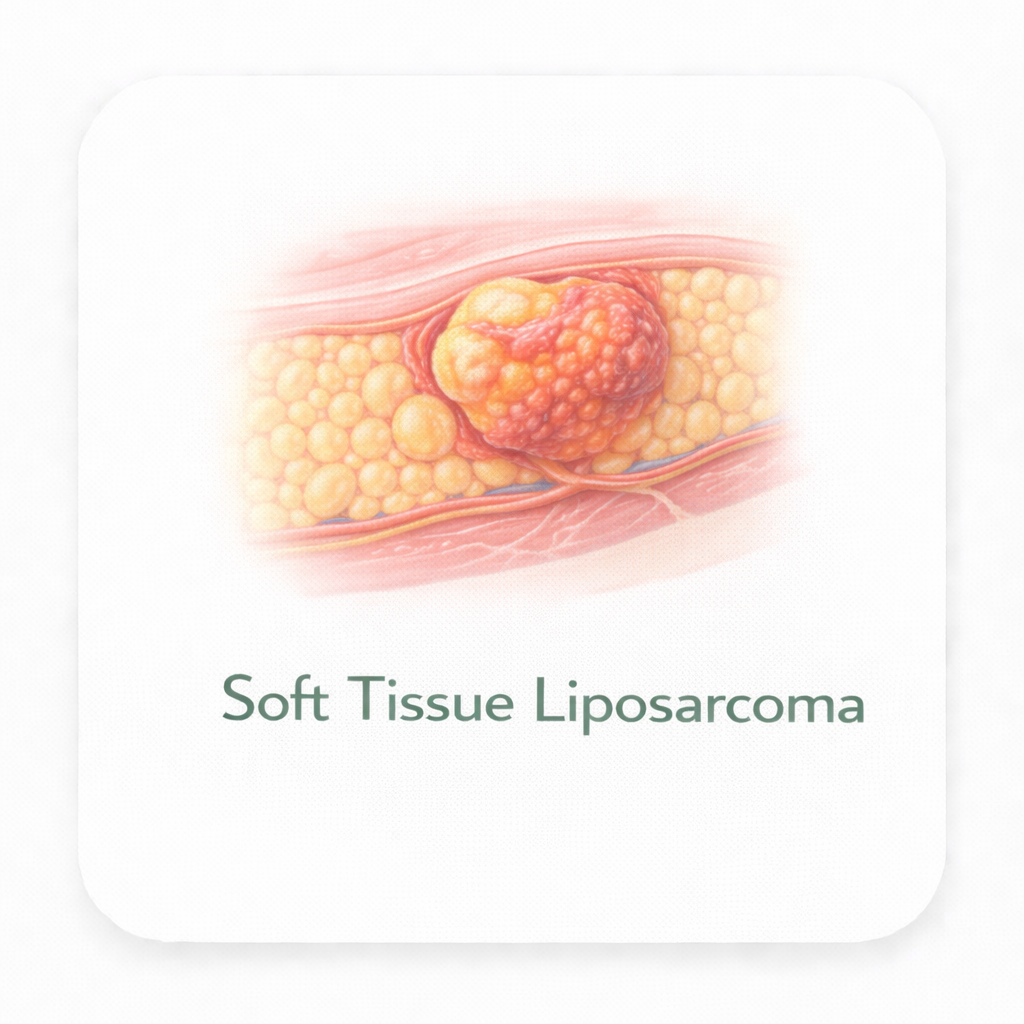
Soft Tissue Liposarcoma
Main Grouping
Musculoskeletal
Organ System
Adipose/soft tissue
Cell Origin
Adipocytes (mesenchymal)
Pathways Affected
Liposarcoma involves a pathway landscape that is uniquely subtype-specific, structured around the pathognomonic MDM2/CDK4 amplification pathway of WDLPS/DDLPS, the FUS-DDIT3 fusion-driven adipocytic differentiation blockade pathway of MLPS, and the complex copy-number-driven multisignal pathway activation of PLPS.
The MDM2/p53 tumor suppressor pathway is the dominant and most pathognomonic molecular alteration in WDLPS and DDLPS, with MDM2 gene amplification at 12q14.3-15 in approximately 90 to 95 percent of WDLPS and DDLPS; MDM2 protein is an E3 ubiquitin ligase that mediates ubiquitin-dependent proteasomal degradation of TP53 protein, constitutively silencing the p53-Bax-caspase-3 apoptotic axis, the p21-mediated G1 cell cycle checkpoint, and the p53-MDM2 autoregulatory negative feedback loop; MDM2 amplification allows WDLPS and DDLPS tumor cells to constitutively suppress p53 function despite wild-type TP53 sequence (TP53 point mutations are rare in WDLPS/DDLPS in contrast to other sarcomas); quercetin activates p53 by inhibiting MDM2 expression in cancer cell models targeting MDM2/p53 pathway disruption; curcumin induced CHOP and DR5 expression in SW872 human liposarcoma cells (PubMed 21282356) relevant to SERCA2-ER stress-p53 cross-talk.
The CDK4/Rb cell cycle checkpoint pathway is co-disrupted in approximately 90 percent of WDLPS and DDLPS through CDK4 gene amplification at 12q14; CDK4 is a cyclin-dependent kinase that phosphorylates and inactivates the retinoblastoma protein (Rb/RB1) in complex with Cyclin D1; CDK4 overexpression due to amplification drives hyperphosphorylation of Rb, releasing E2F transcription factors from Rb-E2F repressor complexes enabling constitutive S-phase entry and unrestrained cell proliferation; CDKN2A (p16/INK4a) normally inhibits CDK4 kinase activity but is overcome by CDK4 overexpression in amplification-driven WDLPS/DDLPS; quercetin inhibits CDK4/Cyclin D1 and reduces Rb phosphorylation in sarcoma models targeting the CDK4 amplification-driven cell cycle deregulation. The FUS-DDIT3/adipocytic differentiation pathway is the defining molecular event in approximately 90 to 95 percent of MLPS; the t(12;16)(q13;p11) translocation creates the FUS-DDIT3 (TLS-CHOP) fusion protein by joining the RNA-binding protein FUS (TLS) at 16p11 to the C/EBP homology protein DDIT3 (CHOP/GADD153) at 12q13; the FUS-DDIT3 fusion protein inhibits normal adipocytic differentiation by interfering with C/EBP family transcription factors (C/EBPalpha, C/EBPbeta) that normally drive preadipocyte differentiation to mature adipocytes, arresting MLPS cells at the preadipocyte stage; the FUS-DDIT3 fusion protein also constitutively activates PI3K/AKT and MAPK/ERK downstream proliferative signaling; the wild-type DDIT3 (CHOP) protein is the same molecule upregulated by curcumin through SERCA2-ER stress in SW872 liposarcoma cells (PubMed 21282356), as curcumin-induced ER stress activates wild-type CHOP and its transcription target death receptor 5 (DR5/TRAIL-R2).
The PI3K/AKT/mTOR pathway is activated in LPS through FGFR3 amplification in DDLPS (outside the 12q13-15 amplicon), PIK3CA mutations in a subset of PLPS, and RTK signaling from FGFR, EGFR, and IGF-1R in LPS subtypes; curcumin inhibits PI3K/AKT/mTOR in sarcoma models; quercetin inhibits PI3K/AKT targeting LPS growth. The MAPK/ERK pathway is activated in MLPS through FUS-DDIT3-mediated downstream MAPK/ERK activation and in DDLPS through FRS2 amplification in the 12q13-15 amplicon (FRS2 is an FGFR docking protein); curcumin inhibits MAPK/ERK in soft tissue sarcoma models. The NF-kB inflammatory pathway is activated in LPS through TNF-alpha/IL-6 cytokine signaling and AKT downstream activation; curcumin inhibited cell survival of SW872 human liposarcoma cells through ER stress and CHOP/DR5/caspase-3/8 apoptosis in vitro and in vivo (PubMed 21282356); quercetin inhibits NF-kB and reduces liposarcoma cell proliferation in SW872 cells (PubMed 16455111). The adipocytic differentiation/PPARgamma pathway is uniquely relevant to LPS as a lipogenic sarcoma; PPARgamma (encoded by PPARG) regulates normal adipocyte differentiation and is expressed in LPS; WNT5A signaling suppresses PPARgamma-mediated terminal adipocytic differentiation in MLPS; curcumin and quercetin both activate PPARgamma in adipogenic differentiation models. The VEGF/angiogenesis pathway is activated in high-grade LPS subtypes including DDLPS and PLPS through HIF-1alpha-driven VEGF transcription in the hypoxic retroperitoneal microenvironment; curcumin and quercetin inhibit VEGF and angiogenesis in sarcoma models. The autophagy pathway is induced in LPS by SERCA2 inhibition; curcumin-induced SERCA2 inhibition in SW872 liposarcoma cells triggers ER stress, calcium release, and CHOP/DR5 upregulation through the unfolded protein response (UPR), linking ER stress, autophagy, and apoptosis pathways in liposarcoma.
Description
Liposarcoma is the most common soft tissue sarcoma in adults, comprising approximately 20 percent of all soft tissue sarcomas globally. In the United States, soft tissue sarcomas account for approximately 13,590 new cases and 5,480 deaths annually according to 2024 projections. Liposarcoma represents the largest single diagnostic category within adult soft tissue sarcomas, with an estimated 2,500 to 4,000 new liposarcoma diagnoses annually in the United States. Globally, the age-standardized incidence of all soft tissue sarcomas is approximately 5 per 100,000 per year, with liposarcoma being the most prevalent histological subtype. Liposarcoma has a slight male predominance overall, with a male-to-female ratio of approximately 1.2 to 1.5:1.
The retroperitoneum is the most common anatomical site for liposarcoma, accounting for approximately 40 to 45 percent of all liposarcomas, followed by the extremities (approximately 40 percent, with the thigh being by far the most common extremity location), and the trunk, mediastinum, and head and neck regions. Retroperitoneal liposarcomas are predominantly WDLPS and DDLPS subtypes and present at a significantly larger size (often greater than 20 cm) before clinical detection due to the expansive retroperitoneal space, contributing to higher local recurrence rates and worse prognosis compared to extremity lesions. The 5-year overall survival by subtype is approximately 90 to 95 percent for extremity ALT/WDLPS, approximately 48 to 64 percent for retroperitoneal WDLPS, approximately 28 to 44 percent for DDLPS overall (with retroperitoneal DDLPS having worse outcomes), approximately 60 to 80 percent for MLPS grade 1, approximately 30 to 50 percent for round cell MLPS (high-grade MLPS), and approximately 30 to 36 percent for PLPS.
Liposarcoma arises predominantly as a de novo malignancy without an established identifiable benign precursor for the WDLPS/DDLPS and PLPS subtypes; MLPS arises from a different progenitor than lipomas and is not thought to arise from lipoma transformation despite the myxoid stroma; radiation-associated sarcoma is a recognized risk factor for secondary liposarcoma; prior radiation exposure (for other malignancies) and chemical exposures (thorotrast) are the most established environmental risk factors. The dominant biological distinction of liposarcoma subtypes is molecular: WDLPS and DDLPS are the only sarcomas with the ring/giant rod chromosome 12q13-15 amplicon as a pathognomonic molecular feature; MDM2 amplification (approximately 90-95 percent of WDLPS/DDLPS) and CDK4 co-amplification (approximately 90 percent of WDLPS/DDLPS) are pathognomonic; MLPS carries the FUS-DDIT3 or EWSR1-DDIT3 fusion in approximately 95-100 percent of cases; PLPS shows complex karyotype without characteristic alterations.
Published laboratory research documents curcumin with directly confirmed anti-liposarcoma cell line activity in the SW872 human liposarcoma cell line through SERCA2-mediated ER stress and CHOP/DR5/caspase-3/caspase-8 cascade apoptosis in vitro and antitumor activity in vivo, without affecting normal adipose-derived cells (PubMed 21282356); and quercetin with documented antiproliferative activity in SW872 human liposarcoma cells in a time- and dose-dependent manner (PubMed 16455111).
Plant-Based Description
Whole-food plant-based dietary patterns provide nutrients and phytochemicals with documented direct anti-liposarcoma cell line activity in human liposarcoma cell lines. Curcumin from turmeric was documented in a published study (PubMed 21282356) to dose-dependently inhibit cell survival of SW872 human liposarcoma cells without affecting normal human adipose-derived cells, demonstrating cancer-selective activity; curcumin induced ER stress in SW872 liposarcoma cells through SERCA2 inhibition causing increased CHOP expression and CHOP-transcription-target DR5 (TRAIL-R2/death receptor 5) upregulation leading to caspase-3 and caspase-8 cascade-dependent apoptosis in SW872 cells in vitro and confirmed antitumor activity in vivo; 70 percent of human liposarcoma tissues were documented to show elevated SERCA2 expression compared with normal adipose tissues establishing SERCA2 as a liposarcoma-enriched therapeutic target. Quercetin from yellow onions and kale inhibited SW872 human liposarcoma cell proliferation in a time- and dose-dependent manner in a published study (PubMed 16455111), targeting the MDM2/p53 and CDK4/Rb pathways that are the dominant oncogenic drivers in approximately 90 percent of WDLPS and DDLPS; sulforaphane activates Nrf2/ARE and inhibits HDAC targeting epigenetic drivers in LPS; resveratrol inhibits NF-kB and PI3K/AKT in soft tissue sarcoma models; EGCG from green tea inhibits MDM2-p53 interaction in cancer models directly targeting the pathognomonic WDLPS/DDLPS MDM2 amplification.
Plant Chemistry Detail
Curcumin from turmeric has the most directly confirmed anti-liposarcoma cell line activity with in vivo antitumor validation in a published study (PubMed 21282356) in SW872 human liposarcoma cells: curcumin dose-dependently inhibited cell survival of SW872 human liposarcoma cells confirmed by cell viability assay; curcumin did not affect cell survival of normal human adipose-derived cells, demonstrating selective anti-liposarcoma activity; curcumin interacts with SERCA2 (sarcoplasmic/endoplasmic reticulum Ca2+-ATPase 2), inhibiting SERCA2 Ca2+-ATPase activity — SERCA2 pumps cytoplasmic calcium into the ER lumen maintaining ER calcium homeostasis essential for protein folding; SERCA2 inhibition by curcumin causes ER calcium depletion and ER stress with unfolded protein response (UPR) activation; curcumin-mediated ER stress via SERCA2 inhibition increased CHOP (C/EBP homologous protein/DDIT3/GADD153) expression in SW872 liposarcoma cells; increased CHOP in turn increased the expression of its transcription target DR5 (TRAIL-R2/death receptor 5) in SW872 liposarcoma cells; CHOP-DR5 upregulation led to caspase-3 and caspase-8 cascade-dependent apoptosis in SW872 liposarcoma cells confirmed in vitro; curcumin demonstrated antitumor activity in vivo in the liposarcoma model; the study documented that 70 percent of human liposarcoma tissues show elevated SERCA2 expression compared with normal adipose tissues, establishing SERCA2 as a liposarcoma-enriched therapeutic target directly relevant to curcumin's mechanism.
Quercetin from yellow onions and kale was documented in a published study (PubMed 16455111) to inhibit proliferation of SW872 human liposarcoma cells with cell viability significantly influenced by quercetin treatment in a time- and dose-dependent manner; quercetin inhibits MDM2 expression and activates p53 in cancer cell models, directly targeting the pathognomonic MDM2 amplification (approximately 90 to 95 percent of WDLPS/DDLPS) that constitutively silences p53; quercetin additionally inhibits CDK4/Cyclin D1 complex kinase activity and reduces Rb phosphorylation, targeting CDK4 amplification (approximately 90 percent of WDLPS/DDLPS) that drives unrestrained G1/S cell cycle progression; quercetin inhibits PI3K/AKT and NF-kB in sarcoma models; quercetin induces G2/M cell cycle arrest and apoptosis through caspase-3 activation in sarcoma cell lines.
EGCG from green tea inhibits MDM2 by disrupting the MDM2-p53 protein interaction, directly relevant to MDM2-amplification-driven p53 silencing in WDLPS/DDLPS; EGCG additionally inhibits CDK4 kinase and PI3K/AKT in sarcoma models. Sulforaphane from cruciferous vegetables activates Nrf2/ARE providing antioxidant defense and inhibits HDAC and DNMT targeting epigenetic alterations; sulforaphane induces apoptosis in sarcoma cell models. Resveratrol inhibits NF-kB, PI3K/AKT, VEGF, and MDM2 in soft tissue sarcoma models. Apigenin from parsley inhibits MDM2, CDK4, and PI3K/AKT relevant to WDLPS/DDLPS molecular drivers. Luteolin inhibits CDK4/Cyclin D1, NF-kB, and mTOR in sarcoma models. Kaempferol induces apoptosis through caspase-3 activation and Bcl-2 downregulation in soft tissue sarcoma cell lines. Genistein and daidzein from soybeans inhibit VEGF, PI3K/AKT, and MAPK/ERK in sarcoma models.
Nutritional Focus
Nutritional focus in soft tissue liposarcoma research is led by curcumin from turmeric with the most directly confirmed anti-liposarcoma cell line activity with in vivo antitumor validation in a published study (PubMed 21282356) documenting curcumin dose-dependently inhibiting cell survival of SW872 human liposarcoma cells while not affecting normal human adipose-derived cells — demonstrating cancer-selective activity; curcumin inhibiting SERCA2 Ca2+-ATPase activity causing ER calcium depletion and ER stress with UPR activation; curcumin-mediated ER stress via SERCA2 inhibition increasing CHOP expression in SW872 liposarcoma cells; CHOP upregulating its transcription target DR5 (TRAIL-R2/death receptor 5); DR5 upregulation leading to caspase-3 and caspase-8 cascade-dependent apoptosis in SW872 liposarcoma cells in vitro and confirmed antitumor activity in vivo; 70 percent of human liposarcoma tissues showing elevated SERCA2 expression compared with normal adipose tissues; quercetin from yellow onions and kale documented to inhibit SW872 human liposarcoma cell proliferation in a time- and dose-dependent manner (PubMed 16455111) targeting the MDM2 (approximately 90 to 95 percent of WDLPS/DDLPS) and CDK4 (approximately 90 percent of WDLPS/DDLPS) amplification-driven pathways; EGCG from green tea inhibiting MDM2-p53 interaction directly targeting pathognomonic MDM2 amplification and inhibiting CDK4 kinase activity targeting CDK4 amplification in WDLPS/DDLPS; sulforaphane from cruciferous vegetables activating Nrf2/ARE and inhibiting HDAC targeting LPS epigenetic dysregulation; resveratrol inhibiting NF-kB, PI3K/AKT, and VEGF in soft tissue sarcoma models; genistein and daidzein from soybeans inhibiting VEGF, PI3K/AKT, and MAPK/ERK in sarcoma models; and folate from leafy greens and legumes supporting one-carbon SAM-cycle chemistry relevant to DDIT3/CHOP promoter biology in MLPS and YEATS-histone acetylation reader dynamics in WDLPS/DDLPS.
Research Notes
LPS epidemiology: most common adult soft tissue sarcoma (~20% of all STS); ~13,590 new US STS cases and ~5,480 deaths projected 2024; ~2,500-4,000 LPS cases annually US. WHO 2020 subtypes: ALT/WDLPS ~40-45% (locally aggressive, non-metastasizing); DDLPS ~17-18% (metastatic potential ~15-20%); MLPS ~30-35% (extremity, thigh most common); PLPS ~5% (worst prognosis); MPLPS (rare, recently recognized). Anatomical sites: retroperitoneum ~40-45%; extremities ~40% (thigh predominant). 5-year OS: extremity ALT/WDLPS ~90-95%; retroperitoneal WDLPS ~48-64%; DDLPS overall ~28-44%; MLPS grade 1 ~60-80%; round cell MLPS ~30-50%; PLPS ~30-36%. Molecular: WDLPS/DDLPS — MDM2 amplification at 12q14.3-15 ~90-95%; CDK4 amplification at 12q14 ~90% (co-amplified with MDM2); 12q13-15 amplicon co-amplified genes: HMGA2, TSPAN31, FRS2, GLI1, YEATS4, YEATS2, NAV3, CPM; additional non-12q: DDR2 and SDHC in WDLPS, FGFR3 in DDLPS. MLPS — FUS-DDIT3 t(12;16)(q13;p11) ~90-95%; EWSR1-DDIT3 t(12;22)(q13;q12) ~5%. PLPS — complex karyotype, TP53 mutations, RB1 loss.
Curcumin SW872 human liposarcoma cells (PubMed 21282356): dose-dependent cell survival inhibition; normal adipose cells unaffected (selective); SERCA2 Ca2+-ATPase inhibition; ER stress induction; CHOP upregulation; DR5/TRAIL-R2 upregulation (CHOP transcription target); caspase-3 and caspase-8 cascade apoptosis in vitro; antitumor activity confirmed in vivo; 70% of human liposarcoma tissues show elevated SERCA2 vs normal adipose. Quercetin SW872 liposarcoma (PubMed 16455111): time- and dose-dependent cell viability reduction in SW872 human liposarcoma cells.
Notes Visibility
show
Key Foods
Turmeric,Broccoli,Kale,Spinach,Brussels Sprouts,Cauliflower,Garlic,Yellow Onion,Carrot,Tomato,Beetroot,Cabbage,Blueberry,Pomegranate,Grape,Raspberry,Strawberry,Apple,Orange,Lemon,Soybeans,Edamame,Green Lentils,Black Beans,Chickpeas,Brown Rice,Quinoa,Oats,Wild Rice,Black Rice,Walnut,Almond,Brazil Nut,Flaxseed,Pumpkin Seeds,Chia Seeds,Sesame Seeds,Hemp Seeds,Shiitake,Maitake,Cremini,Portobello,Lions Mane,Green Tea,Ginger,Black Pepper,Garlic Powder,Parsley,Rosemary,Oregano, Celery, Leek,Avocado,Artichoke,Radish,Tangerine, Red Onion
Linked Nutrients
vitamin-c,vitamin-e,vitamin-d3,vitamin-b9,vitamin-b6,vitamin-a,selenium,zinc,magnesium,calcium,potassium,iron,curcumin,quercetin,egcg,resveratrol,sulforaphane,genistein,beta-carotene,anthocyanins,beta-glucans,dietary-fiber,plant-ala-omega3
Last Updated
2025-10-13 09:59:03

