
ID
52
Cancer Name
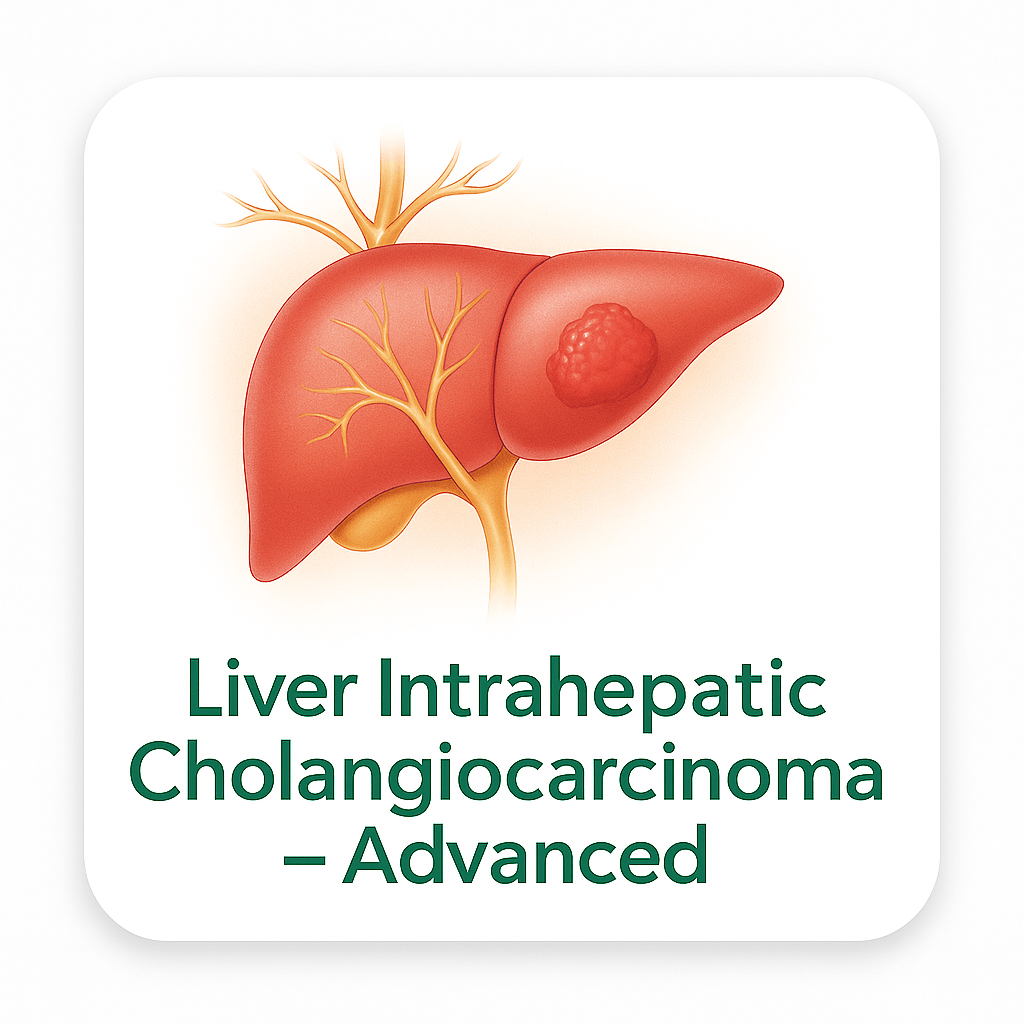
Liver Intrahepatic Cholangiocarcinoma – Advanced
Main Grouping
Digestive
Organ System
Liver
Cell Origin
Cholangiocyte epithelium
Pathways Affected
Intrahepatic cholangiocarcinoma involves a pathway landscape defined by the IDH1/IDH2/2-hydroxyglutarate oncometabolite pathway (the most distinctive and iCCA-enriched alteration), the FGFR2 RTK pathway (pathognomonic for iCCA), and the BAP1 chromatin remodeling pathway, with additional shared biliary epithelial carcinogenesis pathways including NF-kB, JAK/STAT, PI3K/AKT/mTOR, MAPK/ERK, and TGF-beta/SMAD.
The IDH1/IDH2/2-hydroxyglutarate oncometabolite pathway is the most distinctive pathway alteration in iCCA, with IDH1 R132 and IDH2 R172 gain-of-function neomorphic mutations in approximately 14 to 30 percent of iCCA and approximately 3 to 9 percent respectively; mutant IDH1/2 converts alpha-ketoglutarate (alpha-KG) to the oncometabolite 2-hydroxyglutarate (2-HG) instead of performing normal TCA cycle isocitrate-to-alpha-KG oxidative decarboxylation; 2-HG competitively inhibits alpha-KG-dependent enzymes including TET2/TET3 DNA demethylases (causing CpG island hypermethylation and CIMP epigenetic phenotype silencing differentiation genes), KDM histone demethylases (at H3K4me3, H3K9me3, H3K27me3), EglN prolyl hydroxylases (stabilizing HIF-1alpha under normoxia), and collagen prolyl hydroxylases (P4HA1/P4HA2); IDH mutations cluster with BAP1 mutations and FGFR2 fusions in the small duct iCCA molecular subgroup with better prognosis, being mutually exclusive with TP53 and KRAS mutations; EGCG inhibits DNMT activity targeting 2-HG-driven CIMP epigenetic silencing relevant to IDH-mutant iCCA; curcumin inhibits HDAC and DNMT targeting epigenetic disruption in iCCA.
The FGFR2 RTK signaling pathway is activated in approximately 10 to 22 percent of iCCA through FGFR2 gene fusions (most commonly with BICC1, PPHLN1, TACC3, or MGEA5 as the 3-prime fusion partner), with the fusion creating constitutively dimerized and kinase-active FGFR2 fusion proteins that signal through RAS/MAPK/ERK, PI3K/AKT/mTOR, and STAT3 downstream pathways; FGFR2 fusions are essentially pathognomonic for iCCA among all adult solid tumors; EGCG and quercetin both inhibit FGFR RTK activity and downstream MAPK/ERK and PI3K/AKT in cholangiocarcinoma models.
The NF-kB inflammatory pathway is constitutively activated in iCCA through tumor necrosis factor-alpha and IL-6 from cancer-associated fibroblasts and tumor-associated macrophages, through TLR4 signaling from gut microbiome lipopolysaccharide in the portal circulation activating Kupffer cells and iCCA biliary epithelial cells, and through KRAS mutation downstream IKK activation; curcumin abolished constitutive NF-kB activation in KKU100, KKU-M156, and KKU-M213 human cholangiocarcinoma cells confirmed by DNA binding and nuclear translocation assays, and NF-kB abolition by curcumin was IKK-dependent (confirmed with IKK-alpha and IKK-beta knockout cells) (PMC3165121); curcumin treatment inhibited proliferation and induced apoptosis in all three CCA cell lines through NF-kB pathway suppression.
The JAK/STAT pathway is constitutively activated in iCCA through IL-6 and IFN-gamma receptor signaling from the inflammatory biliary microenvironment; STAT3 phosphorylation (Y705) by JAK1/JAK2 is a dominant pro-survival and pro-proliferative signal in iCCA cholangiocytes; quercetin and EGCG suppressed IL-6- and IFN-gamma-regulated JAK/STAT (STAT1/3 phosphorylation) pathways in KKU100 cholangiocarcinoma cells, suppressing KKU100 cancer cell proliferation and migration in published research. The PI3K/AKT/mTOR pathway is activated in iCCA through PIK3CA mutations (approximately 6 to 14 percent), PTEN loss, and downstream of FGFR2 fusions, KRAS mutations, and EGFR signaling; curcumin inhibited PI3K/AKT in KKU100 CCA cells (PMC3165121); quercetin inhibits PI3K/AKT and mTOR in biliary tract cancer models. The MAPK/ERK pathway is activated in iCCA through KRAS mutations (approximately 10 to 18 percent), BRAF mutations (approximately 5 to 7 percent), and downstream of FGFR2 fusions; curcumin inhibited MAPK/ERK in KKU100 CCA cells (PMC3165121). The BAP1 chromatin remodeling pathway is inactivated through BAP1 loss-of-function mutations (approximately 9 to 23 percent of iCCA); BAP1 is a nuclear deubiquitylase that removes monoubiquitin from histone H2A K119 (H2AK119ub1), a Polycomb-repressed chromatin mark; BAP1 loss stabilizes H2AK119ub1 at Polycomb-repressed gene promoters maintaining gene silencing; BAP1 mutations co-occur with IDH1/2 mutations in the small duct iCCA subgroup; sulforaphane activates Nrf2/ARE and inhibits HDAC relevant to BAP1-loss-driven epigenetic deregulation in iCCA. The TGF-beta/SMAD tumor suppressor pathway is inactivated through SMAD4 loss (approximately 6 to 11 percent) and through TGF-beta/SMAD-independent signaling driving iCCA EMT; curcumin inhibits TGF-beta/SMAD in biliary tract cancer models.
Description
Intrahepatic cholangiocarcinoma (iCCA) is the second most common primary liver malignancy after hepatocellular carcinoma (HCC), representing approximately 10 to 15 percent of all primary liver cancers and approximately 20 percent of all liver cancer deaths. The global incidence of iCCA has been increasing over the past four decades in most regions of the world, with an estimated annual US incidence of approximately 2.1 per 100,000 and approximately 8,000 to 10,000 new iCCA diagnoses annually in the United States. Globally, bile duct cancers account for approximately 215,000 new cases and 199,000 deaths annually according to GLOBOCAN 2022 data. The highest incidence rates of cholangiocarcinoma are in Southeast Asia, particularly in Thailand, Laos, and Cambodia due to endemic liver fluke infestation causing chronic biliary inflammation.
The overall 5-year survival for iCCA across all stages is approximately 7 to 20 percent, making iCCA among the most lethal gastrointestinal malignancies. The 5-year survival for resectable iCCA (approximately 20 to 30 percent of patients at diagnosis) is approximately 20 to 40 percent after R0 resection, with a high recurrence rate of approximately 50 to 65 percent within 2 years; the 5-year survival for locally advanced unresectable iCCA is approximately 5 to 10 percent; and for metastatic iCCA the median overall survival is approximately 6 to 12 months with systemic treatment. Approximately 60 to 70 percent of patients present with advanced or metastatic iCCA at diagnosis, precluding curative surgical resection.
Risk factors for iCCA include primary sclerosing cholangitis (PSC, a particularly strong risk factor); inflammatory bowel disease (IBD), especially ulcerative colitis associated with PSC; hepatolithiasis (intrahepatic bile duct stones); congenital biliary abnormalities (Caroli disease, choledochal cysts); cirrhosis and chronic liver diseases; non-alcoholic fatty liver disease (NAFLD) and non-alcoholic steatohepatitis (NASH) association with iCCA has been documented; and toxin exposures including thorotrast.
The molecular landscape of iCCA is uniquely defined by IDH1/2 mutations (iCCA-enriched, approximately 20 to 30 percent), FGFR2 fusions (pathognomonic for iCCA, approximately 10 to 22 percent), and BAP1 mutations (iCCA-enriched, approximately 9 to 23 percent). Published laboratory research documents curcumin suppressing proliferation and inducing apoptosis in KKU100, KKU-M156, and KKU-M213 human cholangiocarcinoma cell lines through abolition of constitutive NF-kB activation, caspase activation, and PARP cleavage confirmed by multiple methods (PMC3165121); and quercetin and EGCG suppressing KKU100 cholangiocarcinoma cell proliferation and migration through JAK/STAT (STAT1/3 phosphorylation) pathway inhibition.
Plant-Based Description
Whole-food plant-based dietary patterns provide nutrients and phytochemicals with documented direct anti-cholangiocarcinoma cell line activity. Curcumin from turmeric was documented in a published study (PMC3165121) to inhibit proliferation of and induce apoptosis in KKU100, KKU-M156, and KKU-M213 human cholangiocarcinoma cell lines through abolition of constitutive NF-kB activation confirmed by DNA binding, nuclear translocation, and IKK-dependent mechanism; caspase activation and PARP cleavage confirmed by multiple methods; colony formation assay confirmed growth-inhibitory effect; curcumin activated multiple cell signaling pathways in CCA cells beyond NF-kB including PI3K/AKT, MAPK/ERK, and apoptotic pathways. Quercetin and EGCG from green tea both suppressed KKU100 cholangiocarcinoma cell proliferation and migration through JAK/STAT pathway inhibition confirmed in published research. Sulforaphane, resveratrol, and genistein all have documented activity in biliary tract cancer cell models. Dietary phytochemicals targeting the IDH-mutant 2-HG-driven CIMP epigenetic pathway (EGCG, sulforaphane via DNMT/HDAC inhibition) and the constitutive NF-kB inflammatory pathway (curcumin) address the two dominant oncogenic mechanisms in iCCA.
Plant Chemistry Detail
Curcumin from turmeric has the most directly documented anti-cholangiocarcinoma cell line activity with confirmed NF-kB pathway mechanism in a published study (PMC3165121): three human CCA cell lines representing different stages of adenocarcinoma were used — poorly differentiated KKU100, moderately differentiated KKU-M156, and well-differentiated KKU-M213 — all established from Thai CCA patients; curcumin inhibited proliferation of all three CCA cell lines confirmed by mitochondrial dehydrogenase activity assay; curcumin induced apoptosis in all three CCA cell lines confirmed by phosphatidylserine externalization (annexin V), esterase staining, caspase activation, and PARP cleavage; colony-formation assay confirmed the growth-inhibitory effect of curcumin on CCA cells; the mechanism was identified through the finding that all three CCA cell lines exhibited constitutively active NF-kB, and treatment with curcumin abolished this NF-kB activation confirmed by DNA binding assay, nuclear translocation assay, and p65 phosphorylation; the NF-kB abolition by curcumin was IKK-dependent, confirmed using IKK-alpha and IKK-beta knockout cells where curcumin could not abolish NF-kB activation in IKK knockout cells; curcumin additionally modulated multiple other signaling pathways in CCA cells including PI3K/AKT and MAPK/ERK.
Quercetin from yellow onions and kale was documented to suppress KKU100 cholangiocarcinoma cell proliferation and migration through JAK/STAT pathway inhibition, with IL-6- and IFN-gamma-regulated STAT1/3 phosphorylation reduced; quercetin inhibits constitutively active STAT3 in iCCA relevant to the IL-6-driven inflammatory microenvironment and is relevant to FGFR2-fusion-driven downstream STAT3 activation in iCCA (approximately 10 to 22 percent of iCCA). EGCG from green tea was documented to suppress KKU100 cholangiocarcinoma cell proliferation and migration through JAK/STAT pathway inhibition alongside quercetin in the same published study, targeting the constitutively active STAT3 downstream of FGFR2 fusions and IL-6 signaling; EGCG additionally inhibits DNMT activity targeting IDH1/2-mutation-driven CIMP epigenetic silencing (IDH mutations approximately 20 to 30 percent of iCCA) and inhibits FGFR RTK kinase activity relevant to FGFR2 fusions (approximately 10 to 22 percent of iCCA). Sulforaphane from cruciferous vegetables activates Nrf2/ARE providing antioxidant defense in biliary epithelial cells and inhibits HDAC and DNMT targeting epigenetic tumor suppressor gene silencing driven by IDH1/2-2HG-mediated CIMP and BAP1-loss-mediated H2AK119ub1 stabilization in iCCA. Resveratrol inhibits NF-kB, PI3K/AKT, STAT3, and VEGF in biliary tract cancer cell models. Apigenin from parsley inhibits NF-kB, STAT3, and PI3K/AKT in CCA cell models. Kaempferol from kale and broccoli induces apoptosis through caspase-3 activation in biliary tract cancer cell models. Genistein from soybeans inhibits FGFR, PI3K/AKT, and STAT3 in biliary tract cancer cell models.
Nutritional Focus
Nutritional focus in intrahepatic cholangiocarcinoma research is led by curcumin from turmeric with the most directly documented anti-cholangiocarcinoma cell line activity with confirmed NF-kB mechanism in a published study (PMC3165121): curcumin inhibiting proliferation of and inducing apoptosis in KKU100, KKU-M156, and KKU-M213 human CCA cell lines representing poorly, moderately, and well-differentiated cholangiocarcinoma through abolition of constitutive NF-kB activation confirmed by DNA binding, nuclear translocation, p65 phosphorylation assays and IKK-dependent mechanism confirmed with IKK-alpha and IKK-beta knockout cells; apoptosis confirmed by phosphatidylserine externalization, esterase staining, caspase activation, and PARP cleavage; growth inhibition confirmed by colony-formation assay; curcumin additionally modulating PI3K/AKT and MAPK/ERK in KKU100 CCA cells; quercetin documented to suppress KKU100 CCA cell proliferation and migration through JAK/STAT (STAT1/3) pathway inhibition directly targeting the constitutive STAT3 activity downstream of FGFR2 fusions (approximately 10 to 22 percent of iCCA) and the IL-6 inflammatory signaling driving the iCCA biliary microenvironment; EGCG from green tea documented alongside quercetin to suppress KKU100 cholangiocarcinoma cell proliferation and migration through JAK/STAT pathway inhibition and additionally inhibiting DNMT activity targeting IDH1/2-mutation-driven CIMP epigenetic silencing (IDH mutations approximately 20 to 30 percent of iCCA) and FGFR RTK kinase activity; sulforaphane from cruciferous vegetables activating Nrf2/ARE in biliary epithelial cells providing antioxidant defense against bile acid-induced oxidative DNA damage driving the chronic biliary inflammation-carcinogenesis cascade underlying iCCA and inhibiting HDAC targeting IDH1/2-2HG-CIMP and BAP1-loss epigenetic dysregulation; resveratrol inhibiting NF-kB, PI3K/AKT, STAT3, and VEGF in biliary tract cancer cell models; genistein from soybeans inhibiting FGFR, PI3K/AKT, and STAT3 targeting the dominant FGFR2-PI3K/AKT/STAT3 oncogenic axis in FGFR2-fused iCCA; and folate from leafy greens and legumes supporting one-carbon methyl group availability for SAM-cycle chemistry directly relevant to the IDH1/2-CIMP DNA hypermethylation dynamics in approximately 20 to 30 percent of iCCA.
Research Notes
iCCA epidemiology: 2nd most common primary liver malignancy; ~10-15% of all primary liver cancers; ~8,000-10,000 new US diagnoses annually; globally biliary tract cancers ~215,000 new cases and ~199,000 deaths annually (GLOBOCAN 2022); iCCA incidence increasing over past 4 decades globally; highest incidence Southeast Asia. 5-year survival: overall ~7-20%; resectable ~20-40% after R0 resection; locally advanced ~5-10%; metastatic median OS ~6-12 months; ~60-70% present with advanced/metastatic disease. Molecular alterations: IDH1 ~14-30%; IDH2 ~3-9%; FGFR2 fusions/rearrangements ~10-22% (pathognomonic for iCCA); BAP1 ~9-23% (iCCA-enriched, essentially absent from eCCA); ARID1A ~6-23%; TP53 ~11-43%; KRAS ~10-18%; CDKN2A ~7-15%; PIK3CA ~6-14%; SMAD4 ~6-11%; BRAF ~5-7%; ATM ~5-9%; SMARCA4 ~7%; ERBB2 amplification ~3-6%; MSI-H ~1-4%. Two molecular subgroups: small duct iCCA (IDH1/2 + FGFR2 fusions + BAP1; better prognosis) and large duct iCCA (KRAS + SMAD4 + TP53; worse prognosis). IDH1 and FGFR2 mutually exclusive with TP53 and KRAS. IDH1/2 mutations generate 2-HG oncometabolite inhibiting: TET2/TET3 DNA demethylases (CIMP); KDM histone demethylases; EglN prolyl hydroxylases; P4HA1/P4HA2 collagen hydroxylases. Curcumin KKU100 KKU-M156 KKU-M213 CCA (PMC3165121): proliferation inhibited by MTT; apoptosis confirmed by annexin V, esterase staining, caspase activation, PARP cleavage; colony formation inhibited; NF-kB abolished by DNA binding/nuclear translocation/p65; IKK-dependent mechanism confirmed with IKK-KO cells; PI3K/AKT and MAPK/ERK modulated. Quercetin + EGCG KKU100: JAK/STAT (STAT1/3) inhibition; proliferation and migration suppressed.
Notes Visibility
Key Foods
Turmeric,Broccoli,Kale,Spinach,Brussels Sprouts,Cauliflower,Garlic,Yellow Onion,Carrot,Tomato,Beetroot,Cabbage,Blueberry,Pomegranate,Grape,Raspberry,Strawberry,Apple,Orange,Lemon,Soybeans,Edamame,Green Lentils,Black Beans,Chickpeas,Brown Rice,Quinoa,Oats,Wild Rice,Black Rice,Walnut,Almond,Brazil Nut,Flaxseed,Pumpkin Seeds,Chia Seeds,Sesame Seeds,Hemp Seeds,Shiitake,Maitake,Cremini,Portobello,Lions Mane,Green Tea,Ginger,Black Pepper,Garlic Powder,Parsley,Rosemary,Oregano, Celery, Fennel, Leek,Avocado,Artichoke,Endive,Radish,Radicchio,Fig,Tangerine,Dragon Fruit Red, Red Onion
Linked Nutrients
vitamin-c,vitamin-e,vitamin-d3,vitamin-b9,vitamin-b6,vitamin-a,selenium,zinc,magnesium,calcium,potassium,iron,curcumin,quercetin,egcg,sulforaphane,resveratrol,genistein,beta-carotene,anthocyanins,beta-glucans,dietary-fiber,plant-ala-omega3
Last Updated
2025-10-13 10:01:58

