
ID
53
Cancer Name
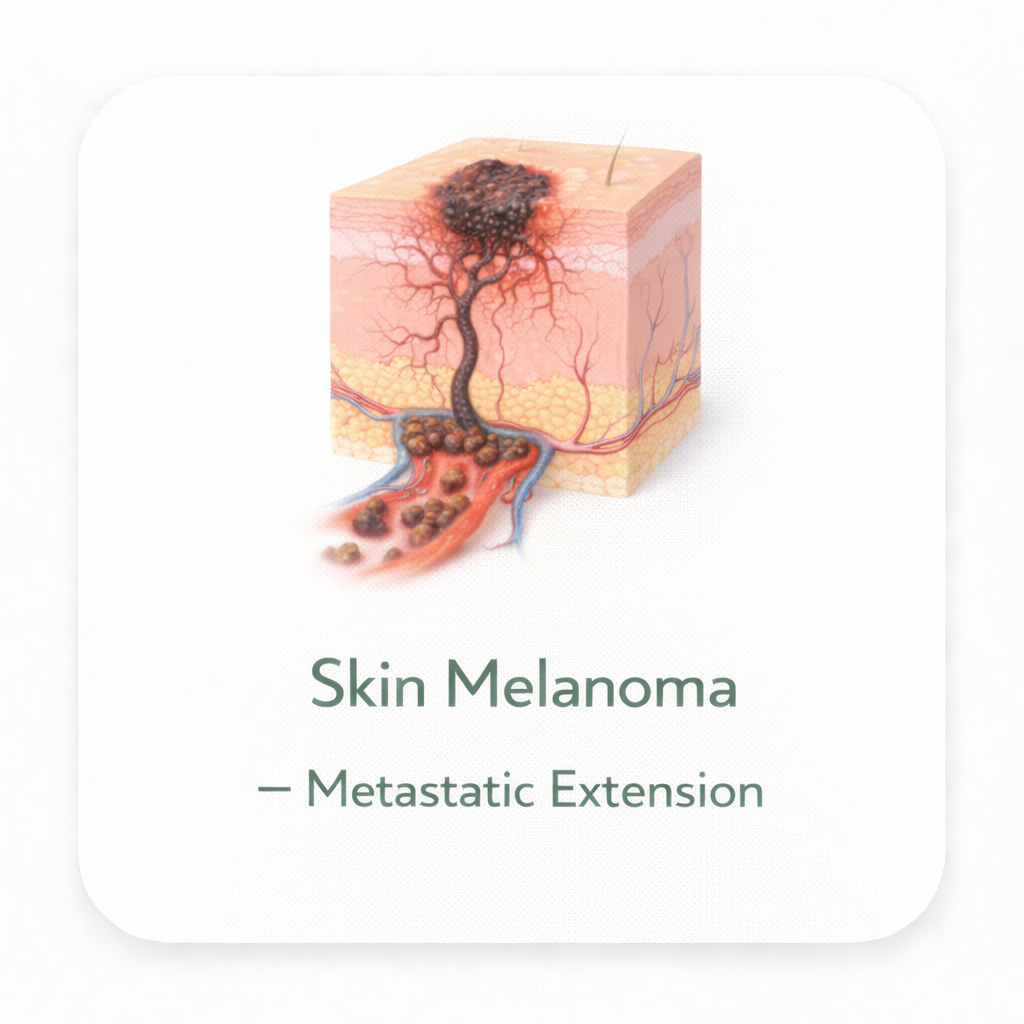
Skin Melanoma – Metastatic Extension
Main Grouping
Integumentary
Organ System
Skin
Cell Origin
Melanocytes
Pathways Affected
Metastatic melanoma involves one of the most extensively characterized and therapeutically targeted oncogenic pathway landscapes among all solid tumors, dominated by constitutive BRAF/NRAS/NF1/RAS/RAF/MEK/ERK MAPK signaling, PI3K/AKT/mTOR pathway activation through PTEN loss, and immune checkpoint evasion through PD-L1/PD-1 signaling.
The BRAF/RAS/RAF/MEK/ERK MAPK pathway is the dominant oncogenic driver pathway in cutaneous melanoma, activated in approximately 80 percent of all cutaneous melanomas through three mutually exclusive mechanisms: BRAF V600E activating mutation (approximately 45 to 52 percent), which allows BRAF to signal as a constitutively active monomer through MEK1/2-ERK1/2 without requiring RAS-mediated dimerization; NRAS Q61 activating mutation (approximately 28 percent), which simultaneously activates BRAF/CRAF/MEK/ERK, PI3K/AKT/mTOR, and RAL-GEF downstream effector arms; and NF1 loss-of-function (approximately 14 percent) through deletion or truncating mutation removing RAS GTPase activating protein activity enabling constitutive RAS activation; ERK1/2 activated by BRAF/MEK drives transcription of CCND1 (Cyclin D1), CDK4, MYC, and MITF pro-proliferative and melanocyte survival target genes; resveratrol inhibited proliferation and induced apoptosis in MV3 and A375 human melanoma cells through negatively regulating the Erk/PKM2/Bcl-2 axis — MTT assay confirmed dose-dependent cell viability reduction at 50, 100, and 200 μM; BrdU staining confirmed significant decrease in BrdU-positive proliferating cells; apoptosis was confirmed (PMC6294058); quercetin with luteolin inhibited viability, induced apoptosis, and modulated ERK/MAPK signaling in A375 BRAFV600E cutaneous melanoma cells (PMC11943993); curcumin combined with genistein inhibited proliferation and invasion in A375 (BRAFV600E) and CHL-1 human melanoma cell lines, induced apoptosis confirmed by MTT, FDA/PI staining, DNA fragmentation, and comet assay, reduced anti-apoptotic Bcl-2 protein, and reduced FAK protein expression (PMC12383553).
The PI3K/AKT/mTOR pathway is activated in melanoma through PTEN loss-of-function (approximately 20 to 30 percent of melanoma, through deletion, mutation, or promoter methylation), AKT3 amplification (approximately 60 percent of melanomas show elevated AKT3 expression), downstream of NRAS mutations that activate PI3K-p110alpha, and through receptor tyrosine kinase (IGF-1R, EGFR, KIT) signaling; PTEN loss is the most common mechanism of PI3K/AKT/mTOR activation in melanoma; PI3K/AKT/mTOR drives melanoma cell survival, resistance to apoptosis, and acquired resistance to BRAF/MEK inhibitors in BRAF-mutant melanoma; resveratrol inhibits PI3K/AKT in melanoma cell models; curcumin inhibits PI3K/AKT in A375 melanoma cells as documented in the published study (PMC12383553). The p53 tumor suppressor pathway is inactivated in melanoma through two parallel mechanisms: CDKN2A deletion or mutation (approximately 50 to 60 percent of melanoma) simultaneously eliminating both p16/INK4a (CDK4/6 inhibitor protecting Rb from phosphorylation) and p14/ARF (MDM2 inhibitor protecting p53 from ubiquitin-mediated degradation); and TP53 direct mutations (approximately 17 to 20 percent); curcumin restores p53 pro-apoptotic signaling and reduces Bcl-2 in A375 melanoma cells (PMC12383553). The TERT promoter/telomere maintenance pathway is uniquely activated in approximately 70 to 75 percent of melanomas through the most common single-nucleotide mutation in melanoma — the TERT promoter C228T or C250T UV-signature C>T transitions creating de novo ETS binding sites for GABPA transcription factor driving constitutive TERT expression and replicative immortality. The PD-1/PD-L1 immune checkpoint pathway is the dominant immunological pathway in melanoma immune evasion; melanoma cells constitutively express PD-L1 (CD274) through JAK/STAT3-driven transcription and BRAF/MEK/ERK-driven IFN-gamma response gene activation; melanoma has the highest proportion of patients responding to PD-1/CTLA-4 checkpoint inhibition among all solid cancers; plant polyphenols including EGCG, resveratrol, and quercetin have documented PD-L1 downregulation activity in cancer cell models. The Wnt/beta-catenin pathway plays a unique dual role in melanoma: Wnt/beta-catenin signaling in melanocytes normally drives MITF transcription supporting melanocyte survival; beta-catenin nuclear accumulation (CTNNB1 mutations in a subset) drives proliferative transcription while suppressing T cell infiltration creating an immune-cold tumor microenvironment; resveratrol inhibits Wnt/beta-catenin and MITF in melanoma models. The MITF (microphthalmia-associated transcription factor) pathway is the master melanocyte lineage transcription factor and oncogene in a subset of melanoma; MITF is amplified in approximately 20 percent of metastatic melanoma; MITF drives transcription of melanocyte differentiation genes (TYR, DCT, TYRP1) and survival genes (BCL2, CDK2); curcumin inhibits MITF in melanoma cell models.
Description
Melanoma is the most lethal form of skin cancer, accounting for approximately 4 to 5 percent of all skin cancer diagnoses but approximately 75 percent of all skin cancer deaths. In the United States, an estimated 100,640 new melanoma cases and 8,290 deaths were projected for 2024, making melanoma the fifth most common cancer in the United States. Globally, melanoma accounts for approximately 325,000 new cases and 57,000 deaths annually according to GLOBOCAN 2022. The incidence of melanoma has increased substantially over the past five decades, driven primarily by cumulative UV radiation exposure and intermittent intense sun exposure causing sunburns, with one blistering sunburn before age 18 doubling lifetime melanoma risk.
The 5-year survival for melanoma by AJCC stage is approximately 98 to 99 percent for stage IA (localized thin melanoma, Breslow thickness less than 0.8 mm, no ulceration); approximately 90 to 97 percent for stage IB; approximately 77 to 90 percent for stage IIA-IIB; approximately 64 to 78 percent for stage IIC-IIIA; approximately 24 to 52 percent for stage IIIB-IIID; and approximately 16 to 36 percent for stage IV metastatic melanoma depending on the specific M substage; M1d brain metastasis has the worst prognosis among stage IV substages.
Melanoma's molecular complexity stems from its high mutational burden (median ~17 mutations/megabase, one of the highest among all cancers) driven by the UV radiation signature — predominantly C>T transitions at dipyrimidine sites. The TERT promoter C>T mutation at positions chr5:1,295,228 (C228T) or 1,295,250 (C250T) is the most common single mutation in melanoma, occurring in approximately 70 to 75 percent of melanomas, creating a de novo ETS/GABPA transcription factor binding site that drives constitutive TERT (telomerase reverse transcriptase) expression and replicative immortality.
The BRAF/NRAS/RAS/RAF/MEK/ERK MAPK pathway is constitutively activated in approximately 80 percent of all cutaneous melanomas: BRAF V600E (approximately 45 to 52 percent of melanoma) constitutively activates MEK1/2/ERK1/2 as a monomer without requiring RAS-mediated dimerization; NRAS Q61 mutations (approximately 28 percent) activate all three major RAS effector arms (RAF/MEK/ERK, PI3K/AKT, and RAL-GEF); and NF1 loss-of-function (approximately 14 percent) removes the dominant negative regulator of RAS GTPase activity leading to constitutive RAS/RAF/MEK/ERK signaling. Published laboratory research documents resveratrol inducing apoptosis in MV3 and A375 human melanoma cells through negatively regulating the Erk/PKM2/Bcl-2 axis with dose-dependent MTT assay and BrdU proliferation inhibition confirmed (PMC6294058); curcumin combined with genistein inducing apoptosis confirmed by MTT, FDA/PI staining, DNA fragmentation, and comet assay in A375 (BRAFV600E) and CHL-1 human melanoma cell lines and reducing Bcl-2 and FAK protein expression (PMC12383553); and quercetin with luteolin inhibiting viability and inducing apoptosis and cell cycle arrest in A375 cutaneous melanoma cells through GPER and MAPK pathway modulation (PMC11943993).
Plant-Based Description
Whole-food plant-based dietary patterns provide phytochemicals with documented direct anti-melanoma cell line activity across multiple human melanoma cell lines. Resveratrol from red grapes induced apoptosis in MV3 and A375 human melanoma cell lines through negatively regulating the Erk/PKM2/Bcl-2 axis confirmed by MTT assay dose-dependent viability reduction and BrdU-staining proliferation inhibition (PMC6294058); curcumin combined with genistein from soybeans induced apoptosis confirmed by MTT, FDA/PI staining, DNA fragmentation, and comet assay in A375 (BRAFV600E) and CHL-1 human melanoma cell lines, reduced Bcl-2 and FAK protein expression, and inhibited cell invasiveness (PMC12383553); quercetin combined with luteolin inhibited viability, induced apoptosis, and produced cell cycle arrest in A375 cutaneous melanoma cells through GPER and MAPK pathway modulation (PMC11943993); and quercetin inhibited tumor growth in mice xenografted with B16-F10 and A375 melanoma cells with upregulation of anti-tumor immune mediators IFN-alpha and IFN-beta confirmed in published research (PMC12730209). Dietary fiber from whole plant foods modulates gut microbiome composition, which is documented to influence melanoma immune checkpoint responses.
Plant Chemistry Detail
Resveratrol from grapes, blueberries, and pomegranate has the most directly documented anti-melanoma cell line activity with confirmed MAPK mechanism targeting the dominant BRAFV600E/ERK oncogenic pathway in melanoma in a published study (PMC6294058): human melanoma cell lines MV3 and A375 (BRAFV600E) were treated with resveratrol at 50, 100, and 200 μM for 48 hours; MTT assay confirmed that resveratrol treatment significantly reduced MV3 and A375 melanoma cell viability in a dose-dependent manner; BrdU staining assay confirmed that resveratrol treatment for 48 hours resulted in significant decrease in the percentage of BrdU-positive proliferating cells compared to DMSO-treated controls; resveratrol dramatically inhibited cell growth and proliferation in human melanoma cells; resveratrol's mechanism involved negative regulation of the Erk/PKM2/Bcl-2 axis — the ERK pathway that is constitutively activated by BRAFV600E in A375 cells — with Bcl-2 anti-apoptotic protein reduction driving apoptosis; the published study concluded that resveratrol is a potent inducer of apoptosis in human melanoma through this ERK/PKM2/Bcl-2 mechanism.
Curcumin from turmeric was documented in a published study (PMC12383553) in A375 (BRAFV600E) and CHL-1 human melanoma cell lines: curcumin induced cell death confirmed by MTT assay and FDA/PI staining in both A375 (BRAFV600E mutant) and CHL-1 (primary melanoma) cell lines; the anti-apoptotic protein Bcl-2 was significantly reduced after curcumin treatment in both cell lines; curcumin significantly increased DNA fragmentation confirmed by DNA fragmentation assay; comet assay confirmed curcumin-induced cell death quantified by measuring displacement between comet head and tail; FAK (focal adhesion kinase) protein expression was significantly reduced by curcumin in both CHL-1 cells and A375 cells; anti-proliferative effects confirmed by scratch assay; phospho-p38 was reduced; combined curcumin and genistein treatment produced synergistic anti-proliferative effects against the most aggressive A375 BRAFV600E melanoma cells; curcumin suppresses melanoma growth through NF-kB, PI3K/AKT, and MAPK signaling inhibition as established across multiple published studies.
Quercetin from kale and yellow onions was documented in a published study (PMC11943993) to exert antitumor effects against A375 cutaneous melanoma cells: quercetin inhibited A375 cell viability confirmed by MTT assay; quercetin induced apoptosis in A375 cells confirmed by flow cytometry; quercetin induced cell cycle arrest in A375 cells; quercetin reduced cell migration confirmed by transwell assay; quercetin upregulated GPER (G-protein coupled estrogen receptor) expression and modulated ERK phosphorylation in A375 BRAFV600E melanoma cells; combined quercetin and luteolin treatment produced enhanced antitumor effects in A375 CM cells; quercetin additionally inhibited tumor growth in mice xenografted with B16-F10 and A375 melanoma cells with upregulation of IFN-alpha and IFN-beta and enhancement of CD8+ T cells, CD4+ T cells, and M1 macrophages in the tumor microenvironment (PMC12730209). EGCG from green tea inhibits BRAF/MEK/ERK and PI3K/AKT in melanoma cell models and inhibits MMP-2 and MMP-9 matrix metalloproteinases that mediate melanoma invasion and metastasis. Ellagic acid from pomegranate inhibits BRAF/MAPK and PI3K/AKT/mTOR in melanoma cell models and induces G1 cell cycle arrest. Sulforaphane from cruciferous vegetables inhibits NF-kB, STAT3, VEGF, and activates Nrf2/ARE providing antioxidant defense against UV-induced oxidative DNA damage. Genistein from soybeans inhibits NF-kB, PI3K/AKT, and MITF in melanoma cell models. Fisetin from strawberries inhibits PI3K/AKT/mTOR and NF-kB in melanoma cell models and induces apoptosis through caspase-3 activation in melanoma cell lines.
Nutritional Focus
Nutritional focus in metastatic melanoma research is led by resveratrol from grapes and berries with the most directly documented anti-melanoma cell line activity with confirmed ERK/PKM2/Bcl-2 axis mechanism in a published study (PMC6294058): resveratrol dramatically inhibiting cell growth and proliferation in MV3 and A375 (BRAFV600E) human melanoma cell lines confirmed by MTT assay dose-dependent viability reduction and BrdU staining proliferation inhibition at 50 to 200 μM, inducing apoptosis through negative regulation of the Erk/PKM2/Bcl-2 axis directly targeting the dominant BRAFV600E-ERK constitutive oncogenic signaling present in approximately 45 to 52 percent of cutaneous melanoma; curcumin from turmeric documented to induce apoptosis confirmed by MTT, FDA/PI staining, DNA fragmentation, and comet assay in A375 (BRAFV600E) and CHL-1 human melanoma cell lines through Bcl-2 reduction, FAK inhibition, and NF-kB/PI3K/AKT/MAPK pathway suppression (PMC12383553); quercetin from kale and onions documented to inhibit A375 melanoma cell viability, induce apoptosis, cause cell cycle arrest, reduce migration, and modulate ERK phosphorylation and GPER in A375 cutaneous melanoma cells (PMC11943993) with additional in vivo xenograft tumor growth inhibition in B16-F10 and A375 melanoma models with IFN-alpha, IFN-beta, CD8+ T cell, and M1 macrophage enhancement (PMC12730209); EGCG from green tea inhibiting BRAF/MEK/ERK and PI3K/AKT in melanoma cells and reducing MMP-2 and MMP-9 metalloproteinase-driven invasion; ellagic acid from pomegranate inhibiting BRAF/MAPK and PI3K/AKT/mTOR targeting two dominant melanoma oncogenic pathways; sulforaphane from cruciferous vegetables activating Nrf2/ARE in keratinocytes and melanocytes providing antioxidant defense against the UV-induced oxidative DNA damage that generates the dominant C>T UV mutational signature responsible for the majority of cutaneous melanoma driver mutations; genistein from soybeans inhibiting NF-kB, PI3K/AKT, and MITF in melanoma cell models; and dietary fiber from whole plant foods modulating gut microbiome composition with documented associations with melanoma immune checkpoint response outcomes.
Research Notes
Melanoma epidemiology: US ~100,640 new cases and ~8,290 deaths projected 2024; 5th most common cancer in US; globally ~325,000 new cases and ~57,000 deaths annually (GLOBOCAN 2022); incidence increased substantially over 5 decades; melanoma is ~4-5% of skin cancers but ~75% of skin cancer deaths. 5-year survival by AJCC stage: IA ~98-99%; IB ~90-97%; IIA-IIB ~77-90%; IIC-IIIA ~64-78%; IIIB-IIID ~24-52%; IV ~16-36% (M1d brain metastasis worst). Molecular alterations: BRAF V600E ~45-52% (V600K ~14%, V600D ~6%); NRAS Q61 mutations ~28%; NF1 loss-of-function ~14%; triple wild-type ~6%; TERT promoter C228T/C250T mutations ~70-75% (most common single mutation); CDKN2A deletions/mutations ~50-60%; PTEN loss ~20-30%; TP53 ~17-20%; MITF amplification ~20% metastatic; KIT mutations ~15-20% acral/mucosal; ARID2 ~13%; TMB median ~17 mutations/Mb (among highest). UV signature C>T transitions at dipyrimidines dominant mutational process. TCGA 4 molecular subgroups: BRAF (~52%), NRAS (~28%), NF1 (~14%), triple WT (~6%). Distant metastasis: lung ~70-87%, liver ~54-77%, brain ~54-75%, bone ~23-49%, small intestine ~35-66%. Resveratrol A375 MV3 melanoma (PMC6294058): MTT dose-dependent viability reduction 50-200 μM; BrdU proliferation inhibition; negative Erk/PKM2/Bcl-2 regulation; apoptosis induction. Curcumin + genistein A375 CHL-1 (PMC12383553): MTT, FDA/PI, DNA fragmentation, comet assay apoptosis; Bcl-2 reduction; FAK reduction; scratch assay anti-proliferative; phospho-p38 reduction. Quercetin + luteolin A375 (PMC11943993): MTT viability reduction; flow cytometry apoptosis and cell cycle arrest; transwell migration inhibition; GPER upregulation; ERK modulation. Quercetin in vivo B16-F10 A375 xenograft: tumor growth inhibition; IFN-alpha, IFN-beta upregulation; CD8+ T cells, CD4+ T cells, M1 macrophages enhancement (PMC12730209).
Notes Visibility
show
Key Foods
Turmeric,Broccoli,Kale,Spinach,Brussels Sprouts,Cauliflower,Garlic,Yellow Onion,Carrot,Tomato,Beetroot,Cabbage,Blueberry,Pomegranate,Grape,Raspberry,Strawberry,Apple,Orange,Lemon,Soybeans,Edamame,Green Lentils,Black Beans,Chickpeas,Brown Rice,Quinoa,Oats,Wild Rice,Black Rice,Walnut,Almond,Brazil Nut,Flaxseed,Pumpkin Seeds,Chia Seeds,Sesame Seeds,Hemp Seeds,Shiitake,Maitake,Cremini,Portobello,Lions Mane,Green Tea,Ginger,Black Pepper,Garlic Powder,Parsley,Rosemary,Oregano, Celery, Leek,Avocado,Artichoke,Radish,Radicchio,Fig,Tangerine,Dragon Fruit Red, Red Onion
Linked Nutrients
vitamin-c,vitamin-e,vitamin-d3,vitamin-b9,vitamin-b6,vitamin-a,selenium,zinc,magnesium,calcium,potassium,iron,resveratrol,curcumin,quercetin,egcg,sulforaphane,genistein,ellagic-acid,beta-carotene,anthocyanins,beta-glucans,dietary-fiber
Last Updated
2025-10-13 10:01:58

