
ID
54
Cancer Name
Kidney Clear Cell Carcinoma – Extension
Main Grouping
Urinary
Organ System
Kidney
Cell Origin
Epithelial (clear cell)
Pathways Affected
Clear cell renal cell carcinoma involves a pathway landscape uniquely defined by constitutive VHL-loss-driven HIF-1alpha and HIF-2alpha stabilization — the founding and nearly universal event (~90 to 92 percent) — which activates a cascade of downstream oncogenic pathways including constitutive VEGF/VEGFR2 tumor angiogenesis, Warburg-effect aerobic glycolysis, mTOR signaling, PI3K/AKT, and NF-kB.
The VHL/HIF/VEGF/angiogenesis pathway is the defining and most therapeutically important pathway in ccRCC: biallelic VHL inactivation prevents pVHL from binding the oxygen-sensing prolyl hydroxylation sites on HIF-alpha subunits (P402 and P564 of HIF-1alpha) resulting in constitutive HIF-1alpha and HIF-2alpha stabilization at all oxygen tensions; HIF-1alpha transcriptionally activates VEGF-A (~3-10-fold upregulation), VEGFR1, GLUT1, GLUT3, LDHA, PDK1, CAIX, CAXII, TGF-alpha, PDGFB, EPO, and hundreds of additional hypoxia-response genes in ccRCC cells; VEGF drives autocrine and paracrine VEGFR2/KDR signaling in ccRCC tumor vasculature creating the strikingly hypervascular histological appearance of ccRCC; HIF-2alpha in ccRCC (the dominant HIF isoform in 786-O cells) drives MYC co-activation (HIF-2alpha/MYC synergy boosting ribosome biogenesis and anabolism), cyclin D1 transcription, VEGF-A, and CCND1; curcumin inhibited mTOR and p-mTOR protein expression in VHL-null 786-O ccRCC cells confirmed by Western blot (PMC8986413); EGCG and quercetin both inhibit HIF-1alpha, VEGF, and VEGFR2 in RCC cell models; quercetin inhibited VEGF/VEGFR2 protein expression in ccRCC Caki-2 cells confirmed by Western blot (PMC4525827).
The mTOR/PI3K/AKT pathway is constitutively activated in ccRCC through two distinct mechanisms: direct mTOR activating somatic mutations (~5 percent of ccRCC) and PIK3CA mutations (~4 percent); and indirectly through HIF-alpha/VEGF/PDGF receptor tyrosine kinase signaling driving PI3K/AKT/mTOR; mTORC1 drives ribosome biogenesis, protein synthesis, and anabolic metabolism in ccRCC; curcumin inhibited mTOR and p-mTOR in 786-O cells by Western blot with dose-dependent MTT proliferation inhibition, S-phase reduction, G1/G2M arrest, and apoptosis rate increase confirmed (PMC8986413); curcumin induced apoptosis and autophagy in ACHN RCC cells through Akt/mTOR suppression confirmed by annexin V-FITC/PI flow cytometry and Western blot (PMC8806675); quercetin inhibited AKT/mTOR/ERK1/2 pathway proteins in Caki-2 ccRCC cells (PMC4525827). The Wnt/beta-catenin pathway is activated in a subset of ccRCC through CTNNB1 mutations and BAP1 loss; Wnt/beta-catenin drives CCND1, MYC, and MMP transcription; curcumin and quercetin both inhibit Wnt/beta-catenin in RCC models. The chromatin remodeling/epigenetic pathway is uniquely dysregulated in ccRCC through PBRM1 loss (~40-55%), BAP1 loss (~10-15%), and SETD2 loss (~10-15%): PBRM1 loss removes the BAF180 SWI/SNF subunit impairing enhancer-promoter contacts for DNA repair and tumor suppressor gene transcription; BAP1 loss stabilizes H2AK119ub1 Polycomb-repressive chromatin marks at tumor suppressor gene promoters; SETD2 loss eliminates H3K36me3 from transcribed gene bodies impairing RNA splicing fidelity, mismatch repair, and homologous recombination; EGCG and curcumin both inhibit HDAC and DNMT targeting epigenetic tumor suppressor gene silencing relevant to BAP1 and SETD2 loss-driven chromatin dysregulation in ccRCC.
The NF-kB inflammatory pathway is activated in ccRCC through HIF-alpha/VEGF/TNF-alpha autocrine signaling from ccRCC tumor cells and tumor-associated macrophages (TAMs); BAP1 loss drives an inflammatory, immune-infiltrated microenvironment with elevated IL-1beta/NF-kB and IL-10/STAT3 signaling; curcumin inhibits NF-kB in RCC cell models; quercetin inhibited COX2 (a NF-kB transcriptional target) in Caki-2 ccRCC cells confirmed by Western blot (PMC4525827). The TGF-beta/SMAD pathway is activated in ccRCC through HIF-alpha-driven TGF-alpha (activating EGFR not TGF-beta receptor) and through TGF-beta secretion from ccRCC cells and CAFs driving EMT and immunosuppressive Treg expansion. The mismatch repair/DNA repair pathway is impaired in SETD2-mutant ccRCC (~10-15%) through H3K36me3 loss — MSH6 binds H3K36me3 for post-replication mismatch repair; SETD2-mutant ccRCC shows microsatellite instability-like phenotype and elevated tumor mutational burden. The hypoxia/HIF-1alpha pathway is constitutively active in ~90-92% of ccRCC through VHL loss regardless of actual oxygen tension. The ferroptosis pathway is an emerging therapeutic target in ccRCC through SLC7A11 (xCT) upregulation by HIF-2alpha providing cystine import for glutathione maintenance — EGCG inhibits SLC7A11 in cancer cell models.
Description
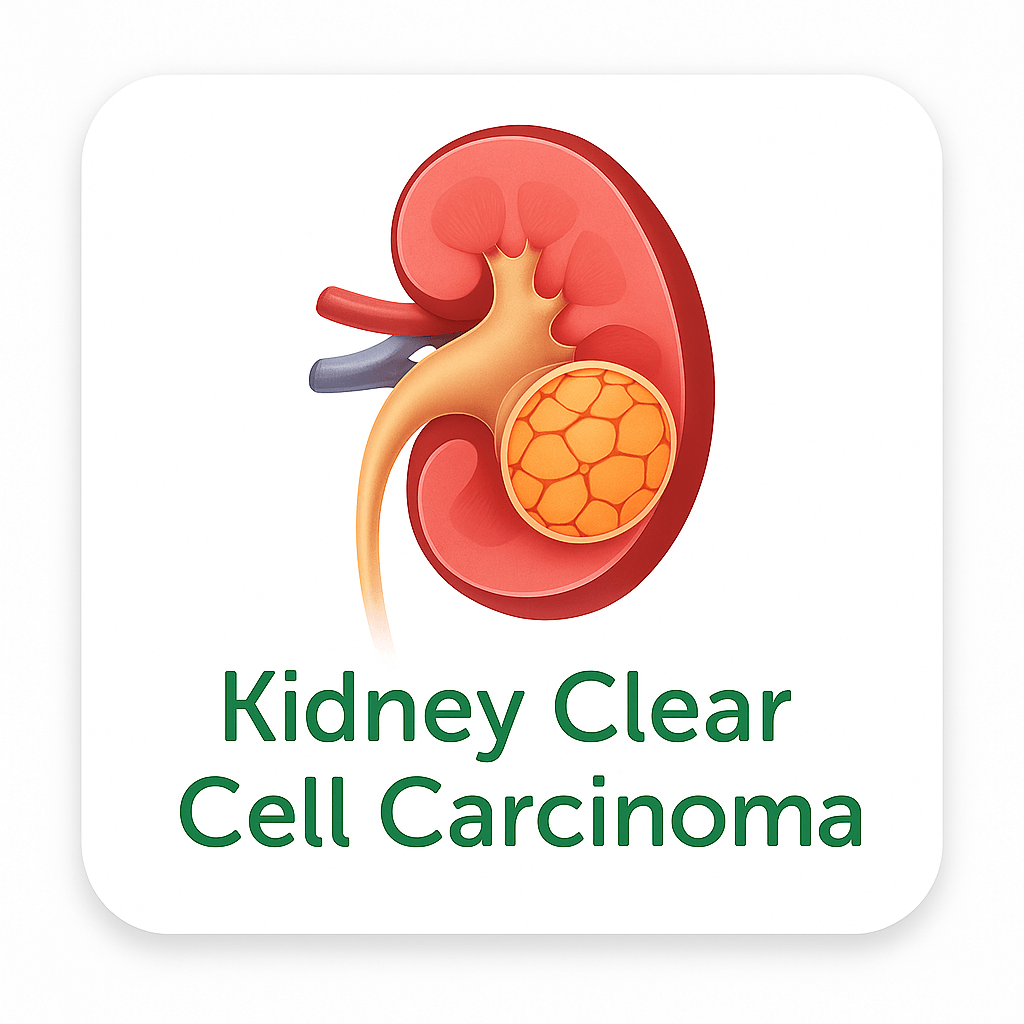
Clear cell renal cell carcinoma (ccRCC) is the most common form of kidney cancer and the most common urological malignancy after bladder and prostate cancer in men. In the United States, an estimated 81,800 new kidney and renal pelvis cancer cases and 14,890 deaths were projected for 2024 according to SEER data. Globally, kidney cancer accounts for approximately 431,000 new cases and 179,000 deaths annually according to GLOBOCAN 2022. Kidney cancer is the sixth most common cancer in American men and the tenth most common in American women. The majority of newly diagnosed RCC cases (approximately 75 to 80 percent) are ccRCC, making ccRCC responsible for approximately 305,000 to 325,000 new diagnoses annually worldwide.
The 5-year relative survival for ccRCC by AJCC stage is approximately 81 percent for stage I (localized, tumor confined to kidney, 7 cm or less); approximately 74 percent for stage II (localized, tumor greater than 7 cm, confined to kidney); approximately 53 percent for stage III (regional extension to perinephric fat, Gerota's fascia, ipsilateral adrenal, or renal vein/vena cava, or regional lymph node involvement); and approximately 8 to 12 percent for stage IV metastatic ccRCC; approximately 16 to 20 percent of patients present with stage IV metastatic ccRCC at diagnosis; the overall 5-year survival for all kidney cancer stages combined is approximately 77 percent in the United States.
The near-universal molecular event in sporadic ccRCC is biallelic VHL inactivation (~90 to 92 percent), occurring through loss of chromosome 3p (affecting one allele) combined with somatic mutation or promoter methylation of the retained allele; VHL loss constitutively stabilizes HIF-1alpha and HIF-2alpha under normoxic conditions, driving the entire ccRCC oncogenic transcriptional program including VEGF-mediated tumor angiogenesis (explaining the dense vascularity of ccRCC), aerobic glycolysis through GLUT1/GLUT3/LDHA upregulation (the unique intracellular glycogen/lipid accumulation creating clear cytoplasm), carbonic anhydrase IX (CAIX) upregulation driving pH regulation and acidic microenvironment, and TGF-alpha/EGFR autocrine proliferative signaling. The second-tier molecular alterations on chromosome 3p — PBRM1 (~40 to 55 percent), BAP1 (~10 to 15 percent), and SETD2 (~10 to 15 percent) — define the evolutionary trajectories of ccRCC and strongly correlate with prognosis: PBRM1-mutant ccRCC follows an angiogenic, initially lower-grade trajectory; BAP1-mutant ccRCC follows an aggressive, inflammatory, immune-enriched trajectory with worse prognosis; SETD2-mutant ccRCC shows H3K36me3 loss and genomic instability. Published laboratory research documents curcumin inhibiting proliferation of 786-O human renal carcinoma cells (VHL-null ccRCC model cells) through mTOR signaling pathway inhibition with confirmed MTT proliferation inhibition, flow cytometry cell cycle arrest and apoptosis, Transwell invasion reduction, scratch migration test results, and Western blot reduction of MMP2, MMP9, mTOR, and p-mTOR protein expression (PMC8986413); curcumin inducing apoptosis and autophagy in ACHN human renal cell carcinoma cells through Akt/mTOR suppression with MTT viability reduction and annexin V/PI flow cytometry apoptosis confirmed (PMC8806675); and quercetin inhibiting proliferation, inducing cell cycle arrest and apoptosis in ccRCC Caki-2 cells through AKT/mTOR/ERK1/2 pathway modulation with HIF-1, VEGF/VEGFR2, COX2, E-cadherin, and CD147 regulation confirmed (PMC4525827).
Plant-Based Description
Whole-food plant-based dietary patterns provide phytochemicals with documented direct anti-ccRCC cell line activity across multiple published studies. Curcumin from turmeric inhibited proliferation of 786-O human renal carcinoma cells (VHL-null ccRCC model) through mTOR signaling pathway inhibition with MTT proliferation, flow cytometry cell cycle and apoptosis, Transwell invasion, scratch migration, and Western blot of MMP2/MMP9/mTOR/p-mTOR confirmed (PMC8986413); curcumin additionally induced apoptosis and autophagy in ACHN human RCC cells through Akt/mTOR suppression with annexin V/PI flow cytometry apoptosis confirmed (PMC8806675); quercetin from kale and onions inhibited proliferation, induced cell cycle arrest and apoptosis, suppressed migration, and downregulated HIF-1, VEGF/VEGFR2, COX2, and AKT/mTOR/ERK1/2 in ccRCC Caki-2 cells (PMC4525827) directly targeting the VHL-loss-driven HIF/VEGF angiogenic oncogenic axis present in approximately 90 to 92 percent of ccRCC; EGCG from green tea inhibits HIF-1alpha, VEGF, mTOR, and PI3K/AKT in RCC cell models; sulforaphane activates Nrf2/ARE providing antioxidant defense in renal tubular epithelial cells. Dietary fiber modulates the gut microbiome which in turn shapes ccRCC immune checkpoint response through SCFA-mediated epigenetic regulation.
Plant Chemistry Detail
Curcumin from turmeric has the most directly documented anti-ccRCC cell line activity with confirmed mTOR pathway mechanism in two published studies. In the first study (PMC8986413) using 786-O human renal carcinoma cells (VHL-null, the dominant ccRCC model representing ~90-92% of sporadic ccRCC): curcumin inhibited 786-O cell growth in different degrees with increasing drug concentration and culture time confirmed by MTT assay; with increasing curcumin concentration, G1 and G2/M phase cell numbers and apoptosis rate increased while S-phase cell numbers decreased confirmed by flow cytometry; with curcumin concentration increasing, expressions of MMP2, MMP9, mTOR, and p-mTOR proteins decreased gradually confirmed by Western blot; cell invasion ability was reduced confirmed by Transwell chamber assay; cell migration ability was reduced confirmed by cell scratch test; the mTOR signaling pathway was identified as the mechanism of curcumin's anti-proliferative activity in 786-O ccRCC cells directly targeting the activated mTOR pathway downstream of VHL-loss/HIF-alpha in ccRCC.
In the second study (PMC8806675) using ACHN human renal cell carcinoma cells: curcumin significantly inhibited ACHN cell viability at all concentrations tested confirmed by MTT assay; apoptosis was significantly increased following curcumin treatment confirmed by Annexin V-FITC/PI kit and flow cytometry; ELISA confirmed reduction of IL-6, IL-8, and TNF-alpha pro-inflammatory cytokines in curcumin-treated ACHN cells; AKT/mTOR and autophagy protein expressions were investigated by Western blot and immunofluorescence; the study confirmed curcumin-induced apoptosis and autophagy in human renal cell carcinoma cells through Akt/mTOR suppression.
Quercetin from kale, broccoli, and yellow onions was documented in a published study (PMC4525827) in ccRCC Caki-2 cells: quercetin suppressed cell proliferation in Caki-2 cells; quercetin induced cell cycle arrest in Caki-2 cells; quercetin induced apoptosis in Caki-2 cells; quercetin suppressed cancer cell migration; quercetin inhibited expression of E-cadherin, COX2, HIF-1, VEGF/VEGFR2, and CD147 by simultaneously modulating AKT/mTOR/ERK1/2 signaling pathways — directly targeting the VHL-loss-driven constitutive HIF-1/VEGF/VEGFR2 angiogenic axis that is near-universal in ccRCC (~90-92%) and the mTOR pathway activated in the majority of ccRCC. EGCG from green tea inhibits HIF-1alpha mRNA and protein expression in VHL-null RCC cell models, VEGF production, mTOR/S6K1 signaling, and PI3K/AKT in RCC cell models in published research. Sulforaphane from cruciferous vegetables activates Nrf2/ARE in renal tubular epithelial cells providing antioxidant defense against oxidative DNA damage, and inhibits HDAC targeting epigenetic tumor suppressor silencing relevant to PBRM1/BAP1/SETD2 loss in ccRCC. Resveratrol inhibits HIF-1alpha, VEGF, mTOR, NF-kB, and PI3K/AKT in RCC cell models in published research. Apigenin from parsley inhibits HIF-1alpha, VEGF, mTOR, and NF-kB in RCC cell models. Genistein from soybeans inhibits mTOR, NF-kB, VEGF, and the EGFR/TGF-alpha autocrine loop (a HIF-alpha transcriptional target) in RCC models. Lycopene from tomatoes inhibits HIF-1alpha and VEGF in RCC cell models. Dietary fiber from whole plant foods produces SCFAs (butyrate, propionate) that inhibit HDAC targeting epigenetic tumor suppressor gene silencing driven by BAP1 and SETD2 losses in ccRCC.
Nutritional Focus
Nutritional focus in clear cell renal cell carcinoma research is led by curcumin from turmeric with directly documented anti-ccRCC cell line activity targeting the dominant mTOR/VHL/HIF pathway oncogenic axis in two published studies: curcumin inhibiting proliferation of 786-O human renal carcinoma cells (VHL-null, the dominant ccRCC model representing ~90-92% of sporadic ccRCC) through mTOR pathway inhibition with MTT proliferation inhibition, flow cytometry G1/G2M arrest and apoptosis increase, Transwell invasion reduction, scratch migration reduction, and Western blot confirmation of dose-dependent reduction of MMP2, MMP9, mTOR, and p-mTOR (PMC8986413); curcumin additionally inducing apoptosis and autophagy in ACHN human RCC cells through Akt/mTOR suppression with annexin V/PI flow cytometry apoptosis confirmation and ELISA reduction of IL-6, IL-8, and TNF-alpha inflammatory cytokines (PMC8806675); quercetin from kale and onions documented to inhibit proliferation, induce cell cycle arrest and apoptosis, suppress migration, and downregulate HIF-1, VEGF/VEGFR2, COX2, and AKT/mTOR/ERK1/2 in ccRCC Caki-2 cells (PMC4525827) targeting the near-universal VHL-loss-driven constitutive HIF-1/VEGF angiogenic axis (~90-92% of ccRCC) and mTOR pathway simultaneously; EGCG from green tea inhibiting HIF-1alpha mRNA and protein in VHL-null RCC models, VEGF production, and mTOR/S6K1/PI3K/AKT targeting the VHL/HIF/VEGF/mTOR triad that drives the majority of ccRCC; sulforaphane from cruciferous vegetables activating Nrf2/ARE in renal tubular epithelial cells and inhibiting HDAC targeting epigenetic tumor suppressor silencing driven by PBRM1/BAP1/SETD2 chromatin regulator losses present in approximately 55 to 75 percent of ccRCC; resveratrol inhibiting HIF-1alpha, VEGF, mTOR, NF-kB, and PI3K/AKT in RCC cell models targeting the dominant VHL/HIF/VEGF/mTOR oncogenic cascade; genistein from soybeans inhibiting mTOR, NF-kB, and the EGFR/TGF-alpha autocrine loop (a HIF-alpha transcriptional target) in RCC models; lycopene from tomatoes inhibiting HIF-1alpha and VEGF in RCC cell models; and dietary fiber from whole plant foods producing SCFAs (butyrate, propionate) that inhibit HDAC enzymes targeting epigenetic tumor suppressor gene silencing driven by the dominant chromatin regulator alterations in ccRCC.
Research Notes
ccRCC epidemiology: US ~81,800 new kidney/renal pelvis cases and ~14,890 deaths projected 2024; globally ~431,000 new cases and ~179,000 deaths annually (GLOBOCAN 2022); ccRCC ~75-80% of all RCC; 6th most common cancer in US men and 10th in US women. 5-year survival: stage I ~81%; stage II ~74%; stage III ~53%; stage IV ~8-12%; ~16-20% present with stage IV. Molecular alterations: VHL biallelic inactivation ~90-92% sporadic ccRCC (3p loss + somatic mutation or promoter methylation); PBRM1 mutations ~40-55%; BAP1 mutations ~10-15% (aggressive, worse prognosis, female-enriched); SETD2 mutations ~10-15% (H3K36me3 loss, genomic instability); KDM5C ~7%; KDM6A; PTEN ~5%; mTOR ~5% (direct activating mutations); PIK3CA ~4%; TP53 ~3%; NF2. Chromosome 3p loss is near-universal. Two major trajectories: PBRM1-angiogenic (lower-grade) and BAP1/SETD2-aggressive (higher-grade, worse prognosis). VHL syndrome (germline) ~4% of ccRCC. The "clear" cytoplasm is due to glycogen/lipid accumulation driven by HIF-alpha-mediated metabolic reprogramming. Curcumin 786-O ccRCC VHL-null (PMC8986413): MTT dose-dependent proliferation inhibition; flow cytometry G1/G2M increase, S decrease, apoptosis increase; Transwell invasion reduction; scratch migration reduction; Western blot MMP2/MMP9/mTOR/p-mTOR reduction. Curcumin ACHN (PMC8806675): MTT viability inhibition; annexin V/PI flow cytometry apoptosis increase; ELISA IL-6/IL-8/TNF-alpha reduction; Western blot AKT/mTOR/autophagy proteins; immunofluorescence. Quercetin Caki-2 ccRCC (PMC4525827): proliferation inhibition; cell cycle arrest; apoptosis; migration suppression; E-cadherin/COX2/HIF-1/VEGF/VEGFR2/CD147/AKT/mTOR/ERK1/2 modulation.
Notes Visibility
Key Foods
Turmeric,Broccoli,Kale,Spinach,Brussels Sprouts,Cauliflower,Garlic,Yellow Onion,Carrot,Tomato,Beetroot,Cabbage,Blueberry,Pomegranate,Grape,Raspberry,Strawberry,Apple,Orange,Lemon,Soybeans,Edamame,Green Lentils,Black Beans,Chickpeas,Brown Rice,Quinoa,Oats,Wild Rice,Black Rice,Walnut,Almond,Brazil Nut,Flaxseed,Pumpkin Seeds,Chia Seeds,Sesame Seeds,Hemp Seeds,Shiitake,Maitake,Cremini,Portobello,Lions Mane,Green Tea,Ginger,Black Pepper,Garlic Powder,Parsley,Rosemary,Oregano, Celery, Fennel, Leek,Avocado,Artichoke,Radish,Tangerine, Red Onion
Linked Nutrients
vitamin-c,vitamin-e,vitamin-d3,vitamin-b9,vitamin-b6,vitamin-a,selenium,zinc,magnesium,calcium,potassium,iron,curcumin,quercetin,egcg,sulforaphane,resveratrol,lycopene,beta-carotene,anthocyanins,beta-glucans,dietary-fiber,plant-ala-omega3
Last Updated
2025-10-13 10:01:58

