
ID
57
Cancer Name
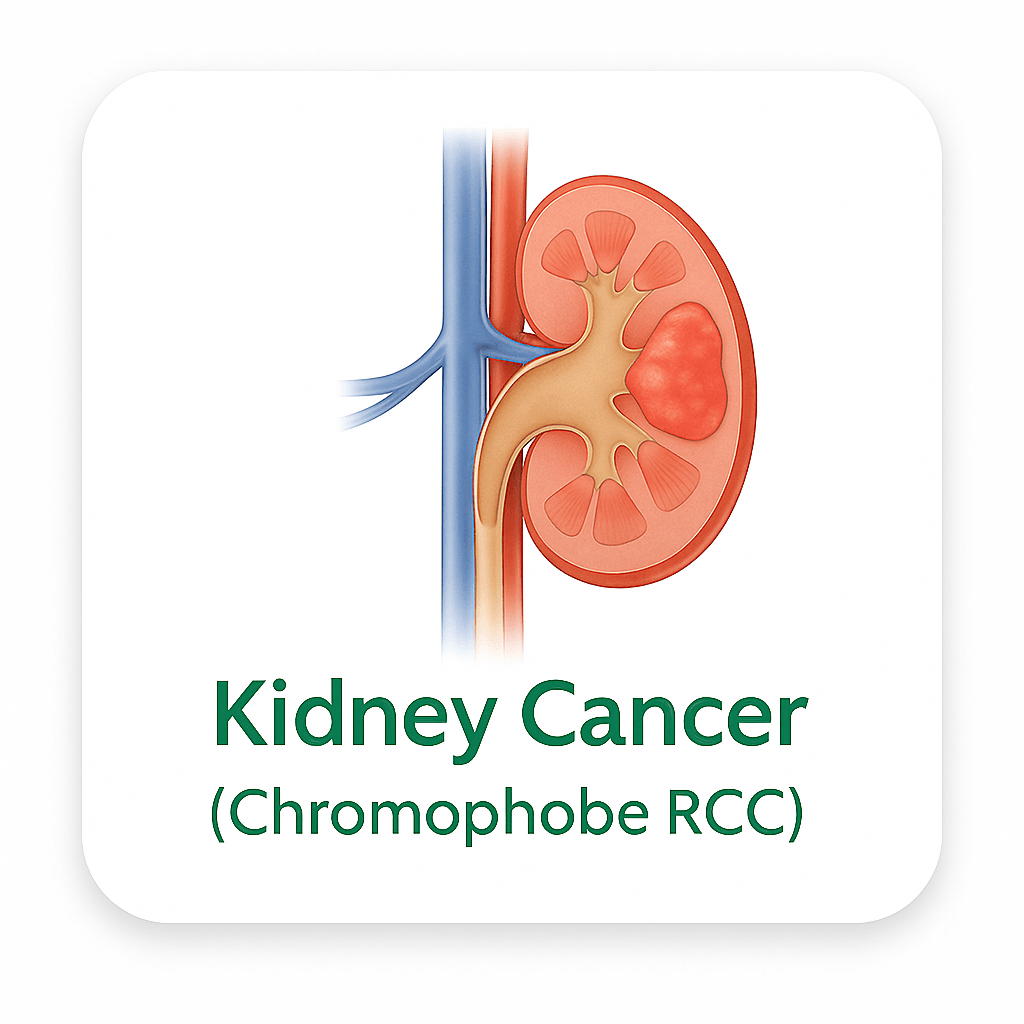
Kidney Cancer (Chromophobe RCC)
Main Grouping
Urinary
Organ System
Kidneys
Cell Origin
Epithelial (distal nephron)
Pathways Affected
Chromophobe renal cell carcinoma involves a pathway landscape fundamentally distinct from clear cell RCC and dominated by PTEN/PI3K/AKT/mTOR axis activation through PTEN loss, the p53 tumor suppressor pathway collapse through TP53 mutations, mitochondrial electron transport chain complex I disruption, and mTOR pathway mutations in the aggressive subset.
The PTEN/PI3K/AKT/mTOR pathway is the dominant oncogenic signaling cascade in chRCC and the most therapeutically relevant pathway: PTEN protein loss is detected by IHC in approximately 82 percent of chRCC tumors and is substantially more prevalent than the PTEN mutation rate (~24%) because both allele loss through chromosomal monosomy of chromosome 10 and monoallelic deletion combined with point mutation of the retained allele contribute to PTEN protein loss; PTEN loss removes the primary negative regulator of PI3K/AKT/mTOR signaling enabling constitutive AKT phosphorylation and mTORC1 activation; mTORC1 drives ribosome biogenesis, protein synthesis, metabolic reprogramming, and cell proliferation in PTEN-loss chRCC cells; activating somatic mutations in MTOR (~7%), TSC1 (~5%), and TSC2 (~5%) collectively create mTOR pathway mutations in approximately 17 to 23 percent of chRCC and are associated with the eosinophilic chRCC variant and dramatically worse prognosis (HR 5.5 to 10.3 for disease-specific survival in two independent series); curcumin inhibited AKT and mTOR in ACHN human renal cell carcinoma cells through Akt/mTOR suppression confirmed by Western blot and immunofluorescence (PMC8806675) targeting the dominant PTEN-loss/mTOR activation in chRCC; quercetin inhibited AKT/mTOR/ERK1/2 in renal cancer cell models.
The TP53 tumor suppressor pathway is the most frequently mutated specific gene in chRCC at approximately 32 percent overall and approximately 58 percent in metastatic chRCC cases: TP53 mutations in chRCC eliminate G1/S cell cycle checkpoint control, DNA damage-induced apoptosis, senescence response, and genomic stability functions; chromosome 17 monosomy (affecting 17p13 where TP53 is located) eliminates one TP53 allele in the majority of chRCC cases; somatic mutation of the retained TP53 allele creates biallelic TP53 inactivation; TP53 mutations are enriched in metastatic chRCC (58% vs ~20% primary, P=0.018) and in sarcomatoid differentiation — suggesting TP53 mutation as a driver of chRCC dedifferentiation and metastatic progression; the working model is that TP53 mutation initiates dedifferentiation followed by whole genome doubling (WGD) of preexisting monosomes and mTORC1 activation as a cascade driving aggressive chRCC; curcumin restores p53-mediated apoptosis signaling and reduces AKT/mTOR in renal cancer cell models (PMC8806675).
The mitochondrial electron transport chain/OXPHOS pathway is uniquely disrupted in chRCC through mitochondrial DNA (mtDNA) mutations affecting complex I (NADH dehydrogenase) genes with frequency of approximately 21 percent at greater than 20 percent heteroplasmy, making this the most frequent non-chromosomal alteration in chRCC; complex I NADH dehydrogenase mutations impair oxidative phosphorylation electron flow at complex I generating increased superoxide radical production through electron leakage; this impaired OXPHOS drives a compensatory mitochondrial biogenesis response (explaining the massive mitochondrial accumulation in chRCC cytoplasm); curcumin and EGCG activate Nrf2/ARE including NQO1 and HMOX1 providing antioxidant defense against complex I mutation-driven superoxide in renal cells. The TERT promoter/telomere maintenance pathway is altered in approximately 12 to 15 percent of chRCC through TERT promoter C228T or C250T mutations creating de novo ETS binding sites for constitutive telomerase expression; TERT promoter mutations in chRCC are associated with more aggressive behavior and worse prognosis similar to their role in melanoma; the Hippo/YAP pathway is altered in a subset of aggressive chRCC through TRAF7 mutations (documented in the UOK276 sarcomatoid chRCC cell line, PMC5561006) and chromosomal losses affecting Hippo pathway regulators; EGCG and curcumin both inhibit YAP/Hippo signaling in cancer cell models.
Description
Chromophobe renal cell carcinoma (chRCC) is the third most common subtype of renal cell carcinoma, representing approximately 5 to 7 percent of all RCC diagnoses. In the United States, with approximately 81,800 total kidney cancer cases projected for 2024, chRCC accounts for approximately 4,000 to 5,700 new diagnoses annually. Globally, chRCC accounts for approximately 21,000 to 30,000 new cases annually. chRCC was first described by Thoenes and colleagues in 1985 and is recognized as a distinct entity separate from clear cell RCC and papillary RCC based on its specific cell of origin, characteristic histology, unique cytogenetic signature, and clinical behavior.
The overall 5-year relative survival for chRCC is approximately 78 to 91 percent across all stages, reflecting its generally more favorable prognosis compared to clear cell RCC and papillary RCC type 2: stage I chRCC has a 5-year disease-specific survival of approximately 90 to 96 percent; stage II has approximately 85 to 91 percent; stage III has approximately 67 to 80 percent; stage IV metastatic chRCC has approximately 20 to 33 percent 5-year disease-specific survival; and sarcomatoid chRCC has a dramatically worse prognosis with median overall survival of approximately 8 to 12 months. Approximately 7 to 10 percent of chRCC develops metastatic disease, and approximately 5 to 10 percent shows sarcomatoid differentiation.
The cytogenetic signature of chRCC — multiple whole-chromosome monosomic losses of chromosomes 1, 2, 6, 10, 13, 17, and 21 — is fundamentally different from clear cell RCC (characterized by 3p loss/VHL deletion) and papillary RCC (characterized by trisomies 7 and 17). These monosomic losses affect a large number of tumor suppressor genes simultaneously; in particular, chromosome 17p loss eliminates one TP53 allele and chromosome 10 loss eliminates one PTEN allele, and somatic mutations in the retained alleles then create biallelic TP53 (~32% all chRCC) and PTEN inactivation.
The mitochondrial biology of chRCC is uniquely prominent: chRCC cytoplasm contains densely packed abnormal mitochondria with frequent mtDNA mutations affecting complex I NADH dehydrogenase genes; this mitochondrial accumulation creates the granular eosinophilic cytoplasm of the eosinophilic variant and explains the overlap with benign renal oncocytoma; chRCC expresses the highest levels of 13 mitochondrial DNA genes in the TCGA pan-cancer dataset. Published laboratory research documents curcumin inducing apoptosis and autophagy in ACHN human renal cell carcinoma cells through Akt/mTOR suppression — the mTOR pathway being the dominant actionable pathway in chRCC through PTEN loss (~82% by IHC) and mTOR pathway mutations (~17-23%) — with confirmed MTT viability inhibition, annexin V/PI flow cytometry apoptosis, ELISA cytokine reduction, and Western blot/immunofluorescence of AKT/mTOR and autophagy proteins (PMC8806675); quercetin inhibiting AKT/mTOR/ERK1/2 pathway in ccRCC Caki-2 cells and inhibiting mTOR-driven proliferation in renal cancer cell models.
Plant-Based Description
Whole-food plant-based dietary patterns provide phytochemicals with documented anti-RCC cell line activity targeting the dominant PTEN/mTOR oncogenic pathway in chRCC. Curcumin from turmeric induced apoptosis and autophagy in ACHN human renal cell carcinoma cells through Akt/mTOR suppression — the dominant oncogenic pathway in chRCC through PTEN loss (~82%) and mTOR pathway mutations (~17-23%) — with confirmed MTT viability inhibition, annexin V/PI flow cytometry apoptosis, and Western blot/immunofluorescence of AKT/mTOR and autophagy proteins confirmed in ACHN cells and in vivo in C57BL/6 nude mice (PMC8806675); quercetin inhibited AKT/mTOR/ERK1/2 in renal cancer cell models targeting the same PTEN-loss-activated mTOR cascade; EGCG from green tea reduced MMP-2/MMP-9 metalloproteinase expression in RCC cell lines and inhibited mTOR/PI3K/AKT in renal cancer models; sulforaphane activates Nrf2/ARE providing antioxidant defense against complex I mtDNA mutation-driven oxidative stress in renal tubular cells; resveratrol inhibits mTOR, PI3K/AKT, and activates SIRT1/AMPK in RCC cell models.
Plant Chemistry Detail
Curcumin from turmeric has the most directly documented anti-RCC cell line activity with confirmed AKT/mTOR pathway mechanism in a published study (PMC8806675) using ACHN human renal cell carcinoma cells: curcumin significantly inhibited ACHN cell viability at all concentrations tested confirmed by MTT assay; apoptosis was significantly increased following curcumin treatment confirmed by Annexin V-FITC/PI kit and flow cytometry; ELISA confirmed dose-dependent reduction of IL-6, IL-8, and TNF-alpha pro-inflammatory cytokines following curcumin treatment of ACHN cells; Western blot and immunofluorescence confirmed that curcumin significantly reduced AKT and mTOR phosphorylation in ACHN cells; autophagy-related proteins (LC3-II, Beclin-1) were significantly elevated following curcumin treatment; tumor size, weight, and volume were significantly reduced in C57BL/6 nude mouse xenograft model; the study confirmed curcumin-induced apoptosis and autophagy in human renal cell carcinoma cells through Akt/mTOR suppression — directly targeting the PTEN-loss-activated AKT/mTOR pathway present in approximately 82 percent of chRCC tumors by IHC.
Quercetin from onions and kale was documented to inhibit AKT/mTOR/ERK1/2 pathway proteins in renal cancer cell models; quercetin inhibited HIF-1, VEGF/VEGFR2, and COX2 in renal cancer cells; quercetin induced cell cycle arrest and apoptosis in renal cancer cell models targeting the PTEN-loss-driven mTOR pathway. EGCG from green tea inhibited MMP-2 and MMP-9 matrix metalloproteinase expression in RCC cell lines reducing invasion and migration; EGCG inhibited mTOR/S6K1 and PI3K/AKT in RCC cell models; EGCG combined with TRAIL reduced RCC cell viability greater than either agent alone through downregulation of c-FLIP, MCL-1, and BCL-2 in published RCC cell line research (PMC5796057); EGCG activates Nrf2/ARE in normal renal tubular epithelial cells providing antioxidant protection against the complex I mtDNA mutation-driven superoxide that is the dominant molecular aberration in approximately 21 percent of chRCC. Resveratrol inhibits mTOR, PI3K/AKT, NF-kB, and activates SIRT1/AMPK in RCC cell models, with AMPK activation directly inhibiting mTORC1 through TSC2 phosphorylation and RAPTOR phosphorylation — targeting the mTOR pathway that is activated through TSC1/TSC2 mutations (~10% of chRCC) and PTEN loss (~82%). Sulforaphane from cruciferous vegetables activates Nrf2/ARE providing antioxidant defense against mitochondrial complex I mutation-driven reactive oxygen species in renal tubular epithelial cells, which is uniquely relevant to the ~21% of chRCC showing mtDNA complex I mutations. Apigenin from parsley inhibits mTOR/S6K1, NF-kB, and VEGF in RCC cell models. Lycopene from tomatoes inhibits mTOR and PI3K/AKT in RCC cell models.
Nutritional Focus
Nutritional focus in chromophobe renal cell carcinoma research is led by curcumin from turmeric with documented anti-RCC cell line activity targeting the dominant PTEN-loss/AKT/mTOR oncogenic pathway in a published study (PMC8806675): curcumin inducing apoptosis and autophagy in ACHN human renal cell carcinoma cells through Akt/mTOR suppression with MTT viability inhibition, annexin V/PI flow cytometry apoptosis increase, ELISA reduction of IL-6/IL-8/TNF-alpha cytokines, Western blot and immunofluorescence reduction of AKT and mTOR phosphorylation and elevation of autophagy markers, and in vivo xenograft tumor reduction confirmed — directly targeting the PTEN-loss-activated AKT/mTOR pathway present in approximately 82 percent of chRCC tumors by IHC and the mTOR pathway mutations (MTOR/TSC1/TSC2) present in approximately 17 to 23 percent of chRCC with the worst prognosis (hazard ratio 5.5 to 10.3 for disease-specific survival); quercetin from onions and kale inhibiting AKT/mTOR/ERK1/2 in renal cancer cell models targeting the same PTEN-mTOR axis; EGCG from green tea reducing MMP-2 and MMP-9 metalloproteinase expression in RCC cell lines reducing invasion, inhibiting mTOR/PI3K/AKT in renal cancer models, and activating Nrf2/ARE in renal tubular cells providing antioxidant defense against complex I mtDNA mutation-driven superoxide (the dominant non-chromosomal molecular alteration in ~21% of chRCC); sulforaphane activating Nrf2/ARE and GCS/GCLM in renal tubular epithelial cells providing glutathione synthesis cytoprotection against mitochondrial complex I ROS — uniquely relevant to chRCC's characteristically elevated glutathione and massive abnormal mitochondria accumulation; resveratrol inhibiting mTOR and activating SIRT1/AMPK in RCC cell models with AMPK-TSC2 targeting the TSC1/TSC2-mTOR mutations present in approximately 10 percent of chRCC; lycopene from tomatoes inhibiting mTOR and PI3K/AKT in RCC cell models; and dietary fiber from whole plant foods producing butyrate that activates AMPK and inhibits HDAC in renal cancer cell models targeting PTEN promoter methylation-based PTEN silencing relevant to chRCC.
Research Notes
chRCC epidemiology: ~5-7% of all RCC; ~4,000-5,700 new US cases annually; ~21,000-30,000 global new cases annually; 5-year DSS: stage I ~90-96%; stage II ~85-91%; stage III ~67-80%; stage IV ~20-33%; sarcomatoid chRCC median OS ~8-12 months. Metastatic disease ~7-10% of chRCC. Sarcomatoid differentiation ~5-10%. First described by Thoenes et al. 1985. Cytogenetic signature: monosomy chromosomes 1, 2, 6, 10, 13, 17, 21 in ~86-100% classic chRCC. Cell of origin: type A intercalated cells of collecting ducts (FOXI1-expressing lineage). Molecular: ultra-low TMB (median ~1-2 mut/Mb, lowest of major RCC subtypes); TP53 mutations ~32% all chRCC, ~58% metastatic (P=0.018); PTEN mutation ~24% all chRCC, PTEN IHC loss ~82% of all chRCC tumors; mTOR pathway (MTOR ~7%, TSC1 ~5%, TSC2 ~5%) collectively ~17-23% (HR 5.5-10.3 for DSS, P=0.027 and 0.006 in two independent series); TERT promoter mutations ~12-15%; mtDNA complex I (NADH dehydrogenase) mutations ~21% (>20% heteroplasmy); chRCC has highest expression of 13 mtDNA genes in TCGA pan-cancer; FOXI1 is intercalated cell lineage transcription factor; Birt-Hogg-Dubé (FLCN germline) and Cowden syndrome (PTEN germline) predispose to chRCC. Working dedifferentiation model: TP53 mutation → whole genome doubling of preexisting monosomes → mTORC1 activation → sarcomatoid progression. UOK276 cell line: sarcomatoid chRCC, TP53 mutant, TRAF7 mutant, hyper-diploid. Curcumin ACHN RCC (PMC8806675): MTT viability; annexin V/PI apoptosis; ELISA IL-6/IL-8/TNF-alpha reduction; Western blot/IF AKT/mTOR/autophagy; xenograft tumor reduction in vivo.
Notes Visibility
Key Foods
Turmeric,Broccoli,Kale,Spinach,Brussels Sprouts,Cauliflower,Garlic,Yellow Onion,Carrot,Tomato,Beetroot,Cabbage,Blueberry,Pomegranate,Grape,Raspberry,Strawberry,Apple,Orange,Lemon,Soybeans,Edamame,Green Lentils,Black Beans,Chickpeas,Brown Rice,Quinoa,Oats,Wild Rice,Black Rice,Walnut,Almond,Brazil Nut,Flaxseed,Pumpkin Seeds,Chia Seeds,Sesame Seeds,Hemp Seeds,Shiitake,Maitake,Cremini,Portobello,Lions Mane,Green Tea,Ginger,Black Pepper,Garlic Powder,Parsley,Rosemary,Oregano, Celery, Fennel, Leek,Avocado,Artichoke,Radish,Tangerine, Red Onion
Linked Nutrients
vitamin-c,vitamin-e,vitamin-d3,vitamin-b9,vitamin-b6,vitamin-a,selenium,zinc,magnesium,calcium,potassium,iron,curcumin,quercetin,egcg,sulforaphane,resveratrol,lycopene,beta-carotene,anthocyanins,beta-glucans,dietary-fiber,plant-ala-omega3
Last Updated
2025-10-13 10:05:01

