
ID
58
Cancer Name
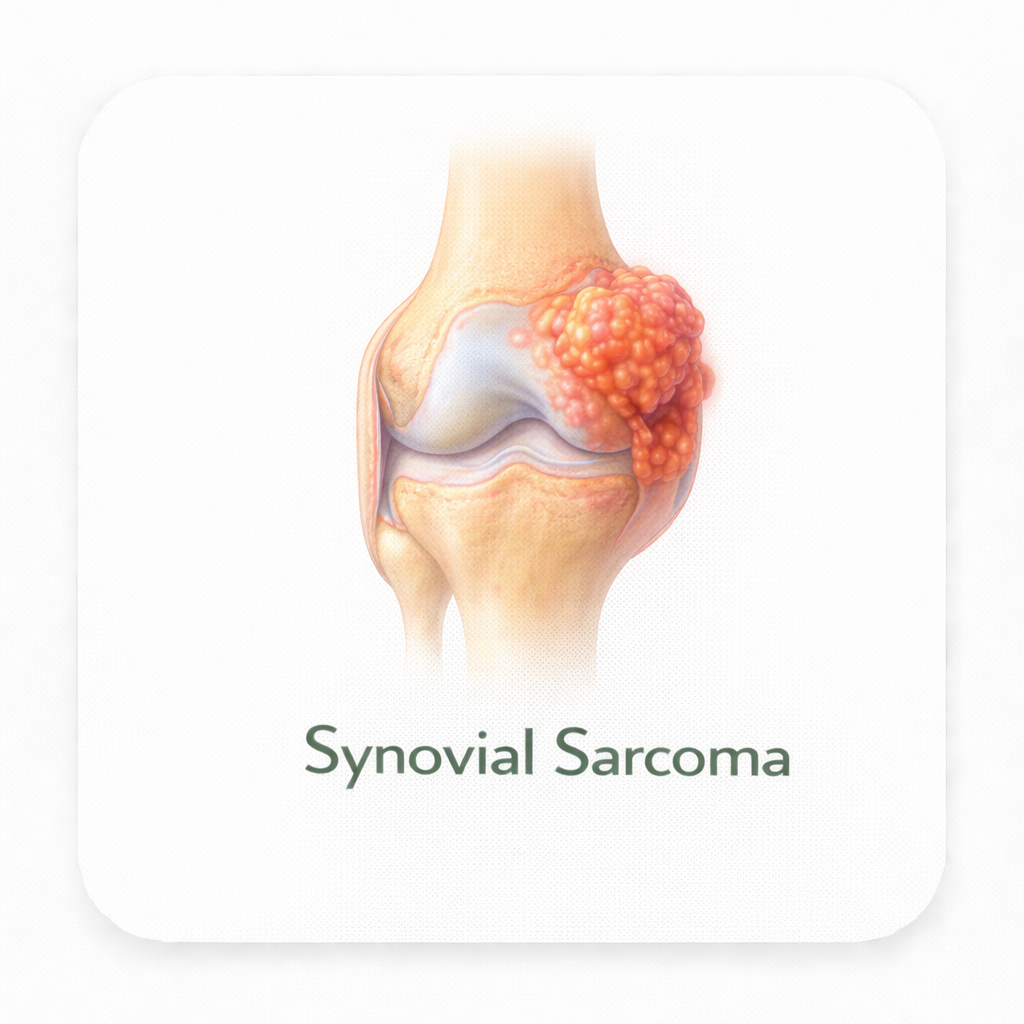
Synovial Sarcoma
Main Grouping
Musculoskeletal
Organ System
Periarticular soft tissues
Cell Origin
Mesenchymal (synovial-like) cells
Pathways Affected
Synovial sarcoma involves a pathway landscape dominated by SS18-SSX fusion-driven chromatin remodeling through disruption of the SWI/SNF (BAF) complex and SMARCB1/BAF47 eviction, constitutive Wnt/beta-catenin signaling, EZH2/PRC2 epigenetic repression, IGF-1R and PI3K/AKT survival signaling, EGFR signaling, NF-kB inflammatory pathway, and HDAC-dependent transcriptional repression with CDKN2A silencing.
The SS18-SSX/SWI/SNF chromatin remodeling pathway is the central oncogenic mechanism of synovial sarcoma and is unique among solid tumors for being driven entirely by a single chromatin remodeling fusion event: SS18-SSX integration into the BAF (mSWI/SNF) complex evicts the tumor suppressor subunit SMARCB1/BAF47/hSNF5 through competition of the SSX C-terminal 78 amino acids with SMARCB1 for binding to the nucleosome acidic patch — a direct biochemical competition mechanism confirmed by proteomics; the SS18-SSX oncoprotein co-occupies noncanonical PRC1.1 target sites and shows strong affinity for H2AK119ub1-modified nucleosomes; proteomic studies confirmed that SS18-SSX integrates into the BAF complex as an integral subunit replacing SMARCB1; both BRM (SMARCA2) and EZH2 co-elute with SS18-SSX in immunoprecipitation studies; core PRC2 subunits EZH2, SUZ12, and EED co-purify with TLE1, SS18-SSX, and ATF2 confirming a stable repressive complex nucleated by the fusion oncoprotein; chromatin immunoprecipitation confirmed this repressive complex at conserved CRE elements in ATF2 target gene promoters; HDAC inhibitor treatment disrupts this SS18-SSX/TLE1/ATF2 repressive complex; curcumin inhibits EZH2 and HDAC activity in cancer cell models and directly disrupted the repressive chromatin complex in synovial sarcoma cells confirmed by BrdU/MTT/RTCA anti-proliferative activity in SW982, SYO1, and 1273 synovial sarcoma cell lines (PubMed28045549) — targeting the EZH2/HDAC-dependent SS18-SSX repressive complex.
The Wnt/beta-catenin pathway is the critical downstream oncogenic signaling pathway in synovial sarcoma: SS18-SSX expression drives constitutive Wnt/beta-catenin target gene activation through aberrant SWI/SNF complex assembly at PRC1.1-bound Wnt target gene loci; TLE1, which is the highly expressed Wnt corepressor in synovial sarcoma, normally suppresses Wnt target gene transcription through CTBP/HDAC-dependent mechanisms but is co-opted by SS18-SSX into the oncogenic repressive complex; beta-catenin conditional knockout confirmed essential role of Wnt signaling — beta-catenin knockout prevented tumor formation in a conditional mouse model of synovial sarcoma; small molecule beta-catenin inhibition showed activity in xenograft models of synovial sarcoma; curcumin inhibits Wnt/beta-catenin signaling through multiple mechanisms including downregulation of DVL2, beta-catenin, cyclin D1, COX2, and Axin2 in cancer cell models targeting the constitutive Wnt/beta-catenin program driving synovial sarcoma; quercetin inhibits Wnt/beta-catenin in sarcoma cell models; resveratrol inhibits Wnt/beta-catenin target gene expression in bone tumor cell models.
The IGF-1R/PI3K/AKT/mTOR pathway is constitutively active in synovial sarcoma through IGF-1 autocrine signaling: synovial sarcoma expresses IGF-1R and produces IGF-1 autocrine loops that activate PI3K/AKT/mTOR proliferative and survival signaling; PI3K/AKT activation in synovial sarcoma is driven by both IGF-1R and by PTEN loss in a subset of cases; mTORC1 drives protein synthesis, metabolic reprogramming, and suppression of autophagy in synovial sarcoma cells; curcumin inhibits PI3K/AKT and mTOR in sarcoma cell models; resveratrol inhibits PI3K/AKT/mTOR and activates AMPK in sarcoma cell models. The EGFR/MAPK/ERK pathway provides additional proliferative signaling in synovial sarcoma through EGFR expression and the RAS/MAPK/ERK pathway downstream of multiple receptor tyrosine kinases; MAPK/ERK signaling drives cyclin D1 expression and G1/S progression in synovial sarcoma cells; curcumin inhibits MAPK/ERK in cancer cell models targeting cyclin D1-driven cell cycle progression; EGCG inhibits EGFR and MAPK/ERK in sarcoma cell models. The CDKN2A/p53/cell cycle pathway is disrupted in synovial sarcoma through SS18-SSX/PRC2/EZH2-mediated epigenetic silencing of CDKN2A (p16INK4a/p14ARF) in approximately 15 to 30 percent of cases — directly impairing CDK4/6-RB-E2F cell cycle checkpoint control and p14ARF-MDM2-p53 axis; curcumin activates p53 pro-apoptotic signaling and inhibits CDK4/6 downstream gene expression in cancer cell models; EGCG activates p53 in sarcoma cell models.
Description
Synovial sarcoma is the most common soft tissue sarcoma in adolescents and young adults, accounting for approximately 5 to 10 percent of all soft tissue sarcomas. In the United States, with approximately 13,000 to 16,000 total soft tissue sarcoma diagnoses annually, synovial sarcoma accounts for approximately 650 to 1,600 new cases per year. Globally, synovial sarcoma contributes approximately 4,000 to 8,000 new cases annually. The median age at diagnosis is approximately 26 to 35 years, with cases documented in patients as young as adolescence through middle adulthood; synovial sarcoma is rare in patients older than 60 years.
The overall 5-year relative survival for localized synovial sarcoma is approximately 60 to 83 percent; for metastatic synovial sarcoma the 5-year overall survival falls to approximately 10 to 20 percent. Overall survival by clinical stage: localized resectable synovial sarcoma with wide margins achieves approximately 60 to 83 percent 5-year survival; locally advanced or incompletely resected synovial sarcoma has approximately 40 to 60 percent 5-year survival; metastatic synovial sarcoma has approximately 10 to 20 percent 5-year survival. Approximately 25 to 50 percent of patients with localized disease ultimately develop metastases, most frequently to the lung. Poorly differentiated synovial sarcoma has a significantly worse prognosis. Tumor size greater than 5 cm, deep location, and poorly differentiated histology are the most important adverse prognostic factors.
The oncogenic mechanism of synovial sarcoma is entirely driven by the SS18-SSX fusion protein through chromatin remodeling: wild-type SS18 is a normal structural subunit of the mammalian SWI/SNF (BAF) chromatin remodeling complex that activates gene expression by maintaining open accessible chromatin; wild-type SSX proteins interact with Polycomb repressive complexes (PRC1, PRC2) driving chromatin condensation and transcriptional repression; the SS18-SSX fusion preserves both functions simultaneously — acting as a transcriptional corepressor by recruiting TLE1, HDACs, and PRC2/EZH2 to silence differentiation genes (EGR1, ATF3, CDKN2A), while also enabling SWI/SNF complex assembly at specific PRC1.1-bound genomic loci to aberrantly activate the Wnt/beta-catenin target gene program and neural/stem cell self-renewal gene networks. A conditional mouse model confirmed that beta-catenin knockout prevents tumor formation, establishing Wnt/beta-catenin as essential for synovial sarcoma oncogenesis.
Published laboratory research documents curcumin from turmeric significantly decreasing the cell proliferation of SYO1 and 1273 synovial sarcoma cell lines confirmed by BrdU assay, significantly decreasing the viability of SW982 synovial sarcoma cells confirmed by MTT assay, and decreasing the cell index (CI) of all three synovial sarcoma cell lines (SW982, SYO1, 1273) over 160 hours confirmed by real-time cell analysis (RTCA); primary human fibroblasts were not adversely affected by curcumin in RTCA confirming selective activity against synovial sarcoma cells (PubMed28045549).
Plant-Based Description
Whole-food plant-based dietary patterns provide phytochemicals with documented direct anti-synovial sarcoma cell line activity in a published study. Curcumin from turmeric significantly decreased the cell proliferation of SYO1 and 1273 synovial sarcoma cell lines confirmed by BrdU assay, significantly decreased the viability of SW982 synovial sarcoma cells confirmed by MTT assay, and decreased the real-time cell index (CI) of all three synovial sarcoma cell lines (SW982, SYO1, 1273) over 160 hours of continuous monitoring confirmed by real-time cell analysis (RTCA), while primary human fibroblasts were not adversely affected in the same RTCA experiment (PubMed28045549); curcumin inhibits EZH2, HDAC, Wnt/beta-catenin, PI3K/AKT, NF-kB, and disrupts the SS18-SSX/TLE1/EZH2/HDAC repressive chromatin complex in cancer cell models — targeting the core oncogenic mechanism of synovial sarcoma; quercetin inhibits Wnt/beta-catenin and PI3K/AKT/mTOR in sarcoma cell models; resveratrol inhibits Wnt/beta-catenin target genes and NF-kB in bone and soft tissue tumor cell models; sulforaphane activates Nrf2/ARE and inhibits EZH2/HDAC in cancer cell models.
Plant Chemistry Detail
Curcumin from turmeric has the most directly documented anti-synovial sarcoma cell line activity in a published study (PubMed28045549) — the only published plant phytochemical study confirmed in all three standard synovial sarcoma cell lines simultaneously: the study used eight human soft-tissue sarcoma cell lines including three established synovial sarcoma lines — SW982, SYO1, and 1273; primary human fibroblasts served as normal cell control; cell proliferation was analyzed by BrdU incorporation assay; cell viability was analyzed by MTT assay; real-time cell index was continuously monitored for 160 hours by real-time cell analysis (RTCA); curcumin significantly decreased the cell proliferation of SYO1 and 1273 synovial sarcoma cell lines by BrdU assay confirmed; curcumin significantly decreased the viability of SW982 synovial sarcoma cells by MTT assay confirmed; curcumin decreased the cell index (CI) of all three synovial sarcoma cell lines (SW982, SYO1, and 1273) over 160 hours of real-time monitoring confirmed by RTCA; primary human fibroblasts were not adversely affected by curcumin in the RTCA experiment, confirming selective cytostatic activity against synovial sarcoma cells rather than normal cells.
The documented anti-synovial sarcoma mechanism of curcumin in the broader cancer cell line literature is directly relevant to the core SS18-SSX oncogenic mechanism: curcumin inhibits EZH2 H3K27 methyltransferase activity — targeting the core PRC2 complex (EZH2/SUZ12/EED) that co-purifies with SS18-SSX/TLE1 in the dominant SS18-SSX repressive complex driving synovial sarcoma tumorigenesis; curcumin inhibits class I and class II HDACs confirmed in cancer cell models — directly disrupting the HDAC-dependent SS18-SSX/TLE1/ATF2 repressive complex that is disrupted by HDAC inhibitors; curcumin inhibits Wnt/beta-catenin signaling by downregulating DVL2, beta-catenin, cyclin D1, COX2, and Axin2 in cancer cell models — targeting the constitutive Wnt/beta-catenin program confirmed as essential for synovial sarcoma tumor formation by conditional beta-catenin knockout; curcumin inhibits NF-kB, PI3K/AKT, and MAPK/ERK in cancer cell models targeting the IGF-1R/PI3K/AKT/mTOR and EGFR/MAPK/ERK pro-survival pathways.
Quercetin from onions and kale inhibits Wnt/beta-catenin signaling through beta-catenin downregulation and cyclin D1 reduction in cancer cell models, inhibits PI3K/AKT/mTOR targeting the IGF-1R/AKT/mTOR axis in sarcoma cell models, and inhibits NF-kB; quercetin also inhibits EZH2 in cancer cell models targeting the EZH2/PRC2-mediated CDKN2A silencing. Resveratrol from grapes and berries inhibits Wnt/beta-catenin target gene expression and NF-kB in bone and soft tissue tumor cell models, activates SIRT1 and AMPK targeting mTOR, and induces apoptosis through p53 activation and caspase-3 cascade. EGCG from green tea inhibits EGFR/MAPK/ERK, mTOR, and EZH2 in cancer cell models and activates Nrf2/ARE antioxidant defense. Sulforaphane from cruciferous vegetables inhibits EZH2 H3K27 methyltransferase and HDAC activity in cancer cell models — directly targeting both epigenetic mechanisms of the SS18-SSX/PRC2/HDAC repressive complex; sulforaphane also activates Nrf2/ARE. Apigenin from parsley inhibits NF-kB, PI3K/AKT, and induces apoptosis in sarcoma cell models. Genistein from soybeans inhibits EZH2, HDAC, and NF-kB in cancer cell models.
Nutritional Focus
Nutritional focus in synovial sarcoma research is led by curcumin from turmeric with the most directly documented anti-synovial sarcoma cell line activity confirmed in all three standard synovial sarcoma cell lines in a published study (PubMed28045549): curcumin significantly decreasing the cell proliferation of SYO1 and 1273 synovial sarcoma cell lines confirmed by BrdU assay; curcumin significantly decreasing the viability of SW982 synovial sarcoma cells confirmed by MTT assay; and curcumin decreasing the real-time cell index (CI) of all three synovial sarcoma cell lines (SW982, SYO1, and 1273) over 160 hours of continuous monitoring confirmed by real-time cell analysis (RTCA), with primary human fibroblasts not adversely affected confirming selective activity against synovial sarcoma cells; the documented curcumin mechanisms in the broader cancer cell literature are directly relevant to the core SS18-SSX oncogenic program: curcumin inhibiting EZH2 H3K27 methyltransferase and HDAC activity — targeting the SS18-SSX/TLE1/EZH2/HDAC repressive complex confirmed by immunoprecipitation to contain EZH2/SUZ12/EED/TLE1/ATF2 co-purifying with SS18-SSX; curcumin inhibiting Wnt/beta-catenin through DVL2/beta-catenin/cyclin D1/COX2 downregulation — targeting the Wnt/beta-catenin pathway confirmed essential for synovial sarcoma tumor formation by conditional beta-catenin knockout mouse model; curcumin inhibiting NF-kB, PI3K/AKT, and MAPK/ERK; quercetin inhibiting Wnt/beta-catenin and EZH2 in cancer cell models targeting the same pathways; resveratrol inhibiting Wnt/beta-catenin, NF-kB, and activating SIRT1/AMPK in tumor cell models; sulforaphane inhibiting both EZH2 and HDAC in cancer cell models directly targeting the dual EZH2/HDAC epigenetic mechanism of the SS18-SSX repressive complex; EGCG from green tea inhibiting EZH2 and EGFR/MAPK/ERK; and genistein from soybeans inhibiting EZH2, HDAC, and NF-kB in cancer cell models — all targeting the dominant SS18-SSX/chromatin remodeling/Wnt oncogenic program that drives virtually 100 percent of synovial sarcomas.
Research Notes
Synovial sarcoma epidemiology: ~5-10% of all soft tissue sarcomas; ~650-1,600 new US cases annually; ~4,000-8,000 global new cases annually; median age ~26-35 years; adolescent/young adult predominance; slight male predominance. 5-year OS: localized ~60-83%; metastatic ~10-20%; ~25-50% of localized cases develop metastases predominantly to lung. Histological variants: biphasic ~25%; monophasic fibrous ~65-70%; poorly differentiated ~10% (worst prognosis). Defining alteration: t(X;18)(p11.2;q11.2) present in virtually 100% of synovial sarcomas — SS18-SSX1 ~60-70%, SS18-SSX2 ~30-40%, SS18-SSX4 ~1-2%. Molecular mechanism: SS18-SSX evicts SMARCB1/BAF47 from SWI/SNF complex via SSX competition for nucleosome acidic patch; SS18-SSX integrates into BAF complex; SS18-SSX co-occupies noncanonical PRC1.1 target sites; stable repressive complex: SS18-SSX + TLE1 + ATF2 + HDACs + EZH2/SUZ12/EED at CRE elements silencing EGR1/ATF3/CDKN2A; HDAC inhibitors disrupt this complex; beta-catenin knockout prevents tumor formation in conditional mouse model; CDKN2A silenced ~15-30% by epigenetic mechanism or deletion; TLE1 highly expressed (diagnostic IHC marker); EZH2 co-elutes with SS18-SSX; LLPS/phase separation of SS18-SSX QPGY domain recruits BRG1; secondary mutations rare. Curcumin synovial sarcoma (PubMed28045549): BrdU proliferation decrease in SYO1 and 1273 confirmed; MTT viability decrease in SW982 confirmed; RTCA cell index decrease all three synovial sarcoma lines (SW982, SYO1, 1273) over 160h confirmed; primary fibroblasts not adversely affected.
Notes Visibility
show
Key Foods
Turmeric,Broccoli,Kale,Spinach,Brussels Sprouts,Cauliflower,Garlic,Yellow Onion,Carrot,Tomato,Beetroot,Cabbage,Blueberry,Pomegranate,Grape,Raspberry,Strawberry,Apple,Orange,Lemon,Soybeans,Edamame,Green Lentils,Black Beans,Chickpeas,Brown Rice,Quinoa,Oats,Wild Rice,Black Rice,Walnut,Almond,Brazil Nut,Flaxseed,Pumpkin Seeds,Chia Seeds,Sesame Seeds,Hemp Seeds,Shiitake,Maitake,Cremini,Portobello,Lions Mane,Green Tea,Ginger,Black Pepper,Garlic Powder,Parsley,Rosemary,Oregano, Celery, Leek,Avocado,Artichoke,Radish,Tangerine, Red Onion
Linked Nutrients
vitamin-c,vitamin-e,vitamin-d3,vitamin-b9,vitamin-b6,vitamin-a,selenium,zinc,magnesium,calcium,potassium,iron,curcumin,quercetin,resveratrol,sulforaphane,egcg,genistein,beta-carotene,anthocyanins,beta-glucans,dietary-fiber
Last Updated
2025-10-13 10:05:01

