
ID
59
Cancer Name
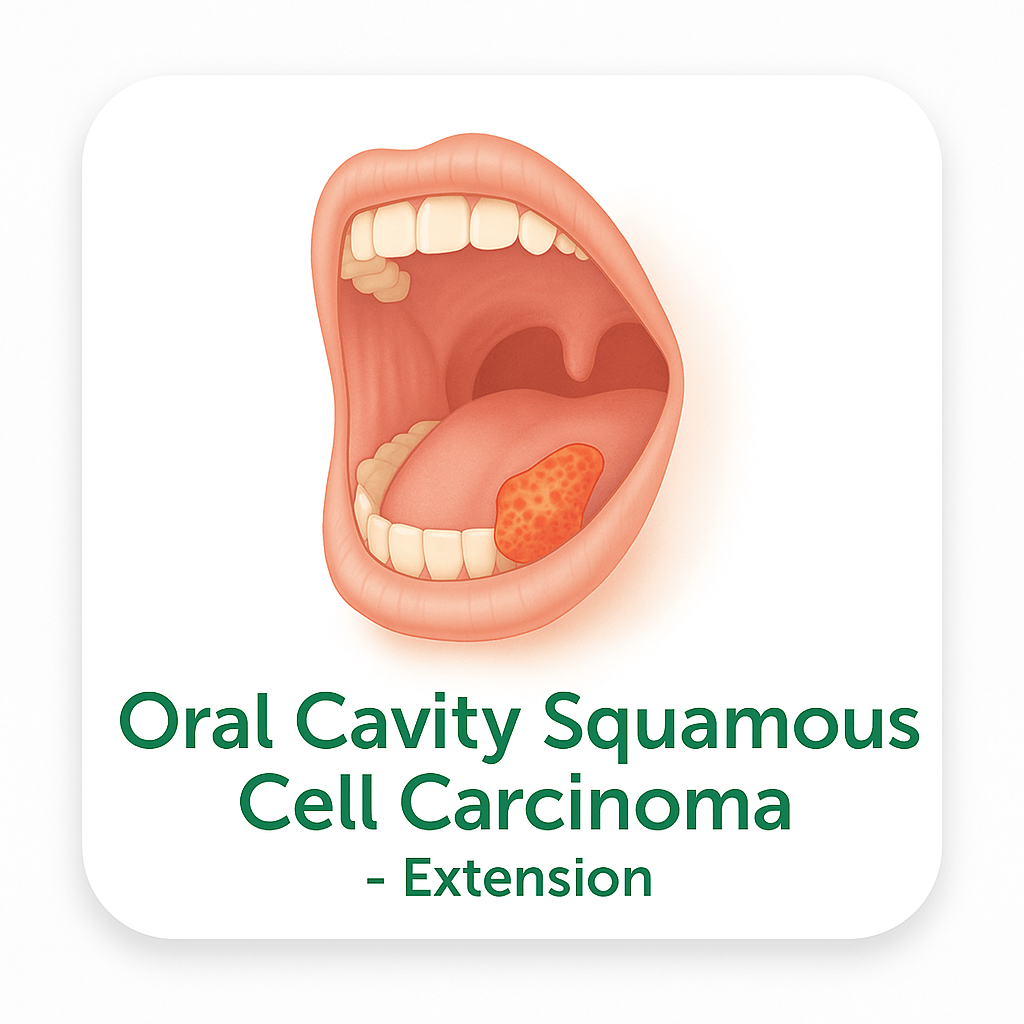
Oral Cavity Squamous Cell Carcinoma – Extension
Main Grouping
Respiratory/Digestive
Organ System
Mouth, tongue, floor of mouth
Cell Origin
Squamous epithelium
Pathways Affected
Oral cavity squamous cell carcinoma involves a pathway landscape driven by TP53 loss-of-function, EGFR/RAS/MAPK/ERK constitutive activation, PI3K/AKT/mTOR activation through PIK3CA mutations and PTEN loss, NF-kB inflammatory pathway, NOTCH1 inactivation/differentiation block, cell cycle checkpoint disruption through CDKN2A loss and CCND1 amplification, and EMT-driven invasion and metastasis through MMP-2/MMP-9 upregulation.
The EGFR/RAS/MAPK/ERK pathway is the dominant receptor tyrosine kinase pathway in OSCC: EGFR protein is overexpressed in approximately 80 to 90 percent of all OSCC regardless of mutation status; EGFR gene amplification occurs in approximately 15 to 25 percent of OSCC; EGFR overexpression drives constitutive RAS/MAPK/ERK and PI3K/AKT/mTOR downstream signaling; HRAS activating mutations (~5-10% of OSCC, higher frequency in tobacco/betel quid-related South Asian OSCC) create constitutive RAS/MAPK/ERK signaling independent of EGFR; FGFR1 amplification (~15%) drives additional RTK/MAPK/ERK input; curcumin inhibits EGFR expression and EGFR downstream signaling in OSCC cell models including reduction of EGFR protein, phospho-EGFR, and downstream ERK/AKT signaling confirmed in multiple OSCC cell line studies; EGCG inhibits EGFR/RAS/MAPK in OSCC cell lines.
The NF-kB inflammatory pathway is constitutively activated in OSCC through multiple mechanisms: chronic tobacco and alcohol exposure activate NF-kB through ROS-mediated IKK activation; EGFR/RAS/PI3K/AKT signaling activates NF-kB through IKKbeta phosphorylation; TRAF3 inactivating mutations (~8%) remove a negative regulator of the non-canonical NF-kB pathway enabling constitutive NIK/IKKalpha/p52 non-canonical NF-kB activation; BIRC2/BIRC3 (cIAP1/2) gene amplification in a subset of OSCC provides additional anti-apoptotic NF-kB target protein support; quercetin downregulated NF-kB by inhibiting phosphorylation of AKT and IKKbeta and suppressed anti-apoptotic xIAP in Tca-8113 and SCC-15 OSCC cells confirmed by Western blot (PMC6746132) — directly targeting the EGFR/AKT/IKK/NF-kB/xIAP pro-survival cascade; curcumin downregulated NOTCH-1/NF-kB in OSCC cell models.
The NOTCH1 pathway is uniquely inactivated (tumor suppressive direction) in OSCC: NOTCH1 inactivating mutations occur in approximately 14 to 20 percent of OSCC and create a loss of squamous differentiation signal that normally drives keratinocytes toward the differentiated cornified cell fate through NOTCH1/HES1/p21 signaling; NOTCH1 loss-of-function in OSCC paradoxically creates a more undifferentiated proliferative squamous cell state; curcumin modulates NOTCH1 through downregulation of NOTCH-1 protein in OSCC cell models targeting this differentiation defect; gamma-secretase modulates NOTCH1 intracellular domain cleavage and curcumin inhibits gamma-secretase in cancer cell models.
The PI3K/AKT/mTOR pathway is activated in OSCC through PIK3CA activating mutations (~8-15%, predominantly E545K and H1047R hotspots in the helical and kinase domains), PTEN loss (~15-25%), and constitutive EGFR/HER2/FGFR1 RTK signaling; mTORC1 drives protein synthesis, HIF-1alpha stability, and VEGF transcription in hypoxic OSCC tumor cores; quercetin inhibited phospho-AKT and IKKbeta in Tca-8113 and SCC-15 OSCC cells (PMC6746132) targeting the PIK3CA-AKT-IKK-NF-kB cascade; curcumin inhibits PI3K/AKT in OSCC cell models. The TP53/apoptosis pathway is the most frequently mutated pathway in OSCC: TP53 mutations (~43-84%) eliminate G1/S and G2/M cell cycle checkpoints and apoptotic response to DNA damage; tobacco carcinogens (nitrosamines, polycyclic aromatic hydrocarbons) and alcohol acetaldehyde cause TP53 G-to-T transversions at codons 175, 248, 249, 273 and others; CASP8 mutations (~8-12%) in OSCC reduce death receptor-mediated apoptosis; quercetin induced caspase-8/caspase-9/caspase-3/PARP cleavage apoptosis in OSCC cells through both extrinsic (death receptor/caspase-8) and intrinsic (mitochondrial/caspase-9) pathways (PMC6746132) bypassing TP53-dependent apoptosis defects; quercetin induced caspase-2/Bak/Bid/Cytochrome c/Apaf-1/caspase-3/6/7 and Fas/FADD/caspase-8 and ER stress ATF-6/XBP-1/GRP-78/caspase-4 pathways in SAS oral SCC cells confirmed by Western blot (PMC6004715).
The EMT/invasion pathway drives OSCC metastasis through MMP-2/MMP-9, Twist/Slug/Snail transcription factors, fibronectin/vimentin/alpha-SMA upregulation, and E-cadherin downregulation; quercetin reversed EMT by increasing E-cadherin and claudin-1 while decreasing fibronectin, vimentin, alpha-SMA, Twist, Slug, Snail, and suppressing MMP-2/MMP-9 in OSC20, SAS, and HN22 OSCC cells confirmed by Western blot and immunofluorescence (PMC7037689) directly targeting the invasive program in OSCC; curcumin inhibits MMP-2/MMP-9 in OSCC cell models.
Description
Oral cavity squamous cell carcinoma (OSCC) is the most common malignancy of the oral cavity and accounts for more than 90 percent of all oral cancers, representing approximately 2 percent of all cancers worldwide. Globally, oral cavity cancer accounts for approximately 390,000 new cases and 188,000 deaths annually according to GLOBOCAN 2022, making it the 16th most common cancer worldwide. In the United States, approximately 54,540 new oral cavity and pharynx cancer cases and approximately 11,580 deaths were projected for 2023, with oral cavity SCC specifically accounting for approximately 30,000 to 35,000 of those cases. In South and Southeast Asia — particularly India, Bangladesh, Sri Lanka, Taiwan, and Papua New Guinea — OSCC represents a significantly greater proportion of all cancers due to tobacco chewing, betel quid use, and areca nut consumption.
The overall 5-year relative survival for oral cavity SCC across all stages is approximately 66 percent: localized (stage I/II) oral SCC has a 5-year survival of approximately 83 to 90 percent; regional (stage III/IVA-B) oral SCC has a 5-year survival of approximately 40 to 65 percent; distant metastatic (stage IVC) oral SCC has a 5-year survival of approximately 23 to 35 percent; overall survival for advanced oral SCC has improved modestly with the addition of concurrent immunotherapy.
The anatomical sites within the oral cavity with the highest incidence in the United States are the tongue (~25-40% of oral OSCC) and floor of mouth (~15-20%), while in South Asia buccal mucosa and gingiva are the most common due to betel quid placement sites. Tumor subsites influence lymph node drainage patterns, surgical approach, and prognosis significantly; tongue SCC has a particularly high rate of occult cervical lymph node metastasis of approximately 20 to 35 percent even in early-stage (T1-T2) disease.
The molecular landscape of OSCC is dominated by TP53 mutations (~43-84%), CDKN2A loss (~30-50%), EGFR overexpression (~80-90%), CCND1 amplification (~30-40%), PIK3CA mutations (~8-15%), HRAS mutations (~5-10%), FAT1 mutations (~25%), NOTCH1 inactivating mutations (~14-20%), and KMT2B/MLL4 mutations (~15-25%). Published laboratory research documents quercetin from onions, kale, and apples inhibiting NF-kB/xIAP pathway and inducing caspase-8/caspase-9/caspase-3/PARP cleavage apoptosis in Tca-8113 and SCC-15 human oral squamous cell carcinoma cell lines confirmed by flow cytometry, Western blot, and in vivo xenograft (PMC6746132); quercetin inhibiting EMT and suppressing invasion through reversal of E-cadherin loss and MMP-2/MMP-9 reduction in OSC20, SAS, and HN22 OSCC cell lines confirmed by G2/M arrest and Western blot (PMC7037689); curcumin downregulating NOTCH-1/NF-kB, EGFR downstream signaling, COX-2, and MMP-2/MMP-9 in OSCC cell models; EGCG inducing caspase-3-dependent apoptosis in HSC-3 and SCC-25 OSCC cell lines with G1 arrest confirmed.
Plant-Based Description
Whole-food plant-based dietary patterns provide phytochemicals with documented direct anti-OSCC cell line activity confirmed in multiple published studies. Quercetin from onions, kale, and apples inhibited NF-kB through AKT/IKKbeta phosphorylation suppression, downregulated anti-apoptotic xIAP, and induced caspase-8/caspase-9/caspase-3/PARP cleavage apoptosis in Tca-8113 and SCC-15 human oral squamous cell carcinoma cell lines confirmed by flow cytometry and Western blot with in vivo xenograft validation (PMC6746132); quercetin inhibited EMT and invasion by reversing E-cadherin loss and suppressing MMP-2/MMP-9 and EMT transcription factors (Twist/Slug/Snail) in OSC20, SAS, and HN22 OSCC cell lines with G2/M arrest confirmed (PMC7037689); quercetin induced caspase-mediated apoptosis in SAS oral SCC cells through both mitochondria and ER stress pathways confirmed by comprehensive Western blot of caspase cascade proteins (PMC6004715); curcumin downregulated NOTCH-1/NF-kB, EGFR, COX-2, and MMP-2/MMP-9 in OSCC cell models; EGCG induced caspase-3-dependent apoptosis in HSC-3 and SCC-25 OSCC cell lines with G1 arrest; sulforaphane activates Nrf2/ARE and inhibits NF-kB in OSCC cell models.
Plant Chemistry Detail
Quercetin from onions and kale has the most comprehensively documented anti-OSCC cell line activity across three confirmed published studies targeting the dominant molecular pathways in OSCC.
In the first confirmed study (PMC6746132) using Tca-8113 and SCC-15 human oral squamous cell carcinoma cell lines: quercetin inhibited phosphorylation of AKT and IKKbeta confirmed by Western blot — directly targeting the EGFR/PIK3CA/AKT/IKK/NF-kB cascade; quercetin suppressed NF-kB transcriptional activity and downregulated anti-apoptotic xIAP protein expression confirmed; quercetin activated caspase-8 (extrinsic/death receptor pathway) and caspase-9 (intrinsic/mitochondrial pathway) confirmed by Western blot; quercetin induced PARP cleavage confirmed; caspase dependence was confirmed by pan-caspase inhibitor Z-VAD-fmk rescue experiment completely blocking PARP, caspase-3/8/9 activation and reversing cell death; quercetin combined with cisplatin demonstrated colony formation inhibition confirmed; quercetin inhibited xenograft tumor growth in mice in vivo confirming anti-OSCC activity beyond cell culture.
In the second confirmed study (PMC7037689) using OSC20, SAS, and HN22 OSCC cell lines: quercetin induced G2/M cell cycle arrest in all three OSCC cell lines at 40 μM confirmed by flow cytometry (G2/M fraction increased from approximately 8-23% control to 36-50% quercetin-treated, p<0.05 to p<0.001); quercetin increased epithelial markers E-cadherin and claudin-1 while decreasing mesenchymal markers fibronectin, vimentin, and alpha-SMA in a dose-dependent manner confirmed by Western blot — directly reversing EMT and targeting the invasive program driven by FAT1 loss (~25% OSCC) and TGFbeta/EMT signaling; quercetin suppressed MMP-2 and MMP-9 activation confirmed; quercetin downregulated EMT transcription factors Twist, Slug, and Snail1 confirmed by Western blot and immunofluorescence — directly targeting the invasion/metastasis program that drives the approximately 20 to 35 percent rate of occult cervical lymph node metastasis in early OSCC.
In the third confirmed study (PMC6004715) using SAS human oral squamous cell carcinoma cells: quercetin induced apoptosis through both extrinsic and intrinsic pathways confirmed by comprehensive Western blot — caspase-2, Bak, Bid, Bad upregulation; cytochrome c, Apaf-1, Endo G, AIF, PARP upregulation; active caspase-9/caspase-3/caspase-6/caspase-7 confirmed; TRAIL, Fas-L, Fas, FADD, and active caspase-8 upregulated; ER stress response confirmed through ATF-6alpha, ATF-6beta, XBP-1, IRE-1alpha, caspase-4, and GRP-78 upregulation; BCL-2 and BCL-x downregulation confirmed — targeting the anti-apoptotic BCL-2 family survival signaling. Curcumin from turmeric inhibits EGFR expression and EGFR downstream signaling, downregulates NOTCH-1/NF-kB, inhibits COX-2 and cytokines, suppresses MMP-2/MMP-9, and regulates BCL-2/caspase cascade in OSCC cell models targeting all four major OSCC driver pathways. EGCG from green tea induces caspase-3-dependent apoptosis in HSC-3 human oral SCC cells with progressive mitochondrial activity reduction; EGCG causes G1 cell cycle arrest in HSC-3 cells; EGCG inhibits DNA synthesis in SCC-25 cells at high doses confirmed. Sulforaphane from cruciferous vegetables activates Nrf2/ARE and inhibits NF-kB in OSCC cell models providing both antioxidant defense against carcinogen-induced ROS and direct anti-tumor NF-kB inhibition. Resveratrol inhibits NF-kB, PI3K/AKT, and MAPK pathways in OSCC cell models. Allicin from garlic induces apoptosis in OSCC cell models through ROS generation and caspase-3 activation.
Nutritional Focus
Nutritional focus in oral cavity squamous cell carcinoma research is led by quercetin from onions, kale, and apples with the most comprehensively documented anti-OSCC cell line activity across three confirmed published studies: quercetin inhibiting NF-kB through AKT/IKKbeta suppression, downregulating xIAP, and inducing caspase-8/caspase-9/caspase-3/PARP apoptosis in Tca-8113 and SCC-15 OSCC cell lines confirmed by Western blot with in vivo xenograft validation (PMC6746132) — directly targeting the constitutive EGFR/PIK3CA/AKT/IKK/NF-kB/xIAP survival cascade in OSCC; quercetin reversing EMT and suppressing invasion through E-cadherin restoration and MMP-2/MMP-9 reduction with Twist/Slug/Snail downregulation in OSC20, SAS, and HN22 OSCC cell lines with G2/M arrest confirmed (PMC7037689) — directly targeting the invasive program driving the approximately 20 to 35 percent occult cervical node metastasis rate in early OSCC; quercetin inducing comprehensive caspase cascade apoptosis (caspase-2/3/6/7/8/9) through both mitochondria and ER stress pathways with Cytochrome c/Apaf-1/AIF and Fas/FADD/TRAIL and GRP-78/ATF-6/XBP-1 confirmed in SAS OSCC cells (PMC6004715); curcumin from turmeric downregulating NOTCH-1/NF-kB, EGFR downstream signaling, COX-2, and MMP-2/MMP-9 in OSCC cell models targeting all four major OSCC driver pathways (RTK/RAS/MAPK, NF-kB, differentiation/NOTCH, invasion/MMP); EGCG from green tea inducing caspase-3-dependent apoptosis in HSC-3 OSCC cells and G1 arrest, and inhibiting DNA synthesis in SCC-25 OSCC cells; sulforaphane from cruciferous vegetables activating Nrf2/ARE targeting KEAP1/NRF2-regulated oxidative stress defense and inhibiting NF-kB in OSCC cell models; allicin from garlic inducing apoptosis in OSCC cell models; resveratrol inhibiting NF-kB, PI3K/AKT, and MAPK in OSCC cell models; and dietary folate from whole plant foods providing one-carbon units for SAM-cycle-mediated DNMT substrate for CDKN2A/CDH1/DAPK1 promoter methylation dynamics directly relevant to epigenetic silencing in field cancerization of the oral mucosa.
Research Notes
OSCC epidemiology: ~390,000 new cases and ~188,000 deaths globally (GLOBOCAN 2022); 16th most common cancer worldwide; ~30,000-35,000 new US oral cavity SCC cases annually; >90% of oral malignancies; South/Southeast Asia highest global burden due to betel quid/areca nut/tobacco. Anatomical sites (US): tongue ~25-40%; floor of mouth ~15-20%; lip ~10-15%; buccal mucosa ~10-20% globally. 5-year OS: localized ~83-90%; regional ~40-65%; distant ~23-35%. Risk factors: smoked tobacco, smokeless tobacco, alcohol, betel quid, areca nut, nutritional deficiencies (vitamins A/C/E/folate/iron). Field cancerization precancer sequence: hyperplasia → dysplasia (mild/moderate/severe) → carcinoma in situ → invasive OSCC. Molecular: TP53 ~43-84%; CDKN2A loss ~30-50% (deletion/mutation/methylation); EGFR overexpression ~80-90%, amplification ~15-25%; CCND1 amplification ~30-40%; PIK3CA mutations ~8-15%; HRAS mutations ~5-10%; FAT1 mutations ~25%; NOTCH1 inactivating ~14-20%; KMT2B/MLL4 ~15-25%; TRAF3 ~8%; CASP8 ~8-12%; chromosomal gains: 3q/PIK3CA/TP63, 8q/MYC, 11q13/CCND1, 7/EGFR; chromosomal losses: 3p, 8p, 9p21/CDKN2A, 17p/TP53, 18q; CpG methylation: CDKN2A ~20-40%, CDH1 ~30-40%, DAPK1 ~35-50%, RASSF1A common. Quercetin Tca-8113 SCC-15 (PMC6746132): AKT/IKKbeta inhibition; xIAP suppression; caspase-8/9/3/PARP confirmed; Z-VAD-fmk rescue confirmed; in vivo xenograft confirmed. Quercetin OSC20 SAS HN22 (PMC7037689): G2/M arrest flow cytometry; EMT reversal E-cadherin/claudin-1 up/fibronectin/vimentin/alpha-SMA down; MMP-2/MMP-9 suppression; Twist/Slug/Snail Western blot. Quercetin SAS (PMC6004715): comprehensive 25-protein Western blot caspase cascade; both mitochondria and ER stress pathways; BCL-2/BCL-x downregulation.
Notes Visibility
Key Foods
Turmeric,Broccoli,Kale,Spinach,Brussels Sprouts,Cauliflower,Garlic,Yellow Onion,Carrot,Tomato,Beetroot,Cabbage,Blueberry,Pomegranate,Grape,Raspberry,Strawberry,Apple,Orange,Lemon,Soybeans,Edamame,Green Lentils,Black Beans,Chickpeas,Brown Rice,Quinoa,Oats,Wild Rice,Black Rice,Walnut,Almond,Brazil Nut,Flaxseed,Pumpkin Seeds,Chia Seeds,Sesame Seeds,Hemp Seeds,Shiitake,Maitake,Cremini,Portobello,Lions Mane,Green Tea,Ginger,Black Pepper,Garlic Powder,Parsley,Rosemary,Oregano, Celery, Fennel, Leek,Avocado,Artichoke,Radish,Tangerine, Red Onion
Linked Nutrients
vitamin-c,vitamin-e,vitamin-d3,vitamin-b9,vitamin-b6,vitamin-a,selenium,zinc,magnesium,calcium,potassium,iron,quercetin,curcumin,egcg,sulforaphane,resveratrol,beta-carotene,lycopene,anthocyanins,beta-glucans,dietary-fiber
Last Updated
2025-10-13 10:05:01

