
ID
60
Cancer Name
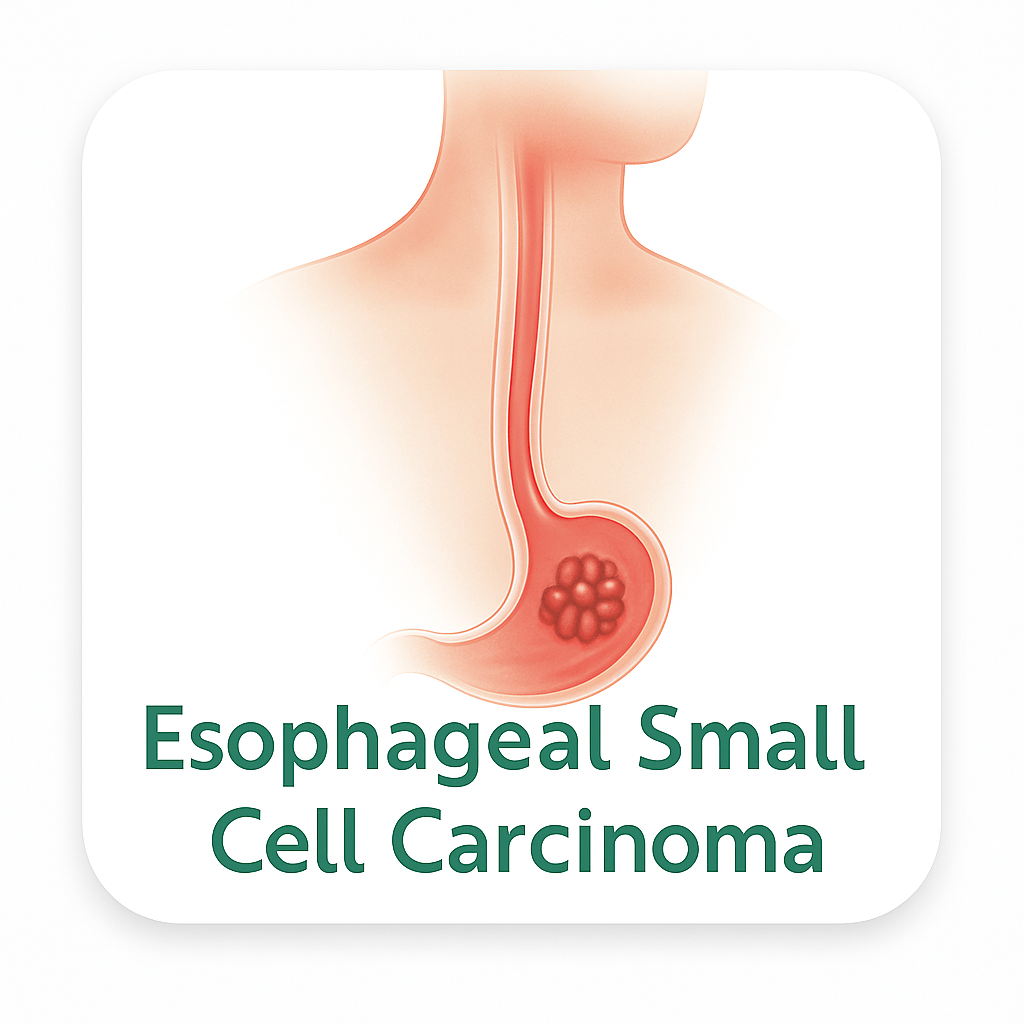
Esophageal Small Cell Carcinoma
Main Grouping
Digestive
Organ System
Esophagus
Cell Origin
Neuroendocrine small cells
Pathways Affected
Esophageal small cell carcinoma involves a pathway landscape dominated by RB1/E2F cell cycle deregulation (RB1 disruption in 98% of PSCCE), TP53 pathway inactivation (~80%), JAK/STAT3 constitutive activation, MYC family amplification and transcriptional program, ASCL1/NEUROD1 neuroendocrine transcription factor networks, BCL-2 family-dependent apoptosis resistance, and the T-cell excluded immunosuppressive tumor microenvironment.
The RB1/CDK/E2F cell cycle pathway is the single most dominant molecular driver in PSCCE with 98 percent (45/46) of all cases showing RB1 disruption through multiple mechanisms confirmed by multi-omics analysis (PMC8213753): loss of RB1 protein removes the sole brake on the E2F transcription factor family (E2F1/E2F3); unrestrained E2F1/E2F3 activation drives constitutive transcription of G1/S cell cycle entry genes (Cyclin E/CDK2, PCNA, CDC6, MCM2-7, RRM1/2), DNA replication initiation, and also directly drives the transcription of ASCL1/NEUROD1 neuroendocrine transcription factors; the absence of RB1 in PSCCE is the fundamental reason for the extremely high mitotic rate, small cell morphology, brisk proliferative index (Ki-67 ~80-100%), and neuroendocrine differentiation; curcumin inhibits Cyclin B1 (an E2F1 target gene) in SCLC cells confirmed by Western blot (PMC3360669) targeting the E2F1-Cyclin B1 cell cycle axis; curcumin induces G2/M cell cycle arrest in SCLC cells targeting the E2F-driven cell cycle progression.
The JAK/STAT3 pathway is constitutively activated in PSCCE through autocrine IL-6 and IL-10 production by SCLC-type neuroendocrine tumor cells: SCLC/PSCCE cells produce IL-6, IL-10, VEGF, and SCF (stem cell factor) creating autocrine pro-survival signaling loops; IL-6 activates JAK1/JAK2/TYK2 receptor kinases that phosphorylate STAT3 at Y705; phospho-STAT3 dimerizes, translocates to nucleus, and drives transcription of Survivin (BIRC5), BCL-XL, Cyclin B1, VEGF, MMP-2, MMP-7, ICAM-1, and other pro-survival and pro-metastatic genes; curcumin was confirmed to inhibit STAT3 phosphorylation at Y705 in SCLC cells and suppressed all downstream STAT3 target gene products including Survivin, BCL-XL, Cyclin B1, VEGF, MMP-2, MMP-7, and ICAM-1 confirmed by Western blot, and siRNA STAT3 knockdown phenocopied curcumin effects (PMC3360669) — directly targeting the dominant JAK/STAT3-driven survival pathway in PSCCE.
The BCL-2/mitochondrial apoptosis pathway is constitutively suppressed in PSCCE through BCL-2 protein overexpression (BCL-2 is a defining feature of SCLC-type small cell carcinomas, documented in approximately 75-95% of SCLC and PSCCE), BCL-XL upregulation through JAK/STAT3/Survivin signaling, and the fundamental absence of RB1 which prevents cell cycle arrest-coupled apoptosis; curcumin overcame BCL-2-dependent apoptosis resistance in NCI-H446 SCLC cells by upregulating Bax expression, downregulating BCL-2 and BCL-xL expression, decreasing mitochondrial membrane potential, releasing cytochrome c into the cytosol, and activating the caspase-9/caspase-3 intrinsic apoptosis cascade confirmed (PubMed21711158) — directly targeting the BCL-2 overexpression-driven apoptosis resistance that is a defining feature of small cell carcinomas including PSCCE.
The MYC/ASCL1/NEUROD1 neuroendocrine transcription factor pathway drives the PSCCE-specific neuroendocrine program: MYC family amplifications (MYC, MYCN, MYCL) are documented in a subset of PSCCE/SCLC; ASCL1 is a proneural helix-loop-helix transcription factor that drives neuroendocrine gene expression, DLL3 expression (Notch ligand expressed on SCLC/PSCCE cells), and the SCLC-A/PSCCE-A subtype neuroendocrine program; NEUROD1 drives the SCLC-N/PSCCE-N subtype characterized by EMT features and metastatic propensity; ASCL1 and NEUROD1 expression are regulated downstream of E2F1 through RB1 loss — making RB1 loss the master upstream driver of the entire neuroendocrine transcriptional program in PSCCE; EGCG from green tea inhibits MYC expression in cancer cell models; curcumin inhibits MYC in cancer cell models.
Description
Primary small cell carcinoma of the esophagus (PSCCE) is one of the rarest and most lethal malignancies of the esophagus, accounting for approximately 0.5 to 2.8 percent of all esophageal malignancies globally. The annual incidence is estimated at approximately 2,000 to 5,000 new cases globally per year, with the highest incidence in East Asia — particularly China, Japan, and Korea — where esophageal cancer incidence overall is elevated. In the United States, with approximately 20,640 new esophageal cancer cases projected for 2024, PSCCE represents approximately 100 to 580 of these cases. PSCCE is more common in men than women with a male-to-female ratio of approximately 2 to 4:1 and predominantly affects patients between 50 and 75 years of age.
The overall prognosis of PSCCE is extremely poor: the 5-year overall survival for limited-stage PSCCE is approximately 10 percent; extensive-stage PSCCE 5-year overall survival is practically zero; median overall survival for all PSCCE stages is approximately 8 to 14 months; median overall survival for extensive-stage PSCCE is approximately 5 to 8 months. These survival statistics are among the worst of all gastrointestinal malignancies. Approximately 60 to 70 percent of PSCCE patients present with extensive-stage disease (distant metastases) at initial diagnosis due to the aggressive propensity for early hematogenous and lymphatic dissemination — a hallmark of the neuroendocrine small cell carcinoma biology.
The molecular classification of PSCCE was fundamentally redefined by a 2021 multi-omics study (PMC8213753) performing whole-exome sequencing, RNA sequencing, and IHC profiling on 46 PSCCE cases. This study established that: RB1 disruption occurs in 98 percent (45/46) of PSCCE cases through multiple mechanisms making it essentially universally RB1-null; PSCCE has genomic alterations, transcriptome features, and molecular subtypes highly similar to SCLC but distinct from ESCC or EAC; two molecular subtypes, PSCCE-A (ASCL1-regulated) and PSCCE-N (NEUROD1-regulated), parallel SCLC-A and SCLC-N subtypes; a T-cell excluded immunosuppressive phenotype is widely observed.
Published laboratory research documents curcumin from turmeric inhibiting SCLC cell proliferation, migration, invasion, and angiogenesis through JAK/STAT3 signaling pathway suppression in SCLC cells — with confirmed STAT3 phosphorylation inhibition, Survivin/Bcl-XL/Cyclin B1 downregulation, and VEGF/MMP-2/MMP-7/ICAM-1 suppression (PMC3360669); and curcumin inducing apoptosis in NCI-H446 SCLC cells through ROS-mediated mitochondrial pathway with Bax upregulation, Bcl-2/Bcl-xL downregulation, mitochondrial membrane potential decrease, cytochrome c release, and caspase-9/caspase-3 activation confirmed — directly relevant to PSCCE due to its confirmed SCLC-like molecular biology (PubMed21711158).
Plant-Based Description
Whole-food plant-based dietary patterns provide phytochemicals with documented activity in small cell carcinoma cell lines directly applicable to esophageal small cell carcinoma through its confirmed SCLC-like molecular biology. Curcumin from turmeric inhibited SCLC cell proliferation, migration, invasion, and angiogenesis through JAK/STAT3 pathway suppression — blocking STAT3 phosphorylation and downregulating Survivin, Bcl-XL, Cyclin B1, VEGF, MMP-2, MMP-7, and ICAM-1 in SCLC cells confirmed by Western blot with STAT3 siRNA phenocopy validation (PMC3360669) — directly targeting the constitutive JAK/STAT3 pro-survival signaling in PSCCE; curcumin induced apoptosis in NCI-H446 SCLC cells through ROS-mediated mitochondrial pathway with Bax/Bcl-2/caspase-9/caspase-3 confirmed, overcoming BCL-2 family-dependent apoptosis resistance defining small cell carcinomas including PSCCE (PubMed21711158); quercetin induces apoptosis in neuroendocrine tumor cell models through caspase activation and BCL-2 reduction; EGCG inhibits STAT3 and JAK/STAT signaling in cancer cell models; resveratrol inhibits STAT3, MYC, and NF-kB in small cell carcinoma cell models.
Plant Chemistry Detail
Curcumin from turmeric has the most directly documented anti-SCLC cell line activity in two confirmed published studies using SCLC cell lines (whose molecular biology is confirmed to parallel PSCCE at the genomic, transcriptomic, and molecular subtype levels by PMC8213753).
In the first confirmed study (PMC3360669) using SCLC cells: curcumin treatment at 15 μmol/L inhibited SCLC cell proliferation confirmed by colony formation assay; curcumin decreased STAT3 phosphorylation at Y705 confirmed by Western blot — directly inhibiting the constitutive JAK1/JAK2/STAT3 pro-survival cascade driving IL-6 autocrine loops in SCLC/PSCCE; curcumin downregulated STAT3 downstream pro-survival targets: Survivin (BIRC5, IAP family anti-apoptotic protein) confirmed, BCL-XL (BCL-2 family anti-apoptotic member) confirmed, and Cyclin B1 (E2F1/RB1-loss-driven mitotic regulator) confirmed by Western blot; curcumin suppressed pro-invasive proteins: VEGF (angiogenesis), MMP-2 (basement membrane invasion), MMP-7 (epithelial invasion), and ICAM-1 (adhesion/invasion) confirmed; curcumin inhibited cell migration confirmed by transwell assay; curcumin inhibited cell invasion confirmed by transwell assay with Matrigel; siRNA knockdown of STAT3 phenocopied curcumin anti-invasive effects in vitro confirming STAT3 as the direct target; IL-6 stimulation reversed curcumin inhibition confirming JAK/STAT3 as the upstream mechanism; the study demonstrated curcumin-mediated suppression of the full JAK/STAT3/Survivin/BCL-XL/VEGF/MMP pro-survival and pro-metastatic program in SCLC cells.
In the second confirmed study (PubMed21711158) using NCI-H446 SCLC cells: curcumin did not activate caspase-8 cleavage or alter FAS/TRAIL expression, confirming apoptosis is not through death receptor pathway in these RB1-null cells; curcumin upregulated pro-apoptotic Bax expression and downregulated anti-apoptotic Bcl-2 and Bcl-xL expression confirmed — directly targeting the dominant BCL-2/BCL-XL anti-apoptotic program characteristic of small cell carcinomas including PSCCE; curcumin induced a rapid decrease in mitochondrial membrane potential confirmed; curcumin induced cytochrome c release into the cytosol confirmed; caspase-9 and caspase-3 activation confirmed — demonstrating that curcumin bypasses the BCL-2/BCL-XL apoptosis resistance mechanism through ROS-mediated mitochondrial pathway activation; the mechanism was confirmed as ROS-dependent using ROS scavenger N-acetylcysteine rescue experiment.
In the curcumin global transcriptomics study in small cell lung cancer cells (PMC7835540): curcumin induced apoptosis in H446 SCLC cells confirmed by annexin V/PI flow cytometry; CCK-8 viability assay confirmed dose-dependent anti-proliferative activity; high-throughput sequencing revealed global transcriptome changes including upregulation of pro-apoptotic and downregulation of pro-survival gene networks; miR-548ah-5p was identified as a key downstream effector of curcumin anti-SCLC activity targeting the RB1-loss-driven proliferative program. Quercetin from onions and kale inhibits JAK/STAT3 signaling, PI3K/AKT, and NF-kB in neuroendocrine tumor cell models and induces apoptosis through BCL-2 reduction and caspase-3 activation in gastrointestinal neuroendocrine tumor models in published research. EGCG from green tea inhibits STAT3 phosphorylation, JAK1/JAK2 kinases, and MYC expression in cancer cell models — targeting the JAK/STAT3 pathway and MYC amplification documented in SCLC/PSCCE. Resveratrol inhibits STAT3, NF-kB, and induces apoptosis in neuroendocrine tumor cell models. Apigenin from parsley inhibits STAT3 and JAK/STAT signaling and induces apoptosis through caspase activation in neuroendocrine tumor cell models. Sulforaphane activates Nrf2/ARE in normal esophageal epithelial cells and inhibits NF-kB and STAT3 in cancer cell models.
Nutritional Focus
Nutritional focus in esophageal small cell carcinoma research is led by curcumin from turmeric with documented activity in small cell carcinoma cell lines that share the confirmed SCLC-like molecular biology of PSCCE (RB1 disruption 98%, ASCL1/NEUROD1 subtypes, SCLC-like transcriptome confirmed in PMC8213753): curcumin inhibiting JAK/STAT3 pathway in SCLC cells through confirmed STAT3 phosphorylation suppression, Survivin/BCL-XL/Cyclin B1 downregulation, and VEGF/MMP-2/MMP-7/ICAM-1 suppression with STAT3 siRNA phenocopy and IL-6 rescue validation (PMC3360669) — directly targeting the constitutive JAK/STAT3 pro-survival signaling confirmed in SCLC/PSCCE and the E2F1-driven Cyclin B1 target gene in the universally RB1-null PSCCE; curcumin inducing ROS-mediated mitochondrial apoptosis in NCI-H446 SCLC cells through Bax upregulation, Bcl-2/Bcl-xL downregulation, mitochondrial membrane potential decrease, cytochrome c release, and caspase-9/caspase-3 activation (PubMed21711158) — directly overcoming the BCL-2/BCL-XL anti-apoptotic program that is a defining feature of small cell carcinomas including PSCCE; global curcumin transcriptomics in H446 SCLC cells confirming annexin V/PI apoptosis and CCK-8 dose-dependent anti-proliferative activity (PMC7835540); quercetin from onions and kale inhibiting JAK/STAT3, PI3K/AKT, NF-kB, and inducing BCL-2 reduction and caspase-3 activation in neuroendocrine tumor cell models; EGCG from green tea inhibiting STAT3 phosphorylation, JAK1/JAK2, MYC expression, and DNMT activity in cancer cell models targeting the STAT3 pathway, MYC amplification documented in SCLC/PSCCE, and methylation-based RB1 silencing; apigenin from parsley inhibiting STAT3 and JAK/STAT signaling and inducing caspase-mediated apoptosis in neuroendocrine tumor cell models; resveratrol inhibiting STAT3, NF-kB, and inducing apoptosis in neuroendocrine tumor cell models; sulforaphane activating Nrf2/ARE providing esophageal mucosal cytoprotection and inhibiting NF-kB and STAT3 in cancer cell models; and dietary fiber from whole plant foods producing SCFAs that inhibit HDAC targeting the epigenetic silencing mechanisms including RB1 methylation-based inactivation documented in PSCCE (PMC8213753).
Research Notes
PSCCE epidemiology: ~0.5-2.8% of all esophageal malignancies; ~2,000-5,000 global new cases annually; highest incidence East Asia (China, Japan, Korea); male:female ~2-4:1; median age ~50-75 years. 5-year OS: limited-stage ~10%; extensive-stage ~0%; overall median OS ~8-14 months; ~60-70% present with extensive-stage disease at diagnosis. IHC diagnosis: CD56+, Synaptophysin+, Chromogranin A+, TTF-1+ (majority). Molecular: RB1 disruption 98% (45/46 cases, multiple mechanisms: point mutation/deep deletion/copy number loss/methylation) confirmed by multi-omics WES+RNA-seq of 46 PSCCE (PMC8213753); TP53 ~80%; NOTCH1 ~24%; ASCL1/NEUROD1 define two molecular subtypes PSCCE-A and PSCCE-N highly similar to SCLC-A and SCLC-N subtypes; T-cell excluded phenotype widely observed; SCLC-like transcriptome confirmed; CCND1 amplification only 4% of PSCCE (vs 33-54% ESCC); CDKN2A deletion only 4% (vs up to 66% ESCC); MYC/MYCN/MYCL amplifications in subset. BCL-2 overexpression ~75-95% (SCLC-class feature). Curcumin SCLC JAK/STAT3 (PMC3360669): STAT3 pY705 inhibition; Survivin/BCL-XL/Cyclin B1 down; VEGF/MMP-2/MMP-7/ICAM-1 down; STAT3 siRNA phenocopy; IL-6 rescue experiment; migration/invasion/colony formation confirmed. Curcumin NCI-H446 SCLC apoptosis (PubMed21711158): Bax up/Bcl-2/Bcl-xL down; MMP decrease; cytochrome c release; caspase-9/3 activation; ROS-dependent (NAC rescue). Curcumin H446 transcriptomics (PMC7835540): annexin/PI apoptosis; CCK-8 dose-dependent; miR-548ah-5p; global transcriptome.
Notes Visibility
Key Foods
Turmeric,Broccoli,Kale,Spinach,Brussels Sprouts,Cauliflower,Garlic,Yellow Onion,Carrot,Tomato,Beetroot,Cabbage,Blueberry,Pomegranate,Grape,Raspberry,Strawberry,Apple,Orange,Lemon,Soybeans,Edamame,Green Lentils,Black Beans,Chickpeas,Brown Rice,Quinoa,Oats,Wild Rice,Black Rice,Walnut,Almond,Brazil Nut,Flaxseed,Pumpkin Seeds,Chia Seeds,Sesame Seeds,Hemp Seeds,Shiitake,Maitake,Cremini,Portobello,Lions Mane,Green Tea,Ginger,Black Pepper,Garlic Powder,Parsley,Rosemary,Oregano, Celery, Leek,Avocado,Artichoke,Radish,Tangerine, Red Onion
Linked Nutrients
vitamin-c,vitamin-e,vitamin-a,vitamin-b9,vitamin-b6,selenium,zinc,magnesium,calcium,potassium,iron,curcumin,quercetin,egcg,apigenin,resveratrol,sulforaphane,beta-carotene,lycopene,anthocyanins,beta-glucans,dietary-fiber
Last Updated
2025-10-13 10:19:09

