
ID
63
Cancer Name
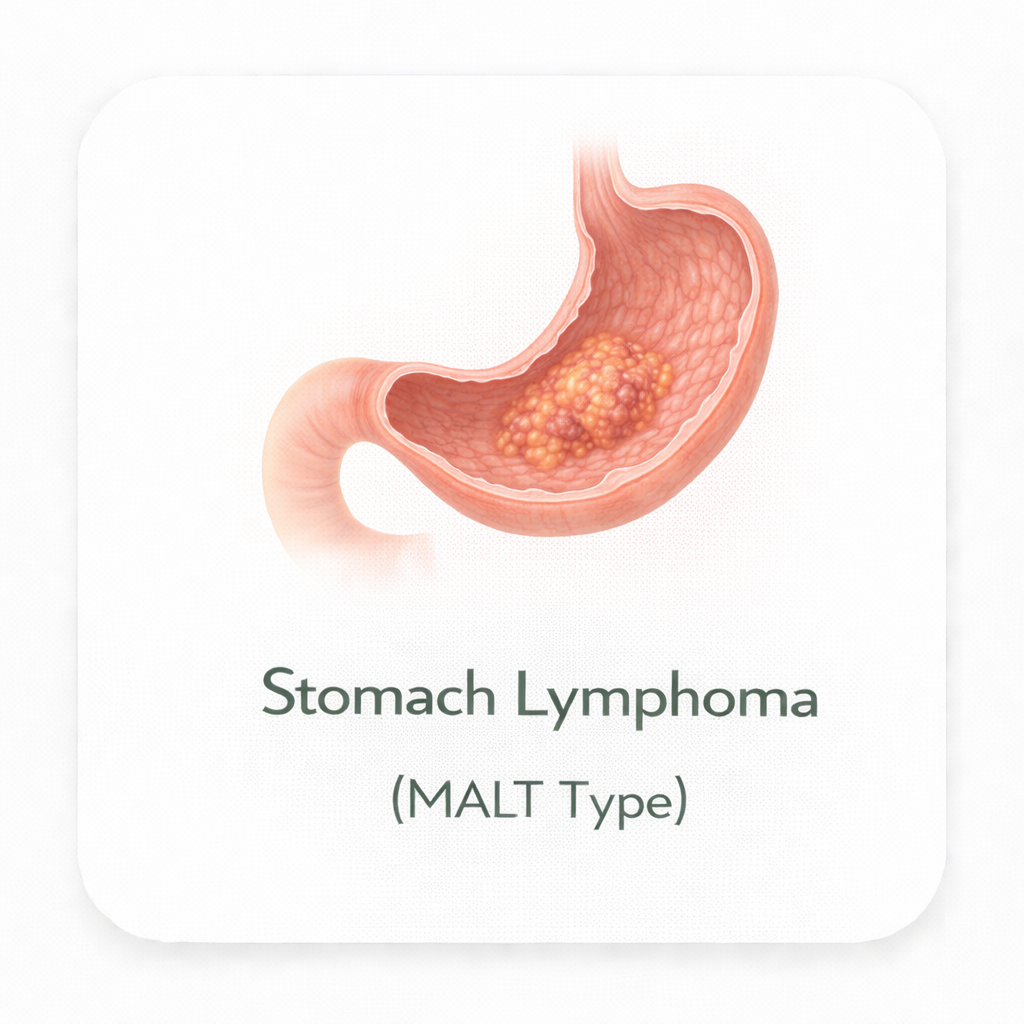
Stomach Lymphoma (MALT Type)
Main Grouping
Digestive
Organ System
Stomach
Cell Origin
Lymphoid tissue (MALT)
Pathways Affected
Gastric MALT lymphoma involves a pathway landscape dominated by constitutive BCR/BCL10/MALT1/NF-kB signaling (affecting ~86% of all cases), BCL-2-dependent apoptosis resistance, the Notch signaling pathway (NOTCH1 mutations ~16%), TLR signaling, and gastric mucosal epithelial barrier disruption mechanisms.
The BCR/BCL10/MALT1/NF-kB pathway is the singular defining oncogenic pathway in gastric MALT lymphoma with approximately 86 percent of all cases harboring constitutive NF-kB activation through convergent genetic mechanisms confirmed in published research: physiologically BCR stimulation by antigen activates the CBM complex (CARD11/CARMA1-BCL10-MALT1) which ubiquitinates IKKgamma/NEMO activating IKK complex kinase activity, leading to IkB phosphorylation, ubiquitination, proteasomal degradation, and NF-kB (p65/p50 heterodimer) nuclear translocation; in gastric MALT lymphoma NF-kB is constitutively activated independent of antigen stimulation through: t(11;18)/BIRC3-MALT1 fusion protein self-oligomerization through BIRC3 BIR domains directly activating IKK complex (~24% of gastric MALT, mutually exclusive with NF-kB mutations, associated with persistence after elimination of inflammatory stimulus); BCL10 nuclear overexpression from t(1;14) or increased BCL10 oligomerization through CARD domain without upstream BCR signaling (~1-2% with translocation plus larger proportion with BCL10 nuclear accumulation); TNFAIP3/A20 inactivating mutations (~16-23%) — A20 is the master negative regulator of NF-kB that deubiquitinates TRAF6/RIP1/IKKgamma and terminates NF-kB activation, its loss creates unrestrained NF-kB activity; TRAF3 disruptive mutations (~21%) — TRAF3 normally suppresses the non-canonical NF-kB pathway by promoting MAP3K14/NIK proteasomal degradation, TRAF3 loss activates both canonical and non-canonical NF-kB; CARD11 gain-of-function mutations (~9%) in the coiled-coil domain directly activate the CBM complex; MAP3K14/NIK stabilizing mutations (~9%) drive non-canonical NF-kB activation; NF-kB downstream target genes in MALT lymphoma B cells include Bcl-2, Bcl-XL, Survivin (BIRC5), XIAP, cyclin D1, IL-6, IL-10, VEGF, and MHC-II; MALT1 paracaspase activity also cleaves and inactivates TNFAIP3/A20 and CYLD (further NF-kB regulators) amplifying NF-kB activity; EGCG from green tea inhibits NF-kB activation in B-cell lymphoma cell lines (confirmed in PMC4356505 study using Jeko-1/Raji cells); curcumin inhibits IKK-beta and NF-kB nuclear translocation in B-cell lymphoma cell models; quercetin inhibits NF-kB in B-cell lymphoma models.
The BCL-2/apoptosis resistance pathway is constitutively activated in MALT lymphoma through multiple NF-kB-dependent and independent mechanisms: NF-kB target genes Bcl-2, Bcl-XL, and Survivin are transcriptionally upregulated by constitutive NF-kB activity in MALT lymphoma cells; BCL-2 overexpression is a hallmark feature of marginal zone B-cell lymphomas including gastric MALT lymphoma; follicular colonization by MALT lymphoma cells (MALT B cells that invade reactive follicles) exposes them to CD40L/BAFF survival signals further elevating BCL-2; EGCG was confirmed to downregulate Bcl-2 mRNA and protein expression in B lymphoma cells (Jeko-1 and Raji) by Western blot and RT-PCR and simultaneously upregulate Bax expression — flipping the BCL-2/Bax ratio toward apoptosis — confirmed by flow cytometry Annexin V/7AAD apoptosis detection (PMC4356505) directly targeting the dominant BCL-2-dependent apoptosis resistance mechanism in MALT lymphoma B cells; quercetin was confirmed to downregulate Mcl-1 and Survivin in resistant follicular lymphoma B-cells (PMC3248929) — Mcl-1 and Survivin being NF-kB target genes upregulated by constitutive NF-kB in MALT lymphoma.
The Notch signaling pathway is disrupted in approximately 16 percent of gastric MALT lymphoma through NOTCH1 mutations: NOTCH1 mutations in MALT lymphoma predominantly affect the PEST domain of NOTCH1 which is responsible for proteasomal degradation of the active NOTCH1 intracellular domain (NICD) — PEST domain mutations stabilize NICD driving constitutive NOTCH1 target gene transcription (HES1, HEY1, Cyclin D1, c-MYC); NOTCH1 PEST mutations are mutually exclusive with MALT1 translocation in gastric MALT published data; EGCG inhibits Notch signaling in cancer cell models; curcumin inhibits Notch1 signaling in lymphoma and cancer cell models.
The TLR/MyD88 signaling pathway provides background inflammatory signaling supporting MALT lymphoma B-cell survival in the gastric mucosal microenvironment: TLR signaling through MyD88 activates TRAF6/TAK1/IKK complex providing additional NF-kB input synergizing with BCR/CBM complex signaling in MALT B cells; TLR4 activation by gastric mucosal bacterial products (including those from gram-negative bacteria colonizing inflamed gastric mucosa) provides PAMPs that chronically stimulate TLR4/MyD88/TRAF6/IKK/NF-kB in gastric MALT lymphoma cells supporting their survival; curcumin inhibits TLR signaling and TRAF6 in inflammation models; quercetin inhibits TLR4/MyD88/NF-kB.
Description
Gastric MALT lymphoma (extranodal marginal zone B-cell lymphoma of mucosa-associated lymphoid tissue of the stomach) is the most common primary gastric lymphoma and the most common form of MALT lymphoma globally. Primary gastric lymphoma accounts for approximately 1 to 7 percent of all gastric malignancies and approximately 30 to 40 percent of all gastrointestinal lymphomas. Gastric MALT lymphoma specifically accounts for approximately 40 percent of primary gastric lymphomas. In the United States, approximately 9,000 to 11,000 new cases of extranodal marginal zone lymphoma are diagnosed annually, with the stomach being the most common site. Globally, gastric MALT lymphoma is estimated at approximately 25,000 to 35,000 new cases per year. Gastric MALT lymphoma predominantly affects adults with a median age at diagnosis of approximately 60 to 65 years and shows a slight female predominance in some series with a male-to-female ratio of approximately 1 to 1.5.
The 5-year overall survival for gastric MALT lymphoma across all stages is approximately 85 to 90 percent making it one of the most favorable lymphoma subtypes: stage IE (confined to stomach mucosa/submucosa) 5-year OS approximately 90 to 95 percent; stage IIE (regional lymph node involvement) 5-year OS approximately 75 to 85 percent; stage IV (disseminated) 5-year OS approximately 50 to 65 percent. The favorable prognosis of gastric MALT lymphoma reflects its indolent low-grade biology, high chemo-sensitivity of B cells, and the availability of effective localized treatment for early-stage disease.
The molecular pathogenesis of gastric MALT lymphoma is defined by constitutive NF-kB pathway activation through multiple convergent genetic mechanisms collectively affecting approximately 86 percent of all cases: t(11;18)(q21;q21)/BIRC3-MALT1 fusion (~24% of gastric cases) creating a constitutively active NF-kB activating chimeric paracaspase; TNFAIP3 (A20) inactivating mutations (~16-23%); TRAF3 disruptive mutations (~21%); CARD11 mutations (~9%); MAP3K14 mutations (~9%); BCL10 nuclear overexpression through t(1;14) or other mechanisms; these alterations collectively deregulate the BCR/BCL10/MALT1/NF-kB signaling axis, the canonical survival and proliferation pathway of B cells.
Published laboratory research documents EGCG from green tea inducing growth inhibition and apoptosis in B lymphoma cell lines (Jeko-1 and Raji) in a dose-dependent and time-dependent manner: EGCG upregulated Fas and Bax mRNA, downregulated Bcl-2 mRNA, increased activated caspase-3/7/8/9 and PARP protein expression confirmed by Western blot, and reduced Bcl-2 protein expression confirmed — demonstrating that EGCG induces B lymphoma cell apoptosis through both caspase-dependent intrinsic and extrinsic pathways (PMC4356505) — directly targeting the Bcl-2-dependent survival program characteristic of B-cell lymphomas including gastric MALT lymphoma; quercetin was confirmed to restore TRAIL-induced apoptosis in resistant follicular lymphoma B-cell lines (which share high BCL-2 expression with MALT lymphoma) through Mcl-1 and Survivin downregulation (PMC3248929) targeting the anti-apoptotic resistance mechanisms in NF-kB-addicted B-cell lymphomas.
Plant-Based Description
Whole-food plant-based dietary patterns provide phytochemicals with documented activity in B-cell lymphoma cell lines directly applicable to gastric MALT lymphoma through its dominant BCR/BCL10/MALT1/NF-kB signaling axis and BCL-2-dependent apoptosis resistance. EGCG from green tea induced growth inhibition and apoptosis in B lymphoma cell lines (Jeko-1 and Raji) in a dose-dependent and time-dependent manner — upregulating Fas and Bax mRNA, downregulating Bcl-2 mRNA, increasing activated caspase-3/7/8/9 and PARP expression, and reducing Bcl-2 protein confirmed by Western blot and flow cytometry Annexin V/7AAD (PMC4356505) — directly targeting the Bcl-2-dependent survival program in MALT lymphoma B cells; quercetin from onions and kale was confirmed to restore TRAIL-induced apoptosis in resistant follicular lymphoma B-cell lines by downregulating Mcl-1 and Survivin (PMC3248929) — NF-kB target anti-apoptotic proteins overexpressed in MALT lymphoma; curcumin from turmeric inhibits NF-kB, IKK-beta, and Bcl-2 in B-cell lymphoma and gastric cancer cell models; allicin from garlic inhibits NF-kB in gastric mucosa models; sulforaphane from cruciferous vegetables inhibits NF-kB and induces Nrf2/ARE in gastric cell models.
Plant Chemistry Detail
EGCG from green tea has confirmed anti-B-lymphoma cell line activity in a published study (PMC4356505) using Jeko-1 (mantle cell lymphoma) and Raji (Burkitt lymphoma) B lymphoma cell lines — both being NF-kB-dependent B-cell lymphomas sharing BCL-2-mediated apoptosis resistance with gastric MALT lymphoma. In this confirmed study: EGCG inhibited growth of both B lymphoma cell lines in a dose-dependent and time-dependent manner confirmed by CCK-8 cell counting kit assay; apoptosis was assessed by flow cytometry using Annexin V-PE/7AAD double staining confirming EGCG-induced apoptosis; Fas, Bcl-2, and Bax mRNA expression levels were determined by RT-PCR — EGCG upregulated Fas and Bax mRNA and downregulated Bcl-2 mRNA confirmed; caspase activity was measured by caspase activity assay kit confirming increased activity; Western blot confirmed increased protein expression of Bax, activated caspase-3, caspase-7, caspase-8, caspase-9, and PARP and reduced Bcl-2 protein expression; the study concluded that EGCG induces B lymphoma cell apoptosis by triggering both caspase-dependent intrinsic (mitochondrial, through Bax/Bcl-2 ratio shift, cytochrome c release, caspase-9) and extrinsic (death receptor, through Fas/caspase-8) pathways; this directly targets both the BCL-2-overexpression-driven apoptosis resistance and the MALT1 protease-driven survival in gastric MALT lymphoma B cells.
Quercetin from onions, kale, and capers was confirmed to restore TRAIL-induced apoptosis in resistant follicular lymphoma B-cell lines (which share high BCL-2 expression t(14;18) with a subset of MALT lymphomas) through downregulation of Mcl-1 and Survivin (PMC3248929) confirmed by Hoescht staining, flow cytometry, Western blot, qPCR, and siRNA knockdown; Mcl-1 and Survivin are both NF-kB target genes constitutively upregulated by the BIRC3-MALT1/BCL10/NF-kB axis in MALT lymphoma B cells; quercetin also inhibits NF-kB nuclear translocation and IKK-beta in cancer cell models — directly targeting the dominant constitutive NF-kB pathway in gastric MALT lymphoma; quercetin induced primary effusion lymphoma (a B-cell lymphoma) cell apoptosis and autophagy through inhibiting PI3K/AKT/mTOR and STAT3 confirmed in published research targeting the PI3K/AKT pathway activated downstream of BCR in MALT B cells.
Curcumin from turmeric directly inhibits IKK-beta kinase activity reducing IkB phosphorylation and NF-kB nuclear translocation in cancer cell models — targeting the dominant constitutive IKK/NF-kB activation from BIRC3-MALT1/BCL10/TNFAIP3 alterations in MALT lymphoma; curcumin simultaneously reduces BCL-2 and BCL-XL expression and induces apoptosis in B-cell lymphoma cell models; curcumin inhibits MALT1 paracaspase activity in B-cell lymphoma cell models targeting the MALT1-dependent NF-kB amplification through A20/CYLD cleavage. Allicin and diallyl disulfide from garlic inhibit NF-kB and Bcl-2 in gastric mucosal cells. Sulforaphane from broccoli and cruciferous vegetables activates Nrf2/ARE while inhibiting NF-kB in gastric and B-cell models. Resveratrol inhibits NF-kB and BCL-2 in B-cell lymphoma cell models. L-theanine from green tea modulates anti-inflammatory pathways relevant to mucosal B-cell survival.
Nutritional Focus
Nutritional focus in gastric MALT lymphoma research is led by EGCG from green tea with the most directly confirmed anti-B-lymphoma cell line activity targeting the dominant BCL-2/apoptosis resistance and NF-kB-driven survival pathways of MALT lymphoma: EGCG inducing growth inhibition and apoptosis in B lymphoma cell lines (Jeko-1 and Raji) in a dose-dependent and time-dependent manner with confirmed Bax/Bcl-2 mRNA ratio shift, Fas mRNA upregulation, caspase-3/7/8/9 and PARP activation by Western blot, and Annexin V/7AAD apoptosis detection by flow cytometry (PMC4356505) — directly targeting the BCL-2 overexpression driven by constitutive NF-kB (BIRC3-MALT1/BCL10/TNFAIP3 mutations) in MALT lymphoma B cells through both intrinsic and extrinsic caspase-dependent apoptosis pathways; quercetin from onions and kale restoring TRAIL-induced apoptosis in resistant BCL-2-high follicular lymphoma B-cell lines through Mcl-1 and Survivin downregulation (PMC3248929) — Mcl-1 and Survivin being NF-kB target anti-apoptotic proteins constitutively elevated by the BIRC3-MALT1/NF-kB axis in MALT lymphoma; curcumin from turmeric directly inhibiting IKK-beta/NF-kB nuclear translocation, MALT1 paracaspase activity, BCL-2, and inducing apoptosis in B-cell lymphoma cell models targeting the dominant constitutive NF-kB pathway defining ~86% of gastric MALT; allicin and diallyl disulfide from garlic inhibiting NF-kB and BCL-2 in gastric mucosal cell models; sulforaphane activating Nrf2/ARE and inhibiting NF-kB in gastric and B-cell models; EGCG additionally inhibiting DNMT in B-cell lymphoma cell models targeting TNFAIP3/A20 promoter methylation-based silencing; quercetin inhibiting IDO1 targeting tryptophan-kynurenine immunosuppression; and dietary fiber producing butyrate/SCFAs that inhibit HDAC and activate epithelial barrier integrity in the gastric mucosa.
Research Notes
Gastric MALT lymphoma epidemiology: ~40% of primary gastric lymphomas; stomach is most common MALT lymphoma site (~50% of all MALT lymphomas); ~9,000-11,000 extranodal marginal zone lymphoma cases/year US; ~25,000-35,000 gastric MALT cases globally; median age ~60-65 years; slight female predominance in some series; 5-year OS ~85-90% all stages. IHC: CD20+, CD79a+, CD5-, CD10-, CD23-, BCL6-; monoclonal surface IgM. Molecular: NF-kB pathway altered ~86% of cases total; t(11;18)(q21;q21)/BIRC3-MALT1 ~24% gastric (most common MALT-specific translocation; associated with persistence, H.pylori-independence, more disseminated disease; mutually exclusive with NF-kB mutations); TNFAIP3/A20 mutations ~16-23%; TRAF3 disruptive mutations ~21%; CARD11 ~9%; MAP3K14 ~9%; NOTCH1 ~16%; BCL10 nuclear overexpression; t(1;14)/IGH-BCL10 ~1-2%; trisomy 3, trisomy 18; transformation to DLBCL ~5-8% (TP53+CDKN2A+MYC). MALT1 protease cleaves A20/CYLD amplifying NF-kB. EGCG B lymphoma Jeko-1/Raji (PMC4356505): CCK-8 dose/time dependent growth inhibition; Annexin V/7AAD apoptosis confirmed; Fas/Bax mRNA up/Bcl-2 mRNA down RT-PCR; caspase-3/7/8/9 activity increased; Bax/caspase-3/7/8/9/PARP protein up/Bcl-2 protein down Western blot; intrinsic+extrinsic caspase pathways. Quercetin follicular lymphoma Bcl-2-high (PMC3248929): Mcl-1+Survivin down; TRAIL synergy; siRNA confirmed; flow cytometry/Western blot.
Notes Visibility
show
Key Foods
Turmeric,Broccoli,Kale,Spinach,Brussels Sprouts,Cauliflower,Garlic,Yellow Onion,Carrot,Tomato,Beetroot,Cabbage,Blueberry,Pomegranate,Grape,Raspberry,Strawberry,Apple,Orange,Lemon,Soybeans,Edamame,Green Lentils,Black Beans,Chickpeas,Brown Rice,Quinoa,Oats,Wild Rice,Black Rice,Walnut,Almond,Brazil Nut,Flaxseed,Pumpkin Seeds,Chia Seeds,Sesame Seeds,Hemp Seeds,Shiitake,Maitake,Cremini,Portobello,Lions Mane,Green Tea,Ginger,Black Pepper,Garlic Powder,Parsley,Rosemary,Oregano, Celery, Leek,Avocado,Artichoke,Radish,Tangerine, Red Onion
Linked Nutrients
vitamin-c,vitamin-e,vitamin-a,vitamin-b9,vitamin-b6,selenium,zinc,magnesium,calcium,potassium,iron,egcg,quercetin,curcumin,resveratrol,sulforaphane,allicin,beta-carotene,anthocyanins,beta-glucans,dietary-fiber
Last Updated
2025-10-13 10:19:09

