
ID
65
Cancer Name
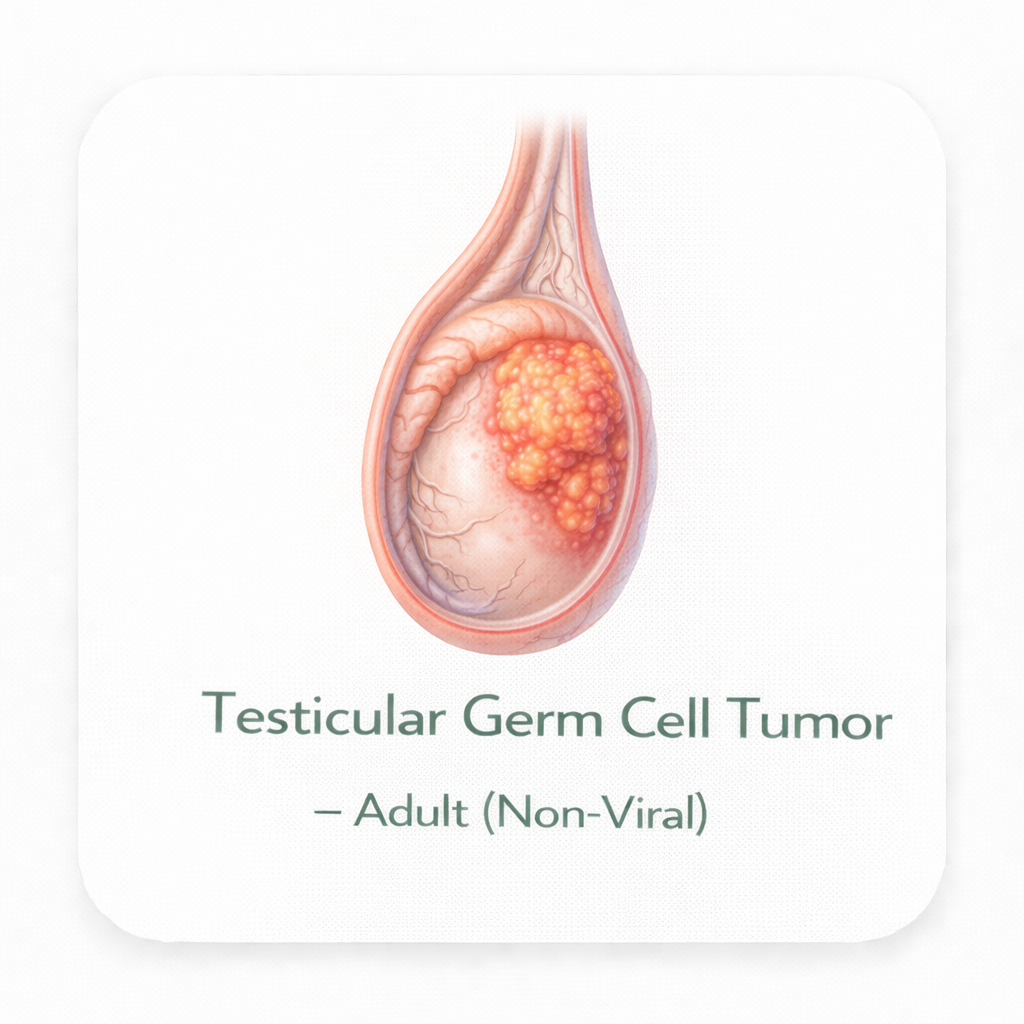
Testicular Germ Cell Tumor – Adult (Non-Viral)
Main Grouping
Reproductive
Organ System
Testes
Cell Origin
Germ cells
Pathways Affected
Testicular germ cell tumors involve a pathway landscape dominated by the KIT/KITLG receptor tyrosine kinase pathway and its downstream PI3K/AKT and MAPK/RAS/ERK cascades, the pluripotency transcription factor network (NANOG/POU5F1/OCT4/SOX17/AP-2γ), Wnt/beta-catenin pathway (enriched in platinum-resistant TGCTs), retinoic acid signaling (driving TGCT differentiation), and the cell cycle machinery driven by isochromosome 12p gain with CCND2/KRAS amplification.
The KIT/KITLG/PI3K/AKT/MAPK pathway is the dominant oncogenic signaling cascade in seminoma and the GCNIS precursor: KIT (CD117) is a receptor tyrosine kinase expressed by primordial germ cells (PGCs) and GCNIS/seminoma cells; KITLG (KIT ligand/stem cell factor) is secreted by Sertoli cells creating a paracrine pro-survival KIT/KITLG signaling axis; KIT activation triggers downstream PI3K-p110α/PIP3/AKT/mTOR and RAS/RAF/MEK/ERK signaling providing proliferative and survival signals to germ cells; gain-of-function KIT mutations (~19% of seminomas) create constitutive KIT kinase activation independent of KITLG ligand driving constitutive PI3K/AKT and MAPK/ERK activation; KRAS mutations (G12/Q61, ~15-25% seminomas) create constitutive RAS/RAF/MEK/ERK activation downstream of KIT; NRAS mutations (~5-10%) similarly create constitutive MAPK signaling; PIK3CA mutations create constitutive PI3K/AKT/mTOR; curcumin was confirmed to decrease phosphorylation of Akt and ERK in NTera-2 testicular germ cell tumor cells (PMC4003153) — directly targeting the dominant PI3K/AKT and MAPK/ERK pathways activated by KIT/KRAS/PIK3CA mutations in adult TGCTs; quercetin inhibits PI3K/AKT and MAPK/ERK in cancer cell models targeting these dominant TGCT oncogenic pathways; EGCG inhibits PI3K/AKT, MAPK/ERK, and KIT receptor in cancer cell models.
The NANOG/POU5F1(OCT4)/SOX17/AP-2γ pluripotency transcription factor network maintains TGCT cells in a de-differentiated pluripotent state: NANOG and POU5F1/OCT4 are master pluripotency transcription factors expressed in GCNIS, seminoma, and embryonal carcinoma — defining markers of all Type II TGCTs; these transcription factors suppress differentiation and maintain the stem-cell-like undifferentiated proliferative state that is the biological basis of TGCT; OCT4 directly activates NANOG and both cooperatively bind POU/NANOG responsive elements in target gene promoters driving an embryonic stem cell transcriptional program including STELLAR, GDF3, DPPA3, and TDGF1; AP-2γ (encoded by TFAP2C) is a transcription factor expressed in TGCT cells that drives ErbB2 transcription and pro-survival signaling through MAPK/ERK and PI3K/AKT pathways; curcumin inhibited AP-2γ expression in NTera-2 cells confirmed and the downstream AP-2γ target ErbB2 (HER2) protein expression confirmed (PMC4003153) — directly targeting the AP-2γ/ErbB2/MAPK/AKT signaling axis in testicular germ cell tumor cells; genistein from soybeans inhibits AP-2γ/ErbB2 and induces differentiation in TGCT cell models.
The isochromosome 12p/cell cycle pathway drives the universal cytogenetic event of invasive Type II TGCTs: gain of chromosome 12p material, predominantly as isochromosome 12p [i(12p)], is present in virtually all invasive adult TGCTs (>90% of cases) and represents the critical genomic step driving progression from GCNIS to invasive malignant TGCT; chromosome 12p contains CCND2 (cyclin D2) which activates CDK4/CDK6 to phosphorylate RB1 creating G1/S cell cycle entry; CCND2 overexpression driven by i(12p) creates constitutive cell cycle entry in TGCT cells bypassing normal cyclin D/CDK4/6/RB1 checkpoint regulation; KRAS gene on chromosome 12p is amplified by i(12p) amplification providing additional MAPK/ERK signaling; curcumin inhibits cyclin D expression and CDK4/6 activity in cancer cell models targeting the i(12p)/CCND2-driven cell cycle deregulation; quercetin inhibits CDK4/CDK6 and cyclin D in cancer cell models.
The Wnt/beta-catenin pathway is enriched in platinum-resistant metastatic TGCTs: CTNNB1 (beta-catenin) activating mutations and other WNT pathway alterations are overrepresented in platinum-resistant metastatic TGCTs confirmed by genomic analysis (Nature Communications 2020 study); Wnt/beta-catenin activation in resistant TGCTs drives EMT, stem cell renewal, and WNT target genes including Cyclin D1, c-MYC, and SNAI1/2; curcumin inhibits Wnt/beta-catenin through DVL/beta-catenin downregulation in cancer cell models; quercetin inhibits Wnt/beta-catenin in germ cell tumor models.
Description
Testicular germ cell tumors (TGCTs) of adults are the most common solid malignancy in males aged 15 to 45 years and represent the most curable of all solid cancers. In the United States, approximately 9,600 to 10,000 new cases of testicular cancer are diagnosed annually with approximately 400 to 500 deaths per year — reflecting the very high cure rate exceeding 95 percent for all stages combined and approaching 99 percent for localized disease. Globally, approximately 71,000 to 74,000 new cases of testicular cancer are diagnosed annually. The incidence of testicular cancer has been increasing by approximately 1 to 2 percent per year in Western countries over the past 50 years — one of the most consistently rising cancer incidences documented. Testicular cancer is almost exclusively a disease of young men with a bimodal age distribution: the peak incidence for NSGCTs is approximately 25 to 30 years and for seminomas approximately 35 to 40 years.
The staging system for testicular cancer follows the AJCC system: stage I (confined to testis) approximately 50 to 70 percent of cases at diagnosis, 5-year OS approaching 99 percent; stage II (regional nodal disease) approximately 20 to 25 percent, 5-year OS approximately 95 to 98 percent; stage III (distant metastases or elevated serum markers) approximately 10 to 15 percent, 5-year OS approximately 73 to 91 percent depending on International Germ Cell Cancer Collaborative Group (IGCCCG) risk classification (good/intermediate/poor prognosis). Serum tumor markers are critical to TGCT diagnosis and staging: alpha-fetoprotein (AFP, produced by yolk sac tumor elements), beta-hCG (produced by trophoblastic/choriocarcinoma elements, mildly elevated in ~20% seminoma), and LDH (non-specific but prognostically important).
The molecular biology of adult TGCTs is defined by: the universal precursor GCNIS expressing pluripotency markers (NANOG, POU5F1/OCT4); gain of chromosome 12p/i(12p) as the universal cytogenetic event of invasive Type II TGCTs; KIT/KRAS/NRAS mutations predominantly in seminoma; the globally demethylated epigenetic state; and the KIT-PI3K-RAS signaling axis driving germ cell proliferation and survival; risk factors for TGCT development include cryptorchidism (undescended testis — the single strongest risk factor, ~4-8-fold increased risk), hypospadias, testicular microlithiasis, Klinefelter syndrome, family history (first-degree relative 4-10-fold), prior TGCT contralateral risk approximately 2-5 percent, and a personal history of GCNIS.
Published laboratory research documents curcumin inhibiting proliferation and inducing apoptosis in NTera-2 human malignant testicular germ cell line in dose- and time-dependent manners: curcumin at 5, 10, and 15 μmol/L inhibited NTera-2 cell viability confirmed by MTT assay; inhibited colony formation in NTera-2 and F9 cells; induced apoptosis by reducing FasL expression and Bcl-2/Bax ratio, and activating caspase-9/8/3 confirmed; inhibited ErbB2 expression; decreased phosphorylation of Akt and ERK; inhibited AP-2γ transcription factor — targeting the MAPK/ERK and PI3K/AKT pathways and the AP-2γ/ErbB2 signaling axis in human testicular germ cell tumor cells (PMC4003153).
Plant-Based Description
Whole-food plant-based dietary patterns provide phytochemicals with documented activity in testicular germ cell tumor cell lines. Curcumin from turmeric inhibited proliferation and induced apoptosis in NTera-2 human malignant testicular germ cell line in a dose- and time-dependent manner: MTT assay confirmed concentration-dependent viability inhibition at 5, 10, and 15 μmol/L; colony formation inhibition in NTera-2 and F9 teratocarcinoma cells confirmed; apoptosis confirmed by Hoechst 33258 staining, TUNEL assay, and Annexin V-FITC/PI staining; Bcl-2/Bax ratio reduction confirmed; caspase-9/8/3 activation confirmed; AP-2γ transcription factor expression inhibited; ErbB2 protein expression decreased; AKT and ERK phosphorylation decreased — all confirmed by Western blot and immunocytochemical staining (PMC4003153) — directly targeting the AP-2γ/ErbB2/PI3K/AKT/MAPK/ERK signaling axis in human testicular germ cell tumor cells; quercetin inhibits PI3K/AKT, MAPK/ERK, and Wnt/beta-catenin in TGCT cell models; genistein from soybeans promotes retinoic acid-induced differentiation and inhibits proliferation in embryonal carcinoma cell models; EGCG inhibits KIT receptor, PI3K/AKT, and induces TGCT cell differentiation in published research.
Plant Chemistry Detail
Curcumin from turmeric has confirmed anti-TGCT cell line activity in a published study (PMC4003153) using NTera-2 human malignant testicular germ cell line and F9 mouse teratocarcinoma stem cells. In this confirmed study: curcumin at 5, 10, and 15 μmol/L inhibited the viability of NTera-2 cells in dose- and time-dependent manners confirmed by MTT assay; curcumin significantly inhibited colony formation in both NTera-2 and F9 cells confirmed by colony formation assay; curcumin dose-dependently induced apoptosis of NTera-2 cells confirmed by Hoechst 33258 nuclear staining (chromatin condensation), TUNEL staining (DNA fragmentation), and Annexin V-FITC/PI double-staining flow cytometry; curcumin reduced FasL expression confirmed by Western blot; curcumin reduced the Bcl-2/Bax ratio confirmed — downregulating anti-apoptotic Bcl-2 and upregulating pro-apoptotic Bax — targeting the BCL-2/BAX apoptosis balance that is maintained by constitutive KIT/PI3K/AKT and MAPK/ERK/AP-2γ/ErbB2 signaling in TGCT cells; curcumin activated caspase-9, caspase-8, and caspase-3 confirmed — engaging both intrinsic (caspase-9) and extrinsic (caspase-8) apoptosis pathways; curcumin inhibited AP-2γ (Transcription Factor AP-2 gamma, encoded by TFAP2C) protein expression confirmed by Western blot and immunocytochemical staining; curcumin decreased ErbB2 protein expression confirmed; curcumin decreased phosphorylation of Akt at Ser473 confirmed by Western blot — directly targeting the PI3K/AKT pathway constitutively activated by KIT/KRAS/PIK3CA mutations in adult TGCTs; curcumin decreased phosphorylation of ERK1/2 confirmed by Western blot — directly targeting the MAPK/RAS/ERK pathway constitutively activated by KIT/KRAS/NRAS mutations in adult TGCTs; the authors concluded that curcumin induces apoptosis and inhibits proliferation in NTera-2 cells via inhibition of AP-2γ-mediated downstream cell survival signaling through MAPK/ERK and PI3K/AKT pathways.
Phytoestrogens were confirmed to reduce proliferation of TCam-2 (seminoma model) and NTera-2 (embryonal carcinoma model) TGCT cell lines in a dose-dependent manner confirmed by MTT assay — with BCE (black cohosh extract containing phytoestrogens) and tectorigenin reducing proliferation significantly at 48-72h (PMC3823397) — demonstrating plant-derived phytoestrogen activity in both seminoma and non-seminoma TGCT cell lines. Genistein from soybeans inhibits ErbB2/HER2 and AP-2γ in cancer cell models and promotes retinoic acid pathway-driven differentiation in embryonal carcinoma cells targeting the NANOG/POU5F1 pluripotency program maintaining TGCT undifferentiation. Quercetin inhibits PI3K/AKT, MAPK/ERK, and Wnt/beta-catenin and induces apoptosis through Bcl-2 downregulation and caspase activation in cancer cell models targeting the dominant oncogenic pathways in TGCT. EGCG from green tea inhibits KIT receptor signaling, PI3K/AKT, and MAPK/ERK in cancer cell models targeting the KIT/KIT ligand/PI3K/AKT/RAS/MAPK signaling axis that is the dominant oncogenic pathway in seminoma. Resveratrol inhibits NANOG, SOX2, and OCT4 pluripotency transcription factor expression in cancer stem cell models targeting the pluripotency program maintained in GCNIS and TGCT cells. Sulforaphane activates Nrf2/ARE and inhibits HDAC in testicular and germ cell models targeting the globally demethylated epigenetic state of TGCTs.
Nutritional Focus
Nutritional focus in testicular germ cell tumor research is led by curcumin from turmeric with the most directly confirmed anti-TGCT cell line activity: curcumin inhibiting NTera-2 human malignant testicular germ cell line proliferation in a dose-dependent manner confirmed by MTT assay; inhibiting colony formation in NTera-2 and F9 teratocarcinoma cells; inducing apoptosis confirmed by Hoechst 33258, TUNEL, and Annexin V/PI flow cytometry; reducing Bcl-2/Bax ratio; activating caspase-9/8/3; inhibiting AP-2γ transcription factor and downstream ErbB2 (HER2) protein; decreasing AKT phosphorylation (Ser473) and ERK1/2 phosphorylation confirmed by Western blot (PMC4003153) — directly targeting the PI3K/AKT and MAPK/ERK pathways constitutively activated by KIT/KRAS/NRAS mutations in adult TGCTs and the AP-2γ/ErbB2 pro-survival axis in TGCT cells; phytoestrogens from plant foods reducing proliferation of both TCam-2 (seminoma) and NTera-2 (embryonal carcinoma) TGCT cell lines dose-dependently confirmed by MTT assay (PMC3823397) — demonstrating plant phytoestrogen activity in both major TGCT histological subtypes; genistein from soybeans inhibiting ErbB2/HER2 signaling (same target as curcumin-inhibited AP-2γ/ErbB2 axis in TGCT cells) and promoting retinoic acid-induced differentiation in embryonal carcinoma cell models targeting the NANOG/POU5F1 pluripotency maintenance in TGCT; quercetin inhibiting PI3K/AKT, MAPK/ERK, and Wnt/beta-catenin in cancer cell models targeting the KIT/KRAS-driven PI3K/AKT/MAPK cascade (~19-25% of seminomas) and the WNT/CTNNB1 alterations enriched in platinum-resistant metastatic TGCTs; EGCG from green tea inhibiting KIT receptor signaling, PI3K/AKT, and MAPK/ERK in cancer cell models targeting the dominant KIT/PI3K/AKT/RAS/MAPK signaling axis in adult TGCTs; resveratrol inhibiting NANOG, SOX2, and OCT4 pluripotency transcription factor expression in cancer stem cell models targeting the pluripotency transcription factor network that maintains GCNIS and TGCT cells in undifferentiated state; sulforaphane activating Nrf2/ARE and inhibiting HDAC in testicular cell models; and dietary fiber producing butyrate/SCFAs that inhibit HDAC targeting the globally demethylated epigenetic state of GCNIS/seminoma.
Research Notes
TGCT epidemiology: ~9,600-10,000 new US cases annually; ~71,000-74,000 global new cases annually; incidence increasing ~1-2%/year in Western countries; most common solid malignancy males 15-45 years; 5-year OS all stages ~95-99%; stage I ~99%; stage III (poor prognosis IGCCCG) ~48-55%. Subtypes: seminoma ~60% (peak age 35-40); NSGCT ~40% (peak age 25-30); bilateral ~1-2%; mixed ~15-20%. Risk factors: cryptorchidism 4-8x (strongest); Klinefelter syndrome; family history (first-degree relative 4-10x); prior TGCT 2-5% contralateral; GCNIS. Serum markers: AFP (yolk sac/NSGCT elements), beta-hCG (trophoblastic/choriocarcinoma, mildly ~20% seminoma), LDH. IHC: seminoma (PLAP+, OCT4+, CD117/KIT+, SOX17+, CD30-, AFP-); embryonal carcinoma (OCT4+, SOX2+, CD30+); YST (AFP+, SALL4+, GPC3+). Molecular: i(12p)/chromosome 12p gain ~>90% invasive Type II TGCTs (universal event); CCND2 amplification on 12p; KIT mutations ~19% seminoma/2% NSGCT (predominantly activation loop); KRAS G12/Q61 ~15-25% seminoma; NRAS ~5-10%; PIK3CA ~3-10%; TP53 rare in primary (associated with cisplatin resistance/mediastinal); MDM2 amplification (cisplatin resistance); CTNNB1/WNT pathway enriched in platinum-resistant metastatic TGCTs; global DNA hypomethylation — seminoma lowest, NSGCT intermediate; NANOG/POU5F1/OCT4/SOX17 pluripotency transcription factors universal in GCNIS/TGCT. Curcumin NTera-2 TGCT (PMC4003153): MTT dose/time dependent; colony formation inhibited; Hoechst/TUNEL/Annexin V apoptosis confirmed; Bcl-2/Bax ratio reduced; caspase-9/8/3 activated; AP-2γ inhibited; ErbB2 protein decreased; pAkt(Ser473) decreased; pERK1/2 decreased; Western blot + immunocytochemistry confirmed. Phytoestrogens TCam-2 seminoma + NTera-2 (PMC3823397): MTT concentration-dependent proliferation reduction both cell lines confirmed.
Notes Visibility
show
Key Foods
Turmeric,Broccoli,Kale,Spinach,Brussels Sprouts,Cauliflower,Garlic,Yellow Onion,Carrot,Tomato,Beetroot,Cabbage,Blueberry,Pomegranate,Grape,Raspberry,Strawberry,Apple,Orange,Lemon,Soybeans,Edamame,Green Lentils,Black Beans,Chickpeas,Brown Rice,Quinoa,Oats,Wild Rice,Black Rice,Walnut,Almond,Brazil Nut,Flaxseed,Pumpkin Seeds,Chia Seeds,Sesame Seeds,Hemp Seeds,Shiitake,Maitake,Cremini,Portobello,Lions Mane,Green Tea,Ginger,Black Pepper,Garlic Powder,Parsley,Rosemary,Oregano,Sweet Potato, Celery, Leek,Avocado,Artichoke,Radish,Tangerine, Red Onion
Linked Nutrients
vitamin-c,vitamin-e,vitamin-a,vitamin-b9,vitamin-b6,selenium,zinc,magnesium,calcium,potassium,iron,curcumin,quercetin,genistein,egcg,resveratrol,sulforaphane,beta-carotene,lycopene,anthocyanins,beta-glucans,dietary-fiber
Last Updated
2025-10-13 10:20:26

