
ID
66
Cancer Name
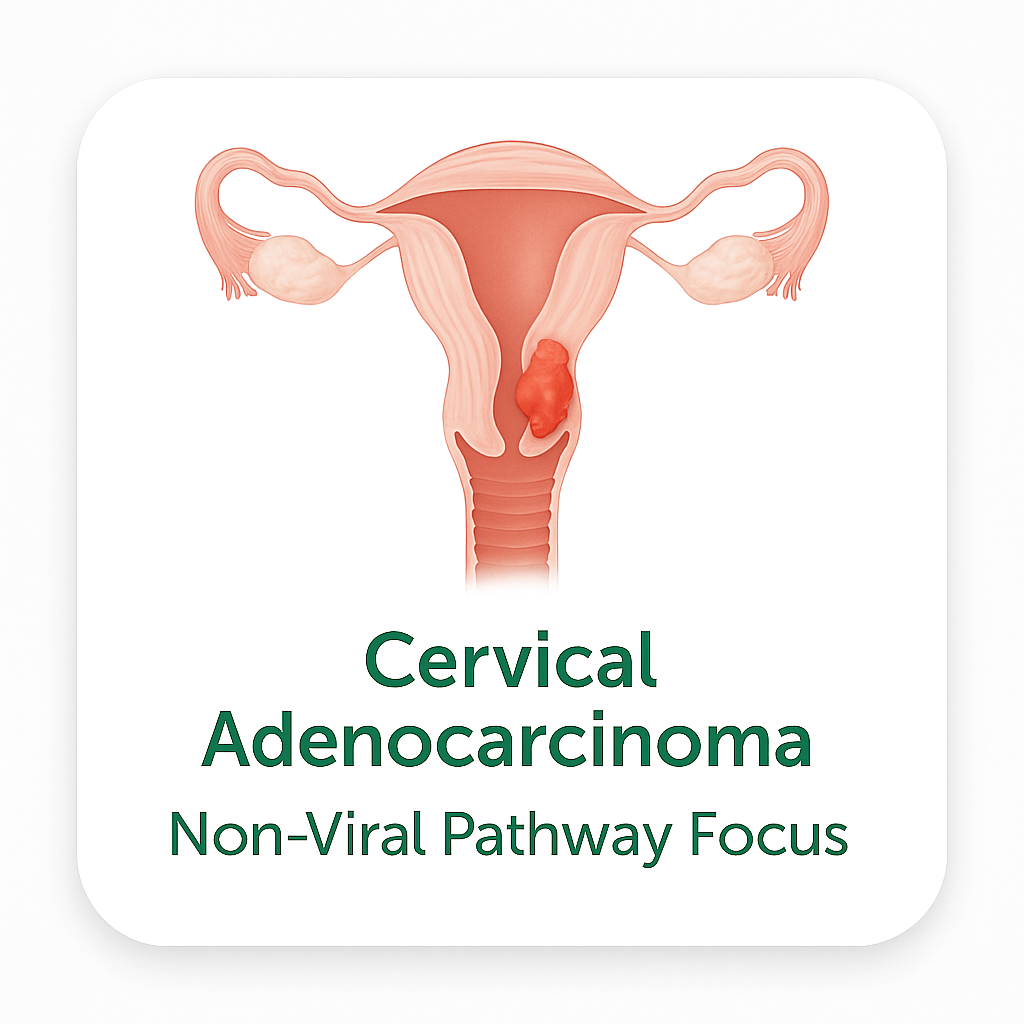
Cervical Adenocarcinoma – Non-Viral Pathway Focus
Main Grouping
Reproductive
Organ System
Cervix
Cell Origin
Glandular epithelium
Pathways Affected
Cervical adenocarcinoma involves a pathway landscape dominated by PIK3CA/KRAS/PTEN-driven PI3K/AKT/mTOR signaling (~32% PIK3CA mutations), the KRAS/RAF/MEK/MAPK/ERK cascade (~16-27% KRAS mutations, enriched in HPV-independent GAS subtype), ARID1A/SWI-SNF chromatin remodeling disruption (~20-30%), STK11/LKB1-AMPK-mTOR tumor suppressor pathway inactivation (~14-55% in GAS), and ERBB2/ERBB3 receptor tyrosine kinase signaling.
The PIK3CA/PI3K/AKT/mTOR pathway is the single most frequently mutated oncogenic pathway in cervical adenocarcinoma with PIK3CA mutations in approximately 25 to 32 percent of CAC — the most commonly mutated gene in CAC confirmed by comprehensive genomic characterization (PMC12842960, TCGA Nature 2017): PIK3CA E545K and H1047R hotspot mutations at the helical and kinase domains create constitutive PI3K-alpha activation generating PIP3/AKT/mTOR/S6K1 proliferative and survival signaling; PTEN loss (~6-20%) removes PIP3 phosphatase creating additional constitutive AKT activation; PIK3CA mutations and PTEN alterations tend to co-occur in adenocarcinoma consistent with the endometrial carcinoma-like molecular profile of some CAC; 3q24-28 chromosomal amplification present in up to 90% of invasive cervical carcinomas includes the PIK3CA gene locus at 3q26 providing additional copy-number-driven PI3K pathway activation; mTOR amplification/mutation has also been reported in CAC; curcumin inhibits PI3K/AKT/mTOR in cervical cancer cell models; quercetin inhibits PI3K/AKT in HeLa cervical cancer cells — PI3K/AKT pathway confirmed as the primary mediator of quercetin anti-proliferative effects in HeLa cells (PMC5764366); apigenin inhibits PI3K/AKT in cervical cancer cell models.
The KRAS/RAF/MEK/MAPK/ERK pathway is specifically enriched in HPV-independent gastric-type adenocarcinoma with KRAS mutations in approximately 16 to 27 percent of CAC cases and up to 50 percent of HPV-independent gastric-type adenocarcinoma: KRAS G12 codon mutations (predominantly G12D, G12V, G12C) create constitutive KRAS GTPase activation bypassing normal RTK-dependent RAS activation; constitutive KRAS drives RAF/MEK1/2/ERK1/2 signaling promoting CAC cell proliferation, survival, and VEGF-driven angiogenesis; KRAS and PIK3CA mutations tend to be mutually exclusive in the adenocarcinoma subtype suggesting they provide functionally redundant proliferative signals; MAPK1 (ERK2) mutations are also found in cervical cancer (TCGA data); curcumin inhibits KRAS/MAPK/ERK in cervical cancer cell models; apigenin inhibits MAPK/ERK in cancer cell models targeting the KRAS-driven proliferative program in HPV-independent CAC.
The ARID1A/SWI-SNF chromatin remodeling pathway is disrupted in approximately 20 to 30 percent of cervical adenocarcinomas: ARID1A (AT-rich Interactive Domain 1A) is the largest subunit of the SWI/SNF chromatin remodeling complex that regulates genome-wide chromatin accessibility and target gene transcription; ARID1A inactivating mutations specifically and strongly contribute to HPV-independent transformation of cervical epithelial cells (PMC12301020) — these mutations disrupt SWI/SNF complex function creating an aberrant epigenetic landscape; ARID1A loss creates synthetic lethality with EZH2 inhibition through loss of competitive H3K27 demethylation; ARID1A-mutant cancers are enriched in PI3K/AKT and MAPK pathway activation; apigenin induces re-expression of silenced tumor suppressor genes in ARID1A-disrupted cancer cell models through HDAC inhibition; curcumin inhibits EZH2 in ARID1A-loss cancer models providing synthetic lethal vulnerability; quercetin inhibits HDAC and EZH2 in cancer cell models.
The STK11/LKB1/AMPK/mTOR pathway is the dominant tumor suppressor pathway in HPV-independent gastric-type adenocarcinoma with STK11 mutations in approximately 33 to 55 percent of GAS: STK11/LKB1 is a serine-threonine kinase that activates AMPK (AMP-activated protein kinase); AMPK phosphorylates TSC1/TSC2 inhibiting RHEB/mTORC1 — therefore STK11/LKB1 inactivation releases constitutive mTORC1 activation; STK11 inactivation also impairs mTOR-independent AMPK functions including cell polarity maintenance (STK11/MARK2/PAR-1 complex), fatty acid oxidation, and autophagy; STK11-mutant Peutz-Jeghers syndrome patients have greatly elevated GAS risk; curcumin activates AMPK and inhibits mTOR targeting the STK11-loss-driven constitutive mTORC1 activation in GAS; quercetin activates AMPK in cancer cell models.
Description
Cervical adenocarcinoma (CAC) is the second most common histological subtype of cervical cancer, accounting for approximately 20 to 25 percent of all cervical cancer cases globally, with the proportion rising over recent decades. Globally, cervical cancer remains one of the most common cancers in women, with approximately 660,000 new cases and 350,000 deaths annually as of the most recent World Health Organization data. In the United States, approximately 13,800 new cases of cervical cancer are diagnosed annually of which approximately 2,760 to 3,450 cases are adenocarcinoma. The overall 5-year relative survival for all-stage cervical cancer is approximately 66 percent; adenocarcinoma historically has worse prognosis per stage than squamous cell carcinoma.
The classification of cervical adenocarcinoma was fundamentally restructured by the 2020 WHO Classification which distinguishes HPV-associated from HPV-independent subtypes, with the latter representing approximately 20 to 25 percent of all cervical adenocarcinoma cases. The HPV-independent subtypes — gastric-type adenocarcinoma (GAS), mesonephric adenocarcinoma, clear cell carcinoma (CCC), and endometrioid-type — have distinct molecular profiles dominated by somatic mutations in STK11 (~14-55% in GAS), PIK3CA (~32%), KRAS (~27%), ARID1A (~20-30%), PTEN (~20%), and TP53 (~21%). This non-viral molecular pathway focus documents the somatic mutation landscape driving CAC independently of HPV-mediated oncogenesis.
The staging of cervical cancer follows the FIGO 2018 system: stage I (confined to cervix, ~50% of cases) 5-year OS approximately 90 percent; stage II (beyond cervix/upper vagina) approximately 70 percent; stage III (pelvic/lower vaginal involvement) approximately 45 percent; stage IV (beyond true pelvis/bladder/rectum) approximately 15 to 20 percent.
Published laboratory research documents apigenin from parsley and celery inducing apoptosis in a comprehensive panel of human cervical cancer-derived cell lines — including C33A cells (HPV-negative, derived from invasive cervical cancer, the most directly relevant non-viral pathway model) — through oxidative stress-mediated mitochondrial pathway: apigenin selectively induced apoptosis in all cervical cancer cell lines tested (HeLa, SiHa, CaSki, and C33A) while sparing normal HaCaT cells; apigenin induced mitochondrial redox impairment confirmed by TMRE membrane potential assay; inhibited cancer cell migration and invasion confirmed by transwell assays (PMC5278229) — directly targeting the mitochondrial apoptosis pathway and cancer cell invasion relevant to the PIK3CA/KRAS/ARID1A-driven survival and migration programs in cervical adenocarcinoma.
Plant-Based Description
Whole-food plant-based dietary patterns provide phytochemicals with documented activity in cervical cancer cell lines applicable to the non-viral molecular pathway landscape of cervical adenocarcinoma. Apigenin from parsley induced apoptosis selectively in all cervical cancer-derived cell lines tested — including C33A cells (HPV-negative cell line, the most relevant non-viral pathway model) — while sparing normal HaCaT cells; apigenin induced mitochondrial redox impairment and inhibited cancer cell migration and invasion confirmed by TMRE membrane potential assay and transwell assays (PMC5278229) — directly relevant to PIK3CA/KRAS-driven cervical adenocarcinoma; quercetin from onions and kale inhibited HeLa and SiHa cervical cancer cell viability in a dose- and time-dependent manner through PI3K/AKT pathway mediation (PMC5764366) — targeting the dominant ~32% PIK3CA mutation pathway in CAC; curcumin from turmeric inhibits PI3K/AKT, mTOR, NF-kB, MAPK/ERK, and ARID1A/EZH2 epigenetic pathways in cervical cancer cell models; EGCG from green tea inhibits EGFR/ERK1/2 and PI3K/AKT/mTOR and arrests cell cycle in cervical cancer cell lines; sulforaphane activates Nrf2/ARE and inhibits HDAC in cervical cancer cell models; genistein from soybeans inhibits PI3K/AKT and MAPK/ERK in cervical cancer cell models.
Plant Chemistry Detail
Apigenin from parsley and celery has confirmed anti-cervical cancer activity in a comprehensive published study (PMC5278229) using five cell lines including C33A (HPV-negative, directly relevant to non-viral pathway focus). In this confirmed study: apigenin was tested in HeLa, SiHa, CaSki, and C33A human cervical cancer-derived cell lines and HaCaT normal cells; apigenin showed selective cytotoxic effects — inducing apoptosis in all four cervical cancer cell lines but NOT in HaCaT normal cells confirmed; apigenin induced mitochondrial redox impairment confirmed by tetramethylrhodamine ethyl ester (TMRE) mitochondrial membrane potential assay — demonstrating mitochondrial apoptotic pathway activation in cervical cancer cells; apigenin inhibited cancer cell migration confirmed by transwell migration assay; apigenin inhibited cancer cell invasion confirmed by transwell invasion assay with Matrigel; the study demonstrated that apigenin-induced ROS generation and mitochondrial membrane potential collapse triggered the intrinsic apoptosis pathway in cervical cancer cells including HPV-negative C33A cells — directly targeting the mitochondrial apoptosis resistance maintained by PIK3CA/KRAS/AKT/BCL-2 survival signaling in CAC.
Quercetin from onions and kale was confirmed to inhibit the viability of HeLa and SiHa cervical cancer cells in a dose-dependent and time-dependent manner confirmed by CCK-8 assay; the PI3K/AKT pathway was confirmed as the primary mediator of quercetin anti-proliferative effects in HeLa cells (PMC5764366); quercetin inhibited cell migration and invasion in HeLa and SiHa cells confirmed by transwell assays; quercetin reduced MMP2 and ezrin expression confirmed by Western blot — targeting the matrix metalloproteinase-driven invasion program relevant to metastatic CAC; METTL3 downregulation by quercetin confirmed by Western blot — targeting the mRNA m6A methylation program in CAC cells.
Curcumin from turmeric was confirmed to inhibit PI3K/AKT and NF-kB signaling in cervical cancer cell models; curcumin causes DNA damage in HeLa human cervical cancer cells confirmed; curcumin inhibits MAPK/ERK in cervical cancer cell models — targeting the dominant KRAS/MAPK/ERK pathway in HPV-independent GAS adenocarcinoma; curcumin activates AMPK targeting the STK11-loss-driven mTORC1 pathway in GAS; curcumin inhibits EZH2 in ARID1A-loss cancer models providing synthetic lethal relevance to the ~20-30% ARID1A-mutant CAC. EGCG from green tea was confirmed to cause G2/M-phase cell cycle arrest in HeLa and SiHa cervical cancer cells with increased p53, p21, p27 expression and EGFR/ERK1/2 deactivation confirmed (published research); EGCG inhibits PI3K/AKT/mTOR and VEGF in cervical cancer cell models. Sulforaphane from broccoli activates Nrf2/ARE and inhibits HDAC in cervical cancer cell models. Genistein from soybeans inhibits PI3K/AKT and MAPK/ERK in cervical cancer cell models targeting the PIK3CA/KRAS dual pathway activation documented in CAC.
Nutritional Focus
Nutritional focus in cervical adenocarcinoma non-viral pathway research is led by apigenin from parsley and celery with confirmed activity in the HPV-negative C33A cervical cancer cell line — the most directly relevant non-viral pathway model: apigenin selectively inducing apoptosis in all tested cervical cancer cell lines including HPV-negative C33A while sparing normal HaCaT cells; inducing mitochondrial redox impairment confirmed by TMRE membrane potential assay; inhibiting cancer cell migration and invasion confirmed by transwell assays (PMC5278229) — directly targeting the mitochondrial apoptosis pathway and invasion programs relevant to PIK3CA/KRAS/ARID1A-driven CAC; quercetin from onions inhibiting HeLa and SiHa cervical cancer cell viability in a dose-dependent and time-dependent manner through confirmed PI3K/AKT pathway mediation with MMP2/ezrin/METTL3 downregulation confirmed by Western blot (PMC5764366) — targeting the dominant ~32% PIK3CA mutation pathway in CAC; curcumin from turmeric inhibiting PI3K/AKT, mTOR, NF-kB, MAPK/ERK, and EZH2 in cervical cancer cell models — targeting the PIK3CA/KRAS dual oncogenic cascade and ARID1A-mutant/EZH2-dependent epigenetic axis in CAC; EGCG from green tea causing confirmed G2/M cell cycle arrest in HeLa/SiHa cells with p53/p21/p27 upregulation and EGFR/ERK1/2 deactivation — targeting KRAS/MAPK and EGFR signaling in CAC; apigenin additionally inhibiting HDAC targeting ARID1A-loss-driven epigenetic dysregulation (~20-30% of CAC); quercetin activating AMPK in cancer cell models targeting STK11-loss-driven mTORC1 deregulation in HPV-independent gastric-type adenocarcinoma (~33-55% STK11 mutations); and dietary fiber producing butyrate/SCFAs that inhibit HDAC targeting the epigenetic programs driven by ARID1A/SWI-SNF disruption in CAC.
Research Notes
Cervical adenocarcinoma epidemiology: ~20-25% of all cervical cancer; globally ~130,000-165,000 new CAC cases/year; US ~2,760-3,450 CAC cases/year; incidence increasing relative to SCC; 5-year OS by stage: stage I ~90%; stage II ~70%; stage III ~45%; stage IV ~15-20%. WHO 2020 classification: HPV-associated (HPVA, ~75-80%) vs HPV-independent (HPVI, ~20-25%); HPVI subtypes: gastric-type adenocarcinoma (GAS, ~10%), mesonephric AC, clear cell CC, endometrioid. IHC CAC: CK7+, CEA variable; HPV-associated: p16 block+; gastric-type: MUC6+, HIK1083+, p16 patchy/neg. Molecular CAC: PIK3CA ~25-32% (most frequently mutated); KRAS G12 ~16-27% (enriched HPVI GAS); ARID1A ~20-30%; TP53 ~21%; STK11/LKB1 ~33-55% HPVI GAS (also Peutz-Jeghers syndrome); ERBB2 amps/muts ~14-28%; ERBB3 mutations (adenocarcinoma-enriched TCGA); ELF3 ~13% (adenocarcinoma-specific); CBFB ~8%; PTEN ~6-20%; FBXW7 ~15%; EP300 ~16%; 3q24-28 amplification ~up to 90% invasive (PIK3CA at 3q26); BCL6 enriched in metastatic CAC. PIK3CA and KRAS tend mutually exclusive in CAC subtype (TCGA). ARID1A mutations contribute to HPV-independent transformation confirmed (PMC12301020). STK11 is co-mutated with ATM in some HPVI cases. Apigenin C33A (HPV-neg) + all cervical cancer lines (PMC5278229): TMRE mitochondrial potential; transwell migration/invasion inhibited; selective vs normal HaCaT. Quercetin HeLa/SiHa (PMC5764366): CCK-8 dose/time dependent; PI3K/AKT primary mediator; MMP2/ezrin/METTL3 Western blot; transwell confirmed.
Notes Visibility
Key Foods
Turmeric,Broccoli,Kale,Spinach,Brussels Sprouts,Cauliflower,Garlic,Yellow Onion,Carrot,Tomato,Beetroot,Cabbage,Blueberry,Pomegranate,Grape,Raspberry,Strawberry,Apple,Orange,Lemon,Soybeans,Edamame,Green Lentils,Black Beans,Chickpeas,Brown Rice,Quinoa,Oats,Wild Rice,Black Rice,Walnut,Almond,Brazil Nut,Flaxseed,Pumpkin Seeds,Chia Seeds,Sesame Seeds,Hemp Seeds,Shiitake,Maitake,Cremini,Portobello,Lions Mane,Green Tea,Ginger,Black Pepper,Garlic Powder,Parsley,Rosemary,Oregano,Sweet Potato, Celery, Leek,Avocado,Artichoke,Radish,Fig,Tangerine, Red Onion
Linked Nutrients
vitamin-c,vitamin-e,vitamin-a,vitamin-b9,vitamin-b6,selenium,zinc,magnesium,calcium,potassium,iron,apigenin,quercetin,curcumin,egcg,sulforaphane,beta-carotene,lycopene,anthocyanins,beta-glucans,dietary-fiber
Last Updated
2025-10-13 10:20:26

