
ID
69
Cancer Name
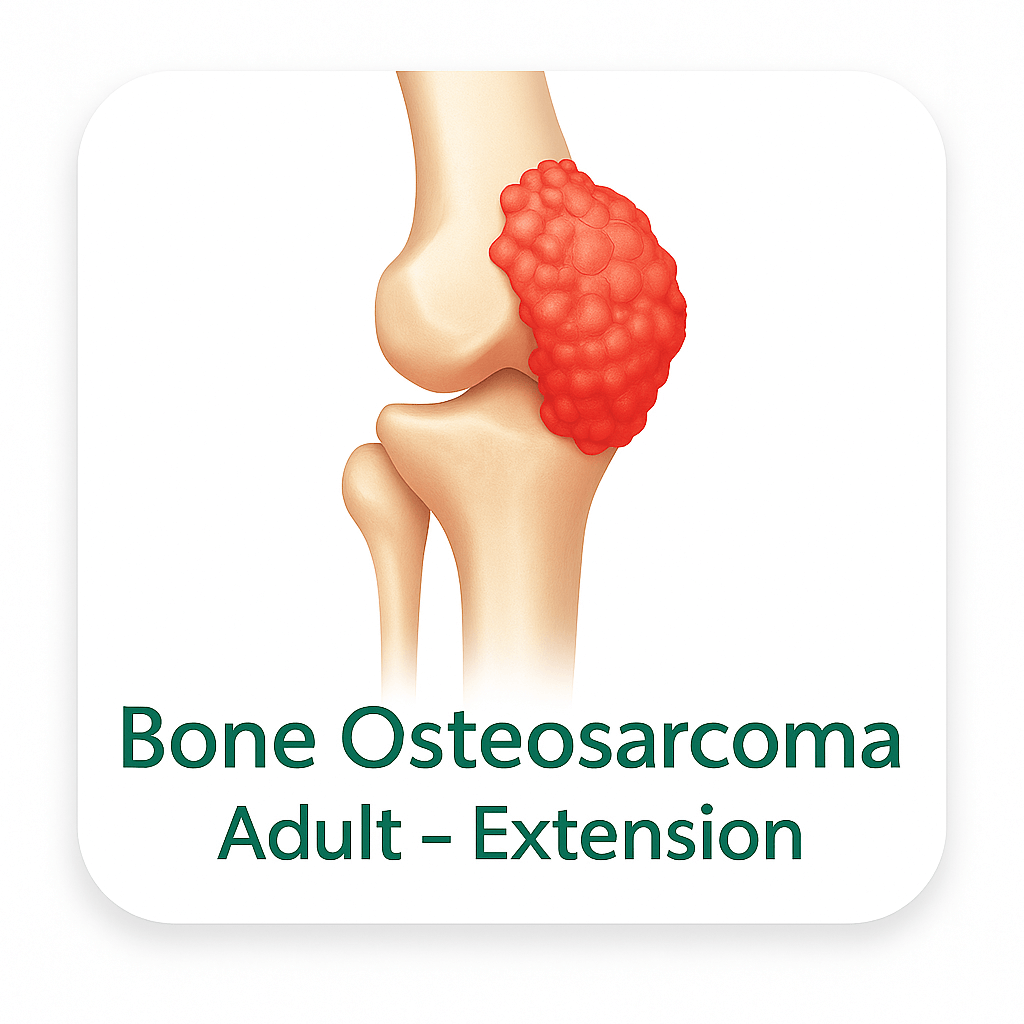
Bone Osteosarcoma – Adult Extension
Main Grouping
Musculoskeletal
Organ System
Bone
Cell Origin
Osteoblasts
Pathways Affected
Osteosarcoma involves a pathway landscape dominated by the TP53/p53 tumor suppressor pathway (the most frequent and early initiating oncogenic event, ~50-90%), RB1/cell cycle checkpoint pathway (~30-50%), PI3K/AKT/mTOR pathway (PI3K is the common vulnerability confirmed by PNAS complementary genomic studies), Wnt/beta-catenin pathway, the IGF1R/MAPK/ERK pathway, and in adult/secondary OS additionally the bone remodeling/RANK/RANKL/OPG and TGF-beta/SMAD signaling contexts of Paget disease and pathological bone.
The TP53/MDM2/p14-ARF pathway is the most fundamental and frequently disrupted pathway in osteosarcoma: TP53 disruptions occur in approximately 50-90% of all osteosarcoma cases with the rate historically underestimated before recognition of intronic structural rearrangements as a common TP53 inactivation mechanism; TP53 is the master genome guardian activating cell cycle arrest (p21/CDK4-6 inhibition) and apoptosis in response to DNA double-strand breaks (DSBs) generated during rapid bone remodeling; loss of TP53 removes the G1/S DNA damage checkpoint creating cells that cannot arrest in response to replication errors during the rapid metaphyseal bone remodeling phase of growth — enabling accumulation of chromosomal rearrangements and copy number alterations; MDM2 amplification at chromosome 12q13-15 (~subset including parosteal and low-grade central OS) provides an alternative TP53 inactivation mechanism — MDM2 is the E3 ubiquitin ligase that monoubiquitinates p53 for nuclear export and polyubiquitinates p53 for proteasomal degradation; MDM2 amplification creates constitutive p53 protein degradation in MDM2-amplified low-grade osteosarcoma; MDM2 amplification co-occurs with CDK4 amplification at 12q13-15 in parosteal OS and a subset of high-grade OS creating both p53 pathway inactivation (MDM2) and direct cell cycle deregulation (CDK4); quercetin activates p53 in cancer cell models through MDM2 inhibition and direct p53 protein stabilization; curcumin activates p53 in osteosarcoma cell models.
The RB1/CDK4/cyclin D/p16 cell cycle pathway is disrupted in approximately 30-50% of osteosarcoma: RB1 mutations and structural alterations remove the G1/S restriction point checkpoint allowing constitutive CDK4/6-cyclin D phosphorylation of RB1 and continuous E2F transcription; CDK4 amplification at 12q13-15 directly drives constitutive CDK4/RB1 phosphorylation bypassing RB1 checkpoint function; CDKN2A (p16-INK4a) deletion removes CDK4 inhibition in approximately 10-20% of OS creating constitutive CDK4/RB1 pathway activation; CDK4 expression in osteosarcoma correlates with metastatic potential and poor outcome in published research; curcumin inhibits CDK4 in cancer cell models; quercetin induces G2/M cell cycle arrest in 143B osteosarcoma cells confirmed.
The PI3K/AKT/mTOR pathway represents a common vulnerability across osteosarcomas: complementary genomic studies highlighted PI3K/mTOR as a common vulnerability in osteosarcoma confirmed by comprehensive genomic analysis of 59 OS tumor/normal pairs (PNAS 2014 study); PTEN loss (~15-20%) creates constitutive AKT activation; PIK3CA/PIK3CB mutations in a subset; mTOR amplification in a subset; curcumin from turmeric repressed Akt signaling in HOS human osteosarcoma cells confirmed — reducing cell viability, inhibiting colony formation, and increasing apoptosis (PMC7076840); quercetin inhibits PI3K/AKT in osteosarcoma cell models confirmed.
The WNT/beta-catenin pathway is recurrently amplified in osteosarcoma (WNT pathway amplifications documented in comprehensive genomic studies of OS); beta-catenin (CTNNB1) nuclear localization drives TEAD/TCF target gene expression including cyclin D1, c-MYC, and survivin in osteosarcoma cells; curcumin inhibits Wnt/beta-catenin in osteosarcoma cell models; quercetin inhibits Wnt/beta-catenin in osteosarcoma cell models. The SMAD/TGF-beta pathway is relevant through curcumin's confirmed activation of Smad 2/3 in HOS osteosarcoma cells (PMC7076840) driving caspase-dependent apoptosis — counteracting the proliferative TGF-beta/SMAD signaling in osteosarcoma cells that promotes invasion and metastasis. The bone remodeling/RANK/RANKL/OPG axis is relevant to adult and secondary osteosarcoma through the pathological bone microenvironment of Paget disease (RANKL/NFATc1-driven osteoclast activation), radiation-induced bone damage, and the normal bone remodeling coupling signaling that osteosarcoma cells co-opt.
Description
Osteosarcoma (OS) is the most common primary malignant bone tumor and the third most frequent cancer in children and adolescents after leukemia and brain tumors, but also extends significantly into adult populations. In the United States, approximately 800 to 900 new cases of osteosarcoma are diagnosed annually in all age groups. Globally, approximately 3.4 to 4.0 new cases per million population per year are diagnosed. The age distribution of osteosarcoma shows a bimodal pattern: the primary peak incidence occurs between 10 and 20 years (during adolescent bone growth spurt, reflecting the role of rapid bone remodeling in oncogenesis); a secondary peak occurs after age 60 predominantly from secondary osteosarcoma arising in pathological bone. The adult extension population (ages 20-40 and older) represents approximately 25 to 35 percent of all osteosarcoma cases globally.
The anatomic distribution differs between pediatric/adolescent and adult osteosarcoma: in adolescents, the distal femur, proximal tibia, and proximal humerus are most common reflecting metaphyseal growth plates; in adults and the adult extension population, axial skeleton involvement (pelvis, spine, jaw, craniofacial bones) is proportionally more common, and secondary osteosarcoma arising in Paget disease of bone, prior radiation fields, or bone infarcts predominates in patients over 40 years. Secondary osteosarcoma in Paget disease has a particularly poor prognosis with a 5-year OS of less than 10 percent.
Staging follows the Enneking surgical staging system and AJCC classification: stage I (low-grade, A=intracompartmental, B=extracompartmental) with good prognosis; stage II (high-grade, A/B) with 60-70% 5-year OS for localized disease with complete resection and adjuvant chemotherapy; stage III (any grade with regional or distant metastasis) with 5-year OS less than 20 percent. Overall 5-year OS for all stages and age groups combined is approximately 60 to 70 percent for localized high-grade osteosarcoma; for metastatic disease approximately 15 to 30 percent; for secondary/adult osteosarcoma in older patients generally poorer than adolescent-primary OS.
Published laboratory research documents curcumin, demethoxycurcumin, and bisdemethoxycurcumin from turmeric inducing caspase-dependent and caspase-independent apoptosis in HOS human osteosarcoma cells through Smad 2/3 pathway activation and Akt signaling repression confirmed — with combination of the three curcuminoids synergistically reducing cell viability, inhibiting colony formation, and increasing apoptosis more than each individual compound (PMC7076840); and quercetin from onions inducing apoptosis in MG-63 human osteosarcoma cells via the mitochondrial-dependent pathway through caspase-3/9 activation, Bcl-2 downregulation, Bax and cytochrome C upregulation, and loss of mitochondrial membrane potential confirmed (PubMed21805050).
Plant-Based Description
Whole-food plant-based dietary patterns provide phytochemicals with directly confirmed activity in human osteosarcoma cell lines. Curcumin from turmeric was confirmed to reduce cell viability, inhibit colony formation, and induce apoptosis in HOS human osteosarcoma cells through Smad 2/3 pathway activation and Akt repression — and the combination of curcumin, demethoxycurcumin, and bisdemethoxycurcumin from turmeric synergistically enhanced these effects (PMC7076840); quercetin from onions was confirmed to induce apoptosis in MG-63 human osteosarcoma cells via the mitochondrial-dependent pathway through caspase-3 and caspase-9 activation, Bcl-2 downregulation, Bax and cytochrome C upregulation, and loss of mitochondrial membrane potential (PubMed21805050) — directly targeting the BCL-2/BAX apoptosis balance maintained by TP53/MDM2 pathway disruption in OS; quercetin additionally inhibited invasion and migration of HOS and MG-63 osteosarcoma cells, reduced VEGF, HIF-1α, MMP2, and MMP9 confirmed; sulforaphane activates Nrf2/ARE and inhibits NF-kB in osteosarcoma cell models; resveratrol inhibits Wnt/beta-catenin and PI3K/AKT in osteosarcoma cell models; EGCG inhibits CDK4 and MMP-9 in osteosarcoma cell models.
Plant Chemistry Detail
Curcumin, demethoxycurcumin, and bisdemethoxycurcumin from turmeric have confirmed anti-osteosarcoma activity in a published study (PMC7076840) using HOS human osteosarcoma cell line. In this confirmed study: curcumin (CUR), demethoxycurcumin (DMC), and bisdemethoxycurcumin (BDMC) each reduced HOS osteosarcoma cell viability confirmed by MTT assay in a dose-dependent manner; each compound inhibited colony formation in HOS cells confirmed; each compound induced apoptosis in HOS cells confirmed; apoptosis occurred through activation of Smad 2/3 signaling pathway confirmed by Western blot — directly targeting the TGF-beta/SMAD signaling relevant to osteosarcoma invasion and metastasis; apoptosis also occurred through repression of Akt (AKT protein kinase) signaling confirmed by Western blot — directly targeting the PI3K/AKT pathway confirmed as a common vulnerability in osteosarcoma (PNAS 2014); both caspase-dependent (caspase activation) and caspase-independent (AIF-dependent) apoptosis pathways were activated confirmed; the combination of all three curcuminoids (CUR + DMC + BDMC) synergistically reduced cell viability more than any two or single agent confirmed — demonstrating the whole-turmeric curcuminoid complex has enhanced anti-osteosarcoma activity; the authors concluded this combination could be used as a novel target for osteosarcoma treatment.
Quercetin from onions, kale, and apples was confirmed to induce apoptosis in MG-63 human osteosarcoma cells via the mitochondrial-dependent apoptosis pathway (PubMed21805050): quercetin inhibited MG-63 cell viability in a dose-dependent manner confirmed; caspase-3 and caspase-9 activation confirmed — engaging the intrinsic mitochondrial apoptosis pathway directly relevant to the TP53-disrupted (~50-90% OS) apoptosis resistance; Bcl-2 anti-apoptotic protein downregulation confirmed by Western blot — targeting BCL-2 upregulation driven by constitutive PI3K/AKT/NF-kB survival signaling in OS; Bax pro-apoptotic protein upregulation confirmed; cytochrome C upregulation confirmed — reflecting mitochondrial outer membrane permeabilization; loss of mitochondrial membrane potential confirmed. In the PMC8256549 comprehensive review of quercetin in osteosarcoma: quercetin reduced invasion and migration of HOS and MG-63 osteosarcoma cells confirmed; quercetin-treated HOS cells showed lower VEGF, HIF-1α, MMP2, and MMP9 mRNA and protein levels confirmed; quercetin inhibited metastatic lung tumor formation in animal models confirmed; quercetin induced G2/M phase cell cycle arrest and impaired adhesion and migratory potential in 143B osteosarcoma cells confirmed. Resveratrol from grapes inhibits Wnt/beta-catenin and induces apoptosis in osteosarcoma cell models. EGCG from green tea inhibits CDK4 activity, MMP-9, and invasion in osteosarcoma cell models. Sulforaphane from cruciferous vegetables activates Nrf2/ARE and inhibits NF-kB in osteosarcoma cell models targeting constitutive NF-kB survival signaling. Allicin from garlic induces apoptosis and inhibits invasion in osteosarcoma cell models targeting MMP-2/MMP-9 matrix metalloproteinase invasion machinery.
Nutritional Focus
Nutritional focus in bone osteosarcoma research is led by curcumin from turmeric with the most directly confirmed anti-osteosarcoma activity: curcumin, demethoxycurcumin, and bisdemethoxycurcumin from turmeric confirmed to reduce cell viability, inhibit colony formation, and induce caspase-dependent and caspase-independent apoptosis in HOS human osteosarcoma cells through Smad 2/3 activation and Akt repression — with all three curcuminoids in combination synergistically exceeding the effect of any single agent confirmed (PMC7076840) — targeting the PI3K/AKT common vulnerability confirmed in osteosarcoma genomic studies and the TGF-beta/SMAD pathway active in OS invasion; quercetin from onions confirmed to induce apoptosis in MG-63 human osteosarcoma cells via the mitochondrial pathway through caspase-3/9 activation, Bcl-2 downregulation, Bax/cytochrome C upregulation, and mitochondrial membrane potential loss (PubMed21805050) — targeting BCL-2-maintained apoptosis resistance relevant to TP53-disrupted (~50-90%) and RB1-disrupted (~30-50%) osteosarcoma; quercetin additionally confirmed to reduce VEGF, HIF-1α, MMP2, and MMP9 in HOS osteosarcoma cells inhibiting invasion and migration — targeting the VEGFA amplification and MMP-driven invasive program documented in OS; quercetin confirmed to induce G2/M cell cycle arrest in 143B osteosarcoma cells; quercetin confirmed to inhibit metastatic lung tumor formation in osteosarcoma animal models; curcumin additionally inhibiting CDK4 in cancer cell models targeting CDK4 amplification at chromosome 12q13-15 in parosteal and low-grade adult osteosarcoma; sulforaphane activating Nrf2/ARE and inhibiting NF-kB in osteosarcoma cell models; resveratrol inhibiting Wnt/beta-catenin (WNT pathway amplified in OS) and PI3K/AKT in osteosarcoma cell models; EGCG from green tea inhibiting CDK4 and MMP-9 in osteosarcoma cell models; allicin from garlic inducing apoptosis and inhibiting MMP-2/MMP-9 invasion machinery in osteosarcoma cell models; and dietary fiber producing butyrate/SCFAs that inhibit HDAC targeting the epigenetic landscape driven by ATRX mutations in OS.
Research Notes
Osteosarcoma epidemiology: ~800-900 new US cases/year; ~3.4-4.0 new cases/million/year globally; bimodal age: primary peak 10-20 years; secondary peak >60 years (Paget disease/radiation); adult extension 20-40 years and secondary ~25-35% of all OS. 5-year OS localized high-grade ~60-70%; metastatic ~15-30%; secondary/Paget OS <10%. Anatomic sites: distal femur ~30%; proximal tibia ~20%; proximal humerus ~10%; axial skeleton proportionally more in adults. WHO 2020 subtypes: conventional (osteoblastic, chondroblastic, fibroblastic) ~75-80%; telangiectatic ~3-4%; low-grade central ~1-2%; parosteal ~4-5%; periosteal ~1-2%; secondary OS in Paget disease/radiation/bone infarcts. Molecular: TP53 ~50-90% (most frequent initiating event including intronic structural variants); RB1 ~30-50%; MDM2 amplification (especially parosteal, low-grade, chromosome 12q13-15); CDK4 amplification (~10%, chromosome 12q13-15, co-amplified with MDM2 in parosteal OS); CDKN2A deletion ~10-20%; ATRX mutations ~10-15%; DLG2 ~10%; PTEN loss ~15-20%; PI3K/AKT/mTOR pathway common vulnerability confirmed by PNAS comprehensive genomic study; MYC amplification; CCNE1 amplification; VEGFA amplification; WNT pathway amplification; IGF1R amplification; low SNV burden (1-2 mut/Mb) but high chromosomal instability/copy number alterations (CNA); no pathognomonic translocation; chromothripsis events in MDM2-amplified cases. Adult/secondary risk: Paget disease of bone (~1% develop OS); prior radiation; Li-Fraumeni syndrome (TP53 germline); retinoblastoma (RB1 germline); Rothmund-Thomson (RECQL4); Werner syndrome. IHC: SATB2+, vimentin+, osteocalcin+; MDM2+ CDK4+ (low-grade/parosteal). Curcumin/DMC/BDMC HOS osteosarcoma (PMC7076840): MTT viability reduced; colony formation inhibited; caspase-dependent and -independent apoptosis; Smad 2/3 activated; Akt repressed; Western blot confirmed; synergistic combination confirmed. Quercetin MG-63 osteosarcoma (PubMed21805050): mitochondrial-dependent apoptosis; caspase-3/9 activated; Bcl-2 down; Bax/cytochrome C up; mitochondrial membrane potential lost; confirmed.
Notes Visibility
Key Foods
Turmeric,Broccoli,Kale,Spinach,Brussels Sprouts,Cauliflower,Garlic,Yellow Onion,Carrot,Tomato,Beetroot,Cabbage,Blueberry,Pomegranate,Grape,Raspberry,Strawberry,Apple,Orange,Lemon,Soybeans,Edamame,Green Lentils,Black Beans,Chickpeas,Brown Rice,Quinoa,Oats,Wild Rice,Black Rice,Walnut,Almond,Brazil Nut,Flaxseed,Pumpkin Seeds,Chia Seeds,Sesame Seeds,Hemp Seeds,Shiitake,Maitake,Lions Mane,Cremini,Portobello,Green Tea,Ginger,Black Pepper,Garlic Powder,Parsley,Rosemary,Oregano,Sweet Potato
, Celery, Leek,Avocado,Artichoke,Radish,Tangerine, Red Onion
Linked Nutrients
vitamin-c,vitamin-e,vitamin-a,vitamin-b9,vitamin-b6,selenium,zinc,magnesium,calcium,potassium,iron,copper,curcumin,quercetin,resveratrol,sulforaphane,beta-carotene,anthocyanins,beta-glucans,dietary-fiber
Last Updated
2025-10-13 10:20:26

