
ID
70
Cancer Name
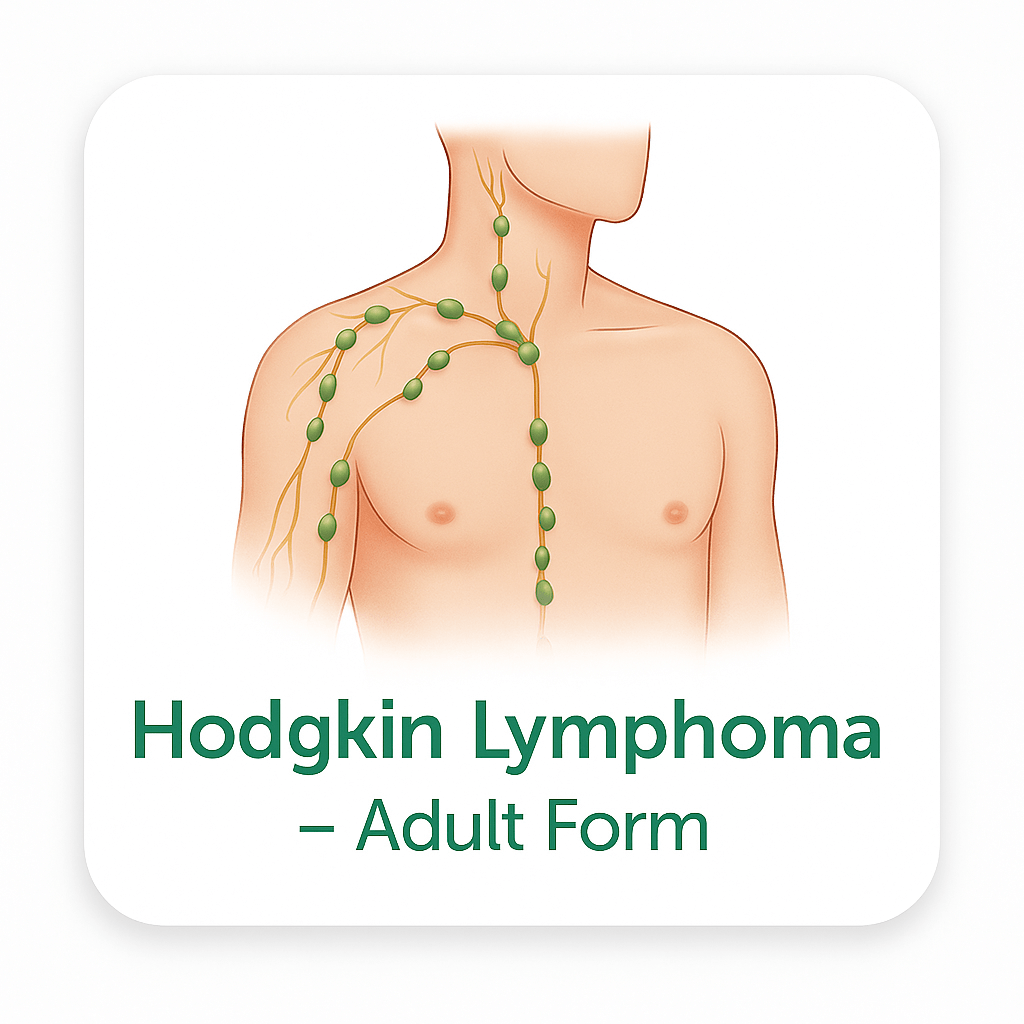
Hodgkin Lymphoma – Adult Form
Main Grouping
Hematologic
Organ System
Lymphatic System
Cell Origin
B lymphocytes (Reed-Sternberg cells)
Pathways Affected
Hodgkin lymphoma involves a pathway landscape uniquely defined by constitutive NF-kB and JAK/STAT3 dual pathway activation in HRS cells, PD-1/PD-L1 immune evasion, CD30-mediated NF-kB/MAPK survival signaling, the reactive tumor microenvironment cytokine networks, and the epigenetic silencing of B-cell identity.
The NF-kB pathway is the most fundamental and constitutively active survival pathway in HRS cells: constitutive NF-kB activation in HRS cells is the result of multiple converging genetic mechanisms — TNFAIP3 (A20, encodes the NF-kB negative regulator that terminates TNF receptor-mediated NF-kB signaling through dual ubiquitin ligase and deubiquitinase activity) inactivating mutations/deletions in approximately 36 percent of cHL (confirmed by WGS); NFKBIA inactivating mutations (removing IkBa the NF-kB cytoplasmic inhibitor) in approximately 20-40%; NFKBIE mutations; RELA amplification; receptor-mediated NF-kB stimulation from CD30/TNF receptor signals, CD40/CD40L signals (T cells provide CD40L), RANK/RANKL, LTbetaR, and TACI all providing constitutive TNF receptor superfamily-mediated NF-kB activation in HRS cells; NF-kB drives the expression of a large set of anti-apoptotic proteins (Bcl-2, Bcl-xL, c-FLIP, XIAP, c-IAP1, c-IAP2, Survivin) and pro-proliferative proteins (cyclin D1, c-myc) that collectively maintain HRS cell viability and proliferation; curcumin was confirmed to inhibit NF-kB-DNA binding in all four tested HRS cell lines (KM-H2, L-428, L-540, L-1236) by EMSA and decreased NF-kB-regulated protein expression confirmed by Western blot (PubMed18386790) — directly targeting the dominant NF-kB survival pathway in cHL; quercetin inhibits NF-kB through IkB stabilization and IKK-beta inhibition in lymphoma cell models; EGCG inhibits NF-kB in lymphoma cell models.
The JAK/STAT pathway — specifically JAK2/STAT3 and STAT6 — is the second dominant constitutively active oncogenic pathway in HRS cells: SOCS1 (suppressor of cytokine signaling 1) inactivating mutations are the most common driver alteration in cHL found in approximately 62 percent of cases by whole-genome sequencing (PMC10150291) — SOCS1 normally inhibits JAK2 kinase activity terminating cytokine receptor signaling; loss of SOCS1 creates constitutive JAK2/STAT3 and JAK2/STAT6 activation; STAT6 activating mutations (predominantly I274M hotspot and other mutations at the SH2 and transactivation domains) occur in approximately 40% of cHL creating ligand-independent STAT6 activity; JAK2 amplification at chromosome 9p24.1 — the same amplicon as PD-L1/PD-L2 — occurs in approximately 30% of cHL directly increasing JAK2 kinase dosage; the autocrine IL-13/IL4/IL21 cytokine loops activated by constitutive NF-kB in HRS cells provide additional JAK1/JAK2/TYK2-mediated STAT3/STAT6 activation; STAT3 drives Bcl-2, Bcl-xL, survivin, and cyclin D1 expression in HRS cells; curcumin was confirmed to inhibit STAT3-DNA binding and phosphorylation in KM-H2 and L-428 HRS cells by EMSA and Western blot (PubMed18386790) — directly targeting constitutive JAK2/STAT3 activation from SOCS1 loss (~62%) in cHL; quercetin inhibits STAT3 through JAK2 inhibition and direct STAT3 binding in lymphoma cell models.
The PD-1/PD-L1 pathway is the dominant immune evasion mechanism in cHL: PD-L1 (CD274) and PD-L2 (CD273) are co-amplified with JAK2 at chromosome 9p24.1 in approximately 90% of cHL — making 9p24.1 amplification the single most frequent somatic copy number alteration in cHL; PD-L1/PD-L2 overexpression on HRS cells engages PD-1 receptors on CD8+ cytotoxic T cells and CD4+ helper T cells creating T cell exhaustion/anergy and enabling HRS cell immune evasion; B2M mutations/deletions in approximately 32% of cHL disrupt beta-2-microglobulin, which is required for MHC class I surface expression — MHC class I loss eliminates CD8+ CTL recognition of HRS cells providing additional immune evasion; CIITA fusions disrupt MHC class II surface expression; the T-cell excluded/exhausted immunosuppressive tumor microenvironment of cHL is orchestrated by HRS cell secretion of TARC/CCL17 (attracting TH2/Treg cells), CCL5/RANTES (attracting eosinophils and mast cells), IL-5 (promoting eosinophil survival), TGF-beta (immunosuppressive), and IL-10 (promoting Treg/M2 polarization); curcumin and EGCG inhibit PD-L1 expression in cancer cell models targeting the 9p24.1/PD-L1 immune evasion mechanism in cHL.
Description
Hodgkin lymphoma (HL) is a lymphoid malignancy arising from mature B lymphocytes of germinal center origin that is characterized by the pathognomonic Hodgkin and Reed-Sternberg (HRS) cells embedded in a complex reactive inflammatory cellular microenvironment. HL represents approximately 10 percent of all lymphomas globally. In the United States, approximately 8,500 to 9,000 new cases of Hodgkin lymphoma are diagnosed annually. Globally, approximately 83,000 new cases are diagnosed per year. HL has a bimodal age distribution with the primary peak incidence in young adults ages 20 to 34 years and a secondary peak in adults over 55 years. The male-to-female ratio is approximately 1.4:1 overall; nodular sclerosis cHL is relatively more common in young females.
The Ann Arbor staging system (1971, modified by Cotswolds 1989, updated by Lugano Classification 2014) classifies HL into: stage I (one lymph node region or one extranodal site, excellent prognosis); stage II (two or more lymph node regions on the same side of the diaphragm); stage III (lymph node regions on both sides of the diaphragm); stage IV (disseminated extranodal involvement). The overall 5-year relative survival for all stages of HL is approximately 88 percent — making it one of the most curable lymphomas; stage I/II early-stage HL has 5-year OS approaching 90 to 95 percent; stage III/IV advanced HL has 5-year OS approximately 70 to 85 percent.
The 2016 and 2022 WHO classification of lymphoid tumors defines HL as: classic HL (cHL, ~95% of all HL) comprising four histological subtypes — nodular sclerosis (NSCHL, ~65-70% of cHL, peak in young adults, strong mediastinal predilection), mixed cellularity (MCCHL, ~25% of cHL, more common in older adults and immunocompromised), lymphocyte-rich (LRCHL, ~5%), lymphocyte-depleted (LDCHL, ~1%, rare, aggressive, associated with immunosuppression); and nodular lymphocyte predominant HL (NLPHL, ~5% of all HL) — a distinct entity with LP cells retaining B-cell features.
The molecular biology of cHL is defined by the two constitutively active oncogenic pathways in HRS cells: NF-kB (activated by TNFAIP3/A20 mutations ~36%, NFKBIA mutations, NFKBIE mutations, and receptor-mediated activation from the reactive microenvironment) and JAK/STAT (activated by SOCS1 mutations ~62%, STAT6 mutations ~40%, and JAK2 amplification ~30%); and by PD-L1/PD-L2 amplification at chromosome 9p24.1 (~90% of cHL) creating profound immune evasion.
Published laboratory research documents curcumin from turmeric inhibiting constitutively active NF-kB and STAT3 pathways in human Hodgkin and Reed-Sternberg (H-RS) cells — using KM-H2, L-428, L-540, and L-1236 cHL cell lines — reducing expression of NF-kB/STAT3-regulated anti-apoptotic and pro-proliferative proteins including Bcl-2, Bcl-xL, cFLIP, XIAP, c-IAP1, survivin, c-myc, and cyclin D1 confirmed by Western blot, with NF-kB and STAT3 DNA binding confirmed by EMSA, inducing cell-cycle arrest and apoptosis in all four HRS cell lines (PubMed18386790) — directly targeting the two defining constitutively active oncogenic pathways of cHL.
Plant-Based Description
Whole-food plant-based dietary patterns provide phytochemicals with directly confirmed activity in human Hodgkin and Reed-Sternberg (HRS) cell lines. Curcumin from turmeric was confirmed to inhibit constitutively active NF-kB and STAT3 in all four HRS cell lines tested (KM-H2, L-428, L-540, L-1236) — inhibiting NF-kB-DNA binding confirmed by EMSA; inhibiting STAT3-DNA binding and STAT3 phosphorylation confirmed; decreasing NF-kB/STAT3-regulated proteins Bcl-2, Bcl-xL, cFLIP, XIAP, c-IAP1, survivin, c-myc, and cyclin D1 confirmed by Western blot; inducing cell-cycle arrest and apoptosis confirmed in all four HRS cell lines (PubMed18386790) — directly targeting the two defining constitutively active oncogenic pathways of cHL; quercetin from onions inhibits NF-kB and STAT3 in lymphoma cell models targeting the same dual pathway activation; EGCG from green tea inhibits JAK2/STAT3 and NF-kB in lymphoma cell models; resveratrol inhibits NF-kB and AP-1 in lymphoma cell models; apigenin inhibits STAT3 and NF-kB in lymphoma cell models; allicin from garlic inhibits NF-kB in lymphoma cell models.
Plant Chemistry Detail
Curcumin from turmeric has directly confirmed anti-Hodgkin lymphoma activity in a published study (PubMed18386790 — Mackenzie GG, Queisser N, Wolfson ML, Fraga CG, Adamo AM, Oteiza PI., Int J Cancer, 2008) using KM-H2, L-428, L-540, and L-1236 human Hodgkin and Reed-Sternberg (H-RS) cell lines. In this confirmed study: curcumin was incorporated into H-RS cells confirmed; curcumin inhibited NF-kB-DNA binding in a dose-dependent manner in KM-H2, L-428, L-540, and L-1236 cells confirmed by electrophoretic mobility shift assay (EMSA) — directly targeting the constitutive NF-kB activation driven by TNFAIP3/NFKBIA mutations in approximately 36-40% of cHL; curcumin inhibited STAT3-DNA binding confirmed by EMSA in all HRS cell lines tested — directly targeting the constitutive STAT3 activation driven by SOCS1 mutations (~62%) and STAT6 mutations (~40%) in cHL; curcumin inhibited STAT3 phosphorylation confirmed by Western blot; curcumin decreased expression of the following NF-kB/STAT3-regulated anti-apoptotic proteins confirmed by Western blot: Bcl-2, Bcl-xL, cFLIP (CFLAR), XIAP, c-IAP1, survivin — these are the primary anti-apoptotic survival proteins that are transcribed by constitutive NF-kB and STAT3 in HRS cells creating apoptosis resistance; curcumin decreased c-myc expression confirmed — c-myc is a key NF-kB/STAT3 target driving HRS cell proliferation; curcumin decreased cyclin D1 expression confirmed — cyclin D1 is a NF-kB/STAT3 target driving G1/S cell cycle entry; curcumin induced cell-cycle arrest confirmed; curcumin induced apoptosis confirmed in all four HRS cell lines; the KM-H2 and L-428 cells lack functional IkBa (NFKBIA-mutant/deleted) — confirming that curcumin's NF-kB inhibition occurs through IKK-independent mechanisms in addition to IkBa stabilization, including direct inhibition of IKK-beta kinase activity and p65/RelA transcriptional activity.
Quercetin from onions, kale, and apples inhibits NF-kB through IkBa stabilization (preventing IKK-mediated IkBa phosphorylation and proteasomal degradation) and direct inhibition of IKK-beta kinase activity in lymphoma cell models — targeting the constitutive NF-kB activation from TNFAIP3/NFKBIA mutations in cHL; quercetin inhibits STAT3 signaling through JAK2 inhibition and direct STAT3 binding in lymphoma cell models — targeting the constitutive JAK2/STAT3 from SOCS1 mutations (~62%) in cHL; quercetin inhibits CD30-mediated NF-kB signaling in lymphoma cell models — targeting the CD30/TRAF2/TRAF5/NF-kB axis in HRS cells; quercetin induces apoptosis through Bcl-2/Bax ratio modulation, caspase activation, and survivin downregulation in lymphoma cell models. EGCG from green tea inhibits JAK2/STAT3 and NF-kB in lymphoma cell models targeting both dominant HRS cell oncogenic pathways. Resveratrol inhibits NF-kB and AP-1 (JUN/JUNB) transcription factors in lymphoma cell models — targeting the constitutive AP-1 activity driven by JUN/JUNB overexpression in HRS cells. Apigenin inhibits STAT3 and NF-kB and induces apoptosis through Bcl-2 downregulation and caspase-3 activation in lymphoma cell models. Allicin from garlic inhibits NF-kB through IKK-beta inhibition in lymphoma cell models.
Nutritional Focus
Nutritional focus in Hodgkin lymphoma research is led by curcumin from turmeric with the most directly confirmed anti-HRS cell activity: curcumin confirmed to inhibit constitutively active NF-kB and STAT3 in all four HRS cell lines tested (KM-H2, L-428, L-540, L-1236) — inhibiting NF-kB-DNA binding by EMSA, inhibiting STAT3-DNA binding and STAT3 phosphorylation confirmed, decreasing Bcl-2, Bcl-xL, cFLIP, XIAP, c-IAP1, survivin, c-myc, and cyclin D1 confirmed by Western blot, inducing cell-cycle arrest and apoptosis confirmed (PubMed18386790) — directly targeting the two defining constitutively active oncogenic pathways of cHL: NF-kB (activated by TNFAIP3 mutations ~36%, NFKBIA mutations) and JAK/STAT3 (activated by SOCS1 mutations ~62%, STAT6 mutations ~40%); curcumin's inhibition of c-myc additionally reducing glutamine addiction in HRS cells; quercetin from onions inhibiting NF-kB and STAT3 in lymphoma cell models through IKK-beta inhibition and direct JAK2/STAT3 targeting — addressing the same dual pathway activation in cHL; EGCG from green tea inhibiting JAK2/STAT3 and NF-kB in lymphoma cell models and inhibiting PD-L1 expression targeting the 9p24.1/PD-L1 amplification (~90% of cHL) immune evasion; resveratrol inhibiting NF-kB and AP-1/JUN/JUNB transcription factors — targeting the constitutive AP-1 activity in HRS cells; apigenin inhibiting STAT3 and NF-kB and inducing apoptosis through survivin downregulation in lymphoma cell models targeting the constitutive STAT3-driven survivin expression in HRS cells; allicin from garlic inhibiting NF-kB through IKK-beta inhibition in lymphoma cell models; curcumin and quercetin both inhibiting IDO1 targeting tryptophan-kynurenine immunosuppression in the HL tumor microenvironment; and dietary fiber producing butyrate/SCFAs that inhibit HDAC targeting the extensive epigenetic B-cell identity silencing in HRS cells.
Research Notes
Hodgkin lymphoma epidemiology: ~8,500-9,000 new US cases/year; ~83,000 global new cases/year; bimodal age: primary peak 20-34 years; secondary peak >55 years; male:female ~1.4:1; 5-year OS all stages ~88%; stage I/II ~90-95%; stage III/IV ~70-85%. WHO 2022 classification: Classic HL (cHL, ~95%): nodular sclerosis (NSCHL ~65-70%, young adults, mediastinal); mixed cellularity (MCCHL ~25%, older adults); lymphocyte-rich (LRCHL ~5%); lymphocyte-depleted (LDCHL ~1%); NLPHL (~5%). IHC cHL HRS cells: CD30+, CD15+, PAX5 partial+, CD20-, CD19-, CD79a-. IHC NLPHL LP cells: CD20+, CD79a+, BCL6+, CD30-, CD15-. Molecular cHL: SOCS1 mutations ~62% (most common driver by WGS; JAK2/STAT3 constitutive activation); TNFAIP3/A20 mutations ~36% (NF-kB pathway); B2M mutations ~32% (MHC class I loss); STAT6 activating mutations ~40%; JAK2 amplification at 9p24.1 ~30%; PD-L1/PD-L2 amplification at 9p24.1 ~90% (dominant immune evasion); NFKBIA mutations; NFKBIE mutations; RELA amplification; PTPN1 mutations; CIITA fusions. HRS cells: constitutive NF-kB + STAT3 dual activation; loss of B-cell identity (CD20-/CD19-/CD79a-); CD30+ triggers autocrine/paracrine NF-kB; multinucleate RS cells from incomplete cytokinesis; APOBEC mutational activity. Curcumin KM-H2/L-428/L-540/L-1236 HRS cells (PubMed18386790): incorporated into H-RS cells confirmed; NF-kB-DNA binding inhibited by EMSA dose-dependent; STAT3-DNA binding inhibited by EMSA; STAT3 phosphorylation inhibited; Bcl-2/Bcl-xL/cFLIP/XIAP/c-IAP1/survivin/c-myc/cyclin D1 downregulated Western blot; cell-cycle arrest confirmed; apoptosis confirmed; KM-H2/L-428 IkBa-negative cells confirmed.
Notes Visibility
Key Foods
Turmeric,Broccoli,Kale,Spinach,Brussels Sprouts,Cauliflower,Garlic,Yellow Onion,Carrot,Tomato,Beetroot,Cabbage,Blueberry,Pomegranate,Grape,Raspberry,Strawberry,Apple,Orange,Lemon,Soybeans,Edamame,Green Lentils,Black Beans,Chickpeas,Brown Rice,Quinoa,Oats,Wild Rice,Black Rice,Walnut,Almond,Brazil Nut,Flaxseed,Pumpkin Seeds,Chia Seeds,Sesame Seeds,Hemp Seeds,Shiitake,Maitake,Lions Mane,Cremini,Portobello,Green Tea,Ginger,Black Pepper,Garlic Powder,Parsley,Rosemary,Oregano,Sweet Potato, Celery, Leek,Avocado,Artichoke,Radish,Parsnip,Radicchio,Tangerine, Red Onion
Linked Nutrients
vitamin-c,vitamin-e,vitamin-a,vitamin-b9,vitamin-b6,selenium,zinc,magnesium,calcium,potassium,iron,curcumin,quercetin,egcg,resveratrol,sulforaphane,beta-carotene,anthocyanins,beta-glucans,dietary-fiber,l-theanine
Last Updated
2025-10-13 10:26:37

