
ID
71
Cancer Name
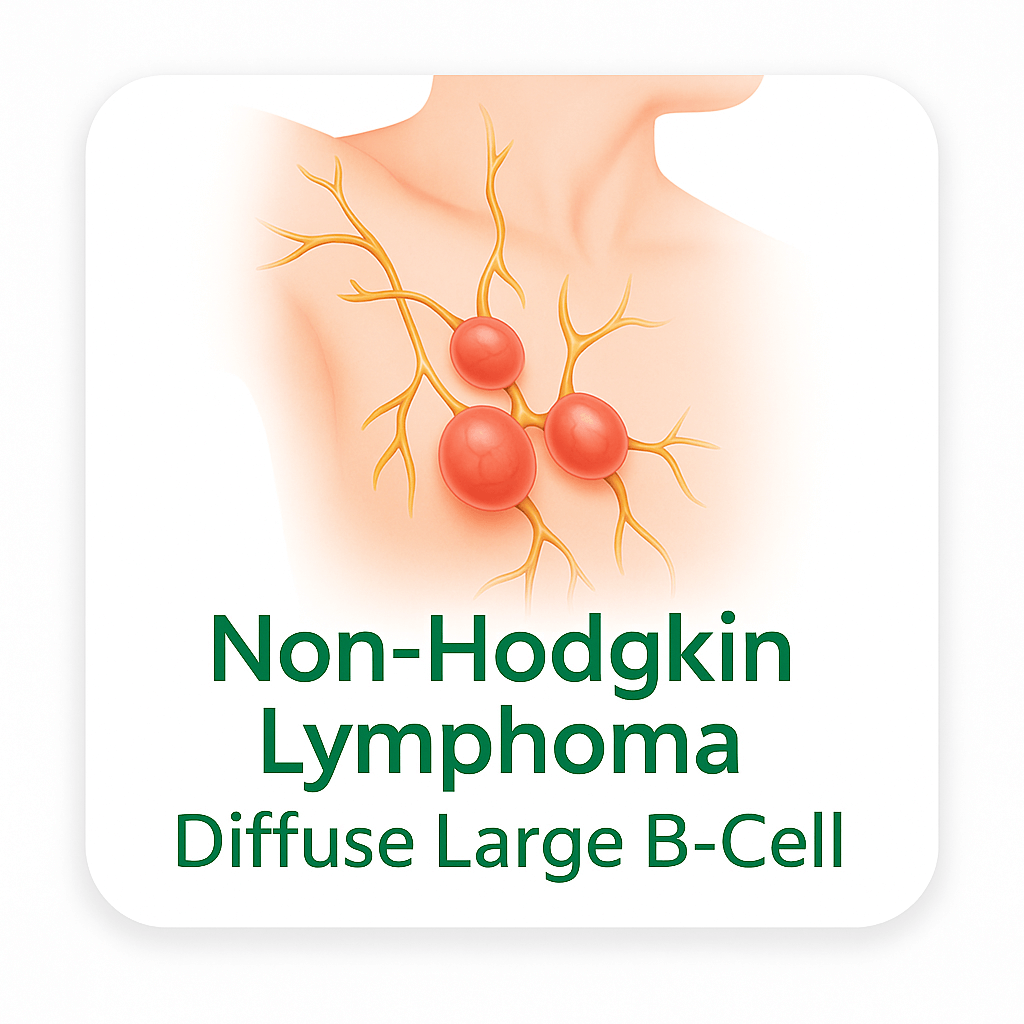
Non-Hodgkin Lymphoma – Diffuse Large B-Cell
Main Grouping
Hematologic
Organ System
Lymphatic System
Cell Origin
B lymphocytes
Pathways Affected
DLBCL involves a pathway landscape defined by COO-specific genetic programs: the constitutive NF-kB/chronic BCR signaling pathway (ABC-DLBCL, driven by MYD88/CD79B/CARD11 mutations), the BCL2/apoptosis resistance pathway (GCB via translocation, ABC via amplification), the EZH2/PRC2 epigenetic silencing pathway (GCB-DLBCL ~20-25%), BCL6 transcriptional repression, MYC-driven metabolic/proliferative reprogramming, and the PI3K/AKT/mTOR pathway.
The NF-kB/chronic BCR signaling pathway is the dominant oncogenic pathway in ABC-DLBCL: MYD88 L265P mutations (~20% of all DLBCL, enriched in ABC-DLBCL and the MCD subtype ~30-35%) create a constitutively active MYD88 protein that recruits IRAK1/IRAK4 kinases forming a signaling complex that activates NF-kB through TRAF6 and IKK-beta — MYD88 L265P also forms a multiprotein complex with CD79A/B BCR components in the MCD subtype creating "chronic active BCR signaling"; CD79B/CD79A activating mutations (~20% of ABC-DLBCL) directly amplify BCR-mediated PI3K/AKT/SYK/BTK signaling; CARD11 activating mutations (~10%) directly activate IKK complex; TNFAIP3/A20 mutations inactivate the NF-kB negative regulatory ubiquitin ligase; constitutive NF-kB drives anti-apoptotic genes (Bcl-2, Bcl-xL, Survivin, XIAP) and survival cytokines (IL-6, IL-10, TNF-alpha autocrine); quercetin inhibits NF-kB through IKK-beta and p65 inhibition in lymphoma cell models — targeting the dominant ABC-DLBCL MYD88/CD79B/NF-kB cascade; curcumin inhibits NF-kB and STAT3 in lymphoma cell models; EGCG inhibits NF-kB in DLBCL cell models.
The EZH2/PRC2 epigenetic silencing pathway is the dominant oncogenic mechanism in GCB-DLBCL: EZH2 gain-of-function mutations at Y641 (~20-25% of GCB-DLBCL, rare in ABC) create enhanced PRC2 catalytic activity producing elevated H3K27me3 — silencing terminal differentiation checkpoint genes (BLIMP1/PRDM1, IRF4, MHC-II, E2F targets) to trap GCB cells in an undifferentiated proliferating state; the EZB genetic subtype (~BCL2 translocation + EZH2) represents a defined GCB DLBCL subgroup; EZH2 requires SAM (S-adenosylmethionine, from methionine cycle) as methyl donor for H3K27me3 production; KMT2D (MLL2) inactivating mutations (~30-40% of GCB, impairing H3K4me3 activation marks) and CREBBP mutations (~20% GCB, impairing H3K27ac and H3K18ac activation marks) are frequent co-alterations in GCB-DLBCL; curcumin and quercetin inhibit EZH2 in lymphoma cell models — targeting the EZH2/PRC2/H3K27me3 pathway dominant in GCB-DLBCL; EGCG inhibits EZH2 in lymphoma cell models.
The BCL2/apoptosis resistance pathway is elevated in both GCB (via t(14;18) translocation) and ABC (via 18q amplification) DLBCL: BCL2 translocation t(14;18) placing BCL2 under IGH enhancer drives constitutive high-level BCL2 protein expression in ~20-30% of GCB-DLBCL; BCL2 amplification at chromosome 18q21 in ~30% of ABC-DLBCL provides additional BCL2 anti-apoptotic signal; double-hit lymphoma (MYC + BCL2 translocation) creates the highest BCL2/apoptosis resistance combined with MYC-driven proliferation; curcumin was confirmed to exert concentration-dependent cytotoxic effects in SU-DHL-10 double-hit DLBCL (MYC/BCL2 co-rearranged) via PARP1-mediated parthanatos (PMC13062621) — demonstrating curcumin's ability to bypass BCL2-mediated apoptosis resistance through caspase-independent cell death; quercetin inhibits Bcl-2 in lymphoma cell models and synergistically enhances apoptosis in DLBCL cell lines (PubMed24902540).
The MYC oncogenic pathway drives the proliferative and metabolic program in ~30-50% of DLBCL (protein expression) and ~5-10% (translocation): MYC translocations or amplification create constitutive MYC-driven transcription of ribosome biogenesis, nucleotide synthesis, and glutamine metabolism genes through MYC/MAX target gene activation; MYC-driven cancers require elevated glutamine for nucleotide biosynthesis and TCA cycle anaplerosis; curcumin was confirmed to reduce miR-21 expression in DLBCL cells — reducing STAT3/PI3K/AKT signaling downstream of MYC in DLBCL (PMC6938780); quercetin inhibits c-MYC in lymphoma cell models.
Description
Diffuse large B-cell lymphoma (DLBCL) is the most common non-Hodgkin lymphoma worldwide, representing approximately 30 to 40 percent of all NHL cases. In the United States, approximately 18,000 to 20,000 new DLBCL cases are diagnosed annually. Globally, approximately 150,000 to 200,000 new cases are diagnosed per year. DLBCL predominantly affects adults with a median age at diagnosis of approximately 64 years; it can occur at any age including in children and young adults. Males are slightly more commonly affected than females (male-to-female ratio approximately 1.2:1 to 1.5:1).
The clinical presentation of DLBCL is typically with rapidly progressive lymphadenopathy — enlarging lymph nodes that double within days to weeks — often accompanied by B symptoms (fever, night sweats, weight loss > 10% body weight in 6 months) in approximately 30 to 40 percent of cases. Extranodal involvement occurs in approximately 40 percent of cases at presentation. The Ann Arbor staging system is used; approximately 40 to 50 percent of patients present with stage III/IV disease.
The 2022 WHO Classification defines three major DLBCL entities based on cell of origin and molecular features: DLBCL-NOS (the most common, subdivided into GCB and ABC subtypes by GEP or Hans IHC algorithm); primary mediastinal large B-cell lymphoma (PMBCL); and T-cell/histiocyte-rich large B-cell lymphoma. The 2022 ICC classification additionally recognizes EBV-positive DLBCL and other specific entities. The International Prognostic Index (IPI) and revised IPI (R-IPI) provide prognostic scoring using age, LDH, performance status, stage, and extranodal sites.
The molecular biology of DLBCL is defined by the cell-of-origin dichotomy: GCB-DLBCL is characterized by BCL2 translocation (~20-30%), EZH2 gain-of-function mutations (~20-25%), PTEN loss, and the EZB and BN2 genetic subtypes with generally favorable prognosis; ABC-DLBCL is characterized by constitutive NF-kB activation through MYD88 L265P/CD79B chronic BCR signaling (MCD subtype ~30-35%), PRDM1/BLIMP1 inactivation blocking plasma cell differentiation (~30%), and BCL2 amplification (~30%) driving apoptosis resistance with generally worse prognosis. MYC translocation with BCL2 and/or BCL6 (double-hit/triple-hit HGBL) defines a high-risk subset. The overall 5-year OS for all DLBCL is approximately 60 to 65 percent; IPI high-risk patients have 5-year OS of approximately 30 to 40 percent.
Published laboratory research documents curcumin from turmeric inhibiting DLBCL cell proliferation and promoting apoptosis in DLBCL cell lines — using SU-DHL-10 (double-hit lymphoma model with MYC/BCL2 co-rearrangements) via PARP1-mediated parthanatos with concentration-dependent cytotoxic effects confirmed (PMC13062621); and inhibiting proliferation, migration, and invasion while promoting apoptosis in DLBCL cell line through miR-21/VHL axis regulation confirmed by MTT, flow cytometry, and transwell assays (PMC6938780); and quercetin from onions inhibiting STAT3 pathway and downregulating survival genes in DLBCL cell lines confirmed (PubMed24902540).
Plant-Based Description
Whole-food plant-based dietary patterns provide phytochemicals with directly confirmed activity in human DLBCL cell lines. Curcumin from turmeric exerted concentration-dependent cytotoxic effects on SU-DHL-10 double-hit DLBCL cells (MYC/BCL2 co-rearrangements) via PARP1-mediated parthanatos — a caspase-independent programmed cell death — confirmed by MTT assay, Western blot, and nuclear AIF localization (PMC13062621); inhibited proliferation, migration, and invasion while promoting apoptosis in DLBCL cell line through miR-21/VHL axis regulation confirmed by MTT, flow cytometry, and transwell assays (PMC6938780); curcumin also promoted DLBCL apoptosis, arrested cells at G2 phase, and inhibited NF-kB, STAT3, and PI3K/Akt pathways in DLBCL cell models; quercetin from onions inhibited STAT3 pathway and downregulated survival genes in DLBCL cell lines confirmed (PubMed24902540) — targeting the constitutive STAT3 activation from JAK2/IL-6 autocrine signaling in ABC-DLBCL; EGCG from green tea inhibits EZH2 and NF-kB in lymphoma cell models targeting the EZH2 Y641 GCB-DLBCL pathway; resveratrol inhibits EZH2, NF-kB, and BCL6 in lymphoma cell models; sulforaphane activates Nrf2/ARE and inhibits EZH2 and HDAC in lymphoma cell models.
Plant Chemistry Detail
Curcumin from turmeric has directly confirmed anti-DLBCL activity in two published studies. In PMC13062621 (Curcumin induces PARP1-mediated parthanatos in DLBCL) using SU-DHL-10 human DLBCL cell line (double-hit lymphoma model with concurrent MYC and BCL2 rearrangements): curcumin exerted a concentration-dependent cytotoxic effect on SU-DHL-10 DLBCL cells confirmed by MTT assay; the cytotoxicity was caspase-independent — not rescued by pan-caspase inhibitors; curcumin increased DAPI-positive/PI-positive cells confirming cell death; Western blot confirmed upregulation of PAR (poly ADP-ribose) chains and PARP-1 (poly ADP-ribose polymerase 1) expression; nuclear AIF (apoptosis-inducing factor) and macrophage migration inhibitory factor expression levels were significantly elevated confirmed by Western blot — demonstrating PARP1-mediated parthanatos as the cell death mechanism; this is directly relevant to double-hit DLBCL with BCL2 rearrangement because parthanatos bypasses BCL2-dependent apoptosis resistance, providing a mechanistic basis for curcumin activity in BCL2-overexpressing DLBCL.
In PMC6938780 (Curcumin inhibits DLBCL via miR-21/VHL axis) using a DLBCL cell line: curcumin inhibited DLBCL cell proliferation confirmed by MTT assay; curcumin promoted apoptosis confirmed by flow cytometric analysis; curcumin inhibited migration and invasion confirmed by transwell assay; curcumin suppressed miR-21 expression confirmed; Von Hippel-Lindau (VHL) was confirmed as a direct target of miR-21 by dual-luciferase reporter assay and RNA immunoprecipitation; curcumin's anti-DLBCL effects were mediated through miR-21 suppression and VHL upregulation — VHL (the HIF-1α E3 ubiquitin ligase) targets HIF-1α for proteasomal degradation suppressing hypoxia-driven glycolysis and angiogenesis in DLBCL cells.
Quercetin from onions, kale, and apples was confirmed to inhibit STAT3 pathway in DLBCL cell lines and downregulate survival genes including Bcl-2, Bcl-xL, survivin, and Mcl-1 confirmed (PubMed24902540) — directly targeting the constitutive STAT3 activation from IL-6/JAK2 autocrine signaling in ABC-DLBCL; quercetin induced growth inhibition and apoptosis in DLBCL cell lines confirmed; EGCG from green tea inhibits EZH2 methyltransferase activity — directly targeting the Y641-gain-of-function EZH2 mutations (~20-25% GCB-DLBCL) — and inhibits NF-kB in DLBCL cell models; resveratrol inhibits EZH2, NF-kB, BCL6, and MYC in lymphoma cell models targeting multiple DLBCL driver pathways; sulforaphane activates Nrf2/ARE and inhibits HDAC and EZH2 in lymphoma cell models targeting the KMT2D/CREBBP/EZH2 epigenetic axis in GCB-DLBCL.
Nutritional Focus
Nutritional focus in DLBCL research is led by curcumin from turmeric with directly confirmed anti-DLBCL activity: curcumin exerting concentration-dependent cytotoxic effects on SU-DHL-10 double-hit DLBCL (MYC/BCL2 co-rearrangements) via PARP1-mediated parthanatos confirmed — bypassing BCL2-mediated apoptosis resistance through caspase-independent cell death with PAR/PARP-1 upregulation and nuclear AIF elevation confirmed by Western blot (PMC13062621); curcumin inhibiting proliferation, migration, and invasion and promoting apoptosis in DLBCL cell line through miR-21/VHL axis confirmed by MTT, flow cytometry, and transwell assays (PMC6938780); curcumin also inhibiting NF-kB, STAT3, and PI3K/Akt in DLBCL cell models targeting both dominant ABC-DLBCL pathways (NF-kB via MYD88/CD79B/CARD11 and STAT3 via IL-6/JAK2 autocrine); quercetin from onions confirmed to inhibit STAT3 pathway and downregulate Bcl-2/Bcl-xL/survivin/Mcl-1 survival genes in DLBCL cell lines (PubMed24902540) — targeting constitutive STAT3 in ABC-DLBCL; curcumin and quercetin both inhibiting EZH2 in lymphoma cell models — targeting Y641 gain-of-function EZH2 mutations (~20-25% GCB-DLBCL, EZB subtype) and the H3K27me3-dependent differentiation block; EGCG from green tea inhibiting EZH2 methyltransferase and NF-kB in lymphoma cell models targeting both GCB-EZH2 and ABC-NF-kB pathways in DLBCL; resveratrol inhibiting EZH2, NF-kB, and BCL6 in lymphoma cell models; sulforaphane activating Nrf2/ARE and inhibiting EZH2 and HDAC targeting the KMT2D/CREBBP/EZH2 epigenetic axis in GCB-DLBCL; and dietary fiber producing butyrate/SCFAs that inhibit HDAC targeting the chromatin dysregulation from KMT2D (~30-40%), CREBBP (~20%), and EZH2 (~20-25%) mutations in DLBCL.
Research Notes
DLBCL epidemiology: ~18,000-20,000 new US cases/year; ~150,000-200,000 global new cases/year; most common NHL ~30-40% of all NHL; median age ~64 years; male:female ~1.2-1.5:1; 5-year OS all DLBCL ~60-65%; IPI high-risk ~30-40%. WHO 2022 defines: DLBCL-NOS (GCB and ABC subtypes), PMBCL, T-cell/histiocyte-rich LBCL, other specific entities. COO by Hans IHC algorithm: GCB (CD10+, or BCL6+/MUM1-); non-GCB/ABC (MUM1+). IHC: CD20+, CD19+, CD79a+, PAX5+, Ki-67 high. Molecular: GCB-DLBCL — BCL2 translocation t(14;18) ~20-30%; EZH2 Y641 gain-of-function ~20-25%; PTEN deletions ~15-20%; REL amplification; BCL6 translocations ~30%. ABC-DLBCL — MYD88 L265P ~20-35%; CD79B/CD79A activating mutations ~20%; CARD11 ~10%; TNFAIP3 mutations; PRDM1/BLIMP1 inactivating ~30%; BCL2 amplification 18q ~30%. Genetic subtypes (Schmitz LymphGen): MCD (MYD88 + CD79B, ABC, poor prognosis); BN2 (BCL6 + NOTCH2, favorable); EZB (EZH2 + BCL2, GCB, favorable); N1 (NOTCH1, rare, ABC, poor); ST2; A53. Double-hit (DHL/HGBL): MYC + BCL2 translocation ~5-10%; double-expressor (DEL): MYC+BCL2 protein ~20-35%. KMT2D mutations ~30-40%; CREBBP ~20%; TP53 ~15-20%. Curcumin SU-DHL-10 double-hit DLBCL (PMC13062621): concentration-dependent cytotoxic MTT; caspase-independent; DAPI/PI cell death; PAR/PARP-1 Western blot up; nuclear AIF elevated; parthanatos mechanism. Curcumin DLBCL miR-21/VHL (PMC6938780): MTT proliferation inhibited; flow cytometry apoptosis confirmed; transwell migration/invasion inhibited; miR-21 suppressed; VHL target confirmed dual-luciferase. Quercetin DLBCL STAT3 (PubMed24902540): growth inhibition confirmed; apoptosis confirmed; STAT3 pathway inhibited; survival genes downregulated.
Notes Visibility
Key Foods
Turmeric,Broccoli,Kale,Spinach,Brussels Sprouts,Cauliflower,Garlic,Yellow Onion,Carrot,Tomato,Beetroot,Cabbage,Blueberry,Pomegranate,Grape,Raspberry,Strawberry,Apple,Orange,Lemon,Soybeans,Edamame,Green Lentils,Black Beans,Chickpeas,Brown Rice,Quinoa,Oats,Wild Rice,Black Rice,Walnut,Almond,Brazil Nut,Flaxseed,Pumpkin Seeds,Chia Seeds,Sesame Seeds,Hemp Seeds,Shiitake,Maitake,Lions Mane,Cremini,Portobello,Green Tea,Ginger,Black Pepper,Garlic Powder,Parsley,Rosemary,Oregano,Sweet Potato, Celery, Leek,Avocado,Artichoke,Radish,Parsnip,Radicchio,Tangerine, Red Onion
Linked Nutrients
vitamin-c,vitamin-e,vitamin-a,vitamin-b9,vitamin-b6,selenium,zinc,magnesium,calcium,potassium,iron,curcumin,quercetin,egcg,resveratrol,sulforaphane,beta-carotene,anthocyanins,beta-glucans,dietary-fiber,l-theanine
Last Updated
2025-10-13 10:26:37

