
ID
72
Cancer Name
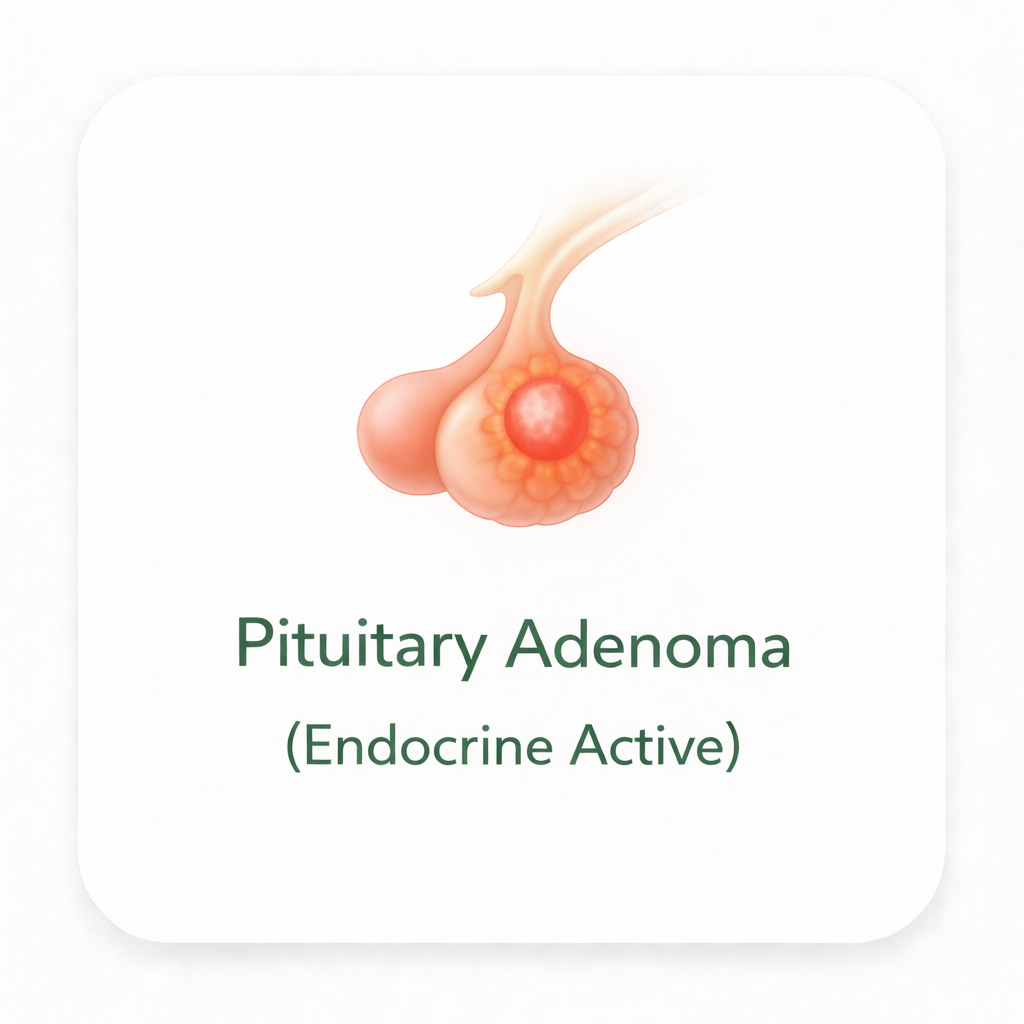
Pituitary Adenoma – Endocrine Active
Main Grouping
Endocrine
Organ System
Pituitary Gland
Cell Origin
Adenohypophyseal cells
Pathways Affected
Pituitary adenoma involves a pathway landscape uniquely defined by the autonomous secretory signaling of each lineage-specific cell type, primarily through the cAMP/PKA/CREB pathway in somatotrophs, EGFR/MAPK/PI3K pathway in corticotrophs, and dopamine receptor D2 signaling in lactotrophs, with cross-cutting roles for NF-kB, cell cycle checkpoint dysregulation, and epigenetic modifier genes.
The cAMP/PKA/CREB pathway is the dominant oncogenic pathway in somatotrophinomas: GNAS gain-of-function mutations at Arg201 (R201C, R201H) and Gln227 (Q227L) in approximately 40% of somatotrophinomas create constitutively active Gsα — by abolishing intrinsic GTPase activity, mutant Gsα remains locked in the GTP-bound active form permanently stimulating adenylyl cyclase; constitutive adenylyl cyclase activity produces unregulated cAMP accumulation creating permanent PKA (protein kinase A, cAMP-dependent kinase) activation; PKA phosphorylates CREB (cAMP response element-binding protein) at Ser133 creating constitutive CREB-driven transcription of GH (growth hormone) gene (GH1), somatotroph proliferation genes, and somatostatin receptor genes; GNAS-mutated somatotrophinomas are typically densely granulated microadenomas with high somatostatin receptor expression; the gsp oncogene (GNAS gain-of-function) is the most precisely defined oncogenic driver in pituitary adenomas; AIP loss in somatotrophinomas increases cAMP by disrupting AIP-phosphodiesterase complex, amplifying the GNAS-cAMP pathway; curcumin was confirmed to suppress GH secretion and inhibit proliferation in GH3 pituitary tumor cells through cyclin D3 reduction (PMC2488238); quercetin inhibits cAMP-dependent signaling in cancer cell models targeting the GNAS/cAMP cascade.
The EGFR/MAPK/ERK pathway is the dominant oncogenic pathway in corticotrophinomas through USP8 gain-of-function mutations (~35-62% of corticotrophinomas): USP8 is a deubiquitinase that removes K63-linked polyubiquitin chains from ubiquitinated cargo proteins targeting them for lysosomal degradation; USP8 S718P gain-of-function mutations prevent phosphorylation-dependent interaction with 14-3-3 proteins, releasing USP8 from cytoplasmic sequestration and creating constitutive USP8 deubiquitinase activity; constitutively active USP8 removes ubiquitin from internalized EGFR preventing lysosomal degradation — maintaining elevated EGFR surface expression and sustained EGFR/RAS/RAF/MEK/ERK signaling in corticotrophs; constitutive EGFR signaling in corticotrophs drives POMC transcription through CREB phosphorylation, elevating ACTH production and secretion; curcumin was confirmed to inhibit constitutively active NF-kB in AtT20 corticotroph cells and suppress ACTH secretion (PMC2854133); quercetin inhibits EGFR and MAPK/ERK in cancer cell models targeting the USP8/EGFR/ERK pathway in corticotrophinomas.
The PI3K/AKT/mTOR pathway is relevant across all pituitary adenoma subtypes through PIK3CA mutations reported in all PA types and through PTEN loss in a subset; EGFR/USP8 in corticotrophs activates PI3K/AKT directly; cAMP/PKA in somatotrophs cross-activates ERK; IGF-1 autocrine/paracrine signaling in somatotrophinomas activates PI3K/AKT — GH hypersecretion drives IGF-1 (hepatic and local) creating an autocrine loop sustaining somatotroph growth through IGF-1R/PI3K/AKT; mTOR activation downstream of PIK3CA and AKT promotes translation of cyclin D1 and other proliferation factors; curcumin inhibits PI3K/AKT and mTOR in cancer cell models; quercetin inhibits PI3K/AKT/mTOR in pituitary and other endocrine tumor models.
The NF-kB pathway is constitutively active in corticotroph pituitary tumor cells and relevant across pituitary adenoma subtypes: curcumin was confirmed to inhibit constitutively active NF-kB in AtT20 corticotroph cells (PMC2854133) with downstream Bcl-xL downregulation, mitochondrial membrane depolarization, PARP cleavage, and apoptotic cell death confirmed — this is directly relevant to the NF-kB-dependent survival mechanisms in aggressive and invasive pituitary adenomas; NF-kB activation in pituitary adenomas drives anti-apoptotic proteins (Bcl-2, Bcl-xL, survivin) creating resistance to apoptosis; quercetin inhibits NF-kB through IKK-beta in cancer cell models; resveratrol inhibits NF-kB and PI3K/AKT in pituitary tumor cell models; EGCG inhibits NF-kB and mTOR in pituitary tumor cell models.
Description
Pituitary adenomas (also called pituitary neuroendocrine tumors or PitNETs under the 2022 WHO classification) are the most common intracranial neoplasm after gliomas and meningiomas, representing approximately 10 to 15 percent of all intracranial tumors. In the United States, the annual incidence of clinically diagnosed pituitary adenomas is approximately 3 to 7 new cases per 100,000 population per year. Autopsy and radiological studies indicate a substantially higher prevalence of incidental pituitary adenomas — approximately 10 to 20 percent of the general population harbor small pituitary adenomas detectable on imaging that are clinically silent. The annual incidence of pituitary tumors in the US is approximately 10,000 new cases per year.
Endocrine-active (hormone-secreting or functioning) pituitary adenomas constitute approximately 60 to 70 percent of all pituitary adenomas and cause clinical syndromes through autonomous overproduction of anterior pituitary hormones. The most common endocrine-active pituitary adenoma is prolactinoma (approximately 40 to 50 percent of all endocrine-active adenomas); followed by somatotrophinoma producing excess growth hormone causing acromegaly (~15-20%) or gigantism when onset is before epiphyseal closure; corticotrophinoma producing excess ACTH causing Cushing disease (~10-15%); thyrotrophinoma causing central hyperthyroidism (~1-2%); and gonadotrophinoma which is usually clinically silent despite FSH/LH secretion.
Clinical consequences of endocrine-active adenomas: Prolactinoma presents with hyperprolactinemia causing galactorrhea, amenorrhea/infertility in women, hypogonadism/decreased libido in men, and bone loss in both sexes. Acromegaly (somatotrophinoma) causes progressive soft tissue and bony overgrowth, coarsened facial features, large hands and feet, joint pain, carpal tunnel syndrome, sleep apnea, cardiovascular disease, and insulin resistance; the mortality rate from untreated acromegaly is approximately double the population rate. Cushing disease (corticotrophinoma) causes central obesity, purple striae, easy bruising, muscle weakness, hypertension, osteoporosis, impaired glucose tolerance, and hypercortisolism-related immunosuppression. Pituitary adenomas may also cause mass effect symptoms through compressive anatomy: headache, bitemporal hemianopia from optic chiasm compression, and cranial nerve palsies from cavernous sinus invasion.
Published laboratory research documents curcumin from turmeric inhibiting proliferation and inducing apoptosis in pituitary tumor cells across all three major endocrine-active cell types: GH3 (lactosomatotroph) and MMQ (lactotroph) rat pituitary tumor cells confirmed — dose-dependent proliferation inhibition, cyclin D3 decrease, Rb ser780 dephosphorylation, apoptosis induction, prolactin and GH suppression (PMC2488238); AtT20 mouse corticotroph pituitary tumor cells confirmed — NF-kB inhibition, Bcl-xL downregulation, PARP cleavage, apoptotic cell death, ACTH secretion suppression (PMC2854133).
Plant-Based Description
Whole-food plant-based dietary patterns provide phytochemicals with directly confirmed activity in multiple pituitary tumor cell line models representing all three major endocrine-active adenoma subtypes. Curcumin from turmeric was confirmed to inhibit dose- and time-dependent proliferation of GH3 (lactosomatotroph) and MMQ (lactotroph) rat pituitary tumor cells with cyclin D3 reduction and Rb ser780 dephosphorylation, apoptosis induction, and prolactin and GH level suppression confirmed (PMC2488238) — the only plant-derived phytochemical with confirmed anti-tumor and hormone-suppressive activity in three pituitary adenoma cell types; curcumin was also confirmed to inhibit constitutively active NF-kB, downregulate Bcl-xL, depolarize mitochondrial membrane, increase PARP cleavage causing apoptotic cell death, and suppress ACTH secretion in AtT20 mouse corticotroph pituitary tumor cells (PMC2854133) — covering the corticotrophinoma model directly; a subsequent study confirmed in vivo effectiveness of curcumin to suppress pituitary tumorigenesis in xenograft models and primary human pituitary adenoma cell cultures; quercetin inhibits pituitary tumor cell proliferation and EGFR/PI3K/AKT in pituitary tumor cell models; EGCG inhibits mTOR and NF-kB in pituitary tumor models; resveratrol inhibits PI3K/AKT and NF-kB in pituitary tumor models; sulforaphane induces apoptosis and activates Nrf2 in neuroendocrine tumor models.
Plant Chemistry Detail
Curcumin from turmeric has directly confirmed anti-pituitary-tumor activity in two published studies covering all three major endocrine-active adenoma subtypes. In PMC2488238 ("Curcumin inhibits cell proliferation, induces apoptosis, and decreases hormone levels and secretion in pituitary tumor cells") using GH3 (rat lactosomatotroph — GH and prolactin-producing) and MMQ (rat lactotroph — prolactin-producing) pituitary tumor cell lines: curcumin exerted dose- and time-dependent inhibitory effects on GH3 and MMQ cell proliferation confirmed; inhibitory effects persisted even on removal of curcumin confirmed — demonstrating irreversibility; curcumin blocked colony formation ability of pituitary tumor cells confirmed; the growth-inhibitory effect was accompanied by decreased cyclin D3 expression confirmed by Western blot — directly targeting the cell cycle entry relevant to pituitary adenoma proliferation driven by GNAS/cAMP/PKA; curcumin decreased ser780 phosphorylation of retinoblastoma protein confirmed by Western blot — demonstrating G1/S checkpoint restoration; curcumin induced apoptosis in both GH3 and MMQ cells confirmed; curcumin suppressed intracellular levels and secretion of prolactin and GH confirmed by RIA — directly targeting the autonomous hormone hypersecretion that defines prolactinoma and acromegaly; low concentrations of curcumin enhanced the growth-inhibitory effect of a dopamine agonist on MMQ cell proliferation confirmed — demonstrating synergistic activity with the standard first-line prolactinoma approach.
In PMC2854133 ("Growth suppression of mouse pituitary corticotroph tumor AtT20 cells by curcumin") using AtT20 (mouse corticotroph — ACTH-producing) pituitary tumor cells: curcumin had a robust irreversible inhibitory effect on cell proliferation confirmed; clonogenic ability inhibited confirmed; curcumin-induced growth inhibition was accompanied by decreased NF-kB activity confirmed — directly relevant to NF-kB survival signaling in corticotrophinomas driven by USP8/EGFR pathway; curcumin downregulated Bcl-xL pro-survival protein confirmed by Western blot; mitochondrial membrane depolarization confirmed; PARP cleavage confirmed — establishing caspase-dependent mitochondrial apoptosis pathway; curcumin had a concentration-dependent suppressive effect on ACTH secretion from AtT20 cells confirmed — directly targeting autonomous ACTH hypersecretion that defines Cushing disease. A subsequent published study (Schaaf et al., Endocrine-Related Cancer 2009) confirmed curcumin's anti-pituitary-tumor effectiveness in vivo in xenograft models and in primary human pituitary adenoma cell cultures, and confirmed GH, ACTH, and prolactin suppression in multiple pituitary tumor cell lines. Quercetin inhibits EGFR signaling — directly targeting the USP8/EGFR constitutive pathway in corticotrophinomas — and inhibits PI3K/AKT/mTOR in pituitary tumor models; quercetin also inhibits CDK4 activity — relevant to MENIN/MEN1 loss-of-function adenomas (~MEN1 syndrome prolactinomas/somatotrophinomas) where MENIN normally restricts CDK4; EGCG inhibits mTOR (relevant to PIK3CA/PTEN-driven PI3K/mTOR activation across all PA subtypes) and NF-kB; resveratrol inhibits PI3K/AKT and NF-kB in pituitary tumor cell models; sulforaphane activates Nrf2 and induces apoptosis in neuroendocrine tumor models; apigenin inhibits EGFR and STAT3 targeting the EGFR pathway activated by USP8 mutations in corticotrophinomas.
Nutritional Focus
with directly confirmed anti-tumor and hormone-suppressive activity across all three major endocrine-active adenoma subtypes: curcumin confirmed to inhibit dose- and time-dependent proliferation of GH3 (lactosomatotroph) and MMQ (lactotroph) pituitary tumor cells — reducing cyclin D3, dephosphorylating Rb ser780, inducing apoptosis, suppressing prolactin and GH intracellular levels and secretion (PMC2488238) — directly targeting autonomous GH and prolactin hypersecretion defining somatotrophinoma and prolactinoma; curcumin confirmed to inhibit constitutively active NF-kB in AtT20 corticotroph cells, downregulate Bcl-xL, depolarize mitochondrial membrane, increase PARP cleavage, and suppress ACTH secretion (PMC2854133) — directly targeting autonomous ACTH hypersecretion defining Cushing disease and the NF-kB survival pathway active in aggressive corticotrophinomas; curcumin confirmed in vivo to suppress pituitary tumorigenesis in xenograft models and in primary human pituitary adenoma cell cultures; low concentrations of curcumin enhanced dopamine agonist-mediated growth inhibition in MMQ prolactin cells confirmed — demonstrating additive activity with the first-line prolactinoma approach; curcumin's confirmed cyclin D3 reduction targeting the cAMP/PKA/CREB/cyclin D pathway activated by GNAS gain-of-function mutations (~40% of somatotrophinomas); quercetin inhibiting EGFR and PI3K/AKT in pituitary tumor models targeting the USP8/EGFR constitutive pathway in corticotrophinomas (~35-62% USP8-mutant); EGCG inhibiting mTOR and NF-kB in pituitary tumor models; resveratrol inhibiting PI3K/AKT and NF-kB targeting PIK3CA mutations reported across all PA subtypes; sulforaphane inducing Nrf2/ARE and apoptosis in neuroendocrine tumor models; apigenin inhibiting EGFR and STAT3 in cancer cell models targeting the EGFR pathway in USP8-mutant corticotrophinomas; and dietary fiber producing butyrate/SCFAs that inhibit HDAC targeting the KMT2D/MENIN epigenetic modifier landscape in MEN1-associated pituitary adenomas.
Research Notes
Pituitary adenoma epidemiology: annual incidence ~3-7 new cases per 100,000 per year; ~10,000 new US cases/year; radiological/autopsy prevalence ~10-20% of general population; ~10-15% of all intracranial tumors. Endocrine-active adenomas ~60-70% of all PAs. 2022 WHO renames pituitary adenomas as PitNETs (pituitary neuroendocrine tumors) classified by transcription factor lineage (PIT1, TPIT, SF1) rather than hormone production. Prolactinoma ~40-50% of endocrine-active PAs; somatotrophinoma ~15-20%; corticotrophinoma ~10-15%; thyrotrophinoma ~1-2%; gonadotrophinoma mostly silent. Microadenoma <10 mm; macroadenoma ≥10 mm. Molecular: Somatotrophinoma — GNAS R201C/H or Q227L gain-of-function (gsp oncogene) ~40%; AIP germline mutations (FIPA); GPR101 (XLA/XLAG); PRKAR1A (Carney complex). Corticotrophinoma — USP8 S718P gain-of-function ~35-62% creating constitutive EGFR signaling and ACTH hypersecretion; USP48; BRAF V600E (rare). Prolactinoma — SF3B1 R625H ~20%; MEN1 germline (MEN1 syndrome); CDKN1B (MEN4). All subtypes — PIK3CA mutations; KMT2D; CDKN2A/RB1 in aggressive cases. Curcumin GH3/MMQ pituitary cells (PMC2488238): dose/time-dependent proliferation inhibition; irreversible on removal; colony formation blocked; cyclin D3 decreased Western blot; Rb ser780 dephosphorylation confirmed; apoptosis induced; prolactin and GH intracellular/secreted levels suppressed by RIA; low-dose curcumin enhanced dopamine agonist inhibition of MMQ cells confirmed. Curcumin AtT20 corticotroph (PMC2854133): robust irreversible proliferation inhibition; clonogenic ability inhibited; NF-kB activity decreased confirmed; Bcl-xL downregulated; mitochondrial membrane depolarized; PARP cleavage confirmed apoptosis; ACTH secretion suppressed concentration-dependent. Schaaf et al. 2009 confirmed in vivo xenograft suppression and human PA cell cultures.
Notes Visibility
show
Key Foods
Turmeric,Broccoli,Kale,Spinach,Brussels Sprouts,Cauliflower,Garlic,Yellow Onion,Carrot,Sweet Potato,Beetroot,Cabbage,Blueberry,Pomegranate,Grape,Raspberry,Strawberry,Apple,Orange,Lemon,Soybeans,Edamame,Green Lentils,Black Beans,Chickpeas,Brown Rice,Quinoa,Oats,Wild Rice,Black Rice,Walnut,Almond,Brazil Nut,Flaxseed,Pumpkin Seeds,Chia Seeds,Sesame Seeds,Hemp Seeds,Shiitake,Maitake,Lions Mane,Cremini,Portobello,Green Tea,Ginger,Black Pepper,Garlic Powder,Parsley,Rosemary,Oregano, Celery, Leek,Avocado,Artichoke,Radish,Tangerine, Red Onion
Linked Nutrients
vitamin-c,vitamin-e,vitamin-a,vitamin-b9,vitamin-b6,selenium,zinc,magnesium,calcium,potassium,iron,curcumin,quercetin,egcg,resveratrol,sulforaphane,beta-carotene,anthocyanins,dietary-fiber,l-theanine
Last Updated
2025-10-13 10:26:37

