
ID
73
Cancer Name
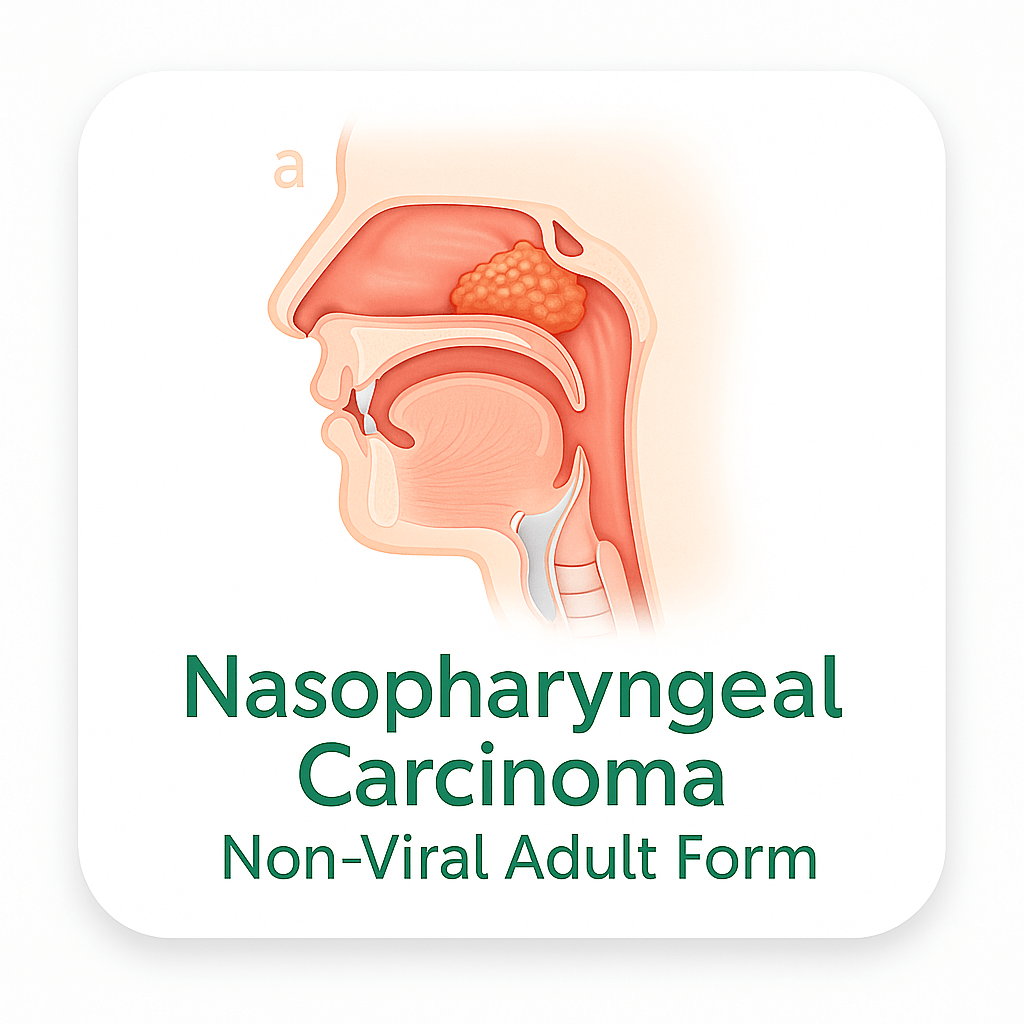
Nasopharyngeal Carcinoma – Non-Viral Adult Form
Main Grouping
Respiratory
Organ System
Nasopharynx
Cell Origin
Epithelial cells
Pathways Affected
Nasopharyngeal carcinoma involves a broad signaling network centered on epithelial growth control, inflammatory transcription, DNA repair, apoptosis, immune signaling, angiogenesis, hypoxia adaptation, and EMT. The PI3K-Akt pathway and mTORC1 signaling influence cell survival, growth signaling, protein synthesis, glucose metabolism, and resistance to apoptosis. EGFR signaling and MAPK/ERK signaling connect surface growth-factor activation to nuclear transcription programs that support proliferation, migration, and tissue remodeling. NF-κB signaling connects inflammatory stress with cytokine activity, survival genes, adhesion changes, and pro-invasive biology. JAK/STAT signaling, especially STAT3-centered signaling, has been reported in nasopharyngeal carcinoma progression, tumor-initiating cell behavior, immune communication, and migration. Wnt/beta-catenin signaling influences epithelial renewal, cell fate, and transcriptional programs that can become abnormal during carcinogenesis.
The p53 tumor suppressor pathway, DNA repair, mismatch repair, base excision repair, nucleotide excision repair, cell-cycle checkpoints, apoptosis, and autophagy determine whether damaged epithelial cells pause, repair, recycle damaged structures, or undergo programmed cell death. Hypoxia-HIF1 response and VEGF signaling connect low-oxygen adaptation with blood-vessel formation. EMT signaling and epithelial barrier integrity influence whether epithelial cells maintain normal adhesion or acquire more migratory behavior. Nrf2 antioxidant response and glutathione defense support redox control under oxidative stress. Detoxification phase II pathways are relevant to conjugation and cellular handling of reactive compounds. Immune-response signaling, T-cell receptor signaling, antigen processing, and PD-1/PD-L1 signaling describe the interaction between altered epithelial cells and the immune environment. These pathways are supported in the food mapping through carotenoid-rich vegetables, vitamin C fruits, cruciferous vegetables, green tea catechins, berries, legumes, whole grains, seeds, mushrooms, allium vegetables, and herbs that provide phytonutrients tied to oxidative-stress balance, DNA integrity, inflammatory regulation, and epithelial repair.
Description
Nasopharyngeal Carcinoma – Non-Viral Adult Form is an epithelial cancer of the nasopharynx, the upper throat region located behind the nasal cavity and above the soft palate. This anatomical site is small but biologically important because it participates in breathing, mucosal immune defense, eustachian tube function, and lymphatic drainage to the retropharyngeal and cervical lymph nodes. Adult non-viral nasopharyngeal carcinoma is best understood as a head and neck epithelial malignancy shaped by altered mucosal biology, chronic inflammatory signaling, oxidative stress, DNA repair imbalance, abnormal cell-cycle regulation, angiogenic support, immune microenvironment changes, and epithelial-mesenchymal transition. It may present as nasal obstruction, nosebleed, ear fullness, hearing changes, headache, neck lymph node enlargement, cranial nerve symptoms, or nonspecific upper airway findings because the nasopharynx lies close to the skull base, eustachian tube opening, parapharyngeal structures, and lymphatic drainage routes.
At the cellular level, this cancer reflects loss of normal epithelial control. Healthy nasopharyngeal epithelial cells regulate when to divide, when to repair DNA damage, when to undergo apoptosis, and when to maintain tight barrier organization. In nasopharyngeal carcinoma, these processes may become disrupted through PI3K-Akt and mTOR activation, EGFR and MAPK/ERK signaling, NF-κB inflammatory transcription, JAK/STAT and STAT3 activity, Wnt/beta-catenin transcription, p53 checkpoint disruption, altered apoptosis, hypoxia adaptation, VEGF signaling, EMT signaling, and DNA repair stress. These pathways determine whether abnormal cells stop dividing, repair injury, remain localized, recruit blood vessels, communicate with immune cells, or migrate into surrounding tissue.
Nutrition-related research has connected higher fruit and vegetable intake with lower observed nasopharyngeal carcinoma risk in population studies, including stronger associations for yellow and red-pigmented vegetables and carotenoid intake. This fits the biology of carotenoids, vitamin C-rich fruits, cruciferous vegetables, leafy greens, allium vegetables, berries, legumes, intact grains, mushrooms, seeds, nuts, and herbs because these foods provide antioxidant compounds, folate, magnesium, potassium, selenium, zinc, fiber, flavonoids, catechins, glucosinolates, isothiocyanates, organosulfur compounds, carotenoids, phenolic acids, and amino acids involved in epithelial integrity and cellular stress response. Green tea EGCG has been studied in nasopharyngeal carcinoma models for STAT3, proliferation, tumor-initiating behavior, migration, and MMP-2 regulation. Curcuminoids from turmeric have been studied in pharyngeal and nasopharyngeal carcinoma cells for growth suppression, apoptosis, cell-cycle effects, and NF-κB-related signaling. This record uses a 100 percent whole-food plant-based framework with no oils, no meat, no dairy, and no toxin-focused ingredients.
Plant-Based Description
Whole-food plant-based dietary patterns for this record emphasize fruits, vegetables, cruciferous vegetables, leafy greens, legumes, intact whole grains, mushrooms, seeds, nuts, green tea, turmeric, ginger, garlic, and herbs. The food logic is built around published observations linking higher fruit and vegetable intake with lower nasopharyngeal carcinoma risk, including carotenoid-rich yellow and red vegetables. Carrots, sweet potatoes, red bell peppers, tomatoes, leafy greens, citrus fruits, berries, pomegranate, cruciferous vegetables, legumes, and whole grains provide vitamin C, folate, carotenoids, magnesium, potassium, zinc, selenium, copper, manganese, amino acids, polyphenols, glucosinolates, organosulfur compounds, and fiber. These plant compounds connect to epithelial barrier support, redox balance, collagen formation, immune signaling, DNA maintenance, inflammatory regulation, microbiome fermentation, and cellular stress response without oils, meat, dairy, or toxin-focused ingredients.
Plant Chemistry Detail
Green tea provides EGCG, epigallocatechin gallate, catechin, epicatechin, epicatechin gallate, epigallocatechin, theaflavin, thearubigin, and L-theanine. EGCG has been studied in nasopharyngeal carcinoma models for attenuation of STAT3 phosphorylation, reduced tumor-initiating cell behavior, inhibition of growth, and reduced migration through downregulation of MMP-2. Turmeric provides curcumin, demethoxycurcumin, and bisdemethoxycurcumin, compounds studied in pharyngeal and nasopharyngeal carcinoma cell systems for growth suppression, apoptosis induction, cell-cycle arrest, and NF-κB-related signaling. Broccoli, kale, Brussels sprouts, cauliflower, cabbage, watercress, mustard greens, bok choy, broccoli rabe, and broccolini provide glucoraphanin, sulforaphane, glucobrassicin, indole-3-carbinol, diindolylmethane, sinigrin, gluconasturtiin, gluconasturtiin-related compounds, and isothiocyanate chemistry connected to Nrf2 antioxidant response, detox phase II enzymes, glutathione defense, redox balance, and epithelial stress response.
Carrot, sweet potato, red bell pepper, tomato, spinach, kale, apricot, mango, orange, and watermelon provide beta-carotene, alpha-carotene, lycopene, lutein, zeaxanthin, beta-cryptoxanthin, phytoene, violaxanthin, and neoxanthin. These carotenoids support antioxidant and epithelial-protective biology and are relevant because carotenoid intake has been studied in relation to nasopharyngeal carcinoma risk. Blueberry, blackberry, raspberry, strawberry, cranberry, black currant, pomegranate, grape, plum, cherry, apple, citrus, and herbs provide quercetin, kaempferol, luteolin, apigenin, ellagic acid, punicalagin, gallic acid, chlorogenic acid, caffeic acid, ferulic acid, rutin, hesperidin, naringenin, naringin, eriocitrin, cyanidin-3-glucoside, delphinidin, malvidin, peonidin, pelargonidin, petunidin, procyanidin-b1, procyanidin-b2, and procyanidin-c1. Garlic, onion, ginger, oregano, rosemary, thyme, black pepper, and parsley provide allicin, diallyl disulfide, diallyl trisulfide, S-allyl-L-cysteine, 6-gingerol, 6-shogaol, rosmarinic acid, carvacrol, thymol, eugenol, and related aromatic plant compounds.
Nutritional Focus
Nutritional focus for Nasopharyngeal Carcinoma – Non-Viral Adult Form is built around carotenoid-rich vegetables, vitamin C fruits, cruciferous vegetables, leafy greens, allium vegetables, legumes, intact grains, mushrooms, seeds, nuts, green tea, turmeric, ginger, and herbs. Published population research has associated greater fruit and vegetable intake, including carotenoid intake and yellow or red-pigmented vegetables, with lower observed nasopharyngeal carcinoma risk. The pathway emphasis is redox balance through Nrf2 and glutathione defense, epithelial integrity through vitamin C, glycine, proline, and lysine, cell-cycle and apoptosis signaling through polyphenols, inflammatory regulation through NF-κB-related plant chemistry, STAT3-related green tea catechin research, DNA maintenance through folate and repair pathways, and microbiome support through legumes, whole grains, seeds, and fiber.
Research Notes
Nasopharyngeal carcinoma research describes a malignant epithelial cancer of the nasopharynx with major pathway activity involving PI3K-Akt, EGFR, MAPK/ERK, NF-κB, JAK/STAT, STAT3, Wnt/beta-catenin, p53 regulation, cell-cycle checkpoints, apoptosis, autophagy, DNA repair, angiogenesis, hypoxia response, EMT, and immune-response signaling. Molecular reviews describe complex tumorigenesis involving many pathways and altered protein-expression programs. Diet-focused population research has reported that higher vegetable and fruit intake is associated with reduced nasopharyngeal carcinoma risk, with one low-risk population study reporting stronger associations for yellow and red vegetables and another study reporting protective associations for carotenoids. Meta-analysis data also reported an inverse association between fruit and vegetable intake and nasopharyngeal carcinoma risk. EGCG research in nasopharyngeal carcinoma models has reported effects on STAT3 phosphorylation, tumor-initiating cell behavior, proliferation, migration, and MMP-2 expression. Curcuminoid research has reported growth suppression and apoptosis induction in pharyngeal and nasopharyngeal carcinoma cell systems. This record maps only whole-food plant sources from the provided slug list and excludes animal products, oils, dairy, pills, supplement framing, and non-plant inputs. Source support includes molecular NPC reviews, diet and carotenoid studies, EGCG NPC research, and curcuminoid NPC cell research.
Notes Visibility
Key Foods
Green Tea,Turmeric,Broccoli,Kale,Spinach,Brussels Sprouts,Cauliflower,Cabbage,Watercress,Mustard Greens,Bok Choy,Broccoli Rabe,Sweet Potato,Carrot,Red Bell Pepper,Tomato,Beetroot,Garlic,Yellow Onion,Blueberry,Blackberry,Raspberry,Strawberry,Cranberry,Black Currant,Pomegranate,Grape,Apple,Orange,Lemon,Kiwi,Mango,Apricot,Plum,Cherry,Black Beans,Brown Lentils,Green Lentils,Red Lentils,Chickpeas,Soybeans,Edamame,Navy Beans,Kidney Beans,Brown Rice,Oats,Quinoa,Wild Rice,Black Rice,Sorghum,Millet,Teff,Walnut,Almond,Brazil Nut,Pistachio,Hazelnut,Flax Seeds,Chia Seeds,Pumpkin Seeds,Sunflower Seeds,Sesame Seeds,Hemp Seeds,Shiitake,Maitake,Oyster Mushroom,Cremini,Portobello,Lion’s Mane,White Button Mushroom,Ginger,Black Pepper,Garlic Powder,Oregano,Rosemary,Thyme,Parsley, Leek,Avocado,Artichoke,Tangerine, Red Onion
Linked Nutrients
vitamin-c,vitamin-b9,vitamin-a,vitamin-e,vitamin-k1,vitamin-b6,vitamin-b1,vitamin-b2,vitamin-b3,magnesium,potassium,zinc,selenium,iron,copper,manganese,calcium,glycine,proline,glutamine,arginine,cysteine,lysine,leucine,isoleucine,valine,serine,threonine,tryptophan,egcg,curcumin,quercetin,kaempferol,luteolin,apigenin,beta-carotene,alpha-carotene,lycopene,lutein,zeaxanthin,sulforaphane,glucoraphanin,indole-3-carbinol,ellagic-acid,punicalagin,gallic-acid,chlorogenic-acid,caffeic-acid,ferulic-acid,allicin,diallyl-disulfide,diallyl-trisulfide,6-gingerol,6-shogaol,dietary-fiber
Last Updated
2025-10-13 10:26:37

