
ID
81
Cancer Name
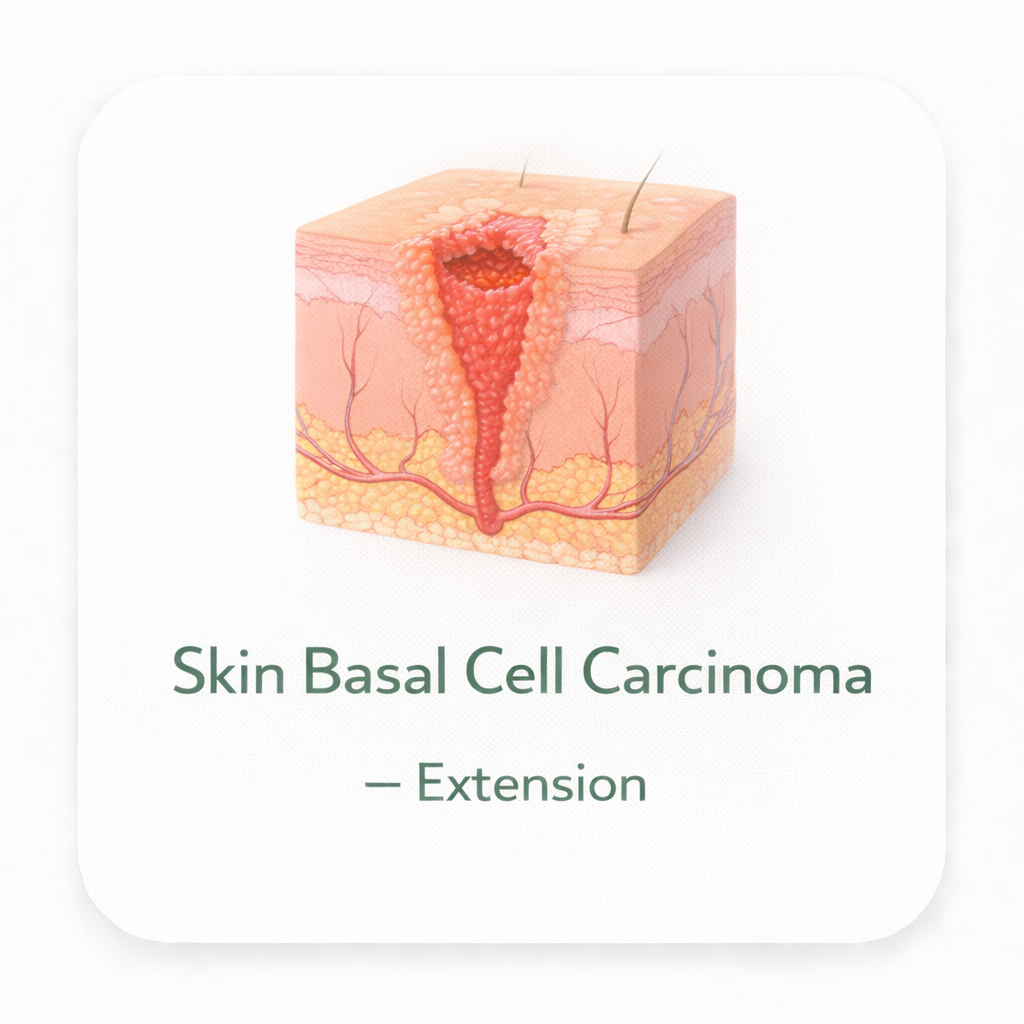
Skin Basal Cell Carcinoma – Extension
Main Grouping
Integumentary
Organ System
Skin
Cell Origin
Basal keratinocytes
Pathways Affected
Basal cell carcinoma is dominated by Hedgehog signaling dysregulation. PTCH1 normally suppresses SMO; when PTCH1 is lost or SMO is activated, GLI transcription factors increase expression of genes that support proliferation, survival, and tissue remodeling. This Hedgehog-GLI axis is the central pathway in BCC and is the strongest molecular distinction between BCC and many other skin cancers. UV-induced DNA damage is another core pathway. Ultraviolet radiation creates cyclobutane pyrimidine dimers, 6-4 photoproducts, oxidative base damage, and UV-signature mutations. Nucleotide excision repair, base excision repair, mismatch repair, p53-mediated checkpoint control, and apoptosis determine whether damaged keratinocytes are repaired, arrested, eliminated, or allowed to expand.
The p53 tumor suppressor pathway is highly relevant because TP53 mutation is common in BCC and removes normal DNA-damage checkpoint control, apoptosis signaling, and genomic stability functions. Cell-cycle checkpoint pathways connect Hedgehog-GLI activation to cyclin regulation, CDK activity, and proliferation. NF-κB and MAPK/AP-1 signaling participate in UV-induced inflammatory responses, cytokine activity, matrix remodeling, and survival signaling. Oxidative stress and Nrf2 antioxidant response pathways are relevant because UV exposure increases reactive oxygen species in skin, while glutathione defense, catalase, superoxide dismutase, and related antioxidant systems buffer oxidative injury. Angiogenesis and VEGF signaling contribute to larger or locally extended lesions by supporting vascular remodeling around tumor tissue. EMT-like stromal remodeling, matrix metalloproteinase activity, collagen breakdown, and inflammatory signaling help explain local extension even when distant metastatic behavior is rare.
Description
Skin basal cell carcinoma is the most common keratinocyte carcinoma and the most common human malignancy overall. It usually grows slowly and remains localized, but extension becomes clinically important when the lesion enlarges, recurs, infiltrates deeply, grows on high-risk facial sites, or develops aggressive histologic features such as morpheaform, infiltrative, micronodular, or basosquamous growth. Extended BCC can damage surrounding tissue through persistent local invasion, especially around the nose, eyelids, ears, scalp, lips, and other cosmetically or functionally sensitive sites. Although distant metastasis is rare, local extension can involve dermis, subcutaneous tissue, cartilage, bone, perineural spaces, and adjacent anatomic structures.
The central molecular event in BCC is dysregulated Hedgehog signaling. In normal skin development and repair, PTCH1 restrains SMO activity until Hedgehog ligand signaling is required. In BCC, PTCH1 loss, SMO activation, or related pathway disruption allows GLI transcription factors to remain active, promoting proliferation of basal keratinocyte-lineage cells. Published BCC molecular genetics reviews consistently identify PTCH1, SMO, SUFU, TP53, and other UV-associated mutations as central to BCC pathogenesis. UV radiation is a major mutagenic driver, creating DNA photoproducts and UV-signature mutations that affect tumor suppressor control and DNA repair. TP53 mutation weakens cell-cycle arrest and apoptosis after DNA damage, allowing altered keratinocytes to survive and clonally expand.
Extended BCC biology also includes stromal invasion and local tissue remodeling. Tumor cells interact with fibroblasts, extracellular matrix, inflammatory mediators, and angiogenic signals. VEGF and microvascular remodeling are relevant where tumors become larger, recurrent, or ulcerated. Oxidative stress is relevant because UV radiation generates reactive oxygen species in skin, affecting DNA bases, membrane lipids, proteins, mitochondrial function, NF-κB signaling, AP-1 signaling, and inflammatory mediator production. DNA repair pathways are central because nucleotide excision repair removes UV-induced cyclobutane pyrimidine dimers and 6-4 photoproducts; reduced repair capacity permits mutation accumulation.
Diet-focused BCC studies do not show a simple single-nutrient prevention pattern. Large human studies on vitamins, carotenoids, fruits, vegetables, tea, coffee, caffeine, selenium, and antioxidant nutrients show mixed or modest associations, with caffeine-containing tea and coffee studies showing a modest inverse association with BCC in several cohorts, while vitamin and carotenoid studies have not consistently shown strong protection. For P53 purposes, the plant-based emphasis is therefore best framed around whole-food phytochemical exposure, antioxidant network support, DNA repair substrate support, collagen and epithelial barrier nutrients, and avoidance of animal products, dairy, oils, and toxins.
Plant-Based Description
A whole-food plant-based pattern for BCC extension emphasizes colorful fruits, cruciferous vegetables, leafy greens, legumes, whole grains, nuts, seeds, mushrooms, herbs, and unsweetened green tea. The most relevant plant chemistry themes are polyphenols, carotenoids, vitamin C-containing foods, vitamin E-containing foods, folate-containing greens and legumes, selenium-containing Brazil nuts, zinc-containing legumes and seeds, magnesium-containing greens and whole grains, and sulfur-containing compounds from garlic and cruciferous vegetables. This pattern matches the skin biology involved in BCC: UV-driven oxidative stress, DNA repair demand, inflammatory signaling, collagen matrix remodeling, and keratinocyte proliferation. Human BCC diet studies do not support oversimplified claims that one antioxidant nutrient prevents BCC, so the strongest database wording should stay focused on broad plant-food chemistry, cellular protection systems, epithelial barrier support, and avoidance of meat, dairy, oils, and toxins.
Plant Chemistry Detail
Green tea provides catechins including EGCG, epicatechin, epigallocatechin, and related polyphenols studied in skin photobiology and non-melanoma skin cancer prevention models. Tea and caffeine studies in BCC cohorts show a modest inverse association with early-onset or overall BCC risk, and mechanistic skin research connects caffeine with enhanced elimination of UV-damaged keratinocytes. Turmeric provides curcumin, demethoxycurcumin, and bisdemethoxycurcumin, which are widely studied for NF-κB, MAPK, AP-1, oxidative stress, and inflammatory signaling in skin and cancer biology. Cruciferous vegetables provide glucoraphanin, sulforaphane, indole-3-carbinol, sinigrin, glucobrassicin, and related compounds that connect to Nrf2 antioxidant response, phase II detoxification enzymes, and glutathione network activity. Tomatoes, watermelon, red pepper, and pink grapefruit provide lycopene and carotenoids connected to photoprotection research and oxidative stress buffering in skin.
Berries, pomegranate, grapes, apples, and citrus provide anthocyanins, ellagic acid, punicalagin, quercetin, kaempferol, hesperidin, naringenin, catechins, chlorogenic acid, caffeic acid, and gallic acid. These compounds are relevant to UV-related oxidative stress, NF-κB signaling, collagen matrix protection, and keratinocyte stress responses. Garlic and onion provide allicin, diallyl disulfide, diallyl trisulfide, and quercetin-containing compounds relevant to inflammatory signaling and phase II enzyme activity. Mushrooms provide beta-glucan-rich whole-food matrix support, selenium depending on substrate, ergothioneine in some mushrooms, and immune-modulating polysaccharides. Seeds and nuts provide vitamin E-containing foods, magnesium, zinc, selenium, arginine, glycine, cysteine, and plant lignans. The correct interpretation is whole-food plant chemistry support for skin defense biology, not a claim that any single compound prevents or treats BCC.
Nutritional Focus
Nutritional focus for Skin Basal Cell Carcinoma – Extension is centered on whole-food plant chemistry that supports skin antioxidant networks, UV-stress response, epithelial barrier integrity, DNA repair substrate availability, collagen matrix maintenance, and inflammatory balance. The most relevant foods are green tea, cruciferous vegetables, leafy greens, berries, pomegranate, tomatoes, carrots, sweet potatoes, citrus, legumes, whole grains, mushrooms, nuts, seeds, turmeric, ginger, garlic, onion, and herbs. Human BCC diet research shows mixed findings for isolated vitamins and carotenoids, so the database should emphasize broad whole-food patterns, diverse phytochemical exposure, low-fat plant food structure, fiber-rich meals, and the P53 Nutrition standard of no oils, no meat, no dairy, and no toxins.
Research Notes
Skin basal cell carcinoma is driven primarily by aberrant Hedgehog signaling and UV-induced mutational burden. PTCH1 loss-of-function and SMO activation are central molecular events, with GLI transcriptional activation increasing keratinocyte proliferation and survival. TP53 mutation is common and reflects UV-related DNA damage, weakening normal checkpoint and apoptosis control in damaged basal keratinocyte-lineage cells. UV radiation generates cyclobutane pyrimidine dimers, 6-4 photoproducts, oxidative DNA damage, lipid oxidation, protein oxidation, NF-κB activation, AP-1 signaling, inflammatory cytokine activity, and matrix remodeling. Locally extended BCC is biologically important because it can invade dermis, subcutaneous tissue, cartilage, bone, and perineural spaces despite low metastatic frequency. Human dietary studies focused on BCC show mixed evidence for fruits, vegetables, vitamins, carotenoids, selenium, and antioxidant nutrients. Caffeine-containing tea and coffee studies show modest inverse associations with BCC risk in several populations, while selenium trials did not prevent recurrent BCC and are not used here as a food promotion claim. P53 nutritional mapping therefore focuses on whole-food plant diversity, green tea catechins, cruciferous isothiocyanate precursors, carotenoid-rich vegetables, vitamin C-rich fruits, vitamin E-containing nuts and seeds, selenium-containing Brazil nuts as food, zinc-containing legumes and seeds, and polyphenol-rich berries, herbs, and spices.
Notes Visibility
show
Key Foods
Green Tea,Turmeric,Broccoli,Kale,Spinach,Brussels Sprouts,Cauliflower,Watercress,Garlic,Yellow Onion,Tomato,Carrot,Sweet Potato,Red Bell Pepper,Beetroot,Blueberry,Blackberry,Raspberry,Strawberry,Pomegranate,Grape,Apple,Orange,Lemon,Papaya,Kiwi,Black Beans,Chickpeas,Green Lentils,Edamame,Soybeans,Brown Rice,Oats,Quinoa,Wild Rice,Black Rice,Walnut,Almond,Brazil Nut,Flax Seeds,Chia Seeds,Pumpkin Seeds,Sunflower Seeds,Hemp Seeds,Shiitake,Maitake,Cremini,Portobello,Oyster Mushroom,Ginger,Black Pepper,Garlic Powder,Parsley,Rosemary,Oregano,Thyme, Leek,Avocado,Artichoke,Radish,Tangerine, Red Onion
Linked Nutrients
vitamin-c,vitamin-e,vitamin-b9,vitamin-b6,vitamin-a,vitamin-k1,selenium,zinc,magnesium,potassium,iron,manganese,copper,egcg,curcumin,quercetin,sulforaphane,glucoraphanin,lycopene,beta-carotene,lutein,zeaxanthin,ellagic-acid,punicalagin,resveratrol,dietary-fiber,plant-polyphenols,anthocyanins,beta-glucans,glutathione-support
Last Updated
2025-10-13 10:32:44

