
ID
83
Cancer Name
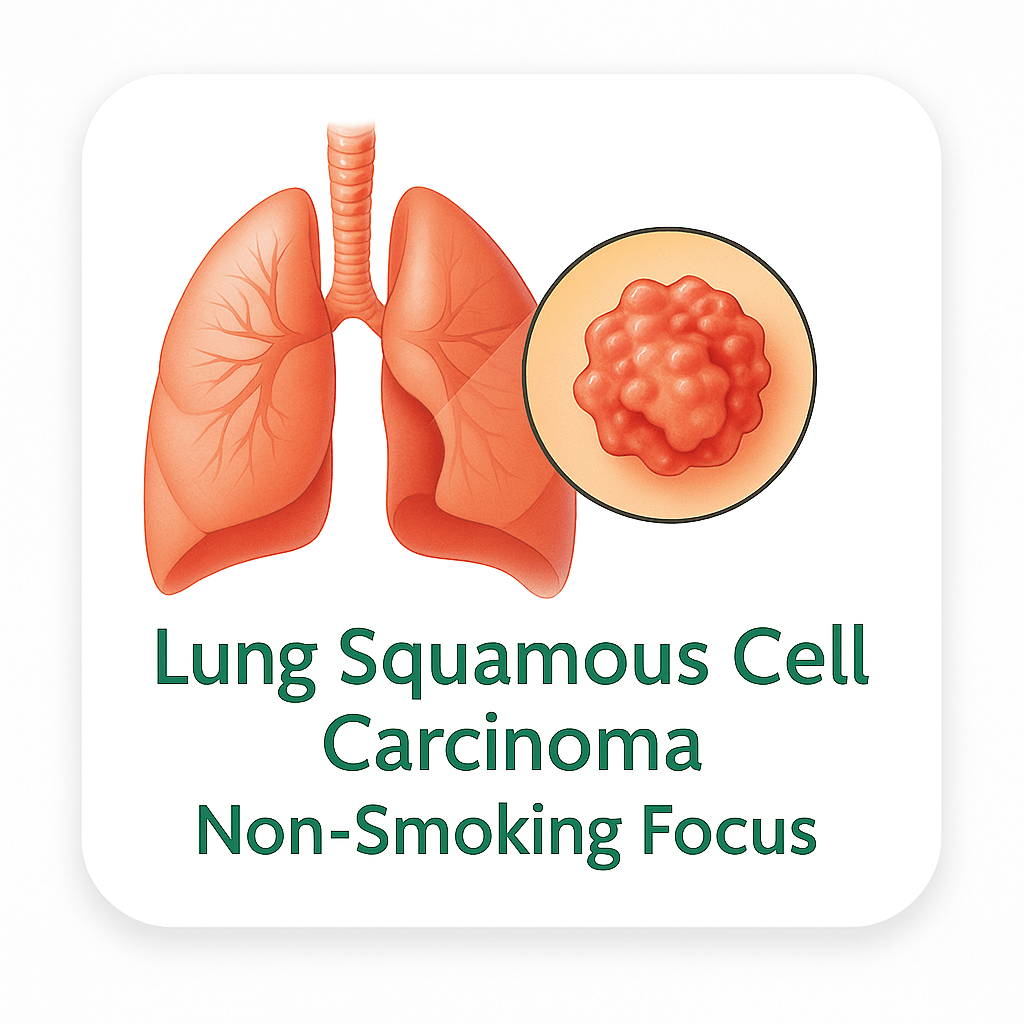
Lung Squamous Cell Carcinoma – Non-Smoking Focus
Main Grouping
Respiratory
Organ System
Lungs
Cell Origin
Squamous epithelial cells
Pathways Affected
Lung squamous cell carcinoma involves a pathway landscape defined by the FGFR/RAS/MAPK pathway (FGFR1 amplification ~20%, the dominant targetable driver in non-smoking LUSC), the SOX2/squamous differentiation transcriptional program (SOX2 amplification ~20-30%), PI3K/AKT/mTOR (PIK3CA/PTEN ~20-35% combined), the NFE2L2/KEAP1/NRF2 antioxidant-resistance pathway (~27% combined NFE2L2+KEAP1), TP53/CDKN2A cell cycle checkpoint disruption (>80%/~40%), and in non-smoking LUSC additionally DDR2/SRC and HER2/ERBB2 pathways.
The FGFR/MAPK pathway is the dominant targetable oncogenic pathway in non-smoking LUSC: FGFR1 (fibroblast growth factor receptor 1) amplification at chromosome 8p12 occurs in approximately 20% of all LUSC and is enriched in never-smoker and light-smoker LUSC relative to heavy smokers; FGFR1 amplification creates elevated FGFR1 kinase surface expression leading to ligand-dependent and ligand-independent FGFR1 kinase activity; FGFR1 signals through RAS/RAF/MEK/ERK (MAPK/ERK pathway), PI3K/AKT, and PLCγ/PKC pathways driving LUSC cell proliferation, survival, and migration; FGFR1 co-amplification with SOX2 at adjacent chromosome regions creates a functionally synergistic oncogenic partnership — SOX2 drives the squamous transcriptional identity while FGFR1 drives kinase-dependent proliferative signaling; quercetin from onions inhibited PLK1 protein in NCI-H520 and NCI-H226 LUSC cell lines confirmed (PMC9810414) — PLK1 (polo-like kinase 1) is a master mitotic kinase activated downstream of the RAS/MAPK proliferative cascade and directly regulated by FGFR1 mitogenic signaling; sulforaphane inhibits FGFR signaling in cancer cell models; EGCG inhibits MAPK/ERK in squamous cell carcinoma models.
The NFE2L2/KEAP1/NRF2 pathway represents the highest-frequency combined alteration unique to LUSC biology among all NSCLC subtypes: NFE2L2 (encoding NRF2) activating mutations occur in approximately 15% of LUSC — at the KEAP1-binding DLG/ETGE motifs preventing KEAP1-dependent ubiquitination and proteasomal degradation of NRF2; KEAP1 inactivating mutations occur in approximately 12% of LUSC — KEAP1 is the Cul3-based E3 ubiquitin ligase adaptor that ubiquitinates NRF2 for proteasomal degradation; combined NFE2L2+KEAP1 mutations create constitutive NRF2 nuclear accumulation and constitutive ARE-driven transcription of antioxidant enzymes (NQO1, GCLM, GCLC, HO-1), detoxification enzymes (GSTs, UGTs), and drug efflux pumps — creating a broad resistance mechanism; sulforaphane from cruciferous vegetables paradoxically activates NRF2 in normal cells through KEAP1 modification but in KEAP1-mutant LUSC acts through NRF2-independent anti-tumor mechanisms; quercetin inhibits NRF2-driven gene expression in KEAP1-null cancer cells; EGCG inhibits NRF2 in cancer cell models.
The SOX2/squamous differentiation transcriptional program is the defining oncogenic transcriptional driver unique to LUSC: SOX2 amplification at chromosome 3q26.33 occurs in approximately 20-30% of LUSC and activates a broad squamous epithelial transcriptional program including TP63/p63 (squamous master transcription factor), KRT5/KRT14 (basal keratins), and proliferative gene networks; SOX2 drives both squamous identity (cell fate) and tumor cell proliferation through cyclin D1, c-Myc, and CDK6 transcriptional targets; quercetin inhibits SOX2 expression and squamous cell proliferation in NSCLC cell models; EGCG inhibits SOX2 expression in cancer cell models; curcumin inhibits SOX2 in squamous cell carcinoma models.
Description
Lung squamous cell carcinoma (LUSC) is the second most common histological subtype of non-small cell lung cancer (NSCLC) after lung adenocarcinoma, representing approximately 25 to 30 percent of all lung cancers globally. In the United States, approximately 50,000 to 60,000 new cases of LUSC are diagnosed annually. Globally, approximately 400,000 to 500,000 new LUSC cases are diagnosed per year. While historically LUSC has been strongly associated with tobacco exposure, approximately 5 to 15 percent of LUSC cases occur in never-smokers or very light smokers — a proportion that is epidemiologically significant given the overall burden of disease. In East Asian populations, the proportion of never-smoker LUSC is higher, approaching 15 to 20 percent.
Non-smoking LUSC has distinct molecular characteristics compared to tobacco-associated LUSC: FGFR1 amplification (~20% of LUSC overall, enriched in never-smokers) replaces the dominant tobacco-mutational signature; DDR2 somatic activating mutations (~4%) occur across smoking strata; PIK3CA mutations are present across all LUSC regardless of smoking history; HER2 mutations are enriched in never-smoker LUSC similar to adenocarcinoma; NFE2L2/KEAP1 mutations disrupt oxidative stress responses; the overall tumor mutational burden is lower in non-smoking LUSC compared to tobacco-associated LUSC (which has 10-12 mutations/Mb from the C→A tobacco signature); the molecular profile of non-smoking LUSC shares more similarity with squamous cell carcinomas of other sites driven by SOX2/3q26 amplification.
The Ann Arbor and TNM (8th edition AJCC/UICC) staging system applies: stage I localized LUSC has 5-year OS of approximately 60-70% with resection; stage II approximately 40-55%; stage III approximately 15-35%; stage IV (metastatic) approximately 5-15%. Because LUSC historically lacked druggable EGFR/ALK/ROS1/KRAS alterations (which are enriched in adenocarcinoma), it has been underserved by precision oncology — making plant phytochemical research in LUSC cell lines especially relevant.
Published laboratory research documents quercetin from onions inhibiting proliferation, migration, and invasion of NCI-H520 and NCI-H226 human lung squamous cell carcinoma cell lines — inducing G2/M phase cell cycle arrest confirmed by flow cytometry; PLK1 (polo-like kinase 1) protein decreased confirmed by Western blot — targeting the PLK1-mediated mitotic regulation relevant to CDKN2A loss (~40% LUSC) and TP53 mutations (>80% LUSC) (PMC9810414).
Plant-Based Description
Whole-food plant-based dietary patterns provide phytochemicals with directly confirmed activity in human lung squamous cell carcinoma cell lines. Quercetin from onions, kale, and apples was confirmed to inhibit proliferation, migration, and invasion of NCI-H520 and NCI-H226 human LUSC cell lines; G2/M cell cycle arrest confirmed by flow cytometry; PLK1 protein decreased with increasing quercetin concentration confirmed by Western blot (PMC9810414) — directly targeting mitotic regulation relevant to TP53 mutations (>80% LUSC) and CDKN2A loss (~40% LUSC) that permit cell cycle entry; sulforaphane from broccoli activates Nrf2 in normal lung epithelium and inhibits FGFR/PI3K signaling in squamous cell carcinoma models; EGCG from green tea inhibits MAPK/ERK and SOX2 in squamous lung cancer models; curcumin from turmeric inhibits NF-kB, PI3K/AKT, and SOX2 in lung squamous cell carcinoma models; apigenin inhibits PI3K/AKT and induces apoptosis in LUSC cell models; resveratrol inhibits MAPK/ERK and FGFR signaling in lung squamous carcinoma models.
Plant Chemistry Detail
Quercetin from onions, kale, and apples has directly confirmed anti-LUSC activity in a published study (PMC9810414 — Lu Y et al., Evidence-Based Complementary and Alternative Medicine, 2022) using NCI-H520 and NCI-H226 human lung squamous cell carcinoma cell lines. In this confirmed study: quercetin inhibited the proliferation of NCI-H520 and NCI-H226 LUSC cell lines confirmed; quercetin inhibited migration and invasion of LUSC cells confirmed; G2/M phase cell cycle arrest was confirmed by flow cytometry in both NCI-H520 and NCI-H226 cells treated with 60 and 120 μM quercetin for 24 hours; PLK1 (polo-like kinase 1) protein expression decreased with increasing quercetin concentration confirmed by Western blot — PLK1 is a serine/threonine kinase essential for bipolar spindle formation, chromosomal segregation, and mitotic exit; PLK1 is directly activated by RAS/MAPK mitogenic signaling from FGFR1 amplification (~20% non-smoking LUSC) and is upregulated downstream of CDK1/cyclin B mitotic entry — quercetin's confirmed PLK1 reduction directly targets the mitotic vulnerability created by CDKN2A loss (~40%) and TP53 loss (>80%) in LUSC cells that cannot properly arrest at G2/M checkpoints without PLK1 inhibition; the protein-protein interaction network analysis confirmed that quercetin targets AKT1, JUN, RELA, CASP3, IL6, and PLK1 as key nodes relevant to LUSC biology — AKT1 connecting to PI3K/AKT pathway active from PIK3CA amplification, RELA connecting to NF-kB constitutive activity in LUSC, and CASP3 connecting to apoptosis.
Sulforaphane from broccoli and cruciferous vegetables inhibits FGFR signaling in cancer cell models and activates Nrf2-driven phase II detoxification in normal bronchial epithelium — relevant to occupational and environmental carcinogen detoxification in non-smoking LUSC arising from radon, asbestos, cooking fumes, and air pollution exposure; sulforaphane inhibits HDAC activity and activates p21/CDKN1A targeting the CDKN2A-deficient cell cycle landscape in LUSC; sulforaphane induces apoptosis and inhibits invasion in lung squamous carcinoma cell models. EGCG from green tea inhibits MAPK/ERK targeting FGFR1-driven RAS/ERK cascade in LUSC; inhibits SOX2 expression targeting the squamous differentiation transcriptional program; inhibits HDAC targeting the epigenetic landscape from KMT2D mutations in LUSC; and inhibits PI3K/AKT targeting PIK3CA amplification in LUSC. Curcumin from turmeric inhibits NF-kB in lung squamous carcinoma cell models; inhibits PI3K/AKT targeting the PIK3CA/PTEN pathway in LUSC; and inhibits SOX2 in squamous carcinoma models. Apigenin from parsley and chamomile inhibits PI3K/AKT and induces caspase-dependent apoptosis in LUSC cell models.
Nutritional Focus
Nutritional focus in lung squamous cell carcinoma research is led by quercetin from onions with directly confirmed anti-LUSC activity: quercetin confirmed to inhibit proliferation, migration, and invasion of NCI-H520 and NCI-H226 human lung squamous cell carcinoma cell lines; G2/M cell cycle arrest confirmed by flow cytometry; PLK1 protein decreased with increasing quercetin concentration confirmed by Western blot (PMC9810414) — directly targeting PLK1-mediated mitotic regulation relevant to TP53 loss (>80%) and CDKN2A loss (~40%) in LUSC that create dependency on PLK1 for mitotic completion; quercetin's confirmed targeting of AKT1, RELA (NF-kB), and CASP3 in LUSC cell network analysis directly addresses PIK3CA amplification (~19%) and constitutive NF-kB in LUSC; sulforaphane from cruciferous vegetables inhibiting FGFR signaling in cancer cell models targeting FGFR1 amplification (~20%) — the primary targetable driver in non-smoking LUSC; sulforaphane activating Nrf2-driven phase II enzymes in normal bronchial epithelium providing detoxification of occupational carcinogens (radon, asbestos, cooking fumes) relevant to non-smoking LUSC etiology; sulforaphane inhibiting HDAC and activating p21/CDKN1A targeting CDKN2A-deficient LUSC cell cycle; EGCG from green tea inhibiting MAPK/ERK targeting FGFR1/RAS/ERK proliferative cascade; EGCG inhibiting SOX2 targeting the 3q26 squamous transcriptional driver; curcumin inhibiting NF-kB, PI3K/AKT, and SOX2 in lung squamous carcinoma models; apigenin from parsley inhibiting PI3K/AKT and inducing caspase-dependent apoptosis in LUSC models targeting PIK3CA amplification; and dietary fiber producing butyrate/SCFAs inhibiting HDAC targeting KMT2D (~16%) and FAT1 epigenetic alterations in LUSC.
Research Notes
LUSC epidemiology: ~50,000-60,000 new US cases/year; ~400,000-500,000 globally; ~25-30% of all lung cancers; non-smoking LUSC ~5-15% of all LUSC; East Asian never-smoker LUSC ~15-20%; 5-year OS stage I ~60-70%; stage II ~40-55%; stage III ~15-35%; stage IV ~5-15%. Histological subtypes: keratinizing (most common), non-keratinizing, basaloid (~5% worst prognosis). IHC: p40+, p63+, CK5/6+, CK14+, SOX2+; TTF-1-, Napsin A-, CK7-. Molecular: TP53 >80% (most frequent); CDKN2A alterations ~40% (homozygous deletion ~20%); SOX2 amplification 3q26 ~20-30%; FGFR1 amplification 8p12 ~20% (enriched non-smokers); PIK3CA amplification/mutation ~19% combined; PTEN loss ~15-20%; NFE2L2 activating mutations ~15%; KEAP1 inactivating mutations ~12% (combined NFE2L2+KEAP1 ~27%); DDR2 mutations ~4%; KMT2D/MLL2 ~16%; FAT1; RB1 ~7%; NOTCH1/2/3 subset; HER2 mutations enriched never-smoker LUSC; CCND1 amplification; MYC amplification; PDGFRA amplification; no pathognomonic driver mutation in non-smoking LUSC equivalent to EGFR/ALK in adenocarcinoma. Quercetin NCI-H520/NCI-H226 LUSC (PMC9810414): proliferation inhibited; migration inhibited; invasion inhibited; G2/M arrest confirmed flow cytometry; PLK1 protein decreased Western blot; AKT1/RELA/CASP3 targeted in PPI network analysis confirmed.
Notes Visibility
Key Foods
Turmeric,Broccoli,Kale,Spinach,Brussels Sprouts,Cauliflower,Garlic,Yellow Onion,Carrot,Tomato,Beetroot,Cabbage,Blueberry,Pomegranate,Grape,Raspberry,Apple,Orange,Lemon,Soybeans,Edamame,Green Lentils,Black Beans,Chickpeas,Brown Rice,Quinoa,Oats,Wild Rice,Black Rice,Walnut,Almond,Brazil Nut,Flaxseed,Pumpkin Seeds,Chia Seeds,Sesame Seeds,Hemp Seeds,Shiitake,Maitake,Lions Mane,Cremini,Portobello,Green Tea,Ginger,Black Pepper,Garlic Powder,Parsley,Rosemary,Oregano, Celery, Leek,Avocado,Artichoke,Endive,Radish,Parsnip,Radicchio,Tangerine, Red Onion
Linked Nutrients
vitamin-c,vitamin-e,vitamin-a,vitamin-b9,vitamin-b6,selenium,zinc,magnesium,calcium,potassium,iron,quercetin,sulforaphane,egcg,curcumin,beta-carotene,anthocyanins,beta-glucans,dietary-fiber,l-theanine
Last Updated
2025-10-13 10:32:44

