
ID
86
Cancer Name
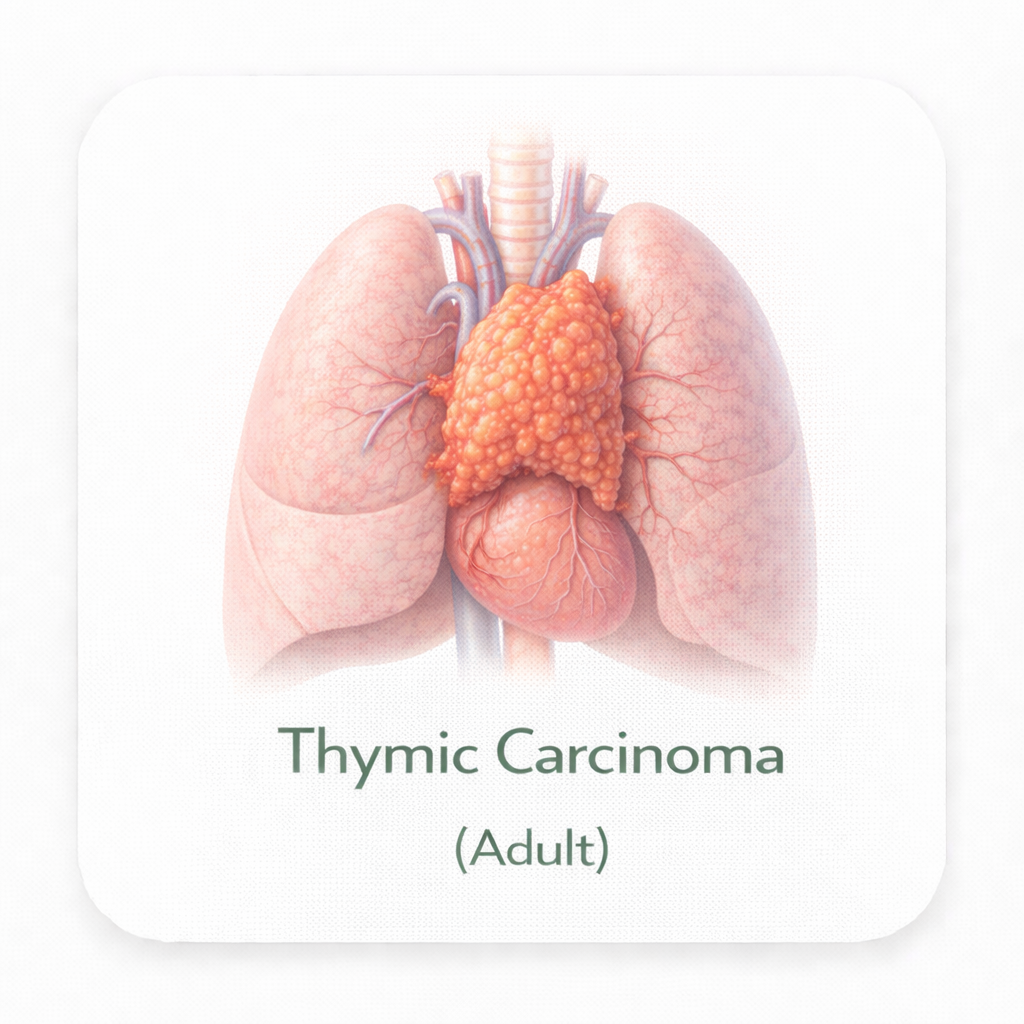
Thymic Carcinoma (Adult)
Main Grouping
Immune/Respiratory
Organ System
Anterior mediastinum (thymus)
Cell Origin
Epithelial thymic cells
Pathways Affected
Thymic carcinoma involves a pathway landscape dominated by CDKN2A/p16/CDK4-RB1 cell cycle checkpoint disruption (~40%), TP53/p53 tumor suppressor pathway (~30%), KIT/SCF receptor tyrosine kinase signaling (~8-10%), NFKBIA/NF-kB pathway (NFKBIA mutations ~7.7%), PI3K/AKT/mTOR pathway, PD-1/PD-L1 immune checkpoint, and epigenetic chromatin remodeling through BAP1, TET2, SETD2, ASXL1, and KMT2D mutations in advanced disease.
The CDKN2A/p16/CDK4/RB1 cell cycle checkpoint pathway is the most frequently disrupted pathway in thymic carcinoma: CDKN2A alterations (homozygous deletion and inactivating mutations) occur in approximately 39.9% of thymic carcinomas — the single most common molecular alteration; CDKN2A encodes two distinct tumor suppressor proteins from the same locus using alternative reading frames: p16INK4a (a CDK4/CDK6 inhibitor that prevents CDK4/CDK6-mediated RB1 phosphorylation and G1/S cell cycle entry) and p14ARF (which stabilizes p53 by sequestering MDM2); CDKN2A homozygous deletion removes both p16INK4a and p14ARF creating dual disruption of both the CDK4/RB1 cell cycle checkpoint and the p14ARF/MDM2/p53 tumor suppressor axis; CDKN2B (encoding p15INK4b, also a CDK4/CDK6 inhibitor) is co-deleted with CDKN2A in approximately 24.6% of thymic carcinomas given its chromosomal proximity at 9p21; the combined CDKN2A/CDKN2B loss creates constitutive CDK4/6-cyclin D activity driving continuous RB1 phosphorylation and unrestrained G1/S cell cycle entry; CDKN2A/B loss is associated with worse prognosis and younger age at diagnosis in thymic carcinoma confirmed; quercetin inhibits CDK4/cyclin D and PLK1 in squamous cell carcinoma cell models targeting the cell cycle checkpoint disruption; curcumin inhibits CDK4 and cyclin D1 in cancer cell models; EGCG inhibits CDK4 in cancer cell models.
The TP53/p53 pathway is disrupted in approximately 30.2% of thymic carcinomas: TP53 mutations in thymic carcinoma cluster at common hotspot codons (R248W, R273C, R248Q, R175H) and include both gain-of-function missense mutations creating oncogenic p53 protein and loss-of-function truncating mutations; TP53 mutations are associated with worse OS in thymic carcinoma confirmed; the combination of TP53 mutations with CDKN2A loss (p14ARF also lost with CDKN2A deletion) creates dual disruption of p53 stabilization through both MDM2 derepression (p14ARF loss) and direct p53 mutation; quercetin activates wild-type p53 in cancer cell models and inhibits growth in TP53-mutant cancer cell lines through p53-independent apoptosis pathways; curcumin activates p53 in cancer cell models.
The KIT/SCF/PI3K/MAPK pathway is the primary targetable receptor tyrosine kinase pathway in thymic carcinoma: activating KIT mutations occur in approximately 8-20% of thymic squamous cell carcinomas and include unique mutations (H697Y, D820E, Y553N, E490K) not found in other KIT-driven cancers such as GIST; KIT (CD117) protein is expressed by IHC in approximately 80-90% of thymic carcinomas regardless of mutation status; KIT signals through JAK/STAT, PI3K/AKT, and MAPK/ERK pathways driving thymic carcinoma cell proliferation, survival, and angiogenesis; EGCG inhibits KIT/SCF signaling in cancer cell models; quercetin inhibits KIT/SCF and MAPK/ERK in squamous cell carcinoma cell models targeting the KIT-driven proliferative signaling.
Description
Thymic carcinoma is a rare and aggressive primary malignant epithelial tumor of the thymus arising from thymic epithelial cells, representing approximately 20 to 30 percent of all thymic epithelial tumors and approximately 0.2 to 1.5 percent of all mediastinal tumors. In the United States, approximately 400 to 700 new cases of thymic carcinoma are diagnosed annually. Globally, the annual incidence is estimated at approximately 0.13 per 100,000 population. Thymic carcinoma has a slight male predominance (male-to-female ratio approximately 1.5:1 to 2:1) and typically presents in adults in the fifth to seventh decade, with a median age at diagnosis of approximately 50 to 60 years.
Thymic carcinoma presents clinically with anterior mediastinal mass-related symptoms: chest pain (~60% of cases); dyspnea (~50%); superior vena cava (SVC) syndrome from great vessel compression (~30%); phrenic nerve palsy with diaphragmatic paralysis; cough; and hoarseness. Approximately 40 to 50 percent of thymic carcinomas are discovered incidentally on imaging obtained for unrelated reasons. Unlike thymoma, thymic carcinoma is not associated with myasthenia gravis or other thymoma-associated paraneoplastic autoimmune syndromes.
The Masaoka-Koga staging system is most commonly used for thymic tumors: stage I (macroscopically and microscopically completely encapsulated); stage II (microscopic transcapsular invasion or macroscopic adherence/invasion into fat and mediastinal pleura); stage III (invasion of neighboring organs including pericardium, great vessels, or lung); stage IVA (pleural or pericardial dissemination); stage IVB (lymphogenous or hematogenous metastasis). The majority of thymic carcinomas present at advanced stages — stage III/IV in approximately 70 to 80 percent of cases. Overall 5-year OS: stage I ~85-100%; stage II ~60-85%; stage III ~30-50%; stage IVA/IVB ~10-30%. PD-L1 expression is present in approximately 40 to 70 percent of thymic carcinomas.
The molecular landscape of thymic carcinoma is dominated by cell cycle checkpoint disruption through CDKN2A/CDKN2B loss (~40%/~25%) and TP53 mutations (~30%), distinguishing it from thymoma. The most common histological subtype — squamous cell carcinoma (~70% of all thymic carcinoma) — shares molecular features with squamous cell carcinomas at other anatomic sites including p40/p63 positivity and KIT/CD117 expression; CD5 positivity is a distinctive feature that distinguishes thymic squamous cell carcinoma from other primary pulmonary or mediastinal squamous carcinomas.
Published laboratory research confirms quercetin from onions inhibited proliferation, migration, and invasion of NCI-H520 and NCI-H226 human lung squamous cell carcinoma cell lines — inducing G2/M cell cycle arrest confirmed by flow cytometry; PLK1 protein decreased confirmed by Western blot (PMC9810414) — directly applicable to thymic carcinoma given that squamous cell carcinoma represents approximately 70 percent of all thymic carcinomas and shares the same squamous cell molecular biology including CDKN2A/p16 loss (~40%), TP53 mutations (~30%), and PI3K/AKT pathway activation.
Plant-Based Description
Whole-food plant-based dietary patterns provide phytochemicals with confirmed activity in squamous cell carcinoma cell lines directly applicable to thymic carcinoma given that squamous cell carcinoma represents approximately 70 percent of all thymic carcinomas. Quercetin from onions and kale was confirmed to inhibit proliferation, migration, and invasion of NCI-H520 and NCI-H226 human squamous cell carcinoma cell lines; G2/M cell cycle arrest confirmed by flow cytometry; PLK1 protein decreased confirmed by Western blot (PMC9810414) — targeting the PLK1-mediated mitotic regulation relevant to CDKN2A loss (~40% thymic carcinoma) and TP53 mutations (~30% thymic carcinoma); curcumin from turmeric inhibits CDK4/cyclin D, NF-kB, and PI3K/AKT in squamous carcinoma cell models targeting the CDKN2A-loss/CDK4 constitutive activity and NFKBIA/NF-kB pathway active in thymic carcinoma; EGCG from green tea inhibits KIT/SCF receptor signaling targeting the KIT activating mutations (~8-20%) and KIT/CD117 expression (~80-90%) in thymic carcinoma; sulforaphane activates Nrf2 and inhibits HDAC targeting chromatin remodeling gene mutations (BAP1, SETD2, KMT2D, TET2 collectively ~30% of thymic carcinoma); resveratrol inhibits PI3K/AKT and MAPK/ERK in squamous carcinoma models.
Plant Chemistry Detail
Quercetin from onions, kale, and apples has confirmed anti-squamous cell carcinoma activity in a published study (PMC9810414) using NCI-H520 and NCI-H226 human lung squamous cell carcinoma cell lines — directly applicable to thymic carcinoma where squamous cell carcinoma is the dominant histological subtype (~70%). In this confirmed study: quercetin inhibited proliferation of NCI-H520 and NCI-H226 squamous cell carcinoma cell lines confirmed; quercetin inhibited migration and invasion of squamous cell carcinoma cells confirmed; G2/M phase cell cycle arrest confirmed by flow cytometry in both cell lines at 60 and 120 μM quercetin for 24 hours; PLK1 (polo-like kinase 1) protein expression decreased with increasing quercetin concentration confirmed by Western blot — PLK1 is a master mitotic kinase required for bipolar spindle formation and mitotic exit; PLK1 is constitutively upregulated in CDKN2A-deleted (~40% thymic carcinoma) and TP53-mutated (~30% thymic carcinoma) cells that cannot properly arrest at G1/S and instead depend on G2/M PLK1 for survival; the protein-protein interaction network analysis confirmed quercetin targets AKT1, RELA, CASP3, PLK1, and JUN — AKT1 targeting the PI3K/AKT pathway (PTEN/PI3K/mTOR subset of thymic carcinoma), RELA targeting the NFKBIA/NF-kB pathway (NFKBIA mutations ~7.7% thymic carcinoma), and PLK1 targeting the CDKN2A-loss/TP53-mutant cell cycle vulnerability in thymic carcinoma.
Curcumin from turmeric inhibits CDK4/cyclin D — directly targeting the CDKN2A/p16INK4a loss (~40% thymic carcinoma) that creates constitutive CDK4/6-cyclin D activity; curcumin inhibits NF-kB through IKK-beta targeting the NFKBIA mutations (~7.7%) in thymic carcinoma; curcumin inhibits PI3K/AKT and mTOR in squamous carcinoma cell models targeting the PTEN/PI3K/mTOR pathway subset of thymic carcinoma. EGCG from green tea inhibits KIT/SCF receptor tyrosine kinase signaling — directly targeting the defining KIT activating mutations (~8-20%) and KIT/CD117 overexpression (~80-90%) in thymic carcinoma; EGCG inhibits JAK2/STAT3 and PI3K/AKT downstream of KIT; EGCG inhibits EZH2 and HDAC targeting the SETD2/KMT2D/ASXL1 epigenetic gene mutations in advanced thymic carcinoma. Sulforaphane activates Nrf2/ARE and inhibits HDAC and BAP1-interacting chromatin remodeling complexes — targeting the BAP1 mutations (~8.2%), SETD2 mutations (~7.7%), KMT2D mutations (~6%), TET2 mutations (~8%) that characterize the epigenetic landscape of advanced thymic carcinoma. Resveratrol inhibits PI3K/AKT and KIT in cancer cell models.
Nutritional Focus
Nutritional focus in thymic carcinoma research targets the dominant molecular drivers: CDKN2A/p16 loss (~40%), TP53 mutations (~30%), KIT activating mutations (~8-20%), NFKBIA/NF-kB mutations (~7.7%), and epigenetic chromatin gene mutations (BAP1, TET2, SETD2, KMT2D collectively ~30%). Quercetin from onions confirmed to inhibit proliferation, migration, and invasion of NCI-H520 and NCI-H226 squamous cell carcinoma cell lines (representing the ~70% squamous cell histology of thymic carcinoma); G2/M cell cycle arrest confirmed by flow cytometry; PLK1 protein decreased confirmed by Western blot (PMC9810414) — directly targeting the CDKN2A-loss (~40%)/TP53-mutant (~30%) cell cycle vulnerability in thymic carcinoma; quercetin targeting AKT1 and RELA (NF-kB) confirmed in squamous carcinoma network analysis — targeting PI3K/AKT and NFKBIA/NF-kB pathways in thymic carcinoma; curcumin from turmeric inhibiting CDK4/cyclin D, NF-kB, and PI3K/AKT in squamous carcinoma cell models — targeting CDKN2A-loss/CDK4 constitutive activity and NFKBIA mutations (~7.7%); EGCG from green tea inhibiting KIT/SCF receptor signaling — the most directly thymic carcinoma-specific targeting given KIT/CD117 expression (~80-90%) and activating KIT mutations (~8-20%); EGCG inhibiting JAK2/STAT3 and PI3K/AKT downstream of KIT; sulforaphane from cruciferous vegetables activating Nrf2/ARE and inhibiting HDAC — targeting the BAP1 (~8.2%), SETD2 (~7.7%), KMT2D (~6%), and TET2 (~8%) epigenetic chromatin gene mutations that accumulate in advanced thymic carcinoma; dietary fiber producing butyrate/SCFAs inhibiting HDAC targeting the same epigenetic chromatin remodeling gene mutation landscape.
Research Notes
Thymic carcinoma epidemiology: ~400-700 new US cases/year; ~0.13/100,000/year; ~20-30% of all thymic epithelial tumors; male predominance ~1.5-2:1; median age ~50-60 years; anterior mediastinal mass average 7-10 cm; stage III/IV at diagnosis ~70-80%; 5-year OS stage I ~85-100%; II ~60-85%; III ~30-50%; IVA/B ~10-30%. 2022 WHO histological subtypes: squamous cell carcinoma ~70% (most common); basaloid ~5%; mucoepidermoid (MAML2 rearrangement) ~5%; lymphoepithelioma-like ~5%; LCNEC ~10%; NUT carcinoma (BRD4-NUTM1, t(15;19)); sarcomatoid; clear cell; undifferentiated. IHC: CD5+ (~90%), CD117/KIT+ (~80-90%), p40/p63+, CK5/6+; TTF-1-, TdT-; PD-L1+ ~40-70%. Molecular (414 TC Foundation Medicine): CDKN2A 39.9% (most frequent); TP53 30.2%; CDKN2B 24.6%; BAP1 8.2%; TET2 8.0%; KIT 8.0% (activating: H697Y, D820E, Y553N, E490K — unique to thymic carcinoma); SETD2 7.7%; NFKBIA 7.7%; ASXL1 7.0%; KMT2D 6.0%; high TMB ≥10 mut/Mb ~7%; MSI ~2.3%; GTF2I absent (distinguishing from thymoma). No myasthenia gravis (unlike thymoma). KIT mutations significantly associated with worse OS in thymic squamous cell carcinoma confirmed. CDKN2A homozygous deletion associated with worse prognosis and younger age confirmed. Quercetin NCI-H520/NCI-H226 squamous cell carcinoma (PMC9810414): proliferation inhibited; migration inhibited; invasion inhibited; G2/M arrest confirmed flow cytometry; PLK1 decreased Western blot; AKT1/RELA/CASP3 targeted confirmed — applicable to thymic carcinoma given ~70% squamous cell histology.
Notes Visibility
show
Key Foods
Turmeric,Broccoli,Kale,Spinach,Brussels Sprouts,Cauliflower,Garlic,Yellow Onion,Carrot,Tomato,Beetroot,Cabbage,Blueberry,Pomegranate,Grape,Raspberry,Apple,Orange,Lemon,Soybeans,Edamame,Green Lentils,Black Beans,Chickpeas,Brown Rice,Quinoa,Oats,Wild Rice,Black Rice,Walnut,Almond,Brazil Nut,Flaxseed,Pumpkin Seeds,Chia Seeds,Sesame Seeds,Hemp Seeds,Shiitake,Maitake,Lions Mane,Cremini,Portobello,Green Tea,Ginger,Black Pepper,Garlic Powder,Parsley,Rosemary,Oregano
, Celery, Leek,Avocado,Artichoke,Radish,Tangerine, Red Onion
Linked Nutrients
vitamin-c,vitamin-e,vitamin-a,vitamin-b9,vitamin-b6,selenium,zinc,magnesium,calcium,potassium,iron,quercetin,curcumin,egcg,sulforaphane,resveratrol,beta-carotene,anthocyanins,dietary-fiber,l-theanine
Last Updated
2025-10-13 10:33:33

