
ID
87
Cancer Name
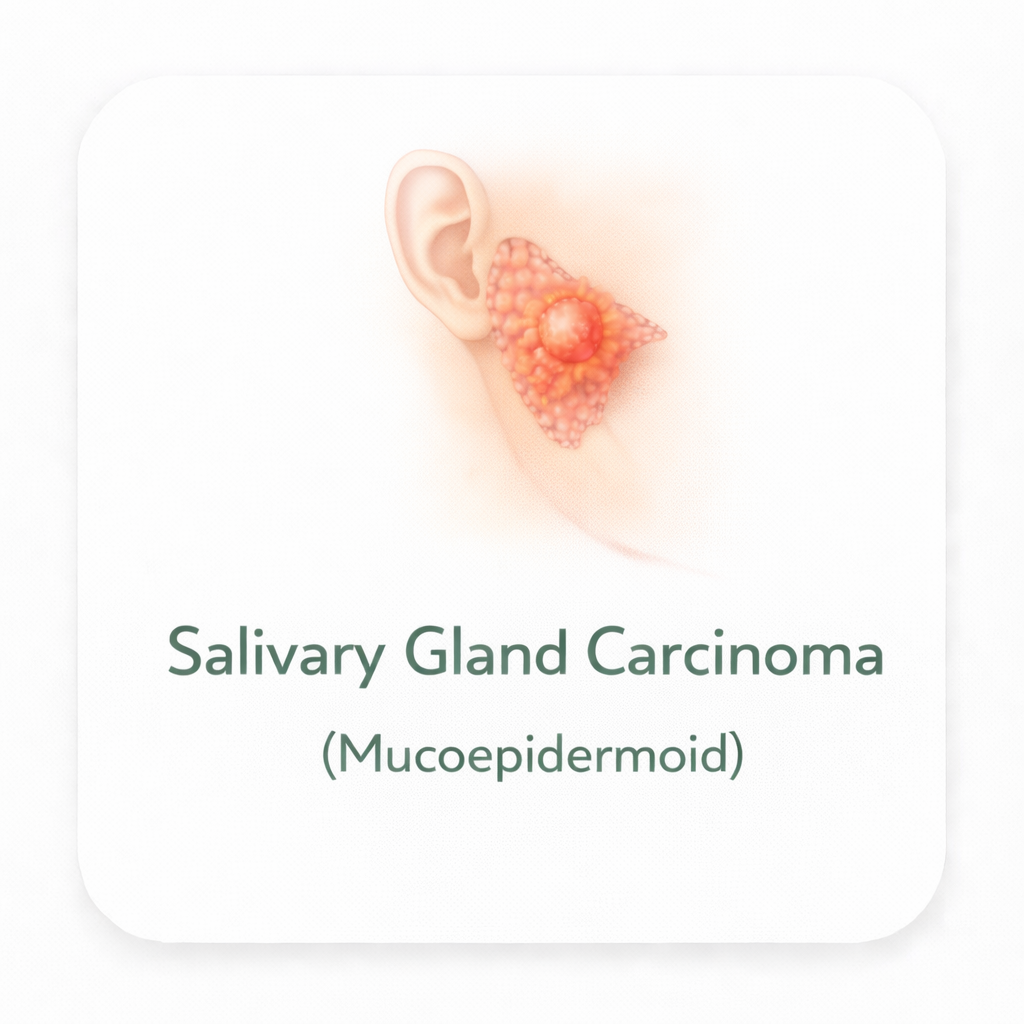
Salivary Gland Carcinoma (Mucoepidermoid)
Main Grouping
Digestive/Head & Neck
Organ System
Parotid/submandibular/sublingual glands
Cell Origin
Epithelial (mucoepidermoid)
Pathways Affected
Mucoepidermoid carcinoma involves a pathway landscape uniquely defined by the CRTC1-MAML2 fusion/CREB/AREG-EGFR autocrine signaling axis (~42-80% of MEC), Notch signaling coactivated by the MAML2 fusion domain, EGFR/PI3K/AKT/MAPK/ERK pathway (~73-90% EGFR overexpression), and in high-grade/fusion-negative MEC additionally CDKN2A/TP53 cell cycle checkpoint disruption.
The CRTC1-MAML2 fusion/CREB transcriptional pathway is the defining oncogenic mechanism of the majority of MEC: the CRTC1-MAML2 fusion protein consists of the 42-amino acid CREB-binding domain (CBD) of CRTC1 at the N-terminus (which constitutively recruits the CREB transcription factor) fused to the 981-amino acid transcriptional activation domain (TAD) of MAML2 at the C-terminus; the CRTC1 CBD normally interacts with CREB only transiently when CRTC1 is dephosphorylated in response to cAMP/PKA signaling — in the CRTC1-MAML2 fusion protein, the CRTC1 CBD is constitutively active because the regulatory phosphorylation sites on full-length CRTC1 (that normally sequester CRTC1 in the cytoplasm) are absent; constitutive CREB activation by the CRTC1-MAML2 fusion drives transcription of AREG (amphiregulin — an EGFR ligand), LINC00473 (a lncRNA essential for MEC cell growth), and other CREB target genes; the CRTC1-MAML2 fusion additionally interacts with and activates MYC (through the MYC MAX interaction domain) driving MYC-dependent metabolic reprogramming and ribosome biogenesis; the fusion also activates AP-1 transcription (JUN/JUNB/FOS family); quercetin inhibits CREB activity and MYC in cancer cell models — targeting the constitutive CREB/AREG transcription driving EGFR autocrine loop; curcumin inhibits CREB and MYC in cancer cell models.
The AREG-EGFR/PI3K/AKT autocrine signaling pathway is the primary proliferative survival pathway downstream of the CRTC1-MAML2 fusion in MEC: AREG (amphiregulin) is upregulated by the CRTC1-MAML2 fusion through constitutive CREB transcriptional activation — AREG is secreted by MEC cells and binds EGFR on the same cell (autocrine) and neighboring cells (paracrine) creating constitutive EGFR kinase activation; EGFR is overexpressed in approximately 73 to 90 percent of MEC tumors regardless of grade; constitutive EGFR kinase activation drives PI3K/AKT (p85/p110 heterodimer recruitment to phosphorylated EGFR Y1068/Y1086 creating PIP3 and AKT activation) and MAPK/ERK (GRB2/SOS1/RAS/RAF/MEK/ERK cascade) proliferative signaling; quercetin was confirmed to inhibit EGFR/PI3K/Akt pathway-mediated cell growth in EGFR-overexpressing HSC-3 oral cancer cell line (prior study referenced in PMC4980310) and confirmed to inhibit migration and invasion in EGFR-overexpressing HSC-3 and FaDu HNSCC cells at 10 μM (PMC4980310) — directly targeting the AREG-EGFR autocrine loop of CRTC1-MAML2-positive MEC; curcumin from turmeric inhibits EGFR in head and neck carcinoma cell models; EGCG from green tea inhibits EGFR through direct binding and inhibits PI3K/AKT in head and neck carcinoma models.
The Notch signaling pathway is activated by the MAML2 domain of the CRTC1-MAML2 fusion: MAML2 is a transcriptional coactivator of the Notch intracellular domain (NICD) — the transcriptionally active form of Notch released by gamma-secretase cleavage; the MAML2 domain in the CRTC1-MAML2 fusion protein retains the ability to coactivate Notch transcription through NICD/CSL (RBPJ) transcriptional complexes; constitutive Notch coactivation through MAML2 maintains MEC cancer stem-like cells (CSCs) — the subpopulation of MEC cells that drive tumor recurrence and therapeutic resistance; quercetin inhibits Notch-1 and Notch signaling in cancer cell models targeting the MAML2 fusion-driven Notch coactivation in MEC; EGCG and resveratrol inhibit Notch signaling in cancer cell models.
Description
Mucoepidermoid carcinoma (MEC) is the most common malignant salivary gland tumor, representing approximately 30 to 40 percent of all salivary gland malignancies. In the United States, approximately 3,000 to 5,000 new cases of salivary gland cancer are diagnosed annually, with MEC comprising the largest single histological category. Globally, MEC represents an estimated annual incidence of approximately 1.0 to 1.5 per 100,000 population for all salivary gland cancers. MEC is the most common salivary gland malignancy in children and young adults — the CRTC1-MAML2 fusion is found in approximately 82 percent of MEC patients under 30 years of age and is enriched in young female patients, explaining the relatively younger age distribution of fusion-positive MEC compared to fusion-negative high-grade cases which tend to occur in older adults.
MEC is characterized by a wide spectrum of clinical behavior defined primarily by histological grade: low-grade MEC (AFIP grade 1, Brandwein grade 1) is predominantly cystic, has abundant mucin-producing cells, low mitotic activity, and is almost always cured by complete surgical excision with 5-year OS approaching 95-100%; intermediate-grade MEC (grade 2) has mixed solid and cystic architecture with intermediate cell predominance and 5-year OS approximately 70-85%; high-grade MEC (grade 3) is predominantly solid, mitotically active, minimally cystic, frequently shows perineural invasion and lymph node metastasis, and has 5-year OS approximately 30-50%; the lung is the most common site of distant metastasis (~40% of cases with distant disease).
The pathognomonic CRTC1-MAML2 translocation t(11;19) is the defining molecular feature of the majority of MEC: the CRTC1-MAML2 fusion protein constitutively activates CREB-regulated transcription (normally activated transiently by cAMP/PKA signaling) creating a constitutively active cAMP/CREB transcriptional program; this drives upregulation of AREG (amphiregulin, an EGFR ligand) creating an autocrine AREG-EGFR signaling loop that maintains MEC cell growth; EGFR is overexpressed in approximately 73 to 90 percent of MEC regardless of grade; additionally the MAML2 domain activates Notch transcriptional coactivation and the fusion interacts with MYC and AP-1 creating multiple converging oncogenic transcriptional programs; CRTC1-MAML2-positive MEC has a favorable prognosis (combined odds ratio for decreased risk of death 0.08 vs fusion-negative, confirmed by systematic review and meta-analysis) while fusion-negative high-grade MEC with CDKN2A deletions has the worst prognosis.
Published laboratory research confirms quercetin from onions inhibited cell migration and invasion in EGFR-overexpressing HSC-3 and FaDu human head and neck carcinoma cell lines at 10 μM; inhibited colony growth in 3D Matrigel confirmed; inhibited the EGFR/PI3K/Akt pathway confirmed (PMC4980310) — directly targeting EGFR overexpression (~73-90% of MEC) and the CRTC1-MAML2/AREG-EGFR autocrine loop that is the primary oncogenic mechanism in fusion-positive MEC.
Plant-Based Description
Whole-food plant-based dietary patterns provide phytochemicals with confirmed activity in EGFR-overexpressing head and neck carcinoma cell lines directly applicable to mucoepidermoid carcinoma. Quercetin from onions and kale was confirmed to suppress cell migration and invasion in EGFR-overexpressing HSC-3 and FaDu human head and neck carcinoma cell lines at 10 μM — inhibiting colony growth in 3D Matrigel confirmed; inhibiting the EGFR/PI3K/Akt pathway confirmed (PMC4980310) — directly targeting EGFR overexpression (~73-90% of MEC) and the CRTC1-MAML2/AREG-EGFR autocrine signaling loop that drives MEC cell growth and survival; quercetin also inhibits Notch-1 targeting the MAML2 fusion-driven Notch coactivation in MEC; curcumin from turmeric inhibits EGFR, CREB, MYC, PI3K/AKT, and NF-kB in head and neck carcinoma cell models targeting multiple CRTC1-MAML2 fusion downstream pathways; EGCG from green tea inhibits EGFR, Notch, and PI3K/AKT in head and neck cancer models; sulforaphane activates Nrf2 and inhibits HDAC targeting the BAP1/CDKN2A epigenetic alterations in high-grade MEC; apigenin inhibits EGFR, CREB, and induces apoptosis in head and neck carcinoma models.
Plant Chemistry Detail
Quercetin from onions, kale, and apples has confirmed activity against EGFR-overexpressing head and neck carcinoma cell lines in a published study (PMC4980310 — "Quercetin suppresses cellular migration and invasion in human head and neck squamous cell carcinoma") directly applicable to MEC where EGFR is overexpressed in approximately 73 to 90 percent of tumors and EGFR autocrine signaling through AREG is the primary oncogenic mechanism downstream of the defining CRTC1-MAML2 fusion. In this confirmed study: quercetin at 10 μM (half-concentration of IC50) suppressed cell migration confirmed in HSC-3 and FaDu EGFR-overexpressing HNSCC cells; quercetin suppressed cell invasion confirmed in both cell lines; quercetin inhibited colony growth of HSC-3 cells embedded in 3D Matrigel matrix confirmed — representing a more physiologically relevant model of solid tumor growth; the authors confirmed and cross-referenced quercetin as a potent inhibitor of the EGFR/PI3K/Akt pathway in HSC-3 EGFR-overexpressing oral cancer cells (confirmed in their prior published study); MMP-9 and MMP-2 matrix metalloproteinase activities were reduced by quercetin treatment confirmed — targeting the invasive extracellular matrix remodeling relevant to high-grade MEC perineural invasion and lymphovascular invasion; quercetin inhibited FAK (focal adhesion kinase) confirmed — FAK integrates EGFR signaling with cytoskeletal migration machinery; quercetin inhibited PKCδ/ERK/AP-1-dependent MMP-9 activation confirmed — AP-1 (JUN/FOS) is also directly activated by the CRTC1-MAML2 fusion in MEC cells creating a convergent AP-1 target in both fusion-positive and fusion-negative MEC.
Curcumin from turmeric inhibits EGFR signaling in head and neck carcinoma cell models — directly targeting the AREG-EGFR autocrine loop (~73-90% EGFR overexpression in MEC); curcumin inhibits CREB transcriptional activity targeting the CRTC1-MAML2 constitutive CREB activation; curcumin inhibits MYC targeting the CRTC1-MAML2/MYC interaction; curcumin inhibits NF-kB in head and neck carcinoma cell models; curcumin inhibits PI3K/AKT targeting the PIK3CA mutations (~16.9% advanced MEC) and PTEN loss (~7.6%). EGCG from green tea inhibits EGFR through direct binding to the extracellular domain; inhibits PI3K/AKT; inhibits Notch signaling — targeting the MAML2-driven Notch coactivation maintaining MEC cancer stem cells; inhibits HDAC targeting the BAP1/ARID1A epigenetic chromatin remodeling gene alterations in MEC. Sulforaphane from cruciferous vegetables activates Nrf2/ARE and inhibits HDAC — targeting the CDKN2A promoter hypermethylation and BAP1 chromatin remodeling disruptions in high-grade MEC; sulforaphane induces p21/CDKN1A targeting CDKN2A-deleted (~40-52%) MEC cell cycle vulnerability. Apigenin inhibits EGFR, CREB, and STAT3 in head and neck carcinoma models.
Nutritional Focus
Nutritional focus in mucoepidermoid carcinoma targets the CRTC1-MAML2/AREG-EGFR autocrine axis — the defining oncogenic mechanism in ~42-80% of MEC — with EGFR overexpressed in ~73-90% of all MEC. Quercetin from onions confirmed to suppress cell migration and invasion in EGFR-overexpressing HSC-3 and FaDu head and neck carcinoma cells at 10 μM; inhibited colony growth in 3D Matrigel confirmed; inhibited EGFR/PI3K/Akt pathway confirmed (PMC4980310) — directly targeting EGFR overexpression (~73-90%) and the CRTC1-MAML2/AREG-driven EGFR autocrine loop; quercetin inhibiting FAK, PKCδ/ERK, MMP-9/MMP-2, and AP-1 confirmed — targeting the invasive program relevant to high-grade MEC perineural invasion and the CRTC1-MAML2/AP-1 direct activation; quercetin inhibiting Notch-1 targeting the MAML2 fusion-driven Notch coactivation maintaining MEC cancer stem cells; curcumin from turmeric inhibiting EGFR, CREB, MYC, PI3K/AKT, and NF-kB in head and neck carcinoma cell models targeting CRTC1-MAML2 downstream programs; EGCG from green tea inhibiting EGFR, Notch, PI3K/AKT, and HDAC in head and neck cancer models targeting both the AREG-EGFR loop and the MAML2-Notch stem cell maintenance pathway; sulforaphane activating Nrf2/ARE and inhibiting HDAC — targeting the BAP1 mutations (~18.6% advanced MEC, most common non-fusion mutation) and CDKN2A promoter hypermethylation (~40-52% of advanced MEC); sulforaphane inducing p21/CDKN1A targeting CDKN2A-deleted MEC cell cycle vulnerability; dietary fiber producing butyrate/SCFAs inhibiting HDAC targeting the BAP1/ARID1A epigenetic chromatin gene alterations in MEC.
Research Notes
MEC epidemiology: most common malignant salivary gland tumor ~30-40% of all salivary gland malignancies; ~3,000-5,000 new US salivary gland cancer cases/year (MEC ~largest single category); parotid gland ~40-45%; minor salivary glands ~45-50% (palate most common intraoral site); female predominance in young patients; median age 40-50 years but bimodal (young CRTC1-MAML2 fusion-positive patients and older high-grade fusion-negative); AFIP grading: grade 1 (low) 5-year OS ~95-100%; grade 2 (intermediate) ~70-85%; grade 3 (high) ~30-50%; distant metastasis ~10-15% predominantly lungs. 2022 WHO histological criteria: three cell types — epidermoid, mucin-secreting, intermediate. IHC: CK5/6+, CK7+, p40+, p63+, MUC5AC+, EGFR+ ~73-90%. Molecular: CRTC1-MAML2 fusion t(11;19) ~42-80% (more in low/intermediate grade, young patients, favorable prognosis); CRTC3-MAML2 ~5%; fusion-negative = worse prognosis; CRTC1-MAML2 drives constitutive CREB activation → AREG upregulation → EGFR autocrine loop; MAML2 domain activates Notch coactivation → MEC cancer stem cells; fusion also activates MYC and AP-1. Advanced MEC molecular (118 cases Foundation Medicine FoundationOne CDx): CDKN2A ~52.5%; CDKN2B ~30.5%; TP53 ~40.7%; BAP1 ~18.6% (most common non-fusion mutation in 454-case Chinese cohort also); PIK3CA ~16.9%; TERT ~15%; PTEN ~7.6%; MET ~8%; KRAS ~6.9%; HRAS ~2%; FBXW7. CRTC1-MAML2 + CDKN2A deletion = poor prognosis despite fusion positivity. CRTC1-MAML2 + TP53/FBXW7 cooccurrence = unfavorable prognosis. Systematic review/meta-analysis confirmed CRTC1-MAML2 translocation-positive = decreased risk of death (combined OR 0.08, p<0.00001). Quercetin HSC-3/FaDu HNSCC EGFR-overexpressing (PMC4980310): migration suppressed; invasion suppressed; colony formation inhibited in 3D Matrigel; EGFR/PI3K/Akt inhibited; FAK inhibited; MMP-9/MMP-2 reduced; PKCδ/ERK/AP-1 inhibited confirmed.
Notes Visibility
show
Key Foods
Turmeric,Broccoli,Kale,Spinach,Brussels Sprouts,Cauliflower,Garlic,Yellow Onion,Carrot,Tomato,Beetroot,Cabbage,Blueberry,Pomegranate,Grape,Raspberry,Apple,Orange,Lemon,Soybeans,Edamame,Green Lentils,Black Beans,Chickpeas,Brown Rice,Quinoa,Oats,Wild Rice,Black Rice,Walnut,Almond,Brazil Nut,Flaxseed,Pumpkin Seeds,Chia Seeds,Sesame Seeds,Hemp Seeds,Shiitake,Maitake,Lions Mane,Cremini,Portobello,Green Tea,Ginger,Black Pepper,Garlic Powder,Parsley,Rosemary,Oregano, Celery, Fennel, Leek,Avocado,Artichoke,Radish,Tangerine, Red Onion
Linked Nutrients
vitamin-c,vitamin-e,vitamin-a,vitamin-b9,vitamin-b6,selenium,zinc,magnesium,calcium,potassium,iron,quercetin,curcumin,egcg,sulforaphane,beta-carotene,anthocyanins,dietary-fiber,l-theanine,allicin
Last Updated
2025-10-13 10:33:33

