
ID
88
Cancer Name
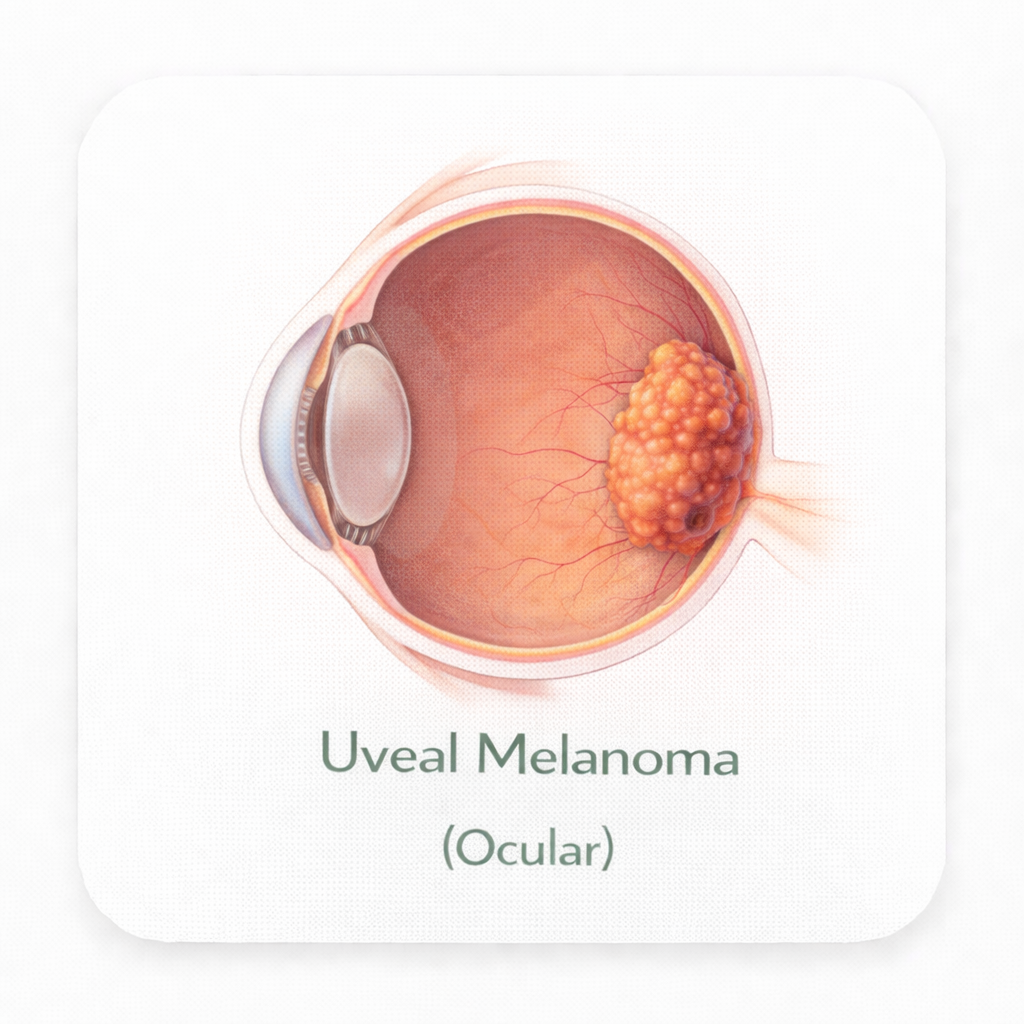
Uveal Melanoma (Ocular)
Main Grouping
Ophthalmologic
Organ System
Eye (iris/ciliary body/choroid)
Cell Origin
Melanocytes (uveal)
Pathways Affected
The dominant initiating pathway in uveal melanoma is constitutive activation of the Gαq/11 signaling axis through GNAQ and GNA11 mutations. Mutant Gα proteins stimulate phospholipase C-beta (PLCβ), generating inositol triphosphate (IP3) and diacylglycerol (DAG), activating protein kinase C (PKC), which sequentially phosphorylates Raf, MEK1/2, and ERK1/2, driving cyclin D1 overexpression and uncontrolled cell cycle progression through the MAPK/ERK pathway. Simultaneously, GNAQ/GNA11 mutations activate the PI3K/AKT/mTOR pathway, promoting MDM2 upregulation, p53 pathway inhibition, and anti-apoptotic survival signaling. The Hippo-YAP pathway is dysregulated through a Trio-RhoGTPase/RhoA/Rac1 circuit downstream of mutant Gα proteins, leading to nuclear localization of YAP1 and transcriptional activation of proliferative gene programs. BAP1 inactivation, the primary event driving metastatic progression, disrupts chromatin remodeling, histone deubiquitination, and DNA repair coordination, with documented downstream activation of epithelial-mesenchymal transition (EMT) signaling. The NF-κB pathway is activated in uveal melanoma, driving pro-inflammatory cytokine secretion including IL-8 and promoting invasion and angiogenesis via VEGF signaling. The p53 tumor suppressor pathway is impaired by MDM2 overexpression and Bcl-2 deregulation. The apoptosis pathway is suppressed through elevated Bcl-2 and Bcl-xL expression, while autophagy and DNA repair mechanisms are also dysregulated. Retinal oxidative stress and hypoxia-driven HIF-1α response pathways are active in the intraocular tumor microenvironment.
mapk-erk-pathway, pi3k-akt-pathway, hippo-signaling, nfkb-pathway, apoptosis-pathway, mtorc1-signaling, wnt-beta-catenin-pathway, emt-signaling, angiogenesis-vegf-signaling, p53-tumor-suppressor-pathway, autophagy, dna-repair, hypoxia-hif1-response, retinal-oxidative-stress, nrf2-antioxidant-response, foxo-signaling
Description
Uveal melanoma (UM) is the most common primary intraocular malignant tumor in adults, arising from melanocytes located within the uveal tract of the eye, which includes the choroid, ciliary body, and iris. The choroid is the site of origin in approximately 90% of cases, with an incidence of approximately 5–7 cases per million per year in the United States and Western countries. Unlike cutaneous melanoma, uveal melanoma does not arise from sun-exposed skin and is molecularly and biologically distinct, with a completely different driver mutation profile. It is classified as a rare cancer and differs substantially from cutaneous melanoma in its etiology, molecular characteristics, and clinical behavior.
The molecular hallmark of uveal melanoma is the presence of activating mutations in GNAQ and GNA11, encoding G-protein alpha subunits, found in more than 80–90% of all cases. These mutations are considered early initiating events and result in constitutive activation of downstream signaling cascades including the MAPK/ERK pathway, the PI3K/AKT/mTOR axis, and the Hippo-YAP pathway via a Trio-RhoGTPase/RhoA/Rac1 signaling circuit. Secondary driver mutations in BAP1, SF3B1, and EIF1AX carry strong prognostic significance. BAP1 loss, commonly associated with monosomy of chromosome 3, is found in approximately 45–50% of tumors and confers a markedly elevated risk of distant metastasis, predominantly to the liver. SF3B1 mutations are associated with intermediate prognosis, while EIF1AX mutations generally indicate a favorable outcome.
Despite effective primary tumor management by radiation therapy or surgical enucleation, approximately 40–50% of patients develop metastatic disease, primarily affecting the liver, and median survival following hepatic metastasis is typically less than one year. This poor metastatic prognosis underscores the critical need to understand the molecular pathways driving uveal melanoma progression, invasion, and immune evasion. Chromosomal alterations, particularly monosomy 3 and amplification of chromosome 8q, are strong prognostic indicators that influence metastatic risk independent of clinical parameters.
Epidemiologically, uveal melanoma predominantly affects individuals of European ancestry, with blue or grey iris color identified as a risk factor. The disease affects men and women at approximately equal rates and most commonly presents in the fifth and sixth decades of life. Ocular melanocytosis and familial BAP1 mutation syndromes are recognized predisposing conditions. Diagnosis is established by ophthalmoscopic examination and confirmed by ultrasonography, with molecular profiling now routinely employed for prognostic stratification. Cytogenetic and gene expression profiling categorize tumors into two classes: Class 1 (low metastatic risk) and Class 2 (high metastatic risk, associated with BAP1 loss and monosomy 3).
Nutritional research has identified several plant-derived compounds with documented activity against uveal melanoma cells. Zeaxanthin and lutein, xanthophyll carotenoids concentrated in the retina and macula, have demonstrated selective cytotoxicity against uveal melanoma cell lines while sparing normal ocular cells. Resveratrol has been shown to inhibit uveal melanoma tumor growth via the intrinsic mitochondrial apoptotic pathway. Curcumin induces selective cell death in uveal melanoma cell lines through cytochrome c release and caspase-9 and caspase-3 activation. Quercetin has demonstrated dose-dependent inhibition of proliferation, survival, and migration in uveal melanoma cell lines, including suppression of AKT phosphorylation and downregulation of MMP2 gene expression. Epigallocatechin-3-gallate (EGCG) from green tea inhibits melanoma cell growth via NF-κB suppression and NLRP1 inflammasome downregulation.
Plant-Based Description
Uveal melanoma research has documented that multiple plant-derived phytochemicals exert direct cytotoxic and anti-invasive effects on uveal melanoma cell lines through molecularly defined mechanisms. Zeaxanthin, concentrated in corn, orange and yellow peppers, and dark leafy greens, selectively induces apoptosis in human uveal melanoma cell lines while sparing normal ocular cells, acting through Bcl-2 family protein modulation and the intrinsic mitochondrial pathway. Lutein from dark greens inhibits NF-κB and JNK signaling in uveal melanocytes. Curcumin from turmeric selectively kills uveal melanoma cells via caspase-9 and caspase-3 activation. Resveratrol from grapes and berries induces mitochondrial membrane potential loss and tumor regression in uveal melanoma models. Quercetin from onions, apples, and berries suppresses AKT phosphorylation and MMP2-driven migration in metastatic uveal melanoma cell lines. EGCG from green tea inhibits NF-κB and NLRP1 inflammasome activity in melanoma cells. Sulforaphane from cruciferous vegetables activates Nrf2 antioxidant response and promotes apoptosis. Lycopene from tomatoes and watermelon engages antioxidant defenses relevant to melanoma cell survival. These compounds collectively target MAPK/ERK, PI3K/AKT, NF-κB, apoptosis, and oxidative stress pathways documented in uveal melanoma biology.
Plant Chemistry Detail
Zeaxanthin (a xanthophyll carotenoid, C40H56O2) is found at high concentrations in corn, orange bell peppers, and dark leafy greens. Research on human uveal melanoma cell lines SP6.5 and C918 demonstrated dose-dependent reduction in cell viability with IC50 values of 40.8 and 28.7 µM respectively, with decreased Bcl-2 and Bcl-xL expression and elevated Bak and Bax, confirming intrinsic mitochondrial apoptosis induction. Lutein from kale, spinach, and collard greens inhibited LPS-induced IL-8 secretion in cultured uveal melanocytes via NF-κB and JNK signal pathway suppression. Curcumin (diferuloylmethane) from turmeric demonstrated selective cytotoxicity in M21 and SP6.5 uveal melanoma cell lines at IC50 19.05–22.39 µM with no effect on normal fibroblasts or melanocytes, acting through cytochrome c release and caspase-9/caspase-3 activation. Resveratrol (trans-3,5,4′-trihydroxystilbene) from grapes and berries directly targeted mitochondrial membrane potential in multiple uveal melanoma cell lines (M619, C918, Mum2b, 92.1), inducing caspase-3 activation and tumor regression in vivo. Quercetin from onions, apples, and berries dephosphorylated AKT and downregulated MMP2 gene expression in the metastatic uveal melanoma line MM28, and separately demonstrated dose-dependent inhibition of proliferation and migration in the 92.1 cell line. EGCG from green tea suppressed melanoma growth by downregulating NF-κB activity and inhibiting NLRP1 inflammasome-mediated IL-1β secretion. Sulforaphane from broccoli and cruciferous vegetables activates the Nrf2/ARE antioxidant response and has been documented to induce apoptosis in melanoma cells. Lycopene from tomatoes and grapefruit and beta-carotene from orange and red produce engage antioxidant and carotenoid-protective mechanisms relevant to ocular melanoma biology.
Nutritional Focus
The nutritional focus for uveal melanoma centers on maximizing dietary intake of xanthophyll carotenoids (zeaxanthin and lutein) from corn, dark leafy greens, and orange peppers, as these compounds are concentrated in ocular tissue and have direct research-documented cytotoxic effects on uveal melanoma cell lines. Polyphenol-rich whole plant foods supplying resveratrol (dark berries, grapes), curcumin (turmeric), quercetin (onions, apples, berries), and EGCG (green tea) target the MAPK, PI3K/AKT, NF-κB, and mitochondrial apoptosis pathways documented in uveal melanoma. Cruciferous vegetables providing sulforaphane and glucoraphanin engage the Nrf2 antioxidant response and apoptosis. Lycopene from tomatoes and watermelon, beta-carotene from orange produce, and selenium from plant foods contribute antioxidant protection relevant to ocular and systemic melanoma biology. Whole grains, legumes, and seeds provide folate for one-carbon metabolism and DNA integrity. Zinc and copper support antioxidant enzyme function in the ocular environment.
Research Notes
Uveal melanoma is driven by GNAQ/GNA11 mutations in over 90% of cases, constitutively activating MAPK, PI3K/AKT/mTOR, and Hippo-YAP pathways. BAP1 loss with monosomy 3 is the primary driver of metastatic progression, predominantly to the liver. Zeaxanthin demonstrated selective cytotoxicity on human uveal melanoma cell lines SP6.5 and C918 (IC50 40.8 and 28.7 µM) via intrinsic mitochondrial apoptosis through Bcl-2 family protein modulation (PMC3810440). Curcumin selectively killed uveal melanoma cell lines M21 and SP6.5 at IC50 19–22 µM via caspase-9/caspase-3 activation and cytochrome c release (PMID 20373902). Resveratrol inhibited growth of four uveal melanoma cell lines and caused tumor regression in vivo via mitochondrial membrane potential loss and caspase-3 activation (PMC2465765). Quercetin at low doses suppressed AKT phosphorylation and MMP2 gene expression in the metastatic uveal melanoma cell line MM28 (PMC12193735) and demonstrated dose-dependent anti-proliferative and anti-migratory effects in the 92.1 cell line. EGCG inhibited melanoma cell growth at physiological doses via NF-κB suppression and NLRP1 inflammasome downregulation (PMID 21982776). Lutein and zeaxanthin inhibited LPS-induced IL-8 secretion in uveal melanocytes via NF-κB and JNK pathway suppression (PMC4644841).
Notes Visibility
show
Key Foods
Corn (zeaxanthin source), orange bell pepper, kale, spinach, tomato, broccoli, green tea, turmeric, blueberries, grapes, onion, pomegranate, watermelon, collard greens, carrots, sweet potato, flaxseed, pumpkin seeds, walnuts, black beans, quinoa, shiitake mushroom, Leek,Avocado,Artichoke,Radish,Tangerine, Red Onion
Linked Nutrients
Lutein, Zeaxanthin, Vitamin C, Vitamin E, Selenium, Zinc, Folate (Vitamin B9), Magnesium, Potassium, Copper, Manganese, Vitamin A (as beta-carotene), Vitamin K1
Last Updated
2025-10-13 10:33:33

