
ID
93
Cancer Name
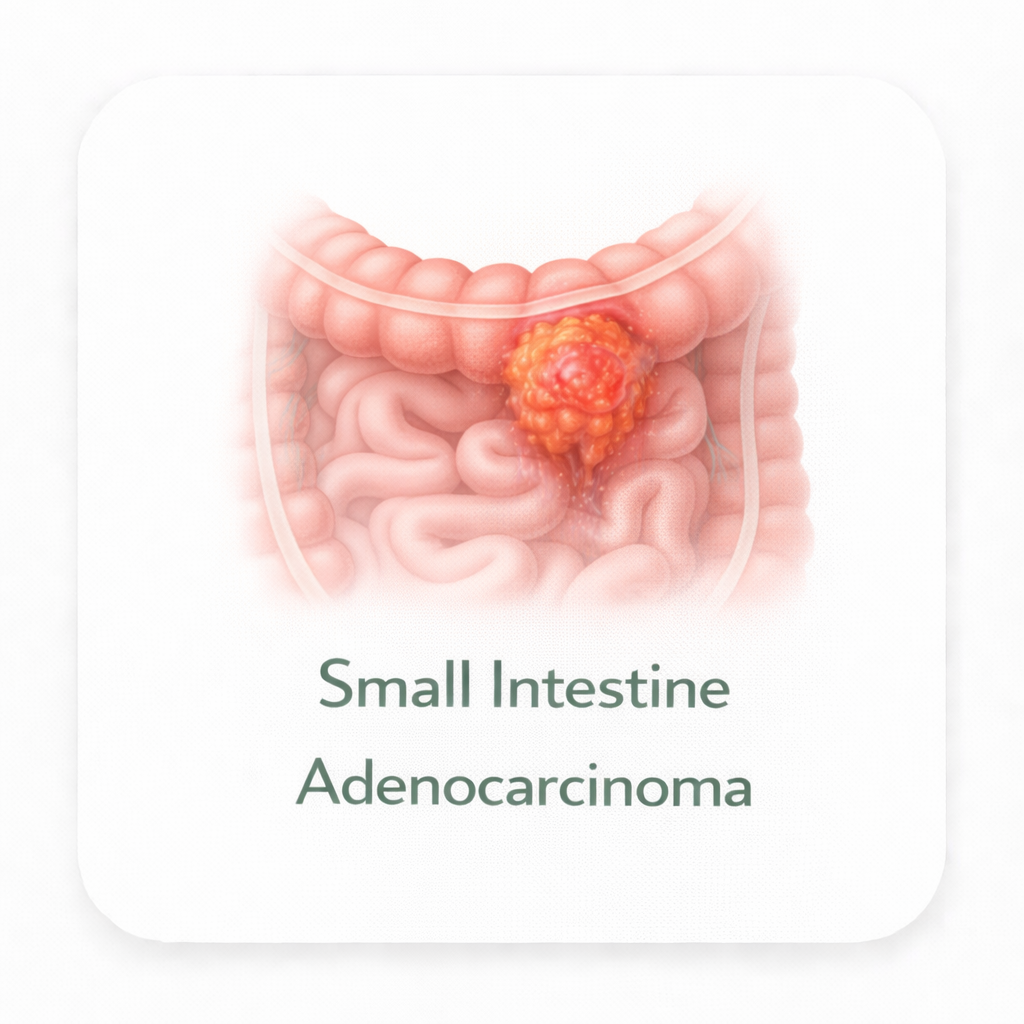
Small Intestine Adenocarcinoma
Main Grouping
Digestive
Organ System
Small Intestine
Cell Origin
Epithelial (adenocarcinoma)
Pathways Affected
Small Intestine Adenocarcinoma involves dysregulation of multiple interconnected oncogenic and tumor suppressive signaling cascades. The KRAS-driven MAPK/ERK pathway is among the most frequently activated, occurring in over 50% of SBA cases, resulting in uncontrolled cell proliferation and suppression of apoptosis. The PI3K/AKT/mTOR pathway is activated through PIK3CA mutations and loss of PTEN expression, driving pro-survival signaling and resistance to apoptosis. Mutations in APC and loss of function in SMAD4 result in aberrant Wnt/β-catenin signaling and disrupted TGF-β/SMAD-mediated tumor suppression, respectively, with β-catenin nuclear translocation further activating proliferative transcription of cyclin D1, c-Myc, and survivin. TP53 mutations, found in nearly 58% of SBA cases, impair cell cycle checkpoint control, DNA repair response, and the p53-dependent apoptotic program, allowing accumulation of genetic errors and tumor progression.
Microsatellite instability arising from mismatch repair (MMR) deficiency occurs in approximately 14% of SBAs, causing accumulation of mutations at repetitive DNA sequences throughout the genome. CDKN2A loss disrupts cell cycle control at the G1/S checkpoint by eliminating p16 tumor suppressor activity, enabling unrestrained cell cycle entry. ERBB2 (HER2) amplification, more prevalent in duodenal adenocarcinomas, activates downstream PI3K/AKT and RAS/MAPK signaling. Angiogenesis driven by VEGF signaling and NF-κB-mediated chronic inflammation are additional contributors, with inflammatory bowel conditions like Crohn's disease providing a persistent inflammatory micro-environment that promotes oncogenic transformation via cytokine-mediated NF-κB and JAK/STAT activation. Epithelial-mesenchymal transition (EMT), regulated by TGF-β and SNAIL/TWIST transcription factors, drives local invasion and metastatic capacity. The Nrf2 antioxidant response pathway, glutathione defense systems, and DNA repair mechanisms represent critical cellular checkpoints whose dysregulation allows oxidative and genotoxic damage to persist in pre-malignant small intestinal epithelium.
Description
Small Intestine Adenocarcinoma (SBA) is a malignancy arising from the glandular epithelial lining of the small bowel, which comprises the duodenum, jejunum, and ileum. Despite the small intestine accounting for approximately 75% of the total length of the gastrointestinal tract and more than 90% of its mucosal surface area, SBA is comparatively rare, representing roughly 36–40% of all small intestinal malignancies and approximately 2–3% of all gastrointestinal cancers. Incidence rates have been gradually rising in both the United States and Europe over recent decades, with the duodenum identified as the most frequent primary site (49–58% of cases), followed by the jejunum (19–29%) and ileum (10–15%). A slight male predominance is documented, and the median age at diagnosis falls within the sixth decade of life.
The carcinogenic process in SBA is not fully elucidated, though genomic profiling of large cohorts has consistently identified recurring somatic mutations. Studies involving panels of hundreds of cancer-related genes have shown that the most commonly altered genes in SBA include TP53 (approximately 58%), KRAS (approximately 54%), APC (approximately 27%), SMAD4 (approximately 17%), PIK3CA (approximately 16%), CDKN2A (approximately 15%), and ARID1A (approximately 12%). The molecular alterations observed in SBA partially overlap with those of colorectal cancer (CRC), particularly in KRAS and SMAD4 mutation rates, while differences from CRC exist in the lower frequency of APC mutations and the presence of alterations in ERBB2, FGFR2, MET, and NOTCH1. Approximately 14% of SBAs exhibit microsatellite instability-high (MSI-H) status, a feature associated with deficient DNA mismatch repair.
Recognized predisposing conditions include Crohn's disease, Lynch syndrome, familial adenomatous polyposis (FAP), Peutz-Jeghers syndrome, and celiac disease, with nearly 20% of SBA cases linked to one of these conditions. Crohn's disease is particularly associated with ileal SBA, while celiac disease carries a relative risk of SBA that has been documented in large collaborative studies. Risk factors also include a history of high saturated fat intake, abdominal obesity, and prior cholecystectomy. Dietary fiber and whole grain intake have been associated with a protective effect against SBA in epidemiological studies. The majority of cases are diagnosed at an advanced stage, with five-year overall survival rates ranging from 5% to 32% depending on disease stage and nodal status.
Plant-based dietary patterns supply several classes of bioactive compounds documented in gastrointestinal cancer research. Quercetin, curcumin, EGCG from green tea, sulforaphane from cruciferous vegetables, allicin from garlic, ellagic acid, resveratrol, and dietary fiber collectively provide a broad spectrum of anti-proliferative, pro-apoptotic, and pathway-modulating activities that have been studied in intestinal and gastrointestinal adenocarcinoma models. The interaction between these phytochemicals and the central oncogenic pathways mutated in SBA — including Wnt/β-catenin, PI3K/AKT/mTOR, MAPK/ERK, TGF-β/SMAD, NF-κB, and p53 — represents the primary rationale for their investigation in this cancer context.
Plant-Based Description
Whole plant foods, including cruciferous vegetables, allium vegetables, leafy greens, legumes, berries, whole grains, and aromatic herbs, supply dietary fiber, polyphenols, organosulfur compounds, carotenoids, and isothiocyanates that interact with the primary oncogenic pathways active in SBA. Epidemiological data associate whole grain and grain fiber intake with a protective effect against small bowel adenocarcinoma. Research in gastrointestinal adenocarcinoma models documents that phytochemicals from these food categories modulate KRAS-driven MAPK/ERK signaling, PI3K/AKT/mTOR activity, Wnt/β-catenin nuclear translocation, NF-κB-mediated inflammation, and p53-dependent apoptosis — pathways that are centrally mutated in SBA. The totality of evidence positions plant-based dietary composition as a source of documented anti-proliferative, pro-apoptotic, and anti-angiogenic bioactives relevant to gastrointestinal carcinogenesis.
Plant Chemistry Detail
Curcumin, the primary polyphenol in turmeric, has been documented in multiple gastrointestinal cancer studies to suppress Wnt/β-catenin nuclear signaling by increasing CDX2 expression and reducing cyclin D1 and c-Myc levels, while inhibiting PI3K/AKT/mTOR and NF-κB pathways to induce apoptosis via upregulation of Bax and caspase-3/9. EGCG from green tea was shown in the Apc(min/+) mouse model to inhibit small intestinal tumor formation by 37–47% through suppression of nuclear β-catenin, phospho-Akt, and phospho-ERK1/2, and elevation of E-cadherin. Quercetin inhibits MAPK/ERK, PI3K, JAK/STAT, and NF-κB inflammatory signaling while inducing apoptosis across multiple gastrointestinal cancer cell lines. Sulforaphane, an isothiocyanate from cruciferous vegetables, activates the Nrf2/Keap1 antioxidant response, induces G2/M cell cycle arrest via downregulation of cyclin B1 and upregulation of p21, inhibits mTOR independently of Nrf2, and suppresses HIF-1α and VEGF-driven angiogenesis. Allicin and its derivatives diallyl disulfide (DADS) and diallyl trisulfide (DATS) from garlic induce apoptosis through mitochondrial pathways, caspase-3/8/9 activation, and inhibition of MAPK, PI3K/AKT, and NF-κB signaling in digestive system cancer models. Resveratrol modulates Notch and PI3K/AKT signaling. Ellagic acid and anthocyanins contribute antioxidant and NF-κB inhibitory activity. Dietary fiber from legumes, whole grains, and vegetables is fermented by gut microbiota into short-chain fatty acids (SCFAs) including butyrate, which functions as an HDAC inhibitor and has documented pro-apoptotic and antiproliferative effects in intestinal epithelial cancer cells.
Nutritional Focus
Dietary fiber and whole grain intake are documented in epidemiological studies to be associated with a protective effect against small bowel adenocarcinoma. Folate (vitamin B9) supports one-carbon metabolism and DNA methylation fidelity, directly relevant to mismatch repair and epigenetic regulation. Selenium contributes to glutathione peroxidase function and oxidative stress defense in intestinal epithelium. Zinc is required for the structural and catalytic function of over 300 enzymes including those involved in DNA repair and immune response signaling. Vitamin C supports collagen biosynthesis and functions as a direct antioxidant in the mucosal microenvironment. Adequate magnesium is required for DNA polymerase activity and mismatch repair enzyme function. Short-chain fatty acids generated from dietary fiber fermentation in the gut, particularly butyrate, act as histone deacetylase (HDAC) inhibitors with documented pro-apoptotic effects in intestinal epithelial cancer cells, linking dietary fiber to epigenetic modulation of intestinal carcinogenesis.
Research Notes
Genomic profiling studies of 317 SBA tumors identified TP53 (58.4%), KRAS (53.6%), APC (26.8%), SMAD4 (17.4%), PIK3CA (16.1%), and CDKN2A (14.5%) as the most frequently altered genes. Duodenal SBAs demonstrate higher rates of ERBB2 (13%) and CDKN2A (18%) alterations compared to jejunal/ileal SBAs. Approximately 14% of SBAs are MSI-H. EGCG oral administration in Apc(min/+) mice inhibited small intestinal tumor formation by 37–47% via nuclear β-catenin suppression and Akt/ERK inhibition (PubMed 16288056). Diet and lifestyle studies from the EPIC cohort examined small intestinal cancer risk factors including dietary patterns. Whole grain and fiber intake are associated with reduced SBA risk. The EPIC study (PMC10460357) is the largest prospective dietary analysis of small intestinal cancer to date. Allicin from garlic and its derivatives DADS/DATS inhibit MAPK, PI3K/AKT, and NF-κB pathways in digestive system cancer models (PMC9234177, PMC8111078). Curcumin inhibits Wnt/β-catenin in colonic adenocarcinoma via CDX2 restoration (PubMed 31584928). Sulforaphane activates Nrf2 antioxidant response and independently inhibits mTOR in cancer models (PMC3553557, PMC8106549). Quercetin and curcumin combinations show synergistic inhibition of Wnt/β-catenin and PI3K/MAPK in cancer cell lines (PubMed 30599890). Lycopene, sulforaphane, quercetin, and curcumin in combination demonstrate additive antiproliferative activity in colon adenocarcinoma cells in vitro (PubMed 31353575).
Notes Visibility
show
Key Foods
Broccoli, kale, Brussels sprouts, spinach, garlic, turmeric, green tea, blueberry, pomegranate, flaxseed, chia seeds, lentils, black beans, brown rice, walnuts, shiitake mushroom, and quinoa are among the plant-based foods whose documented bioactive constituents — sulforaphane, EGCG, curcumin, allicin, quercetin, ellagic acid, lignans, and dietary fiber — have been studied in the context of gastrointestinal and intestinal adenocarcinoma pathways., Leek,Avocado,Tangerine, Red Onion
Linked Nutrients
Dietary fiber (soluble and insoluble), short-chain fatty acids (butyrate, propionate, acetate) from fiber fermentation, folate (vitamin B9), vitamin C, vitamin E, vitamin K1, selenium, zinc, magnesium, iron, copper, manganese, calcium, potassium, and phosphorus represent the nutrient categories documented in gastrointestinal cancer research as supporting DNA repair, antioxidant defense, epithelial barrier function, and immune regulation in the small intestinal environment.
Last Updated
2025-10-13 10:35:00

