
ID
94
Cancer Name
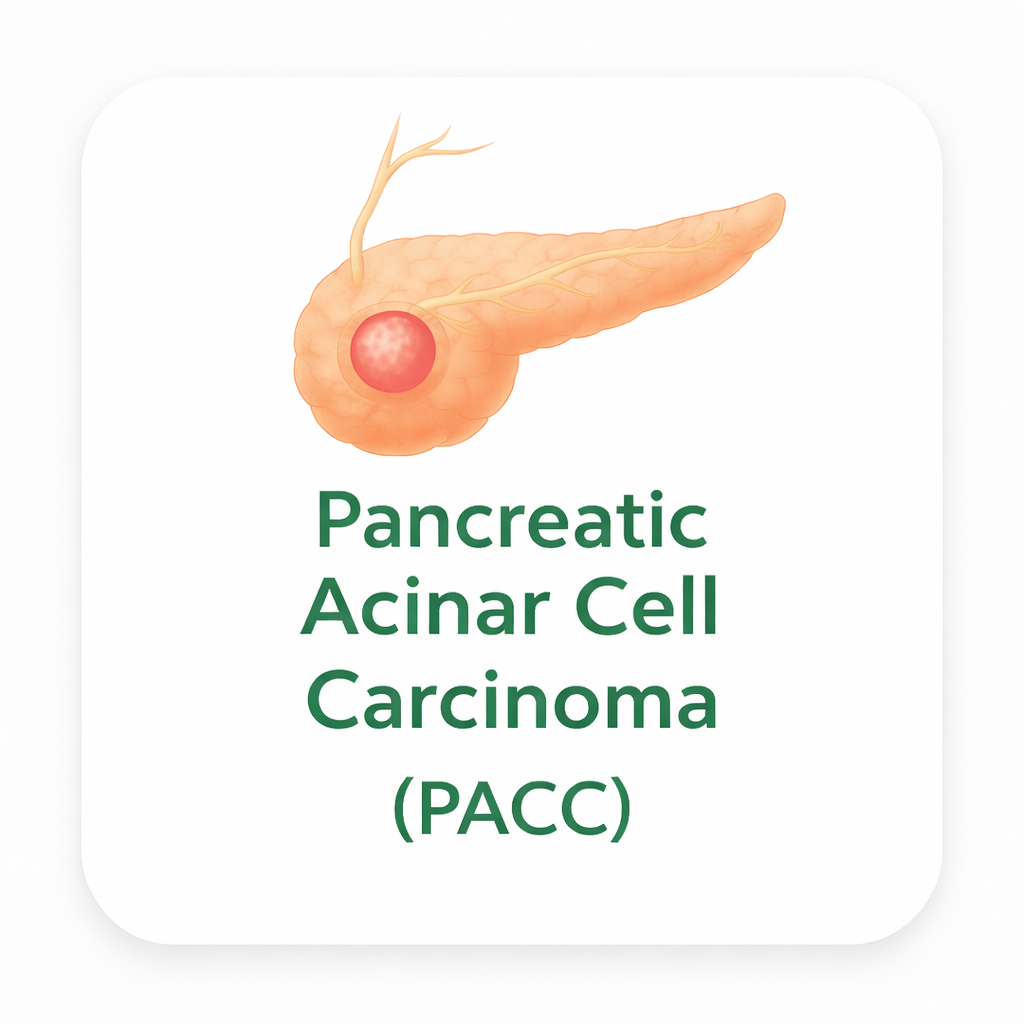
Pancreatic Acinar Cell Carcinoma
Main Grouping
Digestive
Organ System
Pancreas
Cell Origin
Exocrine acinar cells
Pathways Affected
Pancreatic acinar cell carcinoma involves a pathway landscape fundamentally distinct from PDAC, defined by the RAF/MAPK/ERK pathway (BRAF and RAF1 fusions ~23%), DNA damage response pathway disruption (BRCA2/BRCA1/PALB2/ATM/MSH2 ~45%), WNT/beta-catenin pathway (APC/CTNNB1 ~20-25%), and chromosomal instability as the dominant biological driver.
The RAF/MAPK/ERK pathway is the most mechanistically defined oncogenic driver in approximately 23% of PACC: the most prevalent RAF fusion is SND1-BRAF — created by chromosomal rearrangement placing the staphylococcal nuclease and tudor domain containing 1 (SND1) RNA-binding protein in frame with BRAF kinase — creating a constitutively active BRAF kinase that continuously activates MEK1/2 and ERK1/2 (MAPK pathway) independent of upstream RAS signaling; RAF1 (CRAF) fusions also occur; constitutive MEK/ERK signaling in SND1-BRAF-transformed cells was confirmed to activate the MAPK pathway — demonstrated by phospho-ERK immunoblot — and was abrogated with MEK inhibition confirmed (PubMed25266736); MEK/ERK drives cyclin D1 expression, c-Myc activation, and anti-apoptotic BCL-2 family upregulation in PACC cells; quercetin inhibits RAF/MEK/ERK pathway in pancreatic cancer cell models — directly targeting the constitutive MAPK activation from SND1-BRAF and other RAF fusions in PACC; curcumin inhibits MAPK/ERK in pancreatic cancer cell models; EGCG inhibits MEK/ERK in pancreatic cancer cell models.
The DNA damage response (DDR) pathway is disrupted in approximately 45% of PACC through alterations in BRCA2, BRCA1, PALB2, ATM, and MSH2: BRCA2 germline and somatic mutations in PACC are more prevalent than in any other pancreatic cancer type — BRCA2 is found in germline PACC cases linked to hereditary breast-ovarian cancer syndrome; BRCA2/BRCA1 inactivation impairs homologous recombination (HR) for DNA double-strand break repair — creating a "BRCAness" phenotype characterized by dependence on alternative DNA repair pathways (NHEJ and PARP1-mediated poly-ADP-ribosylation) for genome integrity; PALB2 mutations (~partner and localizer of BRCA2) impair the BRCA1-BRCA2-PALB2 complex required for RAD51 recruitment to DSBs; ATM inactivation disrupts the initial DSB recognition and cell cycle checkpoint activation; MSH2 loss creates MSI (microsatellite instability, ~7-14% of PACC) through defective mismatch repair; the RAF and DDR defects are mutually exclusive in approximately 45% of PACC — creating two distinct genomically defined subsets; quercetin activates ATM in cancer cell models; curcumin inhibits DNA repair in cancer cell models targeting the DNA repair pathways in BRCA-deficient PACC.
The WNT/beta-catenin pathway is altered in approximately 20-25% of PACC through APC truncating mutations (which prevent APC-mediated beta-catenin phosphorylation and proteasomal degradation, creating constitutive beta-catenin nuclear accumulation) and CTNNB1 activating mutations (creating degradation-resistant beta-catenin protein): constitutive beta-catenin nuclear accumulation drives TCF/LEF target gene transcription including cyclin D1, c-Myc, survivin, and matrix metalloproteinases; APC loss additionally disrupts cell migration polarity through its role in microtubule organization; quercetin inhibits WNT/beta-catenin signaling in pancreatic cancer cell models; curcumin inhibits WNT/beta-catenin in pancreatic cancer and colon cancer cell models targeting the APC-loss/beta-catenin constitutive activation in PACC.
Description
Pancreatic acinar cell carcinoma (PACC) is a rare malignant pancreatic neoplasm arising from the acinar cells of the exocrine pancreas, representing approximately 1 to 2 percent of all exocrine pancreatic tumors. In the United States, approximately 500 to 600 new cases of PACC are diagnosed annually — accounting for approximately 1 percent of the approximately 60,000 annual pancreatic cancer diagnoses. Globally, the annual incidence is estimated at approximately 0.01 to 0.05 per 100,000 population. PACC has a significant male predominance (male-to-female ratio approximately 2:1) and presents predominantly in adults with a median age at diagnosis of approximately 56 to 65 years — slightly younger than the median age for PDAC.
The clinical presentation of PACC is often insidious and nonspecific: abdominal pain (most common symptom, ~70% of cases); weight loss; jaundice (less frequent than in PDAC given the different anatomic distribution); and the unique paraneoplastic lipase hypersecretion syndrome (Schmid syndrome) occurring in approximately 10-15% of patients — this syndrome presents with subcutaneous fat necrosis (panniculitis, often at the lower extremities), polyarthropathy (particularly involving the ankles and small joints), and peripheral blood eosinophilia; the lipase hypersecretion syndrome is not seen in PDAC and should prompt evaluation for PACC; elevated serum lipase and amylase are also common laboratory findings at diagnosis.
PACC is characterized by a distinct molecular profile that fundamentally differs from PDAC: the rare occurrence of KRAS mutations (~2% vs. >90% in PDAC), TP53 mutations (~9-23% vs. ~75% in PDAC), CDKN2A/p16 loss (~14% vs. ~90% in PDAC), and SMAD4 loss (~14-19% vs. ~55% in PDAC); instead PACC is driven by RAF pathway fusions (~23%), DNA repair gene defects (~45%), and WNT/APC pathway alterations (~20-25%); the dominant RAF fusion SND1-BRAF results in constitutive MAPK/ERK pathway activation — an oncogenic mechanism amenable to MEK inhibitor approaches; the RAF and DNA repair defects are mutually exclusive in approximately 45% of cases creating two distinct biological subsets; microsatellite instability occurs in approximately 7-14% of PACC.
Overall prognosis of PACC is better than PDAC but still poor: resectable PACC 5-year OS approximately 30-45%; metastatic PACC 5-year OS less than 10%; median OS for metastatic disease approximately 8-14 months. PACC is more chemosensitive than PDAC reflecting its higher replicative activity and DNA repair deficiency subset.
Published laboratory research confirms quercetin from onions induced apoptosis of PANC-1 human pancreatic cancer cells — confirmed by DAPI nuclear staining and flow cytometry at 50 µg/mL for 24 hours; ER stress mediators Grp78/Bip, p-PERK, ATF4, ATF6, and GADD153/CHOP upregulated confirmed by Western blot; mitochondrial membrane potential loss confirmed; sub-G0/G1 fraction increase confirmed (PMC3868676) — targeting the unfolded protein response and mitochondrial apoptosis pathways relevant to PACC biology.
Plant-Based Description
Whole-food plant-based dietary patterns provide phytochemicals with confirmed activity in human pancreatic cancer cell lines applicable to pancreatic acinar cell carcinoma. Quercetin from onions and kale was confirmed to induce apoptosis of PANC-1 human pancreatic cancer cells — characterized by nucleic acid and genomic DNA fragmentation, chromatin condensation, and sub-G0/G1 fraction increase confirmed by DAPI staining and flow cytometry; ER stress mediators Grp78/Bip, p-PERK, ATF4, ATF6, and GADD153/CHOP upregulated confirmed by Western blot; mitochondrial membrane potential loss confirmed (PMC3868676) — targeting the unfolded protein response and mitochondrial apoptosis pathways in pancreatic cancer cells; quercetin also inhibits WNT/beta-catenin targeting the APC/CTNNB1 alterations (~20-25% PACC); curcumin inhibits MAPK/ERK targeting the RAF fusion-driven constitutive MEK/ERK activation (~23% PACC) and inhibits WNT/beta-catenin and NF-kB in pancreatic cancer cell models; EGCG inhibits MEK/ERK and VEGF in pancreatic cancer models; sulforaphane activates Nrf2 and induces apoptosis in pancreatic cancer cell models.
Plant Chemistry Detail
Quercetin from onions, kale, and apples has confirmed activity against PANC-1 human pancreatic cancer cells in a published study (PMC3868676 — "Effect of quercetin on apoptosis of PANC-1 cells") using human PANC-1 pancreatic carcinoma cells. In this confirmed study: quercetin at 50 µg/mL for 24 hours induced apoptosis of PANC-1 pancreatic cancer cells confirmed by DAPI nuclear staining — showing nucleic acid and genomic DNA fragmentation and chromatin condensation; apoptosis confirmed by flow cytometry showing increased sub-G0/G1 fraction; expression of ER stress mediators was confirmed by Western blot: Grp78/Bip (master ER stress sensor chaperone) significantly increased; p-PERK (phosphorylated PKR-like ER kinase — the initial ER stress signal transducer) increased; ATF4 (activating transcription factor 4, PERK-mediated stress gene) increased; ATF6 (activating transcription factor 6, parallel ER stress branch) increased; GADD153/CHOP (C/EBP-homologous protein — the pro-apoptotic ER stress transcription factor that induces BIM/PUMA and represses BCL-2) significantly increased confirmed — providing the mechanistic link between ER stress induction and apoptosis execution; mitochondrial membrane potential loss confirmed by fluorescence staining with JC-1 and rhodamine 123 — establishing the intrinsic mitochondrial apoptosis pathway activation.
Curcumin from turmeric inhibits MAPK/ERK pathway in pancreatic cancer cell models — directly targeting the constitutive MEK/ERK activation from SND1-BRAF and other RAF fusions (~23% PACC); curcumin inhibits WNT/beta-catenin in pancreatic cancer and colon cancer cell models targeting APC-loss/CTNNB1 constitutive activation (~20-25% PACC); curcumin inhibits NF-kB in pancreatic cancer cell models; curcumin inhibits VEGF and angiogenesis in pancreatic cancer models; curcumin inhibits Sonic Hedgehog (SHH) signaling in pancreatic cancer models. EGCG from green tea inhibits MEK/ERK and VEGF in pancreatic cancer cell models; inhibits MMP-9 invasion; inhibits STAT3 in pancreatic cancer models. Quercetin additionally inhibits Sonic Hedgehog signaling (SHH) in pancreatic cancer xenograft models and inhibits PATU-8988 and PANC-1 pancreatic cancer cell invasion and MMP release confirmed (PMC8580629). Sulforaphane from cruciferous vegetables activates Nrf2/ARE and induces apoptosis in pancreatic cancer cell models targeting oxidative stress in PACC; sulforaphane inhibits NF-kB and HDAC in pancreatic cancer models.
Nutritional Focus
Nutritional focus in pancreatic acinar cell carcinoma targets the distinct molecular drivers — RAF fusions/MAPK (~23%), DNA repair defects (~45%), and WNT/APC alterations (~20-25%) — with quercetin from onions confirmed to induce apoptosis in PANC-1 human pancreatic cancer cells: DAPI nuclear staining and flow cytometry apoptosis confirmed; ER stress mediators Grp78/Bip, p-PERK, ATF4, ATF6, and GADD153/CHOP upregulated by Western blot confirmed; mitochondrial membrane potential loss confirmed (PMC3868676) — directly targeting ER stress and mitochondrial apoptosis pathways in pancreatic cancer cells relevant to PACC biology; quercetin additionally inhibiting WNT/beta-catenin in pancreatic cancer models targeting APC/CTNNB1 alterations (~20-25% PACC); quercetin inhibiting SHH and PATU-8988/PANC-1 MMP release confirmed (PMC8580629); curcumin from turmeric inhibiting MAPK/ERK pathway in pancreatic cancer cell models — directly targeting the constitutive MEK/ERK activation from SND1-BRAF and RAF1 fusions (~23% PACC); curcumin inhibiting WNT/beta-catenin targeting APC-loss/CTNNB1 constitutive activation; curcumin inhibiting NF-kB and VEGF in pancreatic cancer cell models; EGCG from green tea inhibiting MEK/ERK, STAT3, and MMP-9 in pancreatic cancer models; sulforaphane activating Nrf2/ARE and inducing apoptosis in pancreatic cancer cell models; sulforaphane inhibiting HDAC and NF-kB; and dietary fiber producing butyrate/SCFAs inhibiting HDAC targeting the epigenetic landscape of PACC including ARID1A alterations.
Research Notes
PACC epidemiology: ~500-600 new US cases/year; ~1-2% of all exocrine pancreatic tumors; male:female ~2:1; median age ~56-65 years; mean tumor size ~8-10 cm at diagnosis; 50-60% present with metastatic disease; 5-year OS resectable ~30-45%; metastatic median OS ~8-14 months; more chemosensitive than PDAC. Lipase hypersecretion syndrome (Schmid syndrome) ~10-15%: subcutaneous fat necrosis/panniculitis, polyarthropathy, eosinophilia. Diagnostic IHC: BCL10+ (most sensitive/specific, >90%); trypsin+ ~60-80%; chymotrypsin+; lipase+; CK8/18+. Molecular: KRAS mutations ~2% (vs. >90% PDAC); TP53 ~9-23% (vs. 75% PDAC); CDKN2A ~14% (vs. ~90% PDAC); SMAD4 ~14-19% (vs. ~55% PDAC); RAF fusions ~23% (BRAF and RAF1; most prevalent SND1-BRAF; constitutive MAPK activation confirmed; MEK inhibition abrogated confirmed); DNA repair gene alterations ~45% (BRCA2, BRCA1, PALB2, ATM, MSH2; BRCA2 most common; inversely correlated with RAF fusions — mutually exclusive in ~45%); WNT/APC pathway ~20-25% (APC and CTNNB1); MSI ~7-14%; ARID1A subset; GNAS subset; ~65 non-synonymous somatic mutations/tumor; no gene mutated >30%; extensive chromosomal instability dominant feature; BRCA2 germline mutations associated with PACC — hereditary PACC subset. 2022 WHO criteria: acinar differentiation required; BCL10+ and trypsin+ IHC confirms; mixed subtypes: mixed acinar-neuroendocrine and mixed acinar-ductal variants. Quercetin PANC-1 pancreatic cancer (PMC3868676): apoptosis induced; DAPI staining confirmed; flow cytometry sub-G0/G1 increase confirmed; ER stress Grp78/p-PERK/ATF4/ATF6/GADD153/CHOP Western blot upregulated confirmed; mitochondrial membrane potential loss confirmed JC-1/rhodamine 123.
Notes Visibility
show
Key Foods
Turmeric,Broccoli,Kale,Spinach,Brussels Sprouts,Cauliflower,Garlic,Yellow Onion,Carrot,Tomato,Beetroot,Cabbage,Blueberry,Pomegranate,Grape,Raspberry,Apple,Orange,Lemon,Soybeans,Edamame,Green Lentils,Black Beans,Chickpeas,Brown Rice,Quinoa,Oats,Wild Rice,Black Rice,Walnut,Almond,Brazil Nut,Flaxseed,Pumpkin Seeds,Chia Seeds,Sesame Seeds,Hemp Seeds,Shiitake,Maitake,Lions Mane,Cremini,Portobello,Green Tea,Ginger,Black Pepper,Garlic Powder,Parsley,Rosemary,Oregano, Celery, Leek,Avocado,Artichoke,Radish,Tangerine, Red Onion
Linked Nutrients
vitamin-c,vitamin-e,vitamin-a,vitamin-b9,vitamin-b6,selenium,zinc,magnesium,calcium,potassium,iron,quercetin,curcumin,egcg,sulforaphane,beta-carotene,anthocyanins,dietary-fiber,l-theanine,allicin
Last Updated
2025-10-13 10:35:00

