
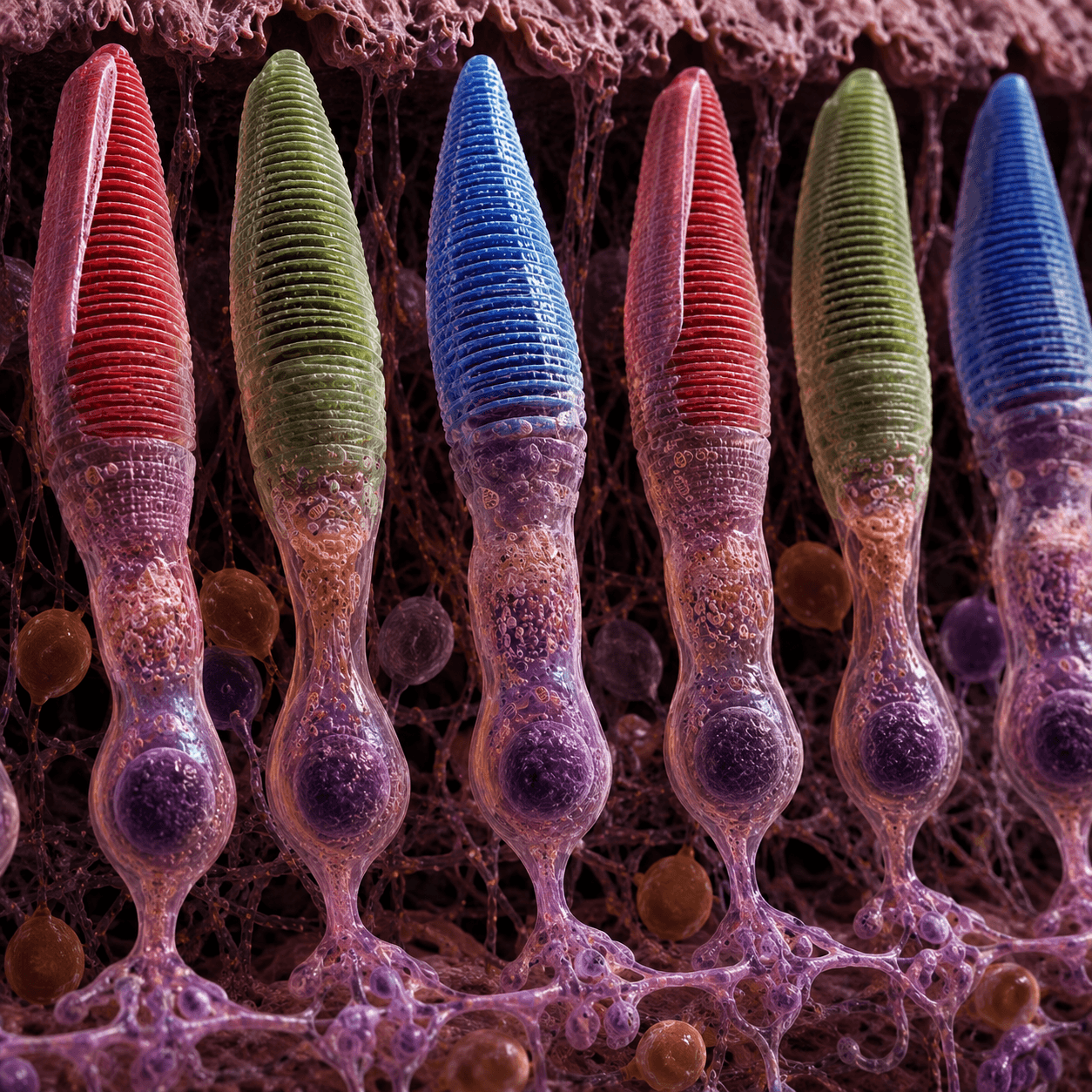
Cone photoreceptors provide color vision, visual acuity, and detailed daylight visual perception.
Cone photoreceptors are specialized sensory neurons located within the retina that provide color vision, visual acuity, and detailed daylight vision. These cells function optimally under bright light conditions and allow humans to distinguish colors, recognize fine details, and perceive visual information with high precision. Together with rod photoreceptors, cones form the foundation of visual perception.
Cones contain light-sensitive pigments that respond to different wavelengths of visible light. Separate cone populations are sensitive to short, medium, and long wavelengths, allowing the visual system to interpret color information. Signals generated by cones are processed through retinal neural circuits and transmitted to the brain for visual interpretation.
The highest concentration of cone photoreceptors is found within the macula and fovea, regions responsible for detailed central vision. Because these cells continuously process large amounts of visual information, they require substantial metabolic support and efficient energy production. Their high activity contributes to significant demands for mitochondrial function and antioxidant protection.
Cone photoreceptors depend upon nutrients involved in retinal metabolism, cellular protection, and visual function. Lutein and zeaxanthin accumulate within the macular region and are associated with visual health. Vitamin C and vitamin E contribute antioxidant support. Zinc participates in numerous retinal enzymatic reactions. Foods including kale, spinach, collard greens, broccoli, oranges, kiwi, blueberries, blackberries, walnuts, and flaxseed provide nutrients associated with visual tissue maintenance.
These cells participate in phototransduction pathways, visual cycle mechanisms, mitochondrial energy production, and oxidative stress responses. Protection from cumulative oxidative stress is important because cone photoreceptors remain active throughout life and support continuous visual processing.
Polyphenols, carotenoids, vitamins, minerals, and antioxidant compounds found in colorful plant foods contribute nutrients associated with retinal cellular support. Leafy greens and brightly colored fruits provide many compounds linked to visual function.
Cone photoreceptors are responsible for the sharp, colorful visual experiences that characterize human daylight vision. Through detection of color and fine visual detail, they allow accurate interpretation of the environment and support complex visual tasks throughout life.
Cone cells require carotenoids, antioxidants, and mitochondrial support for visual performance.
SUMMARY OF CELL SUPPORTnnThis cell strongly benefits from:n• Lutein-rich leafy greensn• Zeaxanthin supportn• Antioxidant-rich berriesn• Vitamin C and E supportn• Mitochondrial protection

