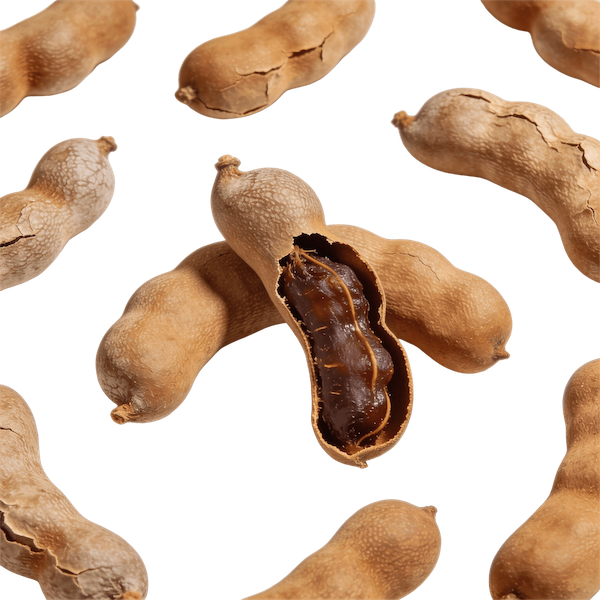
Tamarind (pulp, raw)

Tamarind (pulp, raw)

FamilyFabaceae
Importance
Tamarind is the brown pod fruit of Tamarindus indica, valued for its sweet-sour pulp, tartaric acid, concentrated carbohydrate, fiber, potassium, magnesium, thiamin, iron, copper, calcium, and polyphenol content. Per 100 g, raw tamarind pulp provides about 239 calories, 62.5 g carbohydrate, 5.1 g fiber, 2.8 g protein, and very little fat. Its distinctive flavor comes from the combination of natural sugars and high tartaric acid, giving tamarind a sharp, fruity acidity used in sauces, chutneys, drinks, soups, stews, marinades, and fruit preparations.

Tamarind supports everyday nourishment through carbohydrate energy, fiber, potassium, magnesium, thiamin, and antioxidant-active plant compounds. Fiber supports digestive movement, stool bulk, and microbial fermentation. Potassium supports fluid balance, nerve signaling, and muscle contraction. Magnesium participates in ATP-related energy metabolism and muscle function. Thiamin supports carbohydrate metabolism through thiamin-dependent enzyme systems. Iron and copper support oxygen transport, iron handling, connective tissue enzyme systems, and redox balance.

For cancer and ailment-support nutrition, tamarind is relevant because Tamarindus indica contains tartaric acid, phenolic acids, flavonoids, catechin, epicatechin, procyanidin B2, tannins, saponins, alkaloids, pectin, and antioxidant-active compounds. These compounds connect to Nrf2-related antioxidant response, NF-kB inflammatory signaling balance, AMPK-linked metabolic regulation, insulin-related carbohydrate handling, endothelial function, phase II detoxification enzyme signaling, apoptosis-related cell signaling, and gut fermentation pathways supported by fiber. Tamarind does not act as a standalone disease solution, but the whole pulp contributes digestive fiber, minerals, tart organic acids, and polyphenols tied to cellular repair, inflammatory signaling balance, vascular support, digestive function, and normal metabolic regulation.

Tamarind pairs well with citrus, mango, pineapple, dates, ginger, chili, legumes, leafy greens, whole grains, and vegetable dishes. Its strongest nutritional identity is the combination of concentrated sweet-sour pulp, tartaric acid, fiber, potassium, magnesium, thiamin, iron, copper, catechins, procyanidins, and Tamarindus-family phytochemicals connected to antioxidant, digestive, vascular, metabolic, inflammatory, and cellular defense pathways.

Region FoundTamarind Tamarindus indica is native to tropical Africa and has long been cultivated across South Asia, Southeast Asia, the Middle East, the Caribbean, Central America, South America, and tropical Africa. Major growing regions include India, Thailand, Indonesia, Mexico, Nigeria, Sudan, Tanzania, Kenya, Sri Lanka, and other warm tropical or subtropical regions with dry seasons and well-drained soils.
Helps Fight These Cancers: Colon Cancer, Gastric Cancer, Oral Cavity Pharynx Larynx Cancer
Helps Fight These Ailments: Digestive Health, Antioxidant Defense, Metabolic Health
Linked Hormones:

All values per 100g
Nutrition Facts
Calories (kcal)239
Protein (g)2.8
Carbohydrates (g)62.5
Fiber (g)5.1
Sugars (g)57.4
Total Fat (g)0.6
Saturated Fat (g)0
Vitamins
Vitamin A (µg RAE)2
Vitamin C (mg)3.5
Vitamin D (µg)0
Vitamin E (mg)0.1
Vitamin K (µg)2.8
Vitamin B1 / Thiamin (mg)0.428
Vitamin B2 / Riboflavin (mg)0.152
Vitamin B3 / Niacin (mg)1.938
Vitamin B5 / Pantothenic Acid (mg)0.143
Vitamin B6 (mg)0.066
Vitamin B7 / Biotin (µg)0
Folate B9 (µg)14
Vitamin B12 (µg)0
Vitamin Detail Pages
Minerals
Calcium (mg)74
Iron (mg)2.8
Magnesium (mg)92
Phosphorus (mg)113
Potassium (mg)628
Sodium (mg)28
Zinc (mg)0.1
Copper (mg)0.086
Manganese (mg)0.421
Selenium (µg)1.3
Iodine (µg)0
Mineral Detail Pages
Amino Acids
Alanine (mg)0 mg
Arginine (mg)0 mg
Asparagine (mg)0 mg
Aspartic Acid (mg)0 mg
Cysteine (mg)0 mg
Glutamic Acid (mg)0 mg
Glutamine (mg)0 mg
Glycine (mg)0 mg
Histidine (mg)0 mg
Isoleucine (mg)0 mg
Leucine (mg)0 mg
Lysine (mg)0 mg
Methionine (mg)0 mg
Phenylalanine (mg)0 mg
Proline (mg)0 mg
Serine (mg)0 mg
Threonine (mg)0 mg
Tryptophan (mg)0 mg
Tyrosine (mg)0 mg
Valine (mg)0 mg
Amino Acid Detail Pages
Phytochemicals
Tartaric acid, catechin, epicatechin, procyanidin B2, phenolic acids, flavonoids, tannins, saponins, alkaloids, pectin, organic acids, potassium, magnesium, thiamin, iron, copper, calcium, phosphorus, and Tamarindus indica antioxidant-active compounds. Research references: Kuru P. Tamarindus indica and its health related effects. Asian Pacific Journal of Tropical Biomedicine. 2014. Sookying S, et al. Botanical aspects, phytochemicals, and toxicity of Tamarindus indica. Evidence-Based Complementary and Alternative Medicine. 2022. Haldar S, et al. Postprandial Glycemic and Insulinemic Effects of Tamarind Pulp Extract. Nutrients. 2019.
Research & Notes
Research Notes:
USDA FDC #9328 per 100 g pulp.
Notes:
Raw tamarind pulp (without seeds or shell); per 100 g.
Created: 2025-10-21 13:57:40
Last Updated: 2026-06-04 08:05:23