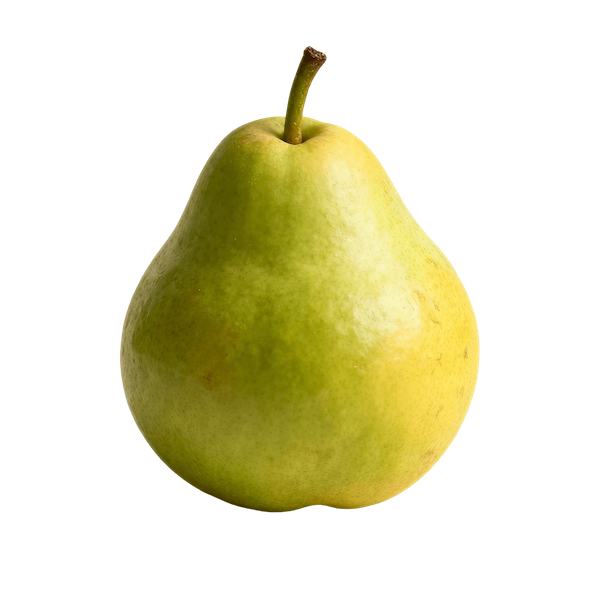
Pear

Pear

FamilyRosaceae
Importance
Pear is the sweet pome fruit of Pyrus species, valued for its juicy texture, mild flavor, edible skin, fiber, potassium, copper, vitamin C, vitamin K, and pear-family polyphenols. Per 100 g, raw pear provides about 57 calories, 15.2 g carbohydrate, 3.1 g fiber, 0.36 g protein, and very little fat. Its natural sugars occur inside a whole fruit matrix that includes water, soluble fiber, insoluble fiber, organic acids, minerals, peel compounds, and phytochemicals. Pear skin is especially important because it contains a meaningful share of the fruit’s flavonoids and antioxidant-active compounds.

Pear supports everyday nourishment through pectin-rich fiber, potassium, copper, vitamin C, and polyphenols. Fiber supports digestive movement, stool bulk, and microbial fermentation. Pectin and other soluble fibers support a thicker digestive matrix and help feed gut microbes. Vitamin C contributes to collagen formation, antioxidant recycling, immune barrier function, and connective tissue maintenance. Potassium supports fluid balance, nerve signaling, and muscle contraction. Copper participates in connective tissue enzyme systems, iron handling, and redox balance.

For cancer and ailment-support nutrition, pear is relevant because Pyrus fruits contain chlorogenic acid, arbutin, catechin, epicatechin, quercetin derivatives, kaempferol derivatives, anthocyanins in red-skinned cultivars, triterpenes, pectin, vitamin C, and organic acids. These compounds connect to Nrf2-related antioxidant response, NF-kB inflammatory signaling balance, AMPK-linked metabolic regulation, insulin-related carbohydrate handling, endothelial function, phase II detoxification enzyme signaling, apoptosis-related cell signaling, and gut fermentation pathways supported by fiber. Pear does not act as a standalone disease solution, but the whole fruit contributes digestive fiber, antioxidant nutrients, minerals, and peel polyphenols tied to cellular repair, inflammatory signaling balance, vascular support, digestive function, and normal metabolic regulation.

Pear pairs well with berries, citrus, apples, grapes, bananas, oats, cinnamon, ginger, mint, walnuts, almonds, leafy greens, legumes, and whole grains. Its strongest nutritional identity is the combination of gentle sweetness, pectin-rich fiber, edible peel, potassium, copper, chlorogenic acid, arbutin, flavonols, and Pyrus-family polyphenols connected to antioxidant, digestive, vascular, metabolic, inflammatory, and cellular defense pathways.

Region FoundPear Pyrus species are native to Europe, western Asia, and parts of East Asia and are now cultivated throughout temperate fruit-growing regions worldwide. Major growing areas include China, Italy, the United States, Argentina, Chile, Turkey, Spain, France, South Africa, Australia, and other regions with winter chilling, mild spring conditions, fertile well-drained soils, and adequate irrigation.
Glycemic Index38.0
Glycemic Load4.60
Helps Fight These Cancers: Bladder, Breast, Lung, Esophageal. Stomach
Helps Fight These Ailments: Hyperlipidemia, Hypertension, Insulin Resistance
Linked Hormones:

All values per 100g
Nutrition Facts
Calories (kcal)57
Protein (g)0.36
Carbohydrates (g)15.23
Fiber (g)3.1
Sugars (g)9.75
Total Fat (g)0.14
Saturated Fat (g)0
Vitamins
Vitamin A (µg RAE)1
Vitamin C (mg)4.3
Vitamin D (µg)0
Vitamin E (mg)0.12
Vitamin K (µg)4.4
Vitamin B1 / Thiamin (mg)0.012
Vitamin B2 / Riboflavin (mg)0.026
Vitamin B3 / Niacin (mg)0.161
Vitamin B5 / Pantothenic Acid (mg)0.049
Vitamin B6 (mg)0.029
Vitamin B7 / Biotin (µg)0
Folate B9 (µg)7
Vitamin B12 (µg)0
Vitamin Detail Pages
Minerals
Calcium (mg)9
Iron (mg)0.18
Magnesium (mg)7
Phosphorus (mg)12
Potassium (mg)116
Sodium (mg)1
Zinc (mg)0.1
Copper (mg)0.082
Manganese (mg)0.048
Selenium (µg)0.1
Iodine (µg)0
Mineral Detail Pages
Amino Acids
Alanine (mg)14 mg
Arginine (mg)10 mg
Asparagine (mg)0 mg
Aspartic Acid (mg)105 mg
Cysteine (mg)2 mg
Glutamic Acid (mg)30 mg
Glutamine (mg)0 mg
Glycine (mg)13 mg
Histidine (mg)2 mg
Isoleucine (mg)14 mg
Leucine (mg)21 mg
Lysine (mg)17 mg
Methionine (mg)2 mg
Phenylalanine (mg)11 mg
Proline (mg)21 mg
Serine (mg)20 mg
Threonine (mg)11 mg
Tryptophan (mg)2 mg
Tyrosine (mg)2 mg
Valine (mg)18 mg
Amino Acid Detail Pages
Phytochemicals
Chlorogenic acid, arbutin, catechin, epicatechin, quercetin derivatives, kaempferol derivatives, anthocyanins in red-skinned cultivars, flavonols, flavan-3-ols, phenolic acids, triterpenes, ursolic acid, oleanolic acid, pectin, soluble fiber, insoluble fiber, organic acids, vitamin C, vitamin K, potassium, copper, and Pyrus-family polyphenols. Research references: Li X, Zhang JY, Gao WY, Wang Y, Wang HY, Cao JG, Huang LQ. Chemical composition and anti-inflammatory and antioxidant activities of eight pear cultivars. Journal of Agricultural and Food Chemistry. 2012. Kolniak-Ostek J. Chemical composition and antioxidant capacity of different anatomical parts of pear Pyrus communis L. Food Chemistry. 2016. Reiland H, Slavin J. Systematic Review of Pears and Health. Nutrition Today. 2015.
Research & Notes
Research Notes:
USDA FoodData Central via MyFoodData; per 100 g values. Amino acids from FDC panel; cystine→cysteine; some AAs not reported left NULL. Evidence from WCRF/AICR & cohorts.
Notes:
Raw, with skin; common market cultivars (e.g., Bartlett/Bosc/Anjou).
Created: 2025-10-21 08:19:49
Last Updated: 2026-06-04 08:05:23