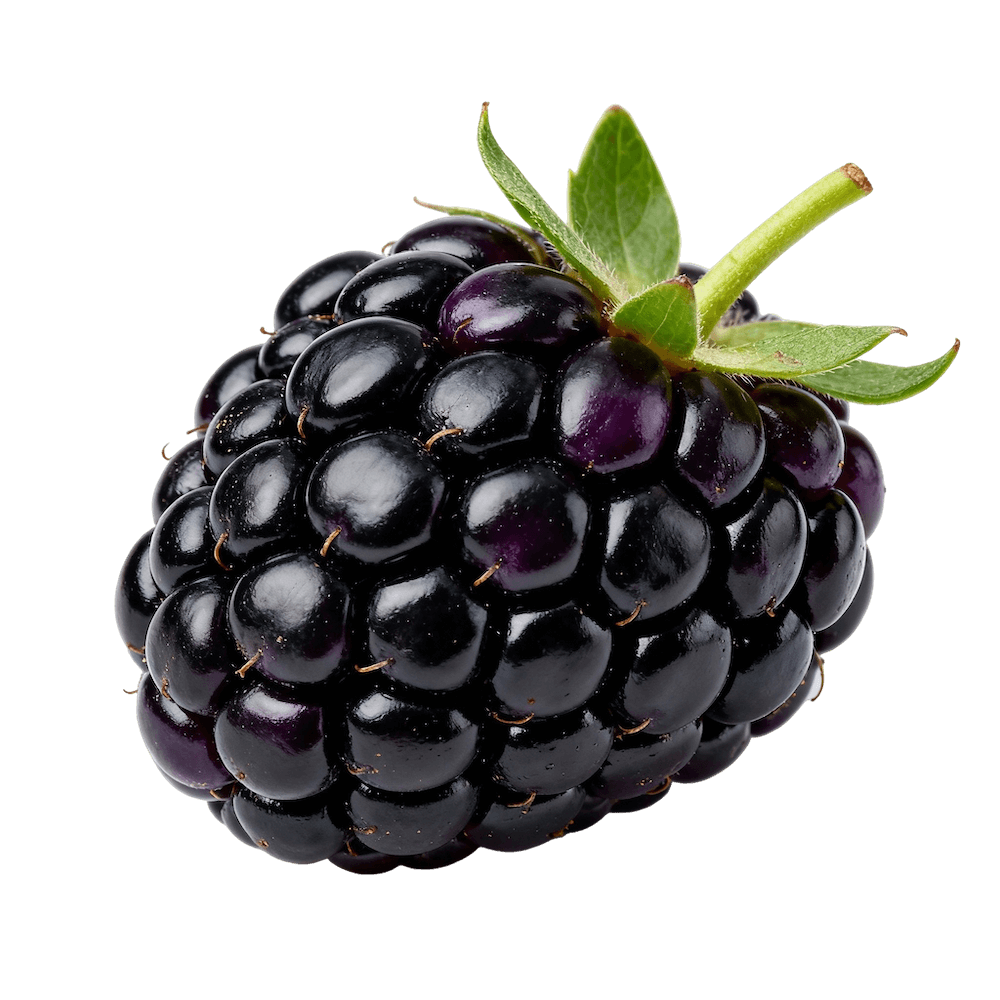
Blackberry

Blackberry

FamilyRosaceae
Importance
Blackberry is a dark, juicy aggregate fruit from Rubus species, valued for its deep purple-black color, tart-sweet flavor, fiber, vitamin C, vitamin K, manganese, and concentrated polyphenol content. Each berry is made of many small drupelets surrounding tiny seeds, giving blackberries their characteristic texture and high fiber density. Per 100 g, raw blackberry is mostly water and carbohydrate, with modest natural sugars, very little fat, and about 1.4 g protein. Its carbohydrate profile is balanced by fiber, organic acids, and polyphenols, which gives the fruit a slower, more complex digestive profile than isolated sugar.

Blackberry is especially notable for dietary fiber. The fruit contains both soluble and insoluble fiber, supporting normal digestive movement, stool bulk, and microbial fermentation in the colon. Its small seeds also contribute texture and fiber. Vitamin C supports collagen formation and antioxidant recycling, while vitamin K participates in normal blood-clotting protein activation and bone-related protein function. Manganese supports normal enzyme systems involved in connective tissue formation, carbohydrate metabolism, and antioxidant defense.

The fruit’s dark color comes from anthocyanins, especially cyanidin-based pigments such as cyanidin-3-glucoside and related glycosides. Blackberry also contains ellagic acid, ellagitannins, gallic acid derivatives, quercetin compounds, kaempferol compounds, catechins, proanthocyanidins, and other phenolic acids. These compounds are found alongside organic acids and natural berry aromatics that shape blackberry’s sharp, fragrant flavor. Ellagitannins and anthocyanins are among the most distinctive blackberry phytochemicals, and their concentrations can vary by cultivar, ripeness, growing region, harvest timing, and storage conditions.

Blackberry fits well into meals where color, fiber, acidity, and berry polyphenols are desired. It pairs naturally with oats, apples, pears, citrus, bananas, leafy greens, chia, flax, walnuts, and other berries. Its tartness balances sweeter fruits, while its pigment-rich juice adds color to smoothies, sauces, fruit bowls, and cooked berry dishes. Fresh blackberries are delicate and should be handled carefully because the drupelets soften quickly after harvest.

Blackberry’s strongest nutrition identity is its combination of dark berry anthocyanins, ellagitannins, vitamin C, vitamin K, manganese, and high fiber for a relatively low-calorie fruit. It is not a major protein food, but it provides a broad plant-chemistry profile and a dense fiber contribution in a small serving. The whole fruit offers color-rich diversity, naturally tart flavor, and a meaningful source of berry polyphenols within everyday fruit intake.

Region FoundBlackberries grow widely in temperate regions of North America, Europe, and parts of Asia. Wild and cultivated Rubus species are common along woodland edges, hedgerows, fields, roadsides, disturbed soils, and managed berry farms. Commercial production is important in the United States Pacific Northwest, California, Mexico, Europe, and other mild temperate growing regions with adequate moisture and seasonal warmth.
Helps Fight These Cancers: Esophageal, Oral, Colon
Helps Fight These Ailments: Hyperlipidemia, Hypertension, Insulin Resistance
Linked Hormones:

All values per 100g
Nutrition Facts
Calories (kcal)43.1
Protein (g)1.39
Carbohydrates (g)9.58
Fiber (g)5.28
Sugars (g)4.86
Total Fat (g)0.49
Saturated Fat (g)0
Vitamins
Vitamin A (µg RAE)11
Vitamin C (mg)21
Vitamin D (µg)0
Vitamin E (mg)1.18
Vitamin K (µg)19.8
Vitamin B1 / Thiamin (mg)0.021
Vitamin B2 / Riboflavin (mg)0.028
Vitamin B3 / Niacin (mg)0.646
Vitamin B5 / Pantothenic Acid (mg)0
Vitamin B6 (mg)0.028
Vitamin B7 / Biotin (µg)0
Folate B9 (µg)25
Vitamin B12 (µg)0
Vitamin Detail Pages
Minerals
Calcium (mg)29
Iron (mg)0.62
Magnesium (mg)20
Phosphorus (mg)22
Potassium (mg)162
Sodium (mg)1
Zinc (mg)0.53
Copper (mg)0.17
Manganese (mg)0
Selenium (µg)0.4
Iodine (µg)0
Mineral Detail Pages
Amino Acids
Alanine (mg)0 mg
Arginine (mg)30 mg
Asparagine (mg)0 mg
Aspartic Acid (mg)0 mg
Cysteine (mg)0 mg
Glutamic Acid (mg)0 mg
Glutamine (mg)0 mg
Glycine (mg)0 mg
Histidine (mg)16 mg
Isoleucine (mg)24 mg
Leucine (mg)48 mg
Lysine (mg)39 mg
Methionine (mg)4 mg
Phenylalanine (mg)28 mg
Proline (mg)0 mg
Serine (mg)0 mg
Threonine (mg)27 mg
Tryptophan (mg)13 mg
Tyrosine (mg)0 mg
Valine (mg)28 mg
Amino Acid Detail Pages
Phytochemicals
Anthocyanins including cyanidin-3-glucoside and related cyanidin glycosides; ellagic acid; ellagitannins; gallic acid derivatives; quercetin compounds; kaempferol compounds; catechins; proanthocyanidins; phenolic acids; organic acids; pectin; vitamin C; vitamin K; and manganese. Research references: Kaume L, Howard LR, Devareddy L. The Blackberry Fruit: A Review on Its Composition and Chemistry, Metabolism and Bioavailability, and Health Benefits. Journal of Agricultural and Food Chemistry. 2012. Lee J, Dossett M, Finn CE. Rubus fruit phenolic research: The good, the bad, and the confusing. Food Chemistry. 2012. Ryu J, Kwon SJ, Ahn JW, Jo YD, Kim SH, Jeong SW, Lee MK, Kim JB, Kang SY. Comparison of phytochemicals and antioxidant activity in blackberry Rubus fruticosus L fruits of mutant lines at the different harvest time. Plant Breeding and Biotechnology. 2016.
Research & Notes
Research Notes:
USDA FDC via MyFoodData; page shows 144 g—values scaled to 100 g.
Notes:
Raw, common cultivars; per 100 g.
Created: 2025-10-21 09:46:30
Last Updated: 2026-06-04 08:05:23