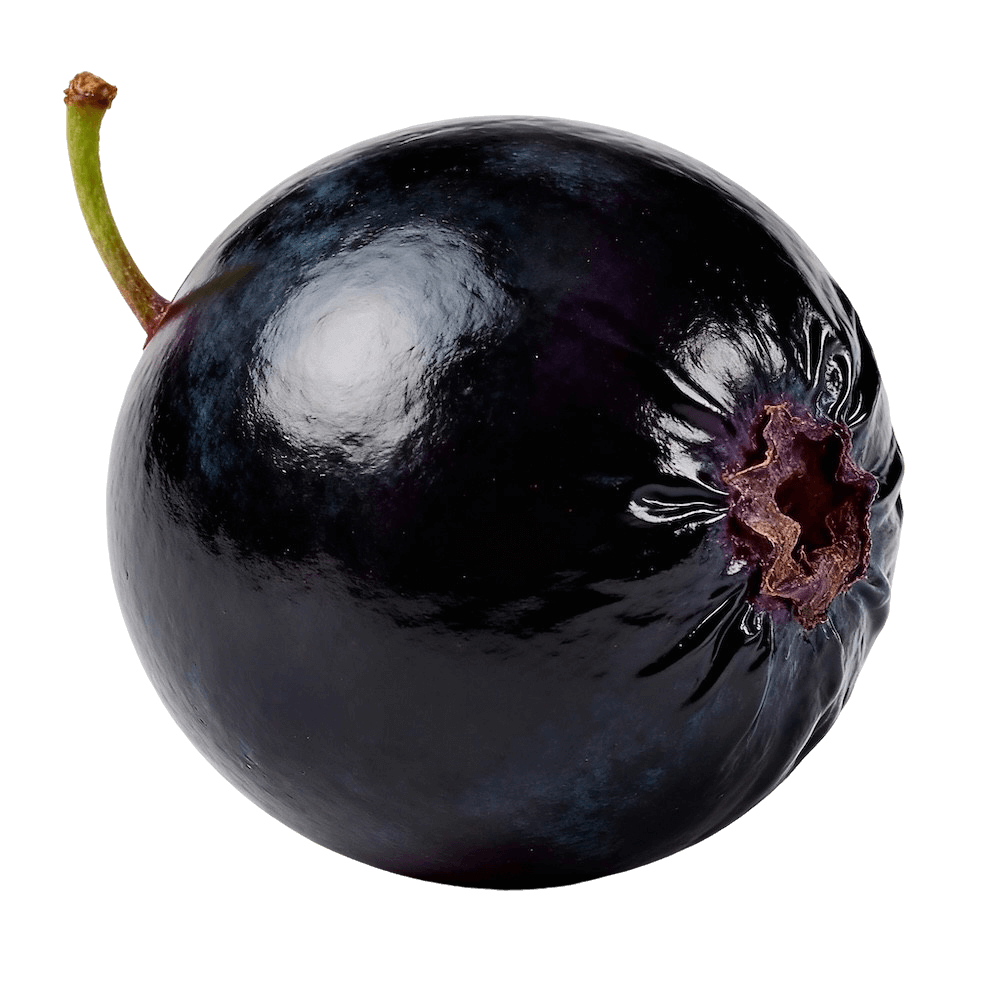
Black currant

Black currant

FamilyGrossulariaceae
Importance
Black currant is a dark purple berry from Ribes nigrum, known for its sharp tart flavor, deep color, vitamin C content, and concentrated berry polyphenols. The fruit is naturally rich in water, carbohydrate, organic acids, fiber, potassium, manganese, and vitamin C. Its dark pigment comes from anthocyanins, especially delphinidin and cyanidin glycosides, which give black currant its intense purple-black color and strong staining quality. These pigments occur with other phenolic compounds, creating a dense phytochemical profile compared with many lighter-colored fruits.

Per 100 g, raw black currant is a low-fat fruit with modest calories and naturally occurring sugars held within a fiber-rich berry matrix. The fruit’s acidity gives it a bright, strong flavor that is often balanced in smoothies, sauces, fruit blends, jams, juices, and baked dishes. Its fiber includes soluble and insoluble fractions that support normal digestive movement and provide fermentable material for gut microbes. The berry’s vitamin C content is especially notable, contributing to collagen formation, antioxidant recycling, and normal connective tissue support. Black currant also supplies potassium for fluid balance and manganese for normal enzyme function.

Black currant is best known for anthocyanins such as delphinidin-3-rutinoside, cyanidin-3-rutinoside, delphinidin-3-glucoside, and cyanidin-3-glucoside. It also contains flavonols, phenolic acids, proanthocyanidins, quercetin derivatives, myricetin derivatives, kaempferol derivatives, and aromatic compounds that contribute to its flavor and color. These compounds have been studied in relation to carbohydrate digestion, glucose transport, oxidative balance, and vascular function. The fruit’s polyphenols are especially relevant because black currant anthocyanins have been shown to interact with carbohydrate-digesting enzymes and post-meal glucose handling.

Black currant has a strong identity as a whole berry because it combines tart fruit acids, deep pigments, fiber, vitamin C, and a broad phenolic profile in a small fruit. Its flavor is more intense than blueberry or grape, with a balance of sourness, mild sweetness, and astringency. It fits well with other berries, citrus, oats, apples, pears, and leafy greens where a deep berry flavor and color-rich plant chemistry are desired. Its strongest nutritional characteristics are vitamin C density, anthocyanin concentration, berry fiber, potassium contribution, and naturally occurring polyphenols found in the edible fruit.

Region FoundBlack currant Ribes nigrum is native to temperate regions of northern and central Europe and parts of northern Asia. It is widely grown in the United Kingdom, Scandinavia, Poland, the Baltic region, Germany, France, Russia, New Zealand, and cool temperate agricultural areas where the plant receives adequate winter chilling and mild summer conditions.
Helps Fight These Cancers: Oral Cavity Pharynx Larynx Cancer, Esophageal Squamous Cell Carcinoma
Helps Fight These Ailments: Hyperlipidemia, Hypertension, Insulin Resistance
Linked Hormones:

All values per 100g
Nutrition Facts
Calories (kcal)63
Protein (g)1.4
Carbohydrates (g)15.4
Fiber (g)6.8
Sugars (g)6.7
Total Fat (g)0.41
Saturated Fat (g)0
Vitamins
Vitamin A (µg RAE)0
Vitamin C (mg)181
Vitamin D (µg)0
Vitamin E (mg)1
Vitamin K (µg)0
Vitamin B1 / Thiamin (mg)0.05
Vitamin B2 / Riboflavin (mg)0.05
Vitamin B3 / Niacin (mg)0.3
Vitamin B5 / Pantothenic Acid (mg)0.4
Vitamin B6 (mg)0.07
Vitamin B7 / Biotin (µg)0
Folate B9 (µg)0
Vitamin B12 (µg)0
Vitamin Detail Pages
Minerals
Calcium (mg)55
Iron (mg)1.5
Magnesium (mg)24
Phosphorus (mg)59
Potassium (mg)322
Sodium (mg)2
Zinc (mg)0.27
Copper (mg)0
Manganese (mg)0.26
Selenium (µg)0
Iodine (µg)0
Mineral Detail Pages
Amino Acids
Alanine (mg)0 mg
Arginine (mg)0 mg
Asparagine (mg)0 mg
Aspartic Acid (mg)0 mg
Cysteine (mg)0 mg
Glutamic Acid (mg)0 mg
Glutamine (mg)0 mg
Glycine (mg)0 mg
Histidine (mg)0 mg
Isoleucine (mg)0 mg
Leucine (mg)0 mg
Lysine (mg)0 mg
Methionine (mg)0 mg
Phenylalanine (mg)0 mg
Proline (mg)0 mg
Serine (mg)0 mg
Threonine (mg)0 mg
Tryptophan (mg)0 mg
Tyrosine (mg)0 mg
Valine (mg)0 mg
Amino Acid Detail Pages
Phytochemicals
Delphinidin-3-rutinoside, cyanidin-3-rutinoside, delphinidin-3-glucoside, cyanidin-3-glucoside, anthocyanins, proanthocyanidins, quercetin derivatives, myricetin derivatives, kaempferol derivatives, phenolic acids, flavonols, vitamin C, organic acids, and berry pectins. Research references: Barik SK, Russell WR, Moar KM, Cruickshank M, Scobbie L, Duncan G, Hoggard N. The anthocyanins in black currants regulate postprandial hyperglycaemia primarily by inhibiting alpha-glucosidase while other phenolics modulate salivary alpha-amylase, glucose uptake and sugar transporters. Journal of Nutritional Biochemistry. 2020. Cortez RE, Gonzalez de Mejia E. Blackcurrants Ribes nigrum: A Review on Chemistry, Processing, and Health Benefits. Journal of Food Science. 2019. Ejaz A, et al. Biological activities, therapeutic potential, and phytochemical profile of blackcurrant Ribes nigrum. Plants. 2023.
Research & Notes
Research Notes:
USDA/FDC via MyFoodData 100 g panel. Some vitamins/minor minerals not reported on FDC page → left NULL.
Notes:
Raw European black currants; per 100 g.
Created: 2025-10-21 10:12:23
Last Updated: 2026-06-04 08:05:23