Gooseberry

Gooseberry

FamilyGrossulariaceae
Importance
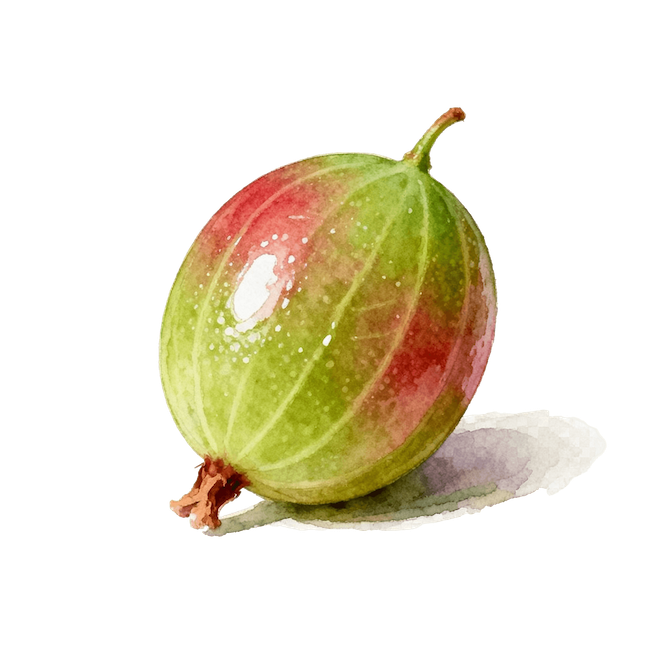
Gooseberry is a tart, translucent berry from Ribes uva-crispa, valued for its bright acidity, vitamin C, fiber, potassium, manganese, and berry polyphenols. The fruit may be green, yellow, red, or purple depending on cultivar and ripeness. Per 100 g, raw gooseberries provide about 44 calories, 10.2 g carbohydrate, 4.3 g fiber, 0.9 g protein, and very little fat. Their sugars occur within a whole berry matrix that includes water, pectin, organic acids, minerals, and phenolic compounds.

Gooseberry supports everyday nourishment through vitamin C, fiber, hydration, and minerals. Vitamin C contributes to collagen formation, antioxidant recycling, immune barrier function, and connective tissue maintenance. Fiber supports digestive movement, stool bulk, and gut microbial fermentation. Potassium supports fluid balance, nerve signaling, and muscle contraction, while manganese participates in normal enzyme systems related to connective tissue formation, carbohydrate metabolism, and antioxidant defense.

For cancer and ailment-support nutrition, gooseberry is relevant because Ribes fruits contain phenolic acids, flavonols, anthocyanins in darker cultivars, ascorbic acid, vitamin E, pectin, and other antioxidant-active compounds. These compounds connect to Nrf2-related antioxidant response, NF-kB inflammatory signaling balance, AMPK-linked metabolic regulation, insulin-related carbohydrate handling, endothelial function, phase II detoxification enzyme signaling, apoptosis-related cell signaling, and gut fermentation pathways supported by fiber. Gooseberry does not act as a standalone disease solution, but the whole fruit contributes antioxidant nutrients, digestive fiber, minerals, and polyphenols tied to cellular resilience, vascular function, inflammatory signaling balance, and normal metabolic regulation.

Gooseberry phytochemicals include quercetin derivatives, kaempferol derivatives, chlorogenic acid, caffeic acid derivatives, anthocyanins in red and purple cultivars, flavonols, phenolic acids, ascorbic acid, vitamin E, pectin, citric acid, malic acid, and other organic acids. Gooseberries pair well with apples, pears, citrus, oats, cinnamon, ginger, berries, leafy greens, walnuts, almonds, and whole grains. Their strongest nutritional identity is tart berry acidity, vitamin C, pectin-rich fiber, Ribes-family polyphenols, and pathways tied to antioxidant defense, digestive support, vascular balance, carbohydrate metabolism, and cellular repair.

Region FoundGooseberry Ribes uva-crispa is native to Europe, northwestern Africa, and parts of western Asia. It is widely cultivated in cool temperate regions, including the United Kingdom, Ireland, Scandinavia, Germany, Poland, France, Russia, Canada, the northern United States, and other areas with cold winters, mild summers, and well-drained soils.
Helps Fight These Cancers: Oral Cavity Pharynx Larynx Cancer, Esophageal Squamous Cell Carcinoma
Helps Fight These Ailments: Hyperlipidemia, Hypertension, Insulin Resistance
Linked Hormones:

All values per 100g
Nutrition Facts
Calories (kcal)44
Protein (g)0.87
Carbohydrates (g)10.2
Fiber (g)4.33
Sugars (g)0
Total Fat (g)0.58
Saturated Fat (g)0
Vitamins
Vitamin A (µg RAE)15
Vitamin C (mg)27.7
Vitamin D (µg)0
Vitamin E (mg)0.37
Vitamin K (µg)0
Vitamin B1 / Thiamin (mg)0.04
Vitamin B2 / Riboflavin (mg)0.033
Vitamin B3 / Niacin (mg)0.3
Vitamin B5 / Pantothenic Acid (mg)0.287
Vitamin B6 (mg)0.08
Vitamin B7 / Biotin (µg)0
Folate B9 (µg)6
Vitamin B12 (µg)0
Vitamin Detail Pages
Minerals
Calcium (mg)25
Iron (mg)0.31
Magnesium (mg)10
Phosphorus (mg)27
Potassium (mg)198
Sodium (mg)1
Zinc (mg)0.12
Copper (mg)0.073
Manganese (mg)0.147
Selenium (µg)0.6
Iodine (µg)0
Mineral Detail Pages
Amino Acids
Alanine (mg)0 mg
Arginine (mg)0 mg
Asparagine (mg)0 mg
Aspartic Acid (mg)0 mg
Cysteine (mg)0 mg
Glutamic Acid (mg)0 mg
Glutamine (mg)0 mg
Glycine (mg)0 mg
Histidine (mg)0 mg
Isoleucine (mg)0 mg
Leucine (mg)0 mg
Lysine (mg)0 mg
Methionine (mg)0 mg
Phenylalanine (mg)0 mg
Proline (mg)0 mg
Serine (mg)0 mg
Threonine (mg)0 mg
Tryptophan (mg)0 mg
Tyrosine (mg)0 mg
Valine (mg)0 mg
Amino Acid Detail Pages
Phytochemicals
Quercetin derivatives, kaempferol derivatives, chlorogenic acid, caffeic acid derivatives, anthocyanins in darker cultivars, flavonols, phenolic acids, ascorbic acid, vitamin E, pectin, citric acid, malic acid, potassium, manganese, and Ribes-family polyphenols. Research references: Chiang CJ, Kadouh H, Zhou K. Phenolic compounds and antioxidant properties of gooseberry as affected by in vitro digestion. LWT - Food Science and Technology. 2013. Orsavová J, Hlaváčová I, Mlček J, Snopek L, Mišurcová L. Contribution of phenolic compounds, ascorbic acid and vitamin E to antioxidant activity of currant Ribes L and gooseberry Ribes uva-crispa L fruits. Food Chemistry. 2019. Pinto MS, et al. Evaluation of red currants Ribes rubrum L, black currants Ribes nigrum L, red and green gooseberries Ribes uva-crispa L for phenolics, antioxidant capacity and enzyme inhibitory activity. Journal of Food Biochemistry. 2010.
Research & Notes
Research Notes:
USDA FDC via MyFoodData; page shows 150 g—scaled precisely to 100 g.
Notes:
Raw gooseberries; per 100 g.
Created: 2025-10-21 10:18:12
Last Updated: 2026-06-04 08:05:23