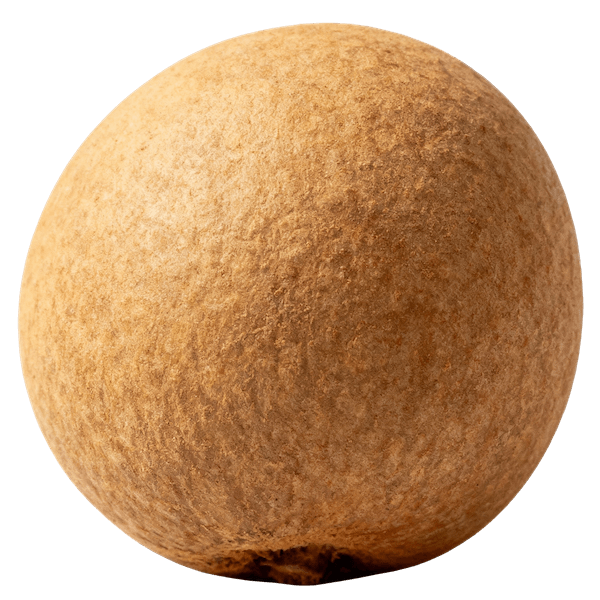
Longan

Longan

FamilySapindaceae
Importance
Longan is the translucent white fruit of Dimocarpus longan, a tropical and subtropical tree in the soapberry family. It is valued for its juicy texture, floral sweetness, vitamin C, potassium, copper, riboflavin, natural carbohydrate, and fruit polyphenols. Per 100 g, raw longan provides about 60 calories, 15.1 g carbohydrate, 1.1 g fiber, 1.3 g protein, and very little fat. Its edible aril surrounds a hard glossy seed that is not eaten. The sweet pulp contains water, sugars, organic acids, minerals, vitamin C, and smaller amounts of phenolic compounds, while the seed and peel are especially concentrated in polyphenols.

Longan supports everyday nourishment through hydration, vitamin C, potassium, copper, and light fruit carbohydrate. Vitamin C contributes to collagen formation, antioxidant recycling, immune barrier function, and connective tissue maintenance. Potassium supports fluid balance, nerve signaling, and muscle contraction. Copper participates in connective tissue enzyme systems, iron handling, and redox balance. Longan fiber supports digestive movement and microbial fermentation, while its natural sugars provide quickly available fruit energy.

For cancer and ailment-support nutrition, longan is relevant because Dimocarpus longan fruit tissues contain phenolic acids, flavonoids, proanthocyanidins, polysaccharides, ellagic acid derivatives, gallic acid, corilagin, and other antioxidant-active compounds. These compounds connect to Nrf2-related antioxidant response, NF-kB inflammatory signaling balance, AMPK-linked metabolic regulation, insulin-related carbohydrate handling, phase II detoxification enzyme signaling, endothelial function, apoptosis-related cell signaling, and gut fermentation pathways supported by fiber and polysaccharides. Longan does not act as a standalone disease solution, but the whole fruit contributes vitamin C, minerals, fiber, and plant compounds tied to cellular repair, inflammatory signaling balance, vascular support, digestive function, and normal metabolic regulation.

Longan is commonly eaten fresh, chilled, dried, or used in fruit bowls, teas, soups, desserts, and blended fruit preparations. It pairs well with citrus, mango, pineapple, banana, berries, coconut, mint, ginger, oats, and whole grains. Its strongest nutritional identity is the combination of sweet translucent pulp, vitamin C, potassium, copper, fruit polysaccharides, and longan-family polyphenols. It supports fruit diversity, antioxidant nutrient intake, digestive health patterns, carbohydrate metabolism, endothelial function, inflammatory signaling balance, and cellular defense pathways.

Region FoundLongan Dimocarpus longan is native to southern China and Southeast Asia and is widely cultivated in China, Thailand, Vietnam, Cambodia, Laos, Myanmar, Taiwan, India, Sri Lanka, Malaysia, Indonesia, the Philippines, Australia, Hawaii, Florida, and other tropical or subtropical regions with warm climates and frost protection.
Helps Fight These Cancers: Oral Cavity Pharynx Larynx Cancer
Helps Fight These Ailments: Immune Support, Iron Absorption, Skin Health
Linked Hormones:

All values per 100g
Nutrition Facts
Calories (kcal)60
Protein (g)1.33
Carbohydrates (g)16
Fiber (g)1.33
Sugars (g)0
Total Fat (g)0
Saturated Fat (g)0
Vitamins
Vitamin A (µg RAE)0
Vitamin C (mg)90
Vitamin D (µg)0
Vitamin E (mg)0
Vitamin K (µg)0
Vitamin B1 / Thiamin (mg)0
Vitamin B2 / Riboflavin (mg)0
Vitamin B3 / Niacin (mg)0.33
Vitamin B5 / Pantothenic Acid (mg)0
Vitamin B6 (mg)0
Vitamin B7 / Biotin (µg)0
Folate B9 (µg)0
Vitamin B12 (µg)0
Vitamin Detail Pages
Minerals
Calcium (mg)1
Iron (mg)0
Magnesium (mg)10.67
Phosphorus (mg)22.33
Potassium (mg)283.33
Sodium (mg)0
Zinc (mg)0
Copper (mg)0.33
Manganese (mg)0
Selenium (µg)0
Iodine (µg)0
Mineral Detail Pages
Amino Acids
Alanine (mg)0 mg
Arginine (mg)0 mg
Asparagine (mg)0 mg
Aspartic Acid (mg)0 mg
Cysteine (mg)0 mg
Glutamic Acid (mg)0 mg
Glutamine (mg)0 mg
Glycine (mg)0 mg
Histidine (mg)0 mg
Isoleucine (mg)0 mg
Leucine (mg)0 mg
Lysine (mg)0 mg
Methionine (mg)0 mg
Phenylalanine (mg)0 mg
Proline (mg)0 mg
Serine (mg)0 mg
Threonine (mg)0 mg
Tryptophan (mg)0 mg
Tyrosine (mg)0 mg
Valine (mg)0 mg
Amino Acid Detail Pages
Phytochemicals
Phenolic acids, flavonoids, proanthocyanidins, polysaccharides, gallic acid, ellagic acid derivatives, corilagin, catechin-related compounds, epicatechin-related compounds, organic acids, vitamin C, potassium, copper, riboflavin, and Dimocarpus longan bioactive compounds. Research references: Rangkadilok N, et al. Evaluation of free radical scavenging and antityrosinase activities of standardized longan fruit extract. Food and Chemical Toxicology. 2007. Yang B, Jiang Y, Shi J, Chen F, Ashraf M. Extraction and pharmacological properties of bioactive compounds from longan Dimocarpus longan Lour. fruit: a review. Food Research International. 2011. Zhong K, Wang Q. Optimization of ultrasonic extraction of polysaccharides from dried longan pulp using response surface methodology. Carbohydrate Polymers. 2010.
Research & Notes
Research Notes:
USDA FDC via MyFoodData; source serving 1 fruit (3 g) scaled exactly to 100 g; vitamin C also appears on MyFoodData 100 g ranking list.
Notes:
Raw aril; per 100 g.
Created: 2025-10-21 12:06:22
Last Updated: 2026-06-04 08:05:23