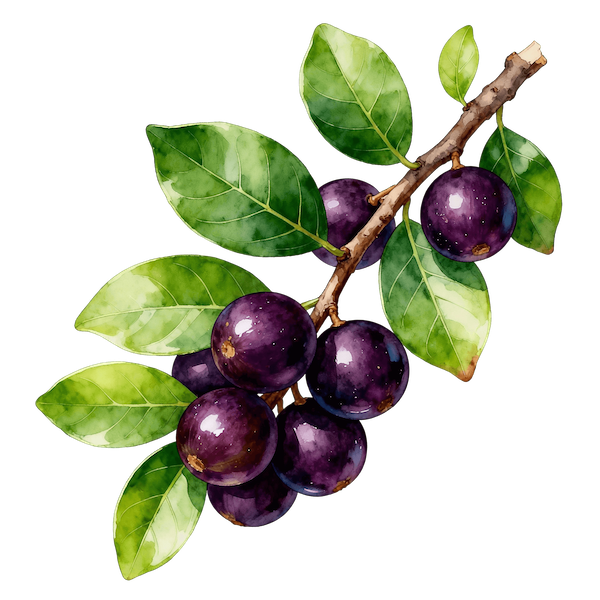
Jabuticaba

Jabuticaba

FamilyMyrtaceae
Importance
Jabuticaba is a dark purple Brazilian fruit from Plinia and Myrciaria species, especially Plinia cauliflora and Plinia jaboticaba, valued for its grape-like pulp, thick pigmented peel, fiber, vitamin C, minerals, organic acids, and concentrated polyphenols. The fruit grows directly on the trunk and branches of the tree, giving it a distinctive appearance. Its sweet-tart pulp is commonly eaten fresh, while the peel contributes strong color, tannins, anthocyanins, ellagitannins, and other phenolic compounds. Per 100 g, jabuticaba is mostly water and carbohydrate, with fiber, low fat, small amounts of protein, potassium, manganese, copper, calcium, phosphorus, and vitamin C.

Jabuticaba supports everyday nourishment through fruit fiber, organic acids, vitamin C, minerals, and polyphenols. Fiber supports digestive movement, stool bulk, and gut microbial fermentation. Vitamin C contributes to collagen formation, antioxidant recycling, immune barrier function, and connective tissue maintenance. Potassium supports fluid balance, nerve signaling, and muscle contraction. Manganese and copper support enzyme systems involved in connective tissue formation, redox balance, and energy metabolism.

For cancer and ailment-support nutrition, jabuticaba is relevant because its peel, pulp, and seeds contain anthocyanins, ellagitannins, ellagic acid, gallic acid, flavonols, proanthocyanidins, catechins, and organic acids. These compounds connect to Nrf2-related antioxidant response, NF-kB inflammatory signaling balance, AMPK-linked metabolic regulation, insulin-related carbohydrate handling, endothelial function, phase II detoxification enzyme signaling, apoptosis-related cell signaling, cell-cycle regulation, and gut fermentation pathways supported by fiber. Jabuticaba does not act as a standalone disease solution, but the whole fruit contributes redox-active pigments, digestive fiber, minerals, and polyphenols tied to cellular resilience, vascular support, inflammatory signaling balance, digestive function, and normal metabolic regulation.

Jabuticaba pairs well with citrus, berries, apples, pears, banana, cacao, oats, mint, ginger, walnuts, almonds, and whole grains. Its strongest nutritional identity is the combination of dark anthocyanin-rich peel, grape-like pulp, ellagitannins, ellagic acid, fiber, vitamin C, and Brazilian native-fruit chemistry. It supports fruit diversity, antioxidant nutrient intake, gut microbiota pathways, cellular repair, inflammatory signaling balance, vascular function, and carbohydrate metabolism.

Region FoundJabuticaba is native to Brazil, especially the Atlantic Forest and southeastern regions such as Minas Gerais, São Paulo, Rio de Janeiro, Espírito Santo, Paraná, and surrounding areas. It is also cultivated in other tropical and subtropical regions of South America and in warm frost-protected locations where humid conditions and suitable soils support slow-growing fruit trees.
Helps Fight These Cancers: Oral Cavity Pharynx Larynx Cancer, Colon Cancer, Gastric Cancer
Helps Fight These Ailments: Immune Support, Skin Health, Hyperlipidemia
Linked Hormones:

All values per 100g
Nutrition Facts
Calories (kcal)60
Protein (g)0.61
Carbohydrates (g)15.3
Fiber (g)2.3
Sugars (g)0
Total Fat (g)0.13
Saturated Fat (g)0
Vitamins
Vitamin A (µg RAE)0
Vitamin C (mg)16.2
Vitamin D (µg)0
Vitamin E (mg)0
Vitamin K (µg)0
Vitamin B1 / Thiamin (mg)0.06
Vitamin B2 / Riboflavin (mg)0
Vitamin B3 / Niacin (mg)0
Vitamin B5 / Pantothenic Acid (mg)0
Vitamin B6 (mg)0
Vitamin B7 / Biotin (µg)0
Folate B9 (µg)0
Vitamin B12 (µg)0
Vitamin Detail Pages
Minerals
Calcium (mg)8.35
Iron (mg)0.1
Magnesium (mg)17.8
Phosphorus (mg)14.6
Potassium (mg)129
Sodium (mg)0
Zinc (mg)0.28
Copper (mg)0.07
Manganese (mg)0.3
Selenium (µg)0
Iodine (µg)0
Mineral Detail Pages
Amino Acids
Alanine (mg)0 mg
Arginine (mg)0 mg
Asparagine (mg)0 mg
Aspartic Acid (mg)0 mg
Cysteine (mg)0 mg
Glutamic Acid (mg)0 mg
Glutamine (mg)0 mg
Glycine (mg)0 mg
Histidine (mg)0 mg
Isoleucine (mg)0 mg
Leucine (mg)0 mg
Lysine (mg)0 mg
Methionine (mg)0 mg
Phenylalanine (mg)0 mg
Proline (mg)0 mg
Serine (mg)0 mg
Threonine (mg)0 mg
Tryptophan (mg)0 mg
Tyrosine (mg)0 mg
Valine (mg)0 mg
Amino Acid Detail Pages
Phytochemicals
Anthocyanins, cyanidin derivatives, delphinidin derivatives, ellagitannins, vescalagin, castalagin, ellagic acid, methyl ellagic acid derivatives, gallic acid, flavonols, quercetin derivatives, myricetin derivatives, catechin, gallocatechin, proanthocyanidins, organic acids, vitamin C, potassium, manganese, copper, calcium, phosphorus, and dietary fiber. Research references: Wu SB, Long C, Kennelly EJ. Phytochemistry and health benefits of jaboticaba, an emerging fruit crop from Brazil. Food Research International. 2013. Neves N de A, et al. Identification and quantification of phenolic composition from jabuticaba fruits. Food Chemistry. 2021. Loubet Filho PS, et al. Gut microbiota modulation by jabuticaba peel and its effect on short-chain fatty acid production. Food Research International. 2022.
Research & Notes
Research Notes:
TBCA (USP) code BRC0079C per 100 g; “available carbohydrates” = 13 g (sugars not itemized) → sugars set NULL; sodium listed as trace → NULL.
Notes:
Whole jabuticaba (edible portion) per 100 g.
Created: 2025-10-21 12:46:19
Last Updated: 2026-06-04 08:05:23