Medlar

Medlar

FamilyRosaceae
Importance
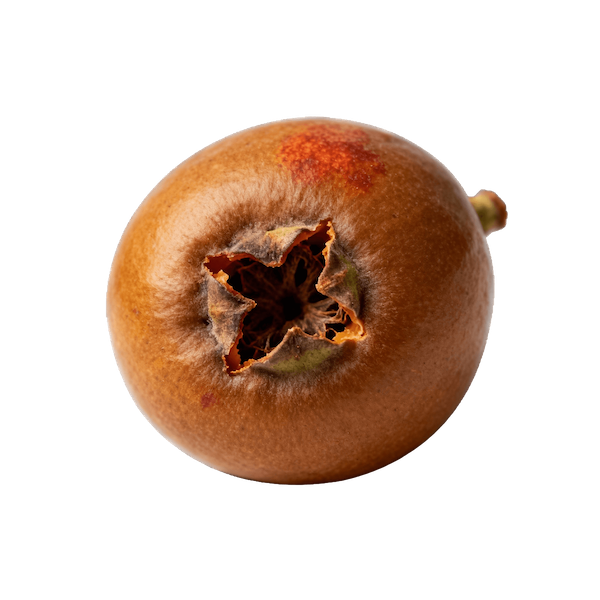
Medlar is the brown pome fruit of Mespilus germanica, a small tree in the rose family. The fruit is firm and acidic when first picked, then becomes soft, sweet, aromatic, and paste-like after bletting, the natural ripening process that makes the pulp edible and flavorful. Medlar is valued for dietary fiber, pectin, organic acids, potassium, calcium, vitamin C, phenolic acids, flavonols, flavanols, tannins, and antioxidant-active plant compounds. Its flavor is often described as a mixture of apple butter, pear, date, citrus, and mild spice, with a texture that becomes smooth when fully softened.

Medlar supports everyday nourishment through fiber, pectin, minerals, and polyphenols. Fiber and pectin support digestive movement, stool bulk, and microbial fermentation. Vitamin C contributes to collagen formation, antioxidant recycling, immune barrier function, and connective tissue maintenance. Potassium supports fluid balance, nerve signaling, and muscle contraction. Calcium supports bone mineral structure and cell signaling, while organic acids contribute tartness and fruit metabolism.

For cancer and ailment-support nutrition, medlar is relevant because Mespilus germanica fruit contains chlorogenic acid, caffeic acid derivatives, gallic acid, catechin, epicatechin, quercetin derivatives, kaempferol derivatives, flavanols, flavonols, tannins, pectin, organic acids, vitamin C, and other antioxidant-active compounds. These compounds connect to Nrf2-related antioxidant response, NF-kB inflammatory signaling balance, AMPK-linked metabolic regulation, insulin-related carbohydrate handling, endothelial function, phase II detoxification enzyme signaling, apoptosis-related cell signaling, and gut fermentation pathways supported by fiber. Medlar does not act as a standalone disease solution, but the whole fruit contributes antioxidant nutrients, digestive fiber, minerals, and plant compounds tied to cellular repair, inflammatory signaling balance, vascular support, digestive function, and normal metabolic regulation.

Medlar pairs well with apples, pears, quince, citrus, cinnamon, ginger, oats, walnuts, almonds, berries, and whole grains. Its strongest nutritional identity is the combination of bletted pome-fruit texture, pectin-rich fiber, tart organic acids, tannins, phenolic acids, flavonols, and Mespilus-family polyphenols connected to antioxidant, digestive, metabolic, vascular, inflammatory, and cellular repair pathways.

Region FoundMedlar Mespilus germanica is native to southeastern Europe and western to central Asia and has long been cultivated across Europe and southwest Asia. It grows in temperate climates, woodland edges, scrublands, orchards, hedgerows, and garden plantings. It is found in the Balkans, the Caucasus, Turkey, Iran, parts of central Asia, western Europe, the United Kingdom, and other mild temperate regions.
Helps Fight These Cancers: Oral Cavity Pharynx Larynx Cancer, Colon Cancer, Gastric Cancer
Helps Fight These Ailments: Antioxidant Defense, Metabolic Health, Skin Health
Linked Hormones:

All values per 100g
Nutrition Facts
Calories (kcal)49
Protein (g)0.5
Carbohydrates (g)10.6
Fiber (g)2.1
Sugars (g)10.6
Total Fat (g)0.2
Saturated Fat (g)0
Vitamins
Vitamin A (µg RAE)10
Vitamin C (mg)2
Vitamin D (µg)0
Vitamin E (mg)0.6
Vitamin K (µg)0
Vitamin B1 / Thiamin (mg)0.02
Vitamin B2 / Riboflavin (mg)0.02
Vitamin B3 / Niacin (mg)0.293
Vitamin B5 / Pantothenic Acid (mg)0
Vitamin B6 (mg)0.019
Vitamin B7 / Biotin (µg)0
Folate B9 (µg)14
Vitamin B12 (µg)0
Vitamin Detail Pages
Minerals
Calcium (mg)16
Iron (mg)0.28
Magnesium (mg)13
Phosphorus (mg)27
Potassium (mg)266
Sodium (mg)1
Zinc (mg)0.05
Copper (mg)0.04
Manganese (mg)0.148
Selenium (µg)0.6
Iodine (µg)0
Mineral Detail Pages
Amino Acids
Alanine (mg)0 mg
Arginine (mg)0 mg
Asparagine (mg)0 mg
Aspartic Acid (mg)0 mg
Cysteine (mg)0 mg
Glutamic Acid (mg)0 mg
Glutamine (mg)0 mg
Glycine (mg)0 mg
Histidine (mg)0 mg
Isoleucine (mg)0 mg
Leucine (mg)0 mg
Lysine (mg)0 mg
Methionine (mg)0 mg
Phenylalanine (mg)0 mg
Proline (mg)0 mg
Serine (mg)0 mg
Threonine (mg)0 mg
Tryptophan (mg)0 mg
Tyrosine (mg)0 mg
Valine (mg)0 mg
Amino Acid Detail Pages
Phytochemicals
Chlorogenic acid, caffeic acid derivatives, gallic acid, catechin, epicatechin, quercetin derivatives, kaempferol derivatives, flavanols, flavonols, flavanones, tannins, phenolic acids, organic acids, malic acid, tartaric acid, oxalic acid, citric acid, pectin, dietary fiber, vitamin C, potassium, calcium, and antioxidant-active Mespilus germanica polyphenols. Research references: Mikulic-Petkovsek M, et al. Changes in the Fruit Quality Parameters of Medlar Fruit Mespilus germanica L. During Development and Ripening. Plants. 2023. Sadeghinejad Z, et al. Bioactive content and phenolic compounds of common medlar Mespilus germanica L. leaf, fruit and seed. Scientific Reports. 2022. Nistor DI, et al. Phytochemistry, nutritional composition, health benefits and food applications of medlar Mespilus germanica L. Food Chemistry Advances. 2024.
Research & Notes
Research Notes:
Per-100 g compiled nutrient panel (FDDB). Government databases lack a full standardized entry; unreported nutrients left NULL.
Notes:
Raw medlar edible portion (bletted fruit); per 100 g.
Created: 2025-10-21 13:15:43
Last Updated: 2026-06-04 08:05:23