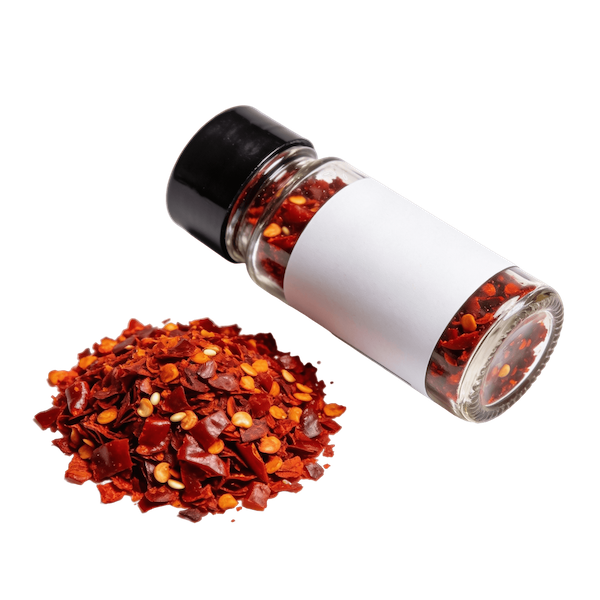
Red Chili Flakes (Crushed, Dried)

Red Chili Flakes (Crushed, Dried)

FamilySolanaceae (Nightshade Family)
Importance
Crushed red chili flakes are a concentrated Capsicum spice made from dried red peppers, often including both flesh and seed. Their nutritional identity is built around capsaicinoids, carotenoids, fiber, potassium, iron, magnesium, vitamin E compounds, phenolic acids, flavonoids, and antioxidant pigments. The strongest active compounds are capsaicin and dihydrocapsaicin, which provide heat and interact with TRPV1 signaling. Red chili flakes also contain capsanthin, capsorubin, beta-carotene, beta-cryptoxanthin, lutein, zeaxanthin, violaxanthin, ferulic acid, caffeic acid, chlorogenic acid, quercetin derivatives, and related Capsicum phytochemicals.

Red chili flakes support metabolic and cellular pathways through capsaicin-sensitive signaling, antioxidant pigments, and inflammatory regulation. Capsaicin interacts with TRPV1, a receptor involved in heat sensation, vascular tone, energy expenditure, digestive signaling, and inflammatory communication. Capsicum compounds have been studied in relation to glucose handling, insulin-related metabolic response, lipid metabolism, appetite signaling, thermogenesis, oxidative stress, and endothelial function. These pathways connect chili flakes to insulin signaling, mitochondrial energy metabolism, redox balance, lipid handling, and vascular regulation.

The antioxidant value of red chili flakes comes from carotenoids, capsaicinoids, phenolic acids, flavonoids, and tocopherols. These compounds connect crushed red chili to Nrf2 antioxidant response, NF-kB inflammatory signaling balance, lipid oxidation defense, mitochondrial protection, DNA protection, and normal cellular repair. In cancer-supportive nutrition patterns, red chili flakes are most relevant for capsaicinoids, carotenoids, phenolic compounds, antioxidant activity, and inflammatory-signaling effects. Capsaicin has been studied in cell-signaling pathways involving oxidative stress, apoptosis signaling balance, inflammatory mediators, angiogenesis-related signaling, cell-cycle regulation, and cellular stress response.

Crushed red chili flakes also provide small amounts of amino acids, including glutamic acid, aspartic acid, alanine, arginine, leucine, valine, glycine, lysine, phenylalanine, and serine. Because chili flakes are used in small amounts, their strongest role is phytochemical and pigment support rather than protein density. Potassium supports fluid and electrical balance, magnesium supports ATP metabolism, iron supports oxygen handling, and carotenoids support membrane protection.

Crushed red chili flakes are best understood as a concentrated whole-food spice that supports digestive signaling, metabolic steadiness, cardiovascular function, immune communication, cellular repair, and long-term antioxidant protection through their combined capsaicinoids, carotenoids, phenolic acids, minerals, fiber, and Capsicum plant chemistry.

Region FoundCapsicum peppers are native to Central America, South America, and Mexico; crushed red chili peppers are now produced across India, China, Mexico, Turkey, Southeast Asia, Africa, the Mediterranean region, and other warm pepper-growing regions
Helps Fight These Cancers: Colorectal Cancer, Liver Cancer, Pancreatic Cancer, Prostate Cancer
Helps Fight These Ailments: Low Circulation, Slow Metabolism, Chronic Inflammation, Dyspepsia, Insulin Resistance
Linked Hormones:
Linked Enzymes:
SUMMARY OF EFFECTS ON THE BODY
Immune System
Capsaicin modulates inflammatory cytokine signaling
Cardiovascular
TRPV1 activation increases circulation and vascular responsiveness
Digestive System
Enhances gastric enzyme secretion and digestive efficiency
Skin & Collagen
Carotenoids protect epithelial surfaces
Cellular Repair
Antioxidants and capsaicin promote mitochondrial adaptive stress response

All values per 100g
Nutrition Facts
Calories (kcal)318
Protein (g)12.1
Carbohydrates (g)56.63
Fiber (g)27.2
Sugars (g)10.34
Total Fat (g)17.27
Saturated Fat (g)3.26
Vitamins
Vitamin A (µg RAE)2081
Vitamin C (mg)76.4
Vitamin D (µg)0
Vitamin E (mg)29.8
Vitamin K (µg)80.3
Vitamin B1 / Thiamin (mg)0.328
Vitamin B2 / Riboflavin (mg)0.919
Vitamin B3 / Niacin (mg)8.701
Vitamin B5 / Pantothenic Acid (mg)1.394
Vitamin B6 (mg)2.45
Vitamin B7 / Biotin (µg)0
Folate B9 (µg)106
Vitamin B12 (µg)0
Vitamin Detail Pages
Minerals
Calcium (mg)148
Iron (mg)7.8
Magnesium (mg)152
Phosphorus (mg)293
Potassium (mg)2014
Sodium (mg)30
Zinc (mg)2.48
Copper (mg)0.373
Manganese (mg)1.727
Selenium (µg)8.8
Iodine (µg)0
Mineral Detail Pages
Amino Acids
Alanine (mg)520 mg
Arginine (mg)430 mg
Asparagine (mg)0 mg
Aspartic Acid (mg)980 mg
Cysteine (mg)100 mg
Glutamic Acid (mg)1,370 mg
Glutamine (mg)0 mg
Glycine (mg)430 mg
Histidine (mg)170 mg
Isoleucine (mg)330 mg
Leucine (mg)600 mg
Lysine (mg)450 mg
Methionine (mg)120 mg
Phenylalanine (mg)400 mg
Proline (mg)390 mg
Serine (mg)400 mg
Threonine (mg)310 mg
Tryptophan (mg)0 mg
Tyrosine (mg)260 mg
Valine (mg)510 mg
Amino Acid Detail Pages
Phytochemicals
Capsaicin, dihydrocapsaicin, nordihydrocapsaicin, homocapsaicin, capsaicinoids, capsanthin, capsorubin, beta-carotene, beta-cryptoxanthin, lutein, zeaxanthin, violaxanthin, carotenoids, alpha-tocopherol, gamma-tocopherol, ferulic acid, caffeic acid, chlorogenic acid, p-coumaric acid, gallic acid, quercetin derivatives, flavonoids, phenolic acids
Research & Notes
Research Notes:
USDA SR-Legacy reference: “Spices, pepper, red or cayenne.” Crushed flakes differ in texture, not nutrient base. Capsaicin content ranges 0.1–0.6% in standard flakes. Amino acids not reported → AA = NULL. GI/GL not measurable.
Notes:
Add at plating stage to preserve volatile oils; best stored in airtight glass away from heat.
Created: 2025-11-08 16:05:57
Last Updated: 2026-06-04 08:14:51