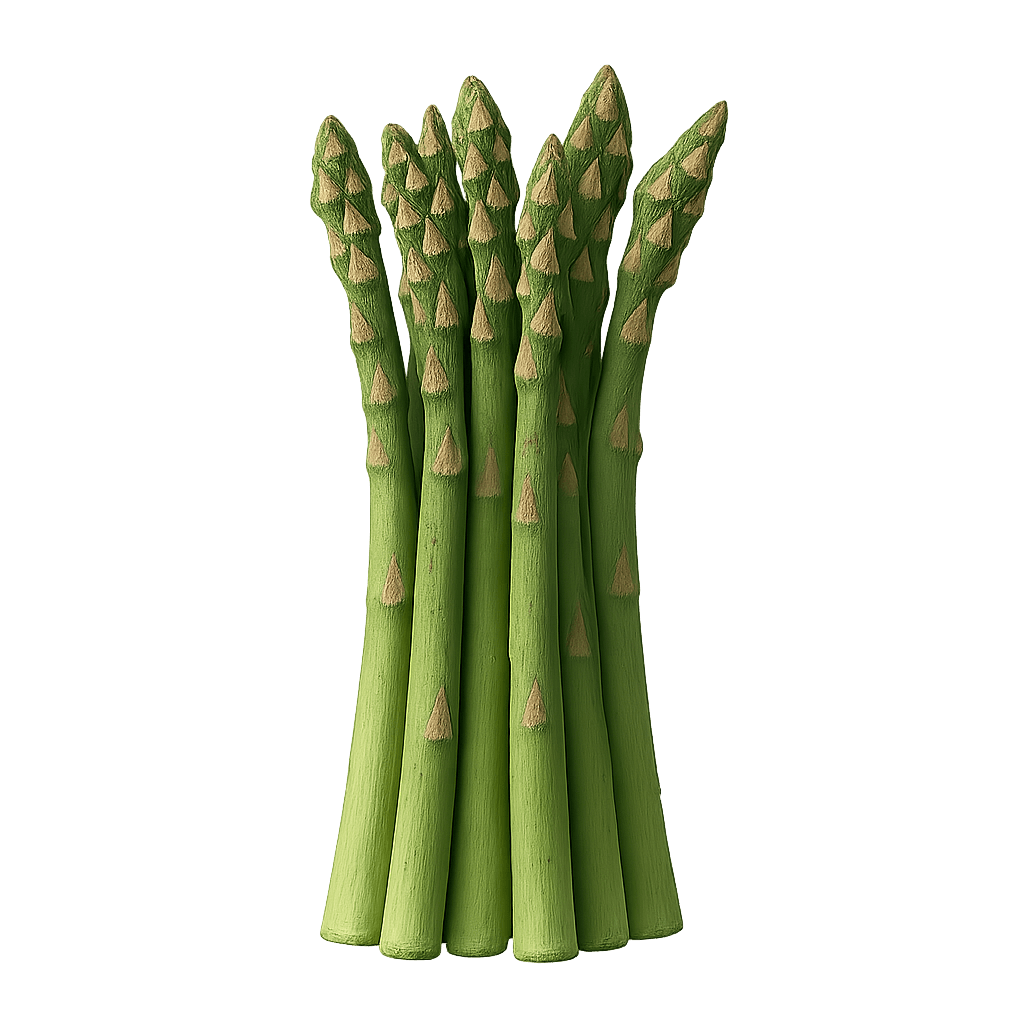
Vegetable Detail

Asparagus

Asparagus

FamilyAsparagaceae
Importance
Asparagus is the young edible spear of Asparagus officinalis, valued for its tender stalks, green color, fiber, folate, vitamin K, vitamin C, vitamin A carotenoid activity, potassium, iron, copper, and distinctive sulfur-containing compounds. Per 100 g, raw asparagus provides about 20 calories, 3.9 g carbohydrate, 2.1 g fiber, 2.2 g protein, and very little fat. Its carbohydrate occurs within a low-calorie vegetable matrix that includes water, soluble fiber, insoluble fiber, minerals, amino acids, organic acids, and antioxidant-active phytochemicals. The tips are especially tender and contain concentrated plant compounds, while the stalks provide texture and fiber.

Asparagus supports everyday nourishment through folate, vitamin K, vitamin C, fiber, potassium, and mineral cofactors. Folate participates in one-carbon metabolism, DNA synthesis, and normal cell division. Vitamin K supports normal blood-clotting protein activation and bone-related protein function. Vitamin C contributes to collagen formation, antioxidant recycling, immune barrier function, and connective tissue maintenance. Fiber supports digestive movement, stool bulk, and microbial fermentation. Potassium supports fluid balance, nerve signaling, and muscle contraction, while iron and copper support oxygen transport, iron handling, connective tissue enzyme systems, and redox balance.

For cancer and ailment-support nutrition, asparagus is relevant because Asparagus officinalis contains rutin, quercetin derivatives, kaempferol derivatives, saponins, glutathione, asparagine, fructans, phenolic acids, chlorophylls, carotenoids, vitamin C, folate, and fiber. These compounds connect to Nrf2-related antioxidant response, NF-kB inflammatory signaling balance, one-carbon metabolism, DNA synthesis and repair support, glutathione-related redox balance, AMPK-linked metabolic regulation, insulin-related carbohydrate handling, endothelial function, phase II detoxification enzyme signaling, and gut fermentation pathways supported by fiber and fructans. Asparagus does not act as a standalone disease solution, but the whole vegetable contributes antioxidant compounds, digestive fiber, folate, minerals, sulfur-related metabolites, and polyphenols tied to cellular repair, inflammatory signaling balance, vascular support, digestive function, and normal metabolic regulation.

Asparagus pairs well with mushrooms, onions, garlic, tomatoes, lentils, beans, chickpeas, brown rice, quinoa, potatoes, citrus, parsley, basil, spinach, kale, walnuts, and pumpkin seeds. Its strongest nutritional identity is the combination of folate, vitamin K, fiber, rutin, glutathione-related chemistry, saponins, potassium, and Asparagus-family phytochemicals connected to antioxidant, digestive, vascular, metabolic, inflammatory, detoxification-enzyme, and cellular defense pathways.

Region FoundAsparagus officinalis is native to Europe, western Asia, and northern Africa and is now cultivated widely in temperate and subtropical vegetable-growing regions. Major production areas include China, Peru, Mexico, Germany, Spain, Italy, France, the United States, Canada, and other regions with well-drained soils, winter dormancy or cool seasons, full sun, and established perennial crowns.
Helps Fight These Cancers: Colorectal, Stomach, Esophagus (Category Level Evidence For Non Starchy Vegetables)
Helps Fight These Ailments: Diuretic And Detox Support, Promotes Healthy Methylation Due To Folate, Antioxidant Saponins.
Linked Hormones:

All values per 100g
Nutrition Facts
Calories (kcal)20
Protein (g)2.2
Carbohydrates (g)3.88
Fiber (g)2.1
Sugars (g)1.88
Total Fat (g)0.12
Saturated Fat (g)0
Vitamins
Vitamin A (µg RAE)38
Vitamin C (mg)5.6
Vitamin D (µg)0
Vitamin E (mg)1.13
Vitamin K (µg)41.6
Vitamin B1 / Thiamin (mg)0.143
Vitamin B2 / Riboflavin (mg)0.141
Vitamin B3 / Niacin (mg)0.978
Vitamin B5 / Pantothenic Acid (mg)0.274
Vitamin B6 (mg)0.091
Vitamin B7 / Biotin (µg)0
Folate B9 (µg)52
Vitamin B12 (µg)0
Vitamin Detail Pages
Minerals
Calcium (mg)24
Iron (mg)2.14
Magnesium (mg)14
Phosphorus (mg)52
Potassium (mg)202
Sodium (mg)2
Zinc (mg)0.54
Copper (mg)0.189
Manganese (mg)0.158
Selenium (µg)2.3
Iodine (µg)0
Mineral Detail Pages
Amino Acids
Alanine (mg)115 mg
Arginine (mg)91 mg
Asparagine (mg)0 mg
Aspartic Acid (mg)508 mg
Cysteine (mg)38 mg
Glutamic Acid (mg)233 mg
Glutamine (mg)0 mg
Glycine (mg)93 mg
Histidine (mg)49 mg
Isoleucine (mg)84 mg
Leucine (mg)128 mg
Lysine (mg)104 mg
Methionine (mg)31 mg
Phenylalanine (mg)75 mg
Proline (mg)71 mg
Serine (mg)106 mg
Threonine (mg)84 mg
Tryptophan (mg)27 mg
Tyrosine (mg)52 mg
Valine (mg)115 mg
Amino Acid Detail Pages
Phytochemicals
Rutin, quercetin derivatives, kaempferol derivatives, saponins, steroidal saponins, glutathione, asparagine, fructans, inulin-type carbohydrates, phenolic acids, chlorophyll a, chlorophyll b, beta-carotene, lutein, zeaxanthin, vitamin C, folate, vitamin K, potassium, iron, copper, selenium traces, fiber, and Asparagus officinalis bioactive compounds. Research references: Jaramillo-Carmona S, et al. Nutritional and functional properties of asparagus Asparagus officinalis L.: a review. Food Chemistry. 2019. Negi JS, Singh P, Joshi GP, Rawat MS, Bisht VK. Chemical constituents of Asparagus. Pharmacognosy Reviews. 2010. Wang M, Tadmor Y, Wu QL, Chin CK, Garrison SA, Simon JE. Quantification of protodioscin and rutin in asparagus shoots by LC/MS and HPLC methods. Journal of Agricultural and Food Chemistry. 2003.
Research & Notes
Research Notes:
USDA FoodData Central / MyFoodData per 100 g. Amino acids from MyFoodData amino panel scaled to 100 g. Biotin, iodine, asparagine, glutamine not reported → NULL. Protective associations from observational studies of non-starchy vegetables and folate-rich foods in colorectal and upper GI cancers.
Notes:
Raw green asparagus spears baseline.
Created: 2025-10-23 16:24:20
Last Updated: 2026-06-04 08:13:13