Vegetable Detail

Beetroot

Beetroot

FamilyAmaranthaceae
Importance
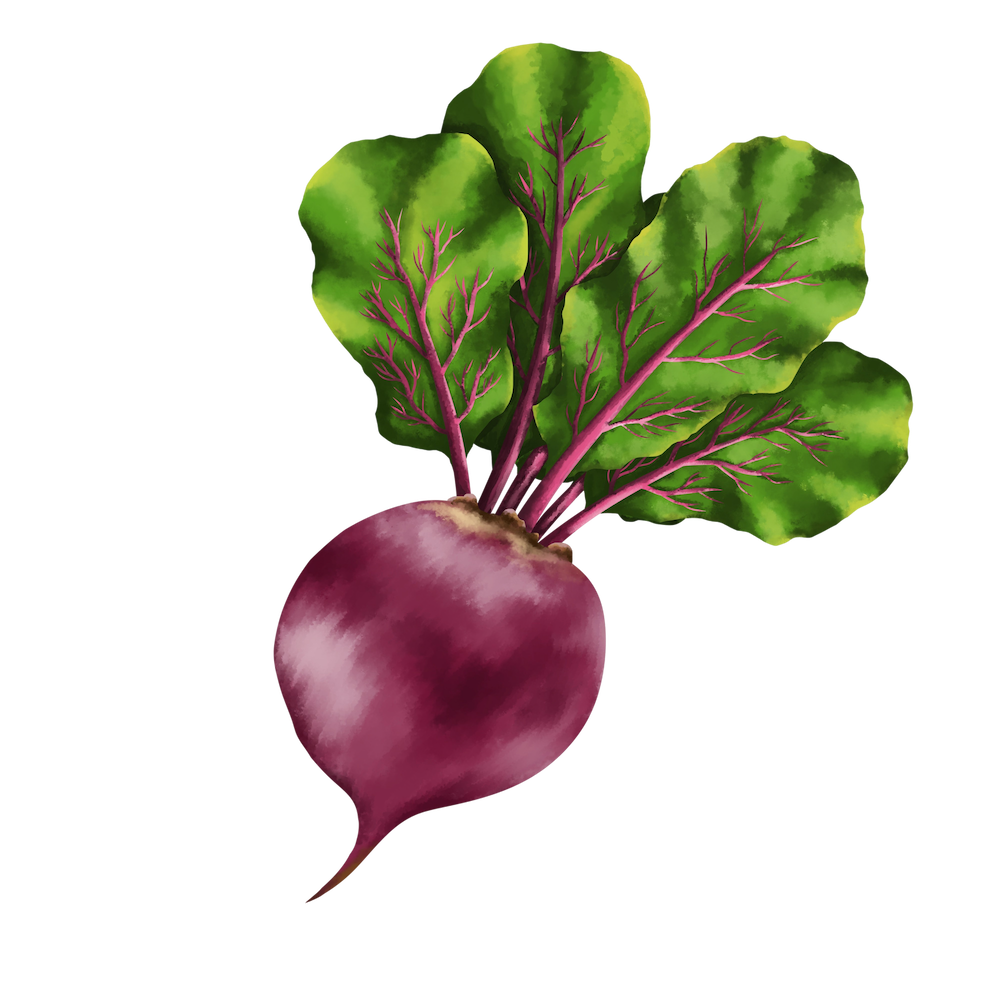
Beetroot is the red-purple storage root of Beta vulgaris, valued for its earthy sweetness, fiber, folate, potassium, manganese, magnesium, dietary nitrate, betalain pigments, and phenolic compounds. Per 100 g, raw beetroot provides about 43 calories, 9.6 g carbohydrate, 2.8 g fiber, 1.6 g protein, and very little fat. Its carbohydrate occurs within a whole root vegetable matrix that includes water, soluble fiber, insoluble fiber, organic acids, minerals, nitrate, and antioxidant-active pigments. The deep red color comes mainly from betalains, especially betanin, while yellow beet varieties contain betaxanthin pigments.

Beetroot supports everyday nourishment through folate, fiber, potassium, manganese, vitamin C, and nitrate. Folate participates in one-carbon metabolism, DNA synthesis, and normal cell division. Fiber supports digestive movement, stool bulk, and microbial fermentation. Potassium supports fluid balance, nerve signaling, and muscle contraction. Manganese supports enzyme systems involved in carbohydrate metabolism, connective tissue formation, and antioxidant defense. Dietary nitrate can be converted through oral and vascular pathways into nitric oxide, a signaling molecule involved in blood vessel function.

For cancer and ailment-support nutrition, beetroot is relevant because Beta vulgaris contains betalains, betanin, vulgaxanthins, phenolic acids, flavonoids, nitrate, pectin, folate, vitamin C, and mineral cofactors. These compounds connect to Nrf2-related antioxidant response, NF-kB inflammatory signaling balance, nitric oxide signaling, endothelial function, one-carbon metabolism, DNA synthesis and repair support, AMPK-linked metabolic regulation, insulin-related carbohydrate handling, phase II detoxification enzyme signaling, apoptosis-related cell signaling, and gut fermentation pathways supported by fiber. Beetroot does not act as a standalone disease solution, but the whole vegetable contributes antioxidant pigments, digestive fiber, folate, nitrate, minerals, and polyphenols tied to cellular repair, inflammatory signaling balance, vascular support, digestive function, and normal metabolic regulation.

Beetroot pairs well with lentils, chickpeas, beans, onions, garlic, carrots, cabbage, kale, arugula, citrus, apples, walnuts, pumpkin seeds, brown rice, quinoa, potatoes, parsley, dill, and ginger. Its strongest nutritional identity is the combination of red betalain color, folate, fiber, potassium, manganese, nitrate, betanin, phenolic acids, and Beta-family phytochemicals connected to antioxidant, digestive, vascular, metabolic, inflammatory, nitric-oxide, and cellular defense pathways.

Region FoundBeetroot Beta vulgaris is derived from beet species native to the Mediterranean and western Asia and is now cultivated worldwide in temperate and subtropical regions. Major growing areas include Europe, North America, Russia, China, India, the Middle East, Australia, and South America. Beetroot grows best in cool to moderate weather, fertile well-drained soils, full sun, and steady moisture.
Glycemic Index61.0
Glycemic Load4.15
Helps Fight These Cancers: Lung, Stomach, Colorectal (Antioxidant Pigment And Nitrate Mediated Effects)
Helps Fight These Ailments: Improves Circulation And Oxygen Delivery, Supports Liver Detox And Antioxidant Enzyme Activity.
Linked Hormones:

All values per 100g
Nutrition Facts
Calories (kcal)43
Protein (g)1.61
Carbohydrates (g)9.56
Fiber (g)2.8
Sugars (g)6.76
Total Fat (g)0.17
Saturated Fat (g)0
Vitamins
Vitamin A (µg RAE)2
Vitamin C (mg)4.9
Vitamin D (µg)0
Vitamin E (mg)0.04
Vitamin K (µg)0.2
Vitamin B1 / Thiamin (mg)0.031
Vitamin B2 / Riboflavin (mg)0.04
Vitamin B3 / Niacin (mg)0.334
Vitamin B5 / Pantothenic Acid (mg)0.145
Vitamin B6 (mg)0.067
Vitamin B7 / Biotin (µg)0
Folate B9 (µg)109
Vitamin B12 (µg)0
Vitamin Detail Pages
Minerals
Calcium (mg)16
Iron (mg)0.8
Magnesium (mg)23
Phosphorus (mg)40
Potassium (mg)325
Sodium (mg)78
Zinc (mg)0.35
Copper (mg)0.075
Manganese (mg)0.329
Selenium (µg)1
Iodine (µg)0
Mineral Detail Pages
Amino Acids
Alanine (mg)60 mg
Arginine (mg)42 mg
Asparagine (mg)0 mg
Aspartic Acid (mg)116 mg
Cysteine (mg)19 mg
Glutamic Acid (mg)428 mg
Glutamine (mg)0 mg
Glycine (mg)31 mg
Histidine (mg)21 mg
Isoleucine (mg)48 mg
Leucine (mg)68 mg
Lysine (mg)58 mg
Methionine (mg)18 mg
Phenylalanine (mg)46 mg
Proline (mg)43 mg
Serine (mg)59 mg
Threonine (mg)47 mg
Tryptophan (mg)19 mg
Tyrosine (mg)38 mg
Valine (mg)56 mg
Amino Acid Detail Pages
Phytochemicals
Betalains, betanin, isobetanin, vulgaxanthins, betaxanthins, phenolic acids, ferulic acid derivatives, caffeic acid derivatives, p-coumaric acid derivatives, flavonoids, nitrate, pectin, soluble fiber, insoluble fiber, folate, vitamin C, potassium, manganese, magnesium, iron, and Beta vulgaris bioactive compounds. Research references: Clifford T, Howatson G, West DJ, Stevenson EJ. The Potential Benefits of Red Beetroot Supplementation in Health and Disease. Nutrients. 2015. Georgiev VG, Weber J, Kneschke EM, Denev PN, Bley T, Pavlov AI. Antioxidant activity and phenolic content of betalain extracts from intact plants and hairy root cultures of the red beetroot Beta vulgaris cv. Detroit Dark Red. Plant Foods for Human Nutrition. 2010. Chhikara N, Kushwaha K, Sharma P, Gat Y, Panghal A. Bioactive compounds of beetroot and utilization in food processing industry: A critical review. Food Chemistry. 2019.
Research & Notes
Research Notes:
USDA FoodData Central via MyFoodData per 100 g raw. Vitamins, minerals, and amino acids from FDC/MyFoodData scaled to 100 g. Biotin, iodine, asparagine, and glutamine not reported and set to NULL. Betalains (betanin, vulgaxanthin) studied for oxidative stress reduction and cancer chemoprevention.
Notes:
Raw red beetroot baseline.
Created: 2025-10-23 16:39:07
Last Updated: 2026-06-04 08:13:13