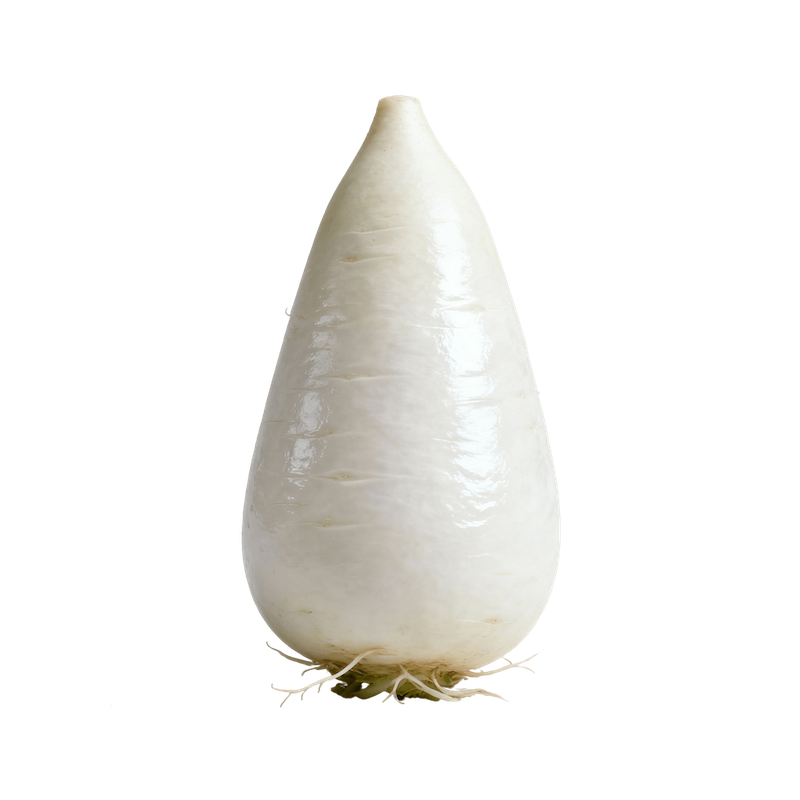
Vegetable Detail

Daikon Radish

Daikon Radish

FamilyBrassicaceae
Importance
Daikon radish is the long white root of Raphanus sativus var. longipinnatus, valued for its crisp texture, mild peppery flavor, high water content, vitamin C, potassium, folate, fiber, and cruciferous phytochemicals. Per 100 g, raw daikon provides about 18 calories, 4.1 g carbohydrate, 1.6 g fiber, 0.6 g protein, and very little fat. Its white root contains a low-calorie vegetable matrix of water, soluble fiber, insoluble fiber, minerals, organic acids, and sulfur-containing Brassica-family compounds. Daikon can be eaten raw, grated, pickled, steamed, added to soups, sliced into salads, or cooked with greens, legumes, mushrooms, and whole grains.

Daikon supports everyday nourishment through hydration, vitamin C, potassium, folate, and fiber. Vitamin C contributes to collagen formation, antioxidant recycling, immune barrier function, and connective tissue maintenance. Potassium supports fluid balance, nerve signaling, and muscle contraction. Folate participates in one-carbon metabolism, DNA synthesis, and normal cell division. Fiber supports digestive movement, stool bulk, microbial fermentation, and short-chain fatty acid production. Its mild pungency comes from glucosinolate breakdown products that create the fresh radish bite.

For cancer and ailment-support nutrition, daikon is relevant because radish-family vegetables contain glucosinolates, isothiocyanates, indole-related compounds, phenolic acids, flavonoids, anthocyanins in colored cultivars, vitamin C, folate, potassium, and fiber. These compounds connect to Nrf2-related antioxidant response, NF-kB inflammatory signaling balance, glutathione-related redox balance, phase II detoxification enzyme signaling, one-carbon metabolism, endothelial function, AMPK-linked metabolic regulation, insulin-related carbohydrate handling, apoptosis-related cell signaling, and gut fermentation pathways supported by fiber. Daikon does not act as a standalone disease solution, but the whole root contributes hydration, digestive fiber, vitamin C, folate, minerals, and sulfur-related cruciferous compounds tied to cellular repair, inflammatory signaling balance, vascular support, digestive function, detoxification-enzyme activity, and normal metabolic regulation.

Daikon pairs well with cabbage, bok choy, carrots, mushrooms, onions, garlic, ginger, lentils, beans, chickpeas, brown rice, quinoa, millet, citrus, cilantro, parsley, scallions, sesame seeds, pumpkin seeds, and leafy greens. Its strongest nutritional identity is the combination of crisp white root, hydration, vitamin C, potassium, folate, fiber, glucosinolate chemistry, and Raphanus-family phytochemicals connected to antioxidant, digestive, vascular, metabolic, inflammatory, detoxification-enzyme, and cellular defense pathways.

Region FoundDaikon radish Raphanus sativus var. longipinnatus is widely cultivated in East Asia, South Asia, Southeast Asia, Europe, North America, and other temperate or subtropical vegetable-growing regions. It is especially common in Japan, China, Korea, India, Vietnam, and Thailand. Daikon grows best in cool seasons with loose well-drained soils, full sun, steady moisture, and enough depth for long root development.
Helps Fight These Cancers: Colorectal, Stomach, Lung, Esophagus
Helps Fight These Ailments: Promotes Liver Detox Enzymes And Antioxidant Defenses Via Isothiocyanate Formation, Fiber Supports Gut Health.
Linked Hormones:

All values per 100g
Nutrition Facts
Calories (kcal)18
Protein (g)0.6
Carbohydrates (g)4.1
Fiber (g)1.6
Sugars (g)2.5
Total Fat (g)0.1
Saturated Fat (g)0
Vitamins
Vitamin A (µg RAE)0
Vitamin C (mg)22
Vitamin D (µg)0
Vitamin E (mg)0.03
Vitamin K (µg)1.3
Vitamin B1 / Thiamin (mg)0.02
Vitamin B2 / Riboflavin (mg)0.014
Vitamin B3 / Niacin (mg)0.234
Vitamin B5 / Pantothenic Acid (mg)0.209
Vitamin B6 (mg)0.073
Vitamin B7 / Biotin (µg)0
Folate B9 (µg)28
Vitamin B12 (µg)0
Vitamin Detail Pages
Minerals
Calcium (mg)27
Iron (mg)0.39
Magnesium (mg)16
Phosphorus (mg)23
Potassium (mg)227
Sodium (mg)21
Zinc (mg)0.13
Copper (mg)0.05
Manganese (mg)0.038
Selenium (µg)0.7
Iodine (µg)0
Mineral Detail Pages
Amino Acids
Alanine (mg)25 mg
Arginine (mg)35 mg
Asparagine (mg)0 mg
Aspartic Acid (mg)64 mg
Cysteine (mg)10 mg
Glutamic Acid (mg)157 mg
Glutamine (mg)0 mg
Glycine (mg)20 mg
Histidine (mg)11 mg
Isoleucine (mg)19 mg
Leucine (mg)31 mg
Lysine (mg)34 mg
Methionine (mg)7 mg
Phenylalanine (mg)20 mg
Proline (mg)18 mg
Serine (mg)25 mg
Threonine (mg)22 mg
Tryptophan (mg)6 mg
Tyrosine (mg)12 mg
Valine (mg)26 mg
Amino Acid Detail Pages
Phytochemicals
Glucosinolates, glucoraphenin-related compounds, glucobrassicin-related compounds, isothiocyanates, sulforaphene-related compounds, indole-related compounds, phenolic acids, caffeic acid derivatives, ferulic acid derivatives, p-coumaric acid derivatives, flavonoids, vitamin C, folate, potassium, calcium, magnesium, fiber, and Raphanus sativus bioactive compounds. Research references: Gamba M, Asllanaj E, Raguindin PF, Glisic M, Franco OH, Minder B, Bussler W, Metzger B, Kern H, Muka T. Nutritional and phytochemical characterization of radish Raphanus sativus: A systematic review. Trends in Food Science & Technology. 2021. Beevi SS, Narasu ML, Gowda BB. Polyphenolics profile, antioxidant and radical scavenging activity of leaves and stem of Raphanus sativus L. Plant Foods for Human Nutrition. 2010. Baenas N, Gómez-Jodar I, Moreno DA, García-Viguera C, Periago PM. Broccoli and radish sprouts are safe and rich in bioactive phytochemicals. Postharvest Biology and Technology. 2017.
Research & Notes
Research Notes:
USDA/FDC per 100 g raw daikon radish. Vitamins/minerals from FDC; amino acids scaled to 100 g based on radish protein profile. Biotin (B7), iodine, asparagine, and glutamine not reported -> NULL.
Notes:
Raw daikon root baseline.
Created: 2025-10-23 17:16:02
Last Updated: 2026-06-04 08:13:13