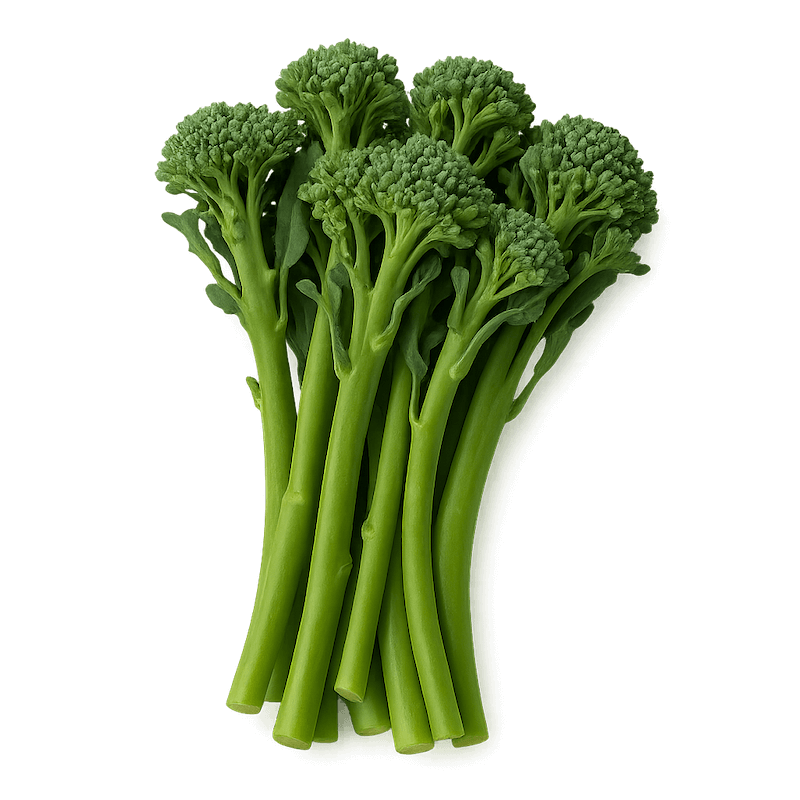
Vegetable Detail

Broccolini (Baby Broccoli)

Broccolini (Baby Broccoli)

FamilyBrassicaceae
Importance
Broccolini is a tender-stemmed Brassica vegetable developed from broccoli and Chinese kale, valued for its small florets, long edible stems, mild sweet flavor, vitamin C, vitamin K, folate, fiber, potassium, calcium, carotenoids, and cruciferous phytochemicals. Per 100 g, broccolini is low in calories and provides carbohydrate, fiber, protein, minerals, green pigments, and sulfur-containing plant compounds. Its stems are softer than mature broccoli stalks, while its florets carry a broccoli-like flavor with a slightly sweeter and more delicate texture.

Broccolini supports everyday nourishment through vitamin C, vitamin K, folate, fiber, potassium, and carotenoid pigments. Vitamin C contributes to collagen formation, antioxidant recycling, immune barrier function, and connective tissue maintenance. Vitamin K supports normal blood-clotting protein activation and bone-related protein function. Folate participates in one-carbon metabolism, DNA synthesis, and normal cell division. Fiber supports digestive movement, stool bulk, and microbial fermentation. Potassium supports fluid balance, nerve signaling, and muscle contraction, while calcium contributes to bone mineral structure and cell signaling.

For cancer and ailment-support nutrition, broccolini is relevant because Brassica vegetables contain glucosinolates, glucoraphanin-related compounds, glucobrassicin-related compounds, sulforaphane-related compounds, indole-3-carbinol-related compounds, isothiocyanates, chlorophylls, beta-carotene, lutein, zeaxanthin, quercetin derivatives, kaempferol derivatives, vitamin C, folate, and fiber. These compounds connect to Nrf2-related antioxidant response, NF-kB inflammatory signaling balance, glutathione-related redox balance, phase II detoxification enzyme signaling, one-carbon metabolism, endothelial function, AMPK-linked metabolic regulation, insulin-related carbohydrate handling, apoptosis-related cell signaling, and gut fermentation pathways supported by fiber. Broccolini does not act as a standalone disease solution, but the whole vegetable contributes antioxidant nutrients, digestive fiber, folate, minerals, green pigments, and sulfur-related cruciferous compounds tied to cellular repair, inflammatory signaling balance, vascular support, digestive function, detoxification-enzyme activity, and normal metabolic regulation.

Broccolini pairs well with mushrooms, onions, garlic, tomatoes, carrots, beans, lentils, chickpeas, brown rice, quinoa, potatoes, citrus, parsley, basil, ginger, turmeric, walnuts, almonds, and pumpkin seeds. Its strongest nutritional identity is the combination of tender edible stems, green florets, vitamin C, vitamin K, folate, fiber, glucosinolate chemistry, chlorophyll, carotenoids, and Brassica-family phytochemicals connected to antioxidant, digestive, vascular, metabolic, inflammatory, detoxification-enzyme, and cellular defense pathways.

Region FoundBroccolini was developed from broccoli Brassica oleracea var. italica and Chinese kale Brassica oleracea var. alboglabra and is now cultivated in cool-season vegetable systems and protected production. It grows well in temperate and subtropical regions with fertile well-drained soils, steady moisture, full sun, and mild growing conditions. Production occurs in the United States, Mexico, Australia, Japan, Europe, and other vegetable-growing regions.
Helps Fight These Cancers: Colorectal, Breast, Lung, Prostate
Helps Fight These Ailments: Contains Sulforaphane And Glucoraphanin—Key Compounds Activating Phase Ii Detox Enzymes, Antioxidant Rich For DNA Protection.
Linked Hormones:

All values per 100g
Nutrition Facts
Calories (kcal)35
Protein (g)3
Carbohydrates (g)6.6
Fiber (g)2.7
Sugars (g)1.3
Total Fat (g)0.4
Saturated Fat (g)0
Vitamins
Vitamin A (µg RAE)260
Vitamin C (mg)65
Vitamin D (µg)0
Vitamin E (mg)0.7
Vitamin K (µg)141
Vitamin B1 / Thiamin (mg)0.07
Vitamin B2 / Riboflavin (mg)0.13
Vitamin B3 / Niacin (mg)1
Vitamin B5 / Pantothenic Acid (mg)0.4
Vitamin B6 (mg)0.15
Vitamin B7 / Biotin (µg)0
Folate B9 (µg)71
Vitamin B12 (µg)0
Vitamin Detail Pages
Minerals
Calcium (mg)48
Iron (mg)0.9
Magnesium (mg)25
Phosphorus (mg)66
Potassium (mg)370
Sodium (mg)33
Zinc (mg)0.3
Copper (mg)0.064
Manganese (mg)0.18
Selenium (µg)1
Iodine (µg)0
Mineral Detail Pages
Amino Acids
Alanine (mg)0 mg
Arginine (mg)72 mg
Asparagine (mg)0 mg
Aspartic Acid (mg)0 mg
Cysteine (mg)0 mg
Glutamic Acid (mg)0 mg
Glutamine (mg)0 mg
Glycine (mg)0 mg
Histidine (mg)28 mg
Isoleucine (mg)56 mg
Leucine (mg)91 mg
Lysine (mg)88 mg
Methionine (mg)19 mg
Phenylalanine (mg)51 mg
Proline (mg)0 mg
Serine (mg)0 mg
Threonine (mg)54 mg
Tryptophan (mg)18 mg
Tyrosine (mg)0 mg
Valine (mg)71 mg
Amino Acid Detail Pages
Phytochemicals
Glucosinolates, glucoraphanin-related compounds, glucobrassicin-related compounds, sulforaphane-related compounds, indole-3-carbinol-related compounds, isothiocyanates, chlorophyll a, chlorophyll b, beta-carotene, lutein, zeaxanthin, quercetin derivatives, kaempferol derivatives, phenolic acids, vitamin C, vitamin K, folate, potassium, calcium, magnesium, fiber, and Brassica bioactive compounds. Research references: Cartea ME, Velasco P. Glucosinolates in Brassica foods: bioavailability in food and significance for human health. Phytochemistry Reviews. 2008. Jahangir M, Kim HK, Choi YH, Verpoorte R. Health-Affecting Compounds in Brassicaceae. Comprehensive Reviews in Food Science and Food Safety. 2009. Podsedek A. Natural antioxidants and antioxidant capacity of Brassica vegetables: a review. LWT Food Science and Technology. 2007.
Research & Notes
Research Notes:
USDA FoodData Central and MyFoodData per 100 g raw broccolini. Nutrients and amino acids scaled to 100 g. Biotin, iodine, asparagine, and glutamine set to NULL. Derived glucosinolates promote anti-carcinogenic enzyme activity via Nrf2 pathway.
Notes:
Raw broccolini florets and stems baseline.
Created: 2025-10-23 17:17:42
Last Updated: 2026-06-04 08:13:13